
1 What is Justice?
Just like love, justice is hard to pin down in a precise definition, and yet we understand intuitively what it means. Everyone wants justice for themselves, and to some extent for others too. But while love is about the small circle of people we know well, justice is about how life in society as a whole is ordered: the rules by which social benefits and social duties get shared out among the members of a society. That is exactly why questions of justice sit at the centre of politics.
Every culture has grappled with the question of justice in its own way. In ancient Indian society, justice was tied to dharma, and maintaining dharma or a just social order was seen as a king’s first duty.
The Chinese philosopher Confucius argued that a king should maintain justice by punishing wrongdoers and rewarding the virtuous.
In fourth century B.C. Athens (Greece), Plato discussed the question of justice in his book The Republic. Through a long dialogue between Socrates and his young friends Glaucon and Adeimantus, Plato showed why we should care about being just. The young people argued that people who are unjust often seem to do better than those who are just, because they twist the rules for their own benefit, dodge taxes and get away with lying and cheating.
Socrates reminded them that if everyone were unjust, no one could ever be sure of benefiting from injustice, and no one would be secure, so obeying the law and being just is actually in our own long-term self-interest. He clarified that justice does not just mean doing good to friends and harm to enemies, or chasing only our own interests; justice is about the well-being of everyone, in the same way that a doctor is concerned with the well-being of all their patients.
“They say that to do injustice is, by nature, good; to suffer injustice, evil; but that the evil is greater than the good. And so when men have both done and suffered injustice and have had experience of both, not being able to avoid the one and obtain the other, they think that they had better agree among themselves to have neither; hence there arise laws and mutual covenants; and that which is ordained by law is termed by them lawful and just.”
– Glaucon to Socrates, in The Republic
The idea that justice means giving each person their due is still central to how we understand justice today. But what someone is actually “due” has changed a great deal since Plato’s time. According to the German philosopher Immanuel Kant, every human being possesses dignity. If everyone’s dignity is accepted, then what each person is due is the opportunity to develop their talents and pursue the goals they choose for themselves. Justice, in other words, requires giving every individual due and equal consideration.
2 The Principle of Equal Treatment
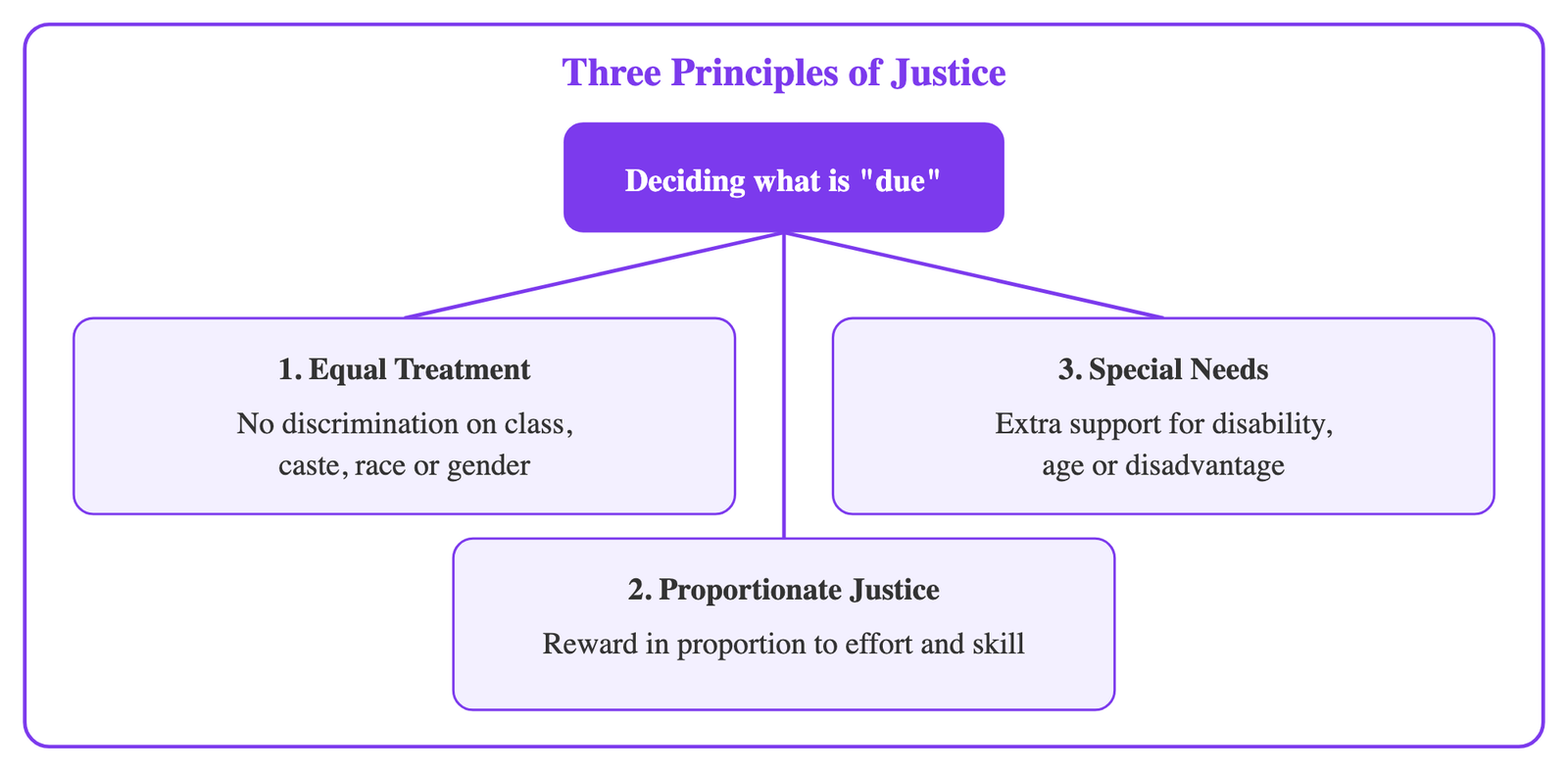
There is broad agreement in modern society that everyone matters equally, but working out exactly how to give each person their due is not simple. The first principle put forward is treating equals equally: all individuals share certain characteristics as human beings, and so they deserve equal rights and equal treatment.
Apart from equal rights, treating equals equally also requires that people are not discriminated against on grounds of class, caste, race or gender. They should be judged by their work and their actions, not by which group they belong to.
If two people from different castes do the same kind of work, whether breaking stones or delivering pizzas, they should get the same reward. If one person gets one hundred rupees for a job and another gets only seventy five rupees for the same work simply because they belong to different castes, that is unfair and unjust. In the same way, if a male teacher in a school is paid more than a female teacher, that difference is also unjustifiable and wrong.
3 Proportionate Justice
Equal treatment is not the only principle of justice. There are situations where treating everyone exactly the same would actually feel unjust. Imagine your school decided that everyone who sat an exam should get the same marks, simply because they are all students of the same school and sat the same paper: would that feel fair? Most people would think it fairer for students to be awarded marks according to the quality of their answers and the effort they put in.
In other words, once everyone starts from the same baseline of equal rights, justice in such cases means rewarding people in proportion to the scale and quality of their effort. Equal work should get equal reward, but it is also fair to reward different kinds of work differently once we account for factors like the effort required, the skill needed and the danger involved.
Miners, skilled craftsmen or policemen do work that is sometimes dangerous but socially useful, and they may not always get a reward that is just when compared to what some other people in society earn. This is why the principle of equal treatment needs to be balanced with the principle of proportionality.
4 Recognition of Special Needs
A third principle of justice is that society should take people’s special needs into account while distributing rewards or duties. This principle does not contradict the principle of equal treatment, it extends it, because treating equals equally already implies that people who are not equal in some important respect should be treated differently. Physical disability, age, or a lack of access to good education or healthcare are some of the factors that many countries recognise as grounds for special treatment.
Examine these situations and work out which principle of justice is at work in each:
- Suresh, a visually impaired student, gets three hours and thirty minutes to finish his mathematics paper, while the rest of the class gets only three hours.
- Geeta walks with a limp. Her teacher decided to give her the same three hours and thirty minutes for her mathematics paper.
- A teacher gives grace marks to the weaker students in the class, to boost their morale.
- A professor distributes different question papers to different students, based on her evaluation of their capabilities.
- There is a proposal to reserve 33 per cent of the seats in Parliament for women.
In our country, lack of access to good education, healthcare and similar facilities is often bound up with social discrimination based on caste. That is why the Constitution provided for reservation of government jobs and quotas in admission to educational institutions for people belonging to the Scheduled Castes and Scheduled Tribes.
A cartoon in the chapter asks: “Why is the statue of justice blindfolded?” The reply: “She is blindfolded because she needs to be impartial.” The first speaker answers: “Of course she needs to be impartial. But I wonder how then does she see the special needs of people?” This little exchange puts the whole problem of the chapter in one line: impartiality (equal treatment) and recognising special needs are hard to hold together at the same time.
Governments often find it difficult to harmonise these three principles of justice, equal treatment for equals, recognising different efforts and skills, and providing a minimum standard of living and equal opportunity to the needy. Leaning too heavily on equal treatment alone can work against rewarding merit fairly, while treating rewarding merit as the only principle can leave marginalised groups permanently at a disadvantage, since they may never have had access to good nourishment or education in the first place.
5 Just Distribution and Rawls’ Theory of Justice
To achieve social justice, governments have to do more than simply ensure that laws and policies treat individuals fairly. Social justice is also about the just distribution of goods and services, whether between nations or between different groups and individuals within a society. If a society has serious economic or social inequalities, it may become necessary to redistribute some of its important resources to give citizens something like a level playing field.
In our country, the Constitution promoted social equality by abolishing untouchability, so that people from “lower” castes could not be denied access to temples, jobs and basic necessities like water. Various state governments have also carried out land reforms to redistribute land more fairly. Disagreements over such questions often arouse strong passions and even violence in society, because people feel their family’s future is at stake, as seen in the anger provoked in our country by proposals to reserve seats in education or government jobs.
5.1 Rawls’ Theory of Justice : The Veil of Ignorance
The political philosopher John Rawls argued that there is a rational justification for helping the least privileged members of a society. According to Rawls, the only way to arrive at fair and just rules is to imagine ourselves in a situation where we have to decide how society should be organised, without knowing what position we would ourselves occupy in that society: what kind of family we would be born into, an “upper” caste family or a “lower” caste one, rich or poor, privileged or disadvantaged.
According to Rawls, when people decide the rules of society from behind a “veil of ignorance,” that is, in complete ignorance of their own future position, each person, reasoning purely out of self-interest, thinks: “What if I turn out to be among the worst-off?” So they will want rules that guarantee reasonable opportunities even to the weakest sections. Fairness, in this account, is the outcome of rational self-interest, not of benevolence or morality.
This argument matters because it does not ask people for extraordinary self-sacrifice or generosity, only that they reason rationally in their own interest. Since no one knows what position they will end up in, everyone will want policies that protect the worst-off, while also making sure that people who are already well off are not made worse off either, since they too might have been born into privilege. Policies that benefit society as a whole, rather than any one section, are the outcome of this kind of rational fairness.
Rawls therefore argues that rational thinking, not morality, can lead us to be fair and to judge impartially how the benefits and burdens of a society should be distributed. In his example there are no goals or norms of morality that are given to us in advance, and we remain free to decide what is best for ourselves. This is what makes his theory an important and compelling way to approach the question of fairness and justice.
A cartoon in the chapter asks why people say “justice delayed is justice denied”. If a decision in a dispute is delayed too long, the injured person may get no benefit from the judicial proceedings at all: what use is a decision in one’s favour after one is dead? A remedy that comes too late gives a person nothing of their due, so a long delay is as good as a denial of justice.
6 Pursuing Social Justice : Free Markets versus State Intervention
If a society has a deep and persistent divide between those who enjoy wealth, property and the power that goes with it, and those who are excluded and deprived, we would say that social justice is lacking there. Justice does not demand complete equality or sameness in how people live, but a society would be considered unjust if the gap between rich and poor is so wide that they seem to live in entirely different worlds, and the deprived have no real chance of improving their condition. A just society, therefore, must provide people with the basic minimum conditions needed to live healthy, secure lives and develop their talents.
Various governments and international organisations like the World Health Organisation have developed ways of calculating people’s basic needs. There is broad agreement that the basic amount of nourishment needed to stay healthy, housing, a supply of clean drinking water, education and a minimum wage form an important part of these basic conditions. But ensuring all this for every citizen, especially in a country like India with a very large poor population, can be a heavy burden on any government.
Free Markets versus State Intervention
Even if everyone agrees that the state should help the most disadvantaged members of society, there can still be disagreement over how best to do this. This is the central debate of the chapter:
The case for free markets
- Individuals should be free to own property and freely negotiate prices, wages and profits with others
- Argument: the market does not see caste, religion or gender, it looks only at talent and skill
- Argument: markets give consumers more choice
The case for state intervention
- Private agencies tend to avoid remote or low-profit areas, so government has to step in there
- Argument: free markets often end up working in favour of those already privileged
- Argument: private services may be good, but their cost can put them out of reach of the poor
Not all supporters of free markets today would support an absolutely unregulated market. Many would now accept that the state can step in to guarantee a basic minimum standard of living so that everyone can compete on equal terms. But they might argue that even here the most efficient way of providing basic services is to allow markets in health care, education and such services to develop: private agencies should be encouraged to provide these services, while state policies try to empower people to buy them. The state may also need to give special help to the old and sick who cannot compete, but beyond this they believe the state’s role should be limited to maintaining a framework of laws and regulations. Those who favour state intervention, on the other hand, point out that private business goes where the profit is greatest, so free markets often end up working in the interest of the strong, wealthy and powerful.
Disagreements over distribution and justice are natural in a democratic society, because they force us to examine different points of view and defend our own rationally. Finding a way through such disagreements by debate is, in a sense, what politics is.
Various government agencies and United Nations agencies have worked out calculations of the minimum requirements of food, income, water and similar facilities. Search your school library or the internet for such calculations and see what figures apply to your own state.
“A Just society is that society in which ascending sense of reverence and descending sense of contempt is dissolved into the creation of a compassionate society.”
– B.R. Ambedkar
“Justice implies something which it is not only right to do and wrong not to do; but which some individual person can claim from us as his moral right.”
– J.S. Mill
- Justice means giving each person their “due”, and what counts as due has changed from Plato’s time to Kant’s idea of human dignity
- Three principles of justice: equal treatment, proportionate justice, recognition of special needs; governments have to harmonise them, since they can pull in different directions
- Legal equality alone is not enough for social justice, redistribution matters too (abolition of untouchability, land reforms, reservation)
- Rawls’ “veil of ignorance”: not knowing your future position makes rational self-interest side with the worst-off
- Basic minimum needs: nutrition, housing, clean water, education, minimum wage
- Free markets versus state intervention: both sides have arguments, but free markets often end up favouring those already privileged
- Can I explain all three principles of justice, each with its own example?
- Can I explain how the veil of ignorance works and why it rests on rational self-interest?
- Do I remember the three steps taken in India (abolition of untouchability, reservation, land reforms by state governments)?
- Can I give at least two arguments each for free markets and for state intervention?
- Can I recall both Ambedkar’s and Mill’s definitions of justice word for word?