
1 What are Rights?
In everyday life we often talk of our rights. As members of a democratic country we may speak of such rights as the right to vote, the right to form political parties and the right to contest elections. Apart from these generally accepted political and civil rights, people today are also making new demands, such as the right to information, the right to clean air or the right to safe drinking water. Rights are claimed not only in relation to our political and public lives but also in relation to our social and personal relationships, and not only for adult human beings but also for children, unborn foetuses, and even animals.
A right is essentially an entitlement or a justified claim. It denotes what we are entitled to as citizens, as individuals and as human beings, something that the rest of society must recognise as a legitimate claim that must be upheld.
This does not mean that everything I regard as necessary and desirable is a right. I may want to wear the clothes of my choice to school rather than the prescribed uniform, or I may want to stay out late at night, but this does not mean I have a right to do either. There is a distinction between what I want and think I am entitled to, and what can actually be designated as a right.
First ground, a life of dignity : rights represent conditions that we collectively see as necessary for self-respect and dignity. For example, the right to livelihood may be considered necessary for a life of dignity, since being gainfully employed gives economic independence. Or the right to freedom of expression, which gives the opportunity to be creative and original and is also important for democratic government. Such rights matter for every human being living in society, so they are described as universal in nature.
Second ground, our well-being : rights help individuals develop their talents and skills. The right to education, for instance, helps develop our capacity to reason, gives us useful skills and enables us to make informed choices, which is why education is designated a universal right.
However, if an activity is injurious to our health and well-being it cannot be claimed as a right. Since medical research has shown that prohibited drugs are injurious to health and affect our relations with others, we cannot insist that we have a right to inhale or inject drugs or smoke tobacco. Smoking may even be injurious to the health of people around the smoker, so in terms of our definition of rights, smoking or taking banned drugs cannot be claimed as a right.
Go through recent newspapers and make a list of people’s movements that have made proposals for new kinds of rights.
2 Where do Rights come from?
In the seventeenth and eighteenth centuries, political theorists argued that rights are given to us by nature or God, hence they were called natural rights. This meant that rights were not conferred by a ruler or a society; rather, we are born with them, which is why these rights are said to be inalienable and no one can take them away from us.
In recent years the term human rights is used more than the term natural rights, because the idea of a natural law laid down for us by nature or God appears less acceptable today. Rights are increasingly seen as guarantees that human beings themselves seek or arrive at in order to lead a minimally good life. The assumption behind human rights is that all persons are entitled to certain things simply because they are human beings: each person is unique and equally valuable, and no one is born to serve others. This understanding underlies the UN’s own Universal Declaration of Human Rights.
For the eighteenth-century German philosopher Immanuel Kant, every person has dignity and ought to be treated as such by virtue of being a human being, however uneducated, poor, powerless or even dishonest he may be. Kant’s famous line: “… everything has either a price or a dignity. What has a price is such that something else can also be put in its place as its equivalent; by contrast, that which is elevated above all price, and admits of no equivalent, has a dignity.” Kant’s moral conception of rights rests on two arguments: first, we should treat others as we would like to be treated ourselves; second, we should never treat another person merely as a means to our ends. We should respect people not because they are useful to us, but because they are human beings.
The notion of universal human rights has been used by oppressed people all over the world to challenge laws that segregate them and deny them equal opportunities. Slavery has, for instance, been abolished, though other struggles have had only limited success. As societies face new threats, the list of claimed rights has kept expanding: to clean air, water, sustainable development, and to livelihood, especially for women, children and the sick in times of war or natural crisis.
Human-rights claims often invoke wide support. You may have heard about the pop star Bob Geldof‘s appeal to western governments to end poverty in Africa, and seen T.V. reports of the scale of support he received from ordinary people.
“My father had applied for a telephone connection. It’s been over two months and he still hasn’t got it. What can he do?” · “You know what! Now we have a right to information. We can find out the status of his application as well as the cause for the delay.”
3 Legal Rights and the State
While claims for human rights appeal to our moral self, their success depends on the support of governments and the law. This is why legal recognition of rights matters so much. A Bill of Rights is enshrined in the constitutions of many countries; since constitutions are the highest law of the land, constitutional recognition gives certain rights a primary importance. In our country we call them Fundamental Rights. In some cases these are supplemented by claims that gain importance because of a country’s particular history and customs: in India, for instance, we have a provision banning untouchability, which draws attention to a traditional social practice in the country.
Many theorists define rights simply as claims recognised by the state. Legal endorsement certainly gives rights a special status in society, but it is not the basis on which rights are claimed. Rights have steadily been expanded and reinterpreted to include previously excluded groups and to reflect our contemporary understanding of a life of dignity.
In most cases, claimed rights are directed towards the state. When I assert my right to education, I call upon the state to make provisions for it, even though society may also contribute. Thus rights place an obligation on the state to act in certain ways: each right indicates what the state must do, and also what it must not do.
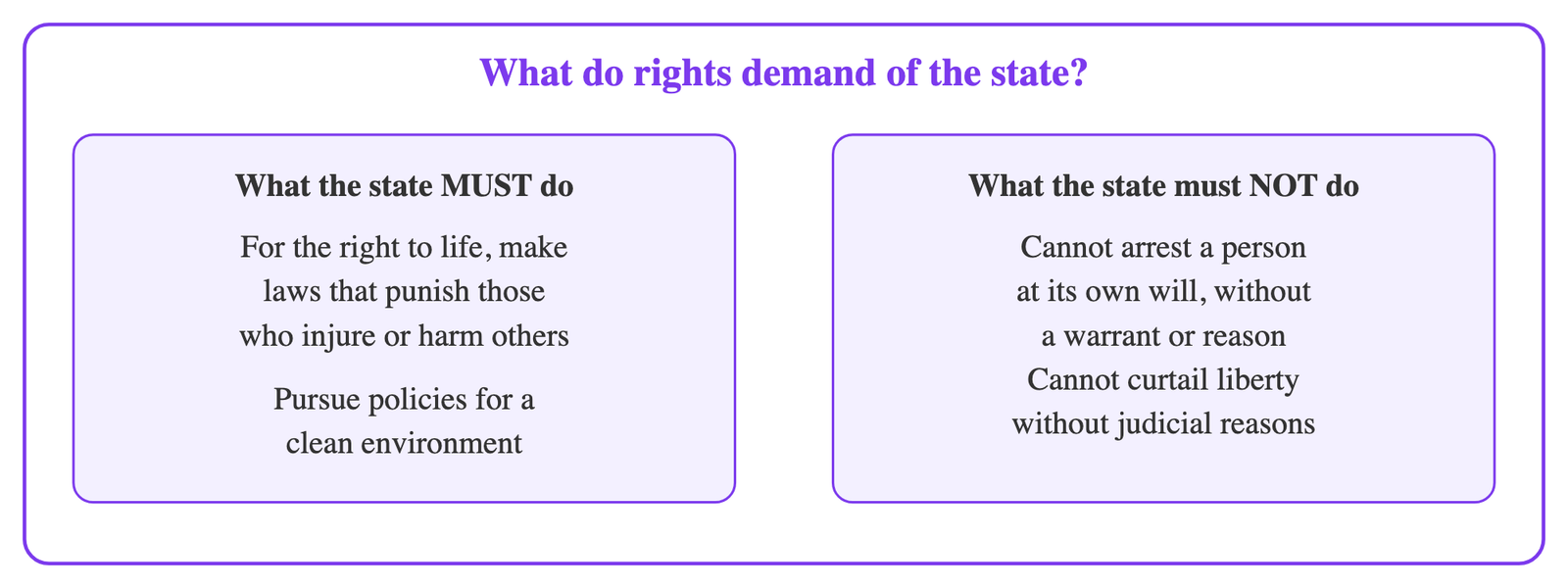
To put it another way, our rights ensure that the authority of the state is exercised without violating the sanctity of individual life and liberty. The state may be the sovereign authority, but it exists not for its own sake but for the sake of the individual. The rulers are accountable for their actions and must not forget that law exists to ensure the good of the people.
Go through the newspapers of the last few days and identify cases of rights violations which have been discussed. What should the government and civil society do to prevent such violations?
4 Kinds of Rights
Most democracies begin by drawing up a charter of political rights: the right to equality before law and to participate in the political process, including the right to vote, elect representatives, contest elections, and form or join political parties. These are supplemented by civil liberties: the right to a free and fair trial, the right to express one’s views freely, and the right to protest and dissent. Together, civil liberties and political rights form the basis of a democratic system of government.
Rights aim to protect the well-being of the individual. Political rights contribute to it in three ways: by making the government accountable to the people, by giving greater importance to the concerns of the individual over those of the rulers, and by ensuring that all persons have an opportunity to influence the decisions of the government.
Our rights of political participation can be exercised fully only when our basic needs of food, shelter, clothing and health are met. For a person living on the pavement and struggling to meet these needs, political rights by themselves have little value.
| Kind of right | What it covers | Example |
|---|---|---|
| Political rights + civil liberties | equality before law, participation in the political process | voting, contesting elections, forming parties, fair trial, protest |
| Economic rights | state’s obligation to help meet basic needs | housing, medical facilities, minimum wage, rural employment guarantee scheme |
| Cultural rights | right to live and learn in one’s own language and culture | primary education in one’s mother tongue, institutions for one’s language and culture |
Of these, the right to life, liberty, equal treatment and political participation are seen as basic rights that must receive priority, while other conditions necessary for a decent life are steadily being recognised as justified claims.
4.1 The puzzle of group rights : Let’s Think
Which of the following rights granted to groups/communities are justifiable? Discuss.
(a) A Jain community in a town sets up its own school and enrols students only from its own community.
(b) Purchase of land or property in Himachal Pradesh is restricted to those who are residents of that state.
(c) The principal of a co-ed college issued a circular that no girl should wear any ‘western’ dress.
(d) A Panchayat in Haryana decided that a boy and girl from different castes who married each other will not be allowed to live in the village.
The right to culture means that no one should be allowed to make films that offend the religious or cultural beliefs of others. Do you agree?
5 Rights and Responsibilities
Rights place obligations not only on the state but on each of us. There are four such responsibilities.
“Did you see the latest sting operation on TV yesterday? I couldn’t believe the conversation between the hotshot official and the famous actress.” · “That was cheap sensationalism. Besides, it was an infringement of their right to privacy.” Freedom of expression does not extend to violating someone else’s right to privacy: rights in conflict have to be balanced.
Should a country facing the threat of terrorist bombings be allowed to curtail the liberty of citizens? Should it be allowed to arrest people on mere suspicion, intercept their mail or tap their phones? Should it be allowed to use torture to extract a confession? In such situations, the book says, the question to ask is whether the person concerned poses an imminent threat to society. Even arrested persons should be allowed legal counsel and the opportunity to present their case before a magistrate or a court of law. We need to be extremely cautious about giving governments powers that could be used to curtail civil liberties, for such powers can be misused: governments can become authoritarian and undermine the very reason they exist, the well-being of the members of the state.
“One man’s rights end where the other man’s nose begins.”
Rights can never be absolute, yet we need to be vigilant in protecting our rights and those of others, for they form the basis of a democratic society.
6 Universal Declaration of Human Rights, 1948
On 10 December 1948, the General Assembly of the United Nations adopted and proclaimed the Universal Declaration of Human Rights. Following this, the Assembly called upon all Member countries to publicise the text of the Declaration and have it read and taught in schools and other educational institutions.
“Whereas recognition of the inherent dignity and of the equal and inalienable rights of all members of the human family is the foundation of freedom, justice and peace in the world…” The Declaration also states that human rights must be protected by the rule of law, so that no one is compelled, as a last resort, to rebel against tyranny and oppression.
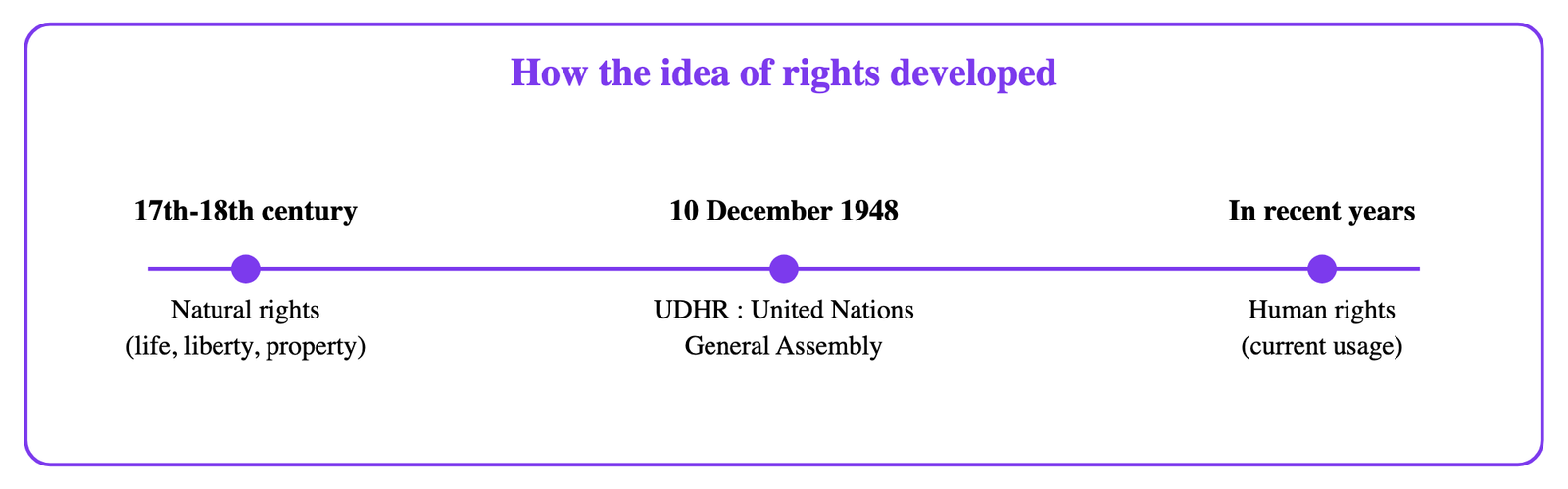
- Right = entitlement/justified claim; there is a difference between a want and a right
- Two grounds : a life of dignity (universal rights) and our well-being (like education, a universal right)
- Natural rights (life, liberty, property) → today’s “human rights”; Kant: dignity is above all price
- Legal recognition gives rights status, but it is not their basis; Fundamental Rights is India’s constitutional term
- Rights place two kinds of obligation on the state : to act, and to refrain (no arbitrary arrest)
- Three kinds : political + civil liberties, economic, cultural rights
- Four responsibilities : common good, respecting others, balancing conflict, vigilance
- UDHR : 10 December 1948, adopted by the UN General Assembly
- Can I state the definition of a right and the want-vs-right distinction word for word?
- Can I explain both grounds on which rights are claimed, each with its own example?
- Can I name all three natural rights and both of Kant’s arguments?
- Can I recall a separate example each of what the state must do and must not do?
- Can I give the three ways political rights protect the individual’s well-being, and the book’s test for national-security restrictions (an imminent threat to society)?
- Can I give one example each of political, economic and cultural rights?
- Can I list all four responsibilities in order?
- Do I remember the UDHR’s date and the exact opening line of its preamble?