
1 Introduction
Citizenship has been defined as full and equal membership of a political community. In today’s world, states give their members a shared political identity along with certain rights. That is why we think of ourselves as Indian, Japanese or German, depending on which state we belong to. Wherever citizens travel, they expect their state to offer them help and protection, on top of the basic rights it grants them at home.
Citizenship is full and equal membership of a political community. The value of full membership of a state becomes clear only when we think of the thousands of people in the world who are forced to live as refugees or illegal migrants because no state is willing to grant them membership, such as the Palestinian refugees of the Middle East.
The exact rights given to citizens differ from state to state, but most democracies today include some political rights (such as the right to vote), some civil rights (such as freedom of speech or belief), and some socio-economic rights (such as the right to a minimum wage or to education). Equality of rights and status is one of the most basic rights of citizenship itself.
Every right citizens enjoy today was won only after a struggle. Ordinary people fought some of the earliest struggles to assert their freedom and rights against powerful monarchies. Many European countries saw such struggles, some of them violent, like the French Revolution of 1789. In the colonies of Asia and Africa, the demand for equal citizenship became part of the struggle for independence from colonial rule. In South Africa, the black African population had to fight a long struggle against the ruling white minority for equal citizenship, one that continued until the early 1990s.
From the seventeenth to the twentieth century, white settlers from Europe ruled over the black population of South Africa. Under the policies followed until 1994: whites alone had the right to vote, contest elections and choose the government; they were free to buy property and travel anywhere in the country. Blacks had none of these rights. Separate colonies existed for blacks and whites. Blacks needed a ‘pass’ to work in white neighbourhoods and could not keep their families there. Schools, too, were separate for people of different colour. Do you think black South Africans had full and equal membership under this system?
The struggle for full membership and equal rights continues in many parts of the world even today, for instance the women’s movement and the dalit movement in India, both of which try to change public opinion and influence government policy so that people get equal rights and opportunities.
Citizenship is not only about the relationship between a state and its members. It is also about how citizens relate to one another. It carries certain obligations of citizens towards each other and towards society, not just the legal obligations a state imposes, but also a moral duty to take part in and contribute to the shared life of the community. Citizens are also seen as the inheritors and trustees of a country’s culture and natural resources.
Think of examples of activities by citizens in your area meant to help others, improve the area, or protect the environment. List some activities that could be taken up by young people your age.
2 Full and Equal Membership
If you have ever travelled in a crowded train compartment or bus, you will know the feeling: people who may have pushed past each other to get in suddenly discover, once inside, a shared interest in keeping everyone else out. An ‘insider’ and ‘outsider’ divide appears almost at once, and ‘outsiders’ start to look like a threat.
The same thing happens, from time to time, in cities, in regions, and occasionally across a whole nation. When jobs, facilities such as healthcare or education, and natural resources such as land or water are limited, demands to keep ‘outsiders’ out can appear, even against fellow citizens. The slogan “Mumbai for Mumbaikars” expressed exactly this feeling. India and the rest of the world have seen many such struggles.
This raises the real question: what does “full and equal membership” actually mean? Does it mean citizens should have equal rights and opportunity to live, study or work wherever they choose in the country? Does it mean that rich and poor citizens alike should get certain basic rights and facilities?
2.1 Freedom of Movement and Migrant Workers
Among the rights given to citizens in India, and in many other countries, is freedom of movement. This right matters most to workers. When opportunities are not available near home, workers migrate in search of jobs. IT workers, for example, may flock to towns like Bangalore, nurses from Kerala can be found across the country, and the booming construction industry in towns draws workers from every part of India.
The 1950s saw the rise of the Civil Rights Movement in the United States, against the inequalities between black and white populations in many southern states. These inequalities were enforced by “Segregation Laws”, which denied black people many civil and political rights and created separate areas for coloured and white people in civic amenities like railways, buses, theatres, housing, hotels and restaurants.
Martin Luther King Jr. led the movement against these laws. He gave three arguments: (1) every human being in the world is equal in self-worth and dignity, whatever their race or colour. (2) Segregation is like a “social leprosy” on the body politic, because it inflicts deep psychological wounds on the people who suffer under such laws; it also diminishes the quality of life for the white community (for instance, the white community closed some community parks rather than let black people enter them as the court had directed, and some baseball teams had to be disbanded because the authorities did not want to accept black players). (3) Segregation laws create artificial boundaries between people and prevent them from cooperating with each other for the overall benefit of the country. King called for peaceful, non-violent resistance to segregation laws, and said in one of his speeches: “We must not allow our creative protest to degenerate into physical violence.”
However, resistance often builds up among local people against so many jobs going to people from outside the area, sometimes at lower wages. This can lead to demands that certain jobs be reserved for people belonging to that state, or for those who speak the local language, and political parties often take up the issue. Occasionally, this resistance turns into organised violence against ‘outsiders’. Almost every region of India has seen such movements at some point. Our response to migration is also not always consistent: we are usually less welcoming to poor migrants than to skilled and well-off ones, even though it is often the poor migrant who most needs the same rights to live and work anywhere in the country.
A full-page cartoon shows middle-class city families struggling with all the work migrant workers usually do for them: cooking and washing dishes, cleaning, carrying loads, looking after children, repairs, washing the car and the house. Its point: migrants do necessary and useful work, often at low wages, and the city cannot run without them, even when local people resist them as ‘outsiders’.
Examine the arguments for and against freedom of movement and occupation across the country for citizens. Should long-term residents of a region get preference in jobs and facilities? Should states be allowed to fix quotas for admission to professional colleges for students who do not belong to that state?
Disputes over this can arise even in democratic societies. The right to protest is one aspect of the freedom of expression our Constitution guarantees citizens, so long as it does not harm anyone’s life or property. Citizens are free to try and shape public opinion and government policy by forming groups, holding demonstrations, using the media, or going to court. A basic principle of democracy is that such disputes should be settled by negotiation and discussion rather than by force, and this is itself one of the obligations of citizenship.
3 Equal Rights
This section looks at another side of citizenship: does full and equal membership mean that the state must guarantee every citizen, rich or poor, certain basic rights and a minimum standard of living? To explore this, we will look at one group in particular: the urban poor. Every Indian city has a large population living in slums and squatter settlements. Even though slum-dwellers often do necessary and useful work, usually at low wages, the rest of the city tends to see them as unwelcome, and blames them for straining resources or spreading crime and disease.
Conditions inside slums are often grim: many people crammed into small rooms with no private toilet, running water or sanitation. And yet slum-dwellers make a real contribution to the city’s economy through their labour, as hawkers, petty traders, scavengers, domestic workers, plumbers and mechanics, among other trades.
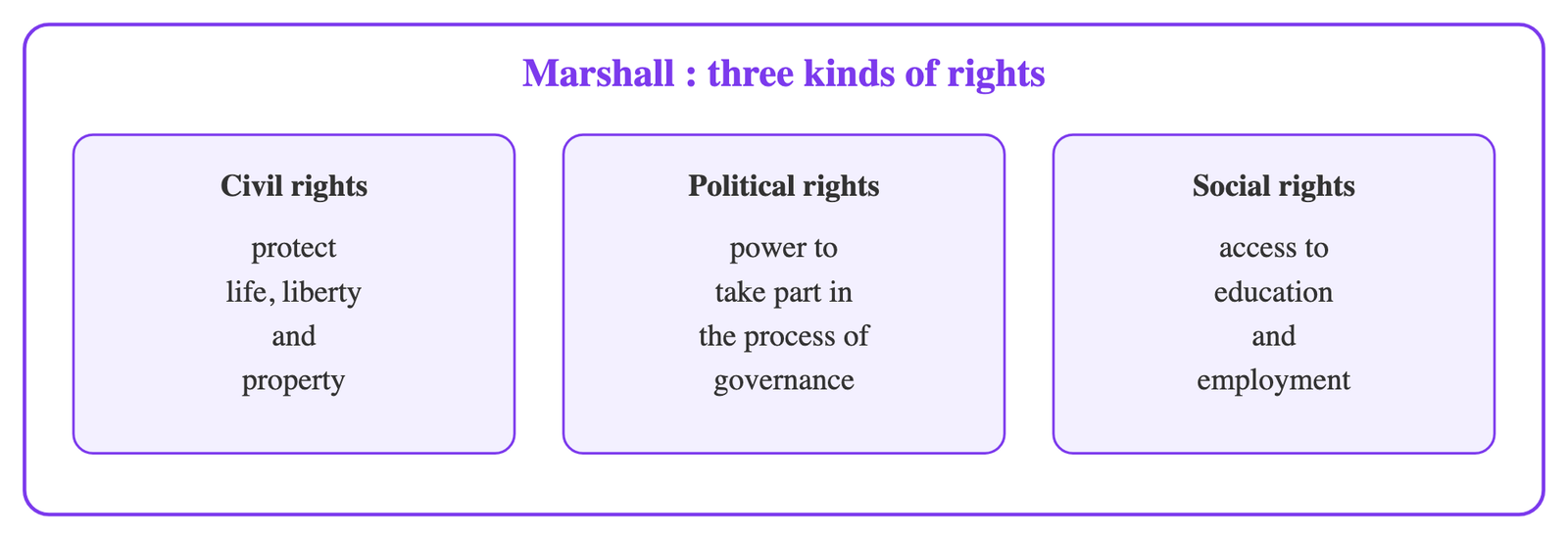
The British sociologist T.H. Marshall (1893-1981), in his book Citizenship and Social Class (1950), defined citizenship as “a status bestowed on those who are full members of a community. All who possess the status are equal with respect to the rights and duties with which the status is endowed.” The key idea in Marshall’s account is equality: the quality of these rights and duties should keep improving, and the number of people who hold them should keep growing. Marshall saw citizenship as carrying three kinds of rights:
• Civil rights: protect an individual’s life, liberty and property
• Political rights: let an individual take part in the process of governance
• Social rights: give an individual access to education and employment
Marshall called social class a “system of inequality”; citizenship counters the divisive effects of that class hierarchy and helps build a more integrated, harmonious community.
Awareness of the condition of the urban poor is growing. For instance, a national policy on urban street vendors was framed in January 2004, meant to give vendors recognition and freedom from harassment so long as they followed government rules. Later came the Street Vendors (Protection of Livelihood and Regulation of Street Vending) Act, 2014. Even a basic political right like voting can be difficult for slum-dwellers to exercise, since being on the voters’ list needs a fixed address, which squatters and pavement dwellers often cannot provide.
The Supreme Court gave an important decision on the rights of slum-dwellers in Bombay, on a Public Interest Litigation filed by social activist Olga Tellis against the Bombay Municipal Corporation in 1985. The petition claimed the right to live on pavements or in slums, since there was no alternative accommodation close to their place of work, and eviction would cost them their livelihood too. The Supreme Court said: “Article 21 of the Constitution which guaranteed the right to life included the right to livelihood. Therefore if pavement dwellers were to be evicted they should first be provided alternative accommodation under the right to shelter.”
Tribal people and forest dwellers are among the other groups being pushed to the margins of our society, since they depend on forests and other natural resources for their way of life. Growing population, shrinking resources, pressure from mining interests and the tourism industry all threaten their livelihood. Governments continue to struggle with how to protect these people and their habitat without holding back the country’s development, and this is an issue that concerns all citizens, not tribal people alone.
According to official figures on land distribution in Zimbabwe, around 4,400 white families owned about 10m hectares of agricultural land (32% of the total), and this land was fertile and irrigated, while about one million black peasant families owned only 16m hectares (38%) of less fertile, unirrigated land. Whites made up just 0.06% of Zimbabwe’s total population, yet nearly a century earlier they had taken this fertile land from the native population. In 1997 the President of Zimbabwe, Mugabe, announced plans to take over around 1,500 farms. What ideas about citizenship would you use to support or oppose the claims made by black and white citizens of Zimbabwe?
Guaranteeing equal rights and opportunities to all citizens is never simple for a government, because different groups can have different needs, and one group’s rights can sometimes conflict with another’s. Equal rights for citizens does not mean applying the same policy to everyone; it means keeping people’s different needs and claims in mind while making policy, so that people become more equal in practice, not just on paper.
4 Citizen and Nation
The idea of the nation-state developed in the modern period. One of the earliest claims to nation-state sovereignty and to democratic rights for citizens was made by the revolutionaries in France in 1789. Nation-states claim that their borders define not just a territory but a distinct culture and a shared history. National identity is expressed through symbols such as a flag, a national anthem, a national language, or particular ceremonies.
Most modern states bring together people of different religions, languages and cultural traditions. National identity is meant to give citizens a shared political identity, but in practice most countries define that identity in a way that makes it easier for some citizens to identify with the nation than for others. This is as true of the United States, which prides itself on being a nation of immigrants, as of any other country.
France, for example, claims to be both secular and inclusive. Its national identity rests heavily on culture and language, and all citizens are expected to adopt French language and culture in the public parts of their lives, while keeping their personal beliefs and practices private. This policy has produced real controversy: some French schools disallowed Sikh boys wearing turbans and Muslim girls wearing headscarves with their uniforms, on the ground that these brought religious symbols into the public sphere of state education.
The criteria for granting citizenship differ from country to country. In countries like Israel and Germany, factors such as religion or ethnic origin are given priority. In Germany, Turkish workers who were once invited to come and work have long demanded that their children, born and raised in Germany, be automatically granted German citizenship, and this debate continues.
India describes itself as a secular, democratic nation-state. The freedom movement was broad-based, and Indian leaders made deliberate efforts to bring together people of different religions, regions and cultures. It is true that unresolved differences with the Muslim League led to the Partition of the country in 1947, but this only strengthened the resolve of India’s national leaders to keep the nation secular and inclusive, a resolve that was written into the Constitution.
The Indian Constitution tried to accommodate an extremely diverse society: it gave full and equal citizenship to groups as different as the Scheduled Castes and Scheduled Tribes, women who had not previously enjoyed equal rights, and remote communities in the Andaman and Nicobar Islands who had had little contact with modern life. It gave everyone equal rights without forcing anyone to abandon their personal beliefs, language or cultural practices, making it a genuinely unique experiment. The Republic Day parade in Delhi reflects this same attempt to bring together people of different regions, cultures and religions.
The citizenship provisions are set out in Part Two of the Constitution and in later laws passed by Parliament. The state must not discriminate against citizens on grounds only of religion, race, caste, sex or place of birth. The rights of religious and linguistic minorities are also protected. Yet even these inclusive provisions have led to struggles and controversies, such as the women’s movement, the dalit movement, and the struggles of people displaced by development projects. India’s own experience shows that democratic citizenship in any country is a project to keep working towards, not a finished achievement, and new issues keep coming up as society changes, needing open negotiation by a democratic state.
It is not appropriate for schools, or any other public agencies like the army, to insist on a common uniform and to ban the display of religious symbols such as the turban.
5 Universal Citizenship
When we think of refugees or illegal migrants, several images come to mind: people from Asia or Africa paying agents to smuggle them into Europe or America, or people displaced by war or famine. Refugees from the Darfur region of Sudan, Palestinians, Burmese or Bangladeshi refugees are all examples, people forced to become refugees in their own or a neighbouring country.
We often assume that any state’s full membership should be open to everyone who ordinarily lives and works there. But every state fixes its own criteria for granting citizenship, and uses its power to keep out unwanted visitors. Despite walls and fences, large-scale migration still takes place across the world. People displaced by war, persecution or famine, and unable to return home if no state accepts them, become stateless people or refugees. They may be forced to live in camps or as illegal migrants, and often they cannot legally work, educate their children or acquire property. The problem is serious enough that the United Nations has appointed a High Commissioner for Refugees to help them.
India prides itself on giving refuge to persecuted people, as it did for the Dalai Lama and his followers in 1959. People from neighbouring countries have entered India along all its borders, and many of them live for years, even generations, as stateless people in camps or as illegal migrants, with only a relative few ever granted citizenship. Such situations test the promise of democratic citizenship, that in today’s world every person should have access to the identity and rights of a citizen. Although many people cannot achieve citizenship of a state of their choice, no alternative identity exists for them.
Deciding how many people can be absorbed as citizens poses a difficult humanitarian and political problem for many states. Many countries have a policy of accepting those fleeing persecution or war, but they may not want to accept an unmanageable number of people or expose the country to security risks.
List some of the stateless people living in India today. Write a short note on any one of them.
6 Global Citizenship
Consider these statements: sympathy and help poured in for the victims of the 2004 tsunami that struck several South Asian countries. International networks connect terrorists across borders today. The United Nations works with different states to try to stop the spread of bird flu and prevent it turning into a human pandemic. What links all three? We live in an interconnected world.
New means of communication such as the internet, television and cell phones have put us in immediate touch with events anywhere on the globe, letting us watch disasters and wars unfold on screen, and this has built shared concern and sympathy between people in different countries. Supporters of global citizenship argue that, although a genuine world society does not yet exist, people already feel connected to each other across national boundaries, as the worldwide outpouring of help for Asian tsunami victims showed. They believe this feeling should be strengthened and built towards a real concept of global citizenship.
National citizenship assumes that our own state can give us the protection and rights we need to live with dignity. But states today face many problems they cannot solve alone (such as the problem of migrants and stateless people), which is why the idea of global citizenship could make cooperation across national borders easier. Even so, socio-economic inequality within a country can ultimately only be solved by that country’s own government and people, so full and equal membership of a state remains just as important today. Global citizenship does not replace national citizenship; it supplements it with an awareness of living in an interconnected world.
Find out about Global Citizenship Education (GCED): what it is, and which organisations promote it.
- Citizenship = full and equal membership of a political community; today’s rights were won through struggle (French Revolution 1789, South Africa’s struggle until the early 1990s)
- The question of “full and equal membership”: freedom of movement, migrant workers, Martin Luther King and segregation laws
- T.H. Marshall’s three rights: civil, political, social; the Olga Tellis case (1985): Article 21, the right to livelihood
- A nation-state defines its own identity (France, Israel, Germany); India’s Constitution, Part Two: five paths to citizenship (birth, descent, registration, naturalisation, inclusion of territory)
- Universal citizenship: refugees, stateless people, India giving refuge to the Dalai Lama (1959)
- Global citizenship: the sympathy of an interconnected world, but a supplement to national citizenship, not a replacement for it
- Can I explain “full and equal membership” precisely, with its three examples (Mumbai for Mumbaikars, freedom of movement, Martin Luther King)?
- Do I remember T.H. Marshall’s three rights separately, and the verdict in the Olga Tellis case?
- Do I remember India’s five paths to citizenship and the grounds on which the state cannot discriminate?
- Do I remember the problems stateless people and refugees face, and India’s example of giving refuge to the Dalai Lama?
- Can I explain why global citizenship cannot replace national citizenship?