
1 Why Local Governments?
In a democracy, it is not enough to have an elected government only at the centre and the State level, a democratically elected local government is essential for taking care of local affairs.
Geeta Rathore of Jamonia Talab Gram Panchayat in Sehore district, Madhya Pradesh, was elected Sarpanch in 1995 from a reserved seat, and villagers rewarded her good work by re-electing her in 2000 from a non-reserved seat. A politically far-sighted leader who emerged from being a housewife, Geeta used her Panchayat’s collective strength to renovate water tanks, build a school building, build village roads, fight domestic violence and atrocities against women, spread environmental awareness, and promote afforestation and water management. (Panchayati Raj Update, Vol. XI, No. 3, February 2004)
The story of a woman Sarpanch of Vengaivasal village in Tamil Nadu is equally remarkable. In 1997 the Tamil Nadu government allotted two hectares of land to 71 government employees, land that fell within the jurisdiction of Vengaivasal Gram Panchayat. The Collector of Kancheepuram district, acting on orders from above, asked the Sarpanch to pass a resolution endorsing this allotment. The Sarpanch and the Gram Panchayat refused, and the Collector ordered the acquisition of the land. The Gram Panchayat filed a writ petition in the Madras High Court. A single-judge bench upheld the Collector’s order, but on the Panchayat’s appeal, the Division Bench reversed the single judge’s order, holding that the government order was not merely an infringement of the Panchayat’s powers but a gross violation of the constitutional status of Panchayats.
These two stories are not isolated events, but examples of a larger transformation taking place across India, especially after local government institutions received constitutional status in 1993.
Local government is government at the village and district level, closest to ordinary citizens and directly connected to their day-to-day life and problems. It holds that local knowledge and local interest are essential both for democratic decision-making and for efficient, people-friendly administration.
Democracy means both meaningful participation and accountability. A strong local government ensures both, Geeta Rathore’s story is an example of participation, Vengaivasal’s story is an example of accountability. Whatever can be done at the local level should be left in the hands of local people and their representatives, so strengthening local government is the same as strengthening the democratic process.
2 Growth of Local Government in India
Self-governing village communities have existed in India since the earliest times as “sabhas” (village assemblies), over time these took the form of Panchayats (an assembly of five persons) that settled village-level matters.
- Modern elected local bodies came into being after 1882, on the initiative of the then Viceroy Lord Ripon, and were called “local boards”
- Because of slow progress, the Indian National Congress demanded that local bodies be made more effective
- Following the Government of India Act, 1919, village panchayats were set up in several provinces, and this continued after the 1935 Act as well
Mahatma Gandhi strongly pleaded for decentralisation of economic and political power during the freedom struggle, he believed that strengthening village panchayats was the means to effective decentralisation. Our national movement was concerned about the enormous concentration of powers in the hands of the Governor General sitting at Delhi, therefore, for our leaders, independence meant an assurance that there would be decentralisation of decision making, executive and administrative powers.
“The independence of India should mean the independence of the whole of India…Independence must begin at the bottom. Thus every village will be a republic… It follows therefore that every village has to be self-sustained and capable of managing its affairs. In this structure composed of innumerable villages, there will be ever-widening, ever-ascending circles. Life will be a pyramid with the apex sustained by the bottom.”
Mahatma Gandhi
2.1 Two Reasons Local Government Did Not Receive Adequate Importance in the Constitution
When the Constitution was being framed, the subject of local government was assigned to the States, and it was also placed in the Directive Principles, which are non-justiciable and primarily advisory in nature. Two reasons are usually given for why local government, including panchayats, did not receive adequate importance in the Constitution:
- The turmoil caused by Partition resulted in a strong unitary inclination in the Constitution, Nehru himself looked upon extreme localism as a threat to the unity and integration of the nation
- There was a powerful voice in the Constituent Assembly led by Dr. B.R. Ambedkar which felt that the faction- and caste-ridden nature of rural society would defeat the noble purpose of local government at the rural level
However, nobody denied the importance of people’s participation in development planning, many members of the Constituent Assembly wanted Village Panchayats to be the basis of democracy in India, but they were concerned about factionalism and other ills present in the villages.
“… in the interests of democracy, the villages maybe trained in the art of self-government, even autonomy… We must be able to reform the villages and introduce democratic principles of government there…”
Ananthasayanam Ayyangar, CAD, Vol. VII, p. 428, 17 November 1948
3 Local Government in Independent India
Local government received a tremendous boost after the 73rd and 74th Constitutional Amendment Acts, but some efforts had already been made before that.
- The Community Development Programme began in 1952, which promoted people’s participation in local development; in this background, a three-tier Panchayati Raj system was recommended for rural areas
- Some States (such as Gujarat and Maharashtra) adopted a system of elected local bodies around 1960, but in many States these bodies did not have adequate powers, and they remained dependent on Central and State financial assistance
- Many States did not think it necessary to set up elected local bodies, in some places they were dissolved and handed to government officials, in some places indirect elections continued, and in some places elections kept getting postponed
- After 1987, a thorough review of the functioning of local government institutions began, in 1989 the P.K. Thungon Committee recommended constitutional recognition for local government bodies, that is, a constitutional amendment ensuring regular elections and the transfer of appropriate functions and funds
4 73rd Amendment: Panchayati Raj Institutions
In 1989 the Central government proposed two constitutional amendments to strengthen local governments and bring uniformity in their structure and functioning across the country.
The Constitution of Brazil has created States, Federal Districts, and Municipal Councils, each assigned independent powers and jurisdiction. Just as the Republic cannot interfere in the affairs of the States (except on grounds provided by the constitution), States are prohibited from interfering in the affairs of the Municipal Councils. This provision protects the powers of local government.
Later, in 1992 Parliament passed the 73rd and the 74th Amendments, both came into force in 1993. Local government is a “State subject”, so States were given one year’s time to amend their own laws in line with the amended Constitution.
4.1 The Three-Tier Structure and the Gram Sabha
All States now have a uniform three-tier Panchayati Raj structure. At the base is the Gram Panchayat, which covers a village or group of villages. The intermediary level is the Mandal (also referred to as Block or Taluka), and its bodies are called Mandal or Taluka Panchayats. At the apex is the Zilla Panchayat, covering the entire rural area of the district. The intermediary level body need not be constituted in smaller States.
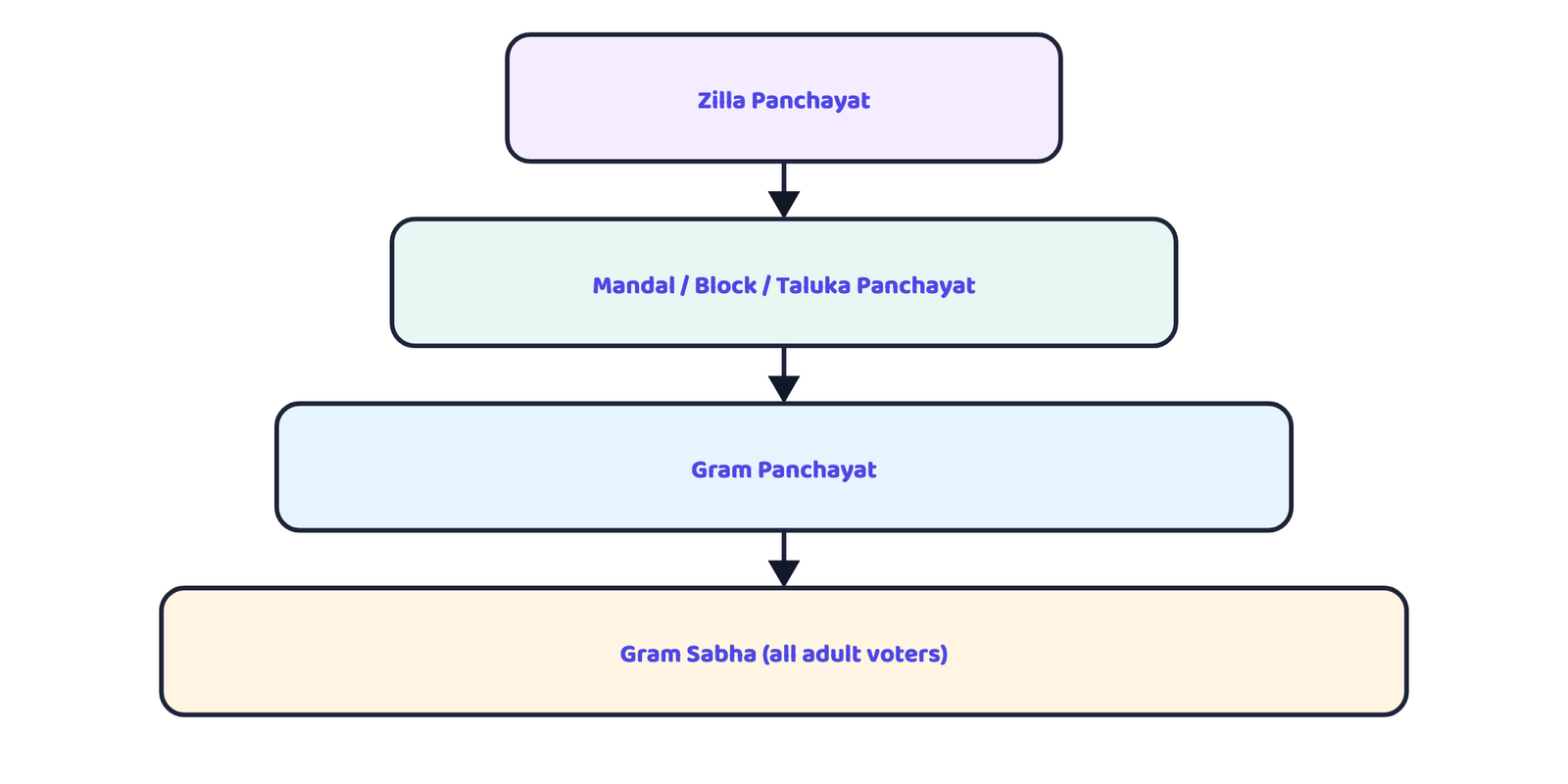
The Amendment also made a Gram Sabha mandatory, comprising all adult voters registered in the Panchayat area, its role and functions are decided by State legislation.
4.2 Elections and Reservations
- All three tiers of the Panchayati Raj are directly elected by the people, every Panchayat’s term is 5 years; if a Panchayat is dissolved earlier, fresh elections are mandatory within 6 months (before the 73rd Amendment, district bodies in many States had indirect elections, and there was no provision for immediate re-election if dissolved)
- One-third of all positions in Panchayati Raj Institutions are reserved for women, at all three levels; Scheduled Castes and Scheduled Tribes also get reservation in proportion to their population at all three levels; States may also reserve seats for Other Backward Classes (OBCs) if they wish
Women’s reservation is not limited to ordinary members, it also applies to Chairperson posts at all three levels. What is even more interesting is that women’s one-third reservation applies not only to general seats but also within seats reserved for Scheduled Castes, Scheduled Tribes, and backward classes. This means a seat can be reserved for both a woman AND an SC/ST candidate at the same time, so the Sarpanch there will have to be a Dalit woman or an Adivasi woman.
4.3 Transfer of Subjects and Article 243G
29 subjects that were earlier in the State List have been identified and listed in the Eleventh Schedule of the Constitution, meant to be transferred to Panchayati Raj Institutions. Their actual transfer depends upon State legislation, each State decides for itself how many of these subjects to hand over to local bodies.
Article 243G: “Powers, authority and responsibilities of Panchayats. …, the Legislature of a State may, by law, endow the Panchayats with such powers and authority…. …with respect to …the matters listed in the Eleventh Schedule.”
Some Eleventh Schedule subjects: Agriculture, minor irrigation/water management/watershed development, small scale industries (including food processing), rural housing, drinking water, roads and culverts, rural electrification, poverty alleviation programme, education (primary and secondary), technical and vocational training, adult and non-formal education, libraries, cultural activities, markets and fairs, health and sanitation (hospitals, primary health centres, dispensaries), family welfare, women and child development, social welfare, welfare of weaker sections (including SC/ST specifically), public distribution system.
The provisions of the 73rd Amendment did not apply to the tribal-majority areas of several Indian States. In 1996 a separate act was passed to extend the provisions of the Panchayat system to these areas. Many tribal communities have their own traditions of looking after common resources such as forests and water bodies, so this Act protects these communities’ right to manage resources in their own way. To this end, Gram Sabhas in these areas have been given greater powers, and elected Gram Panchayats must obtain the Gram Sabha’s consent on many matters. The idea behind this Act is that local traditions of self-government should be protected while introducing modern elected bodies, which is consistent with the spirit of diversity and decentralisation.
4.4 State Election Commissioner and State Finance Commission
- The State government must appoint a State Election Commissioner, who conducts elections to the Panchayati Raj Institutions; this office is as autonomous as the Election Commission of India, but it is not under the control of, or connected to, the Election Commission of India (earlier this task was carried out by the State administration under the control of the State government)
- The State government must also appoint a State Finance Commission every five years, which examines the financial position of local governments, and reviews the distribution of revenue between the State and local governments and between rural and urban local governments, so that the allocation of funds does not become a political matter
5 74th Amendment: Nagarpalikas
The 74th Amendment relates to urban local bodies, that is, Nagarpalikas. According to the Census, an area is considered urban only when: (i) the minimum population is 5,000, (ii) at least 75 percent of the male working population is engaged in non-agricultural activities, and (iii) the population density is at least 400 persons per square kilometre. According to the 2011 Census, about 31 percent of India’s population lives in urban areas.
The 74th Amendment is largely similar to the 73rd Amendment, except that it applies to urban areas, direct elections, reservations, transfer of subjects, the State Election Commission and the State Finance Commission all apply to Nagarpalikas too. The functions the Constitution asks State governments to transfer to urban local bodies are listed in the Twelfth Schedule.
6 Implementation Numbers
All States have now passed legislation implementing the 73rd and 74th Amendments. During the first ten years (1994-2004) after these amendments came into force, most States held at least two rounds of local body elections, and some States, such as Madhya Pradesh and Rajasthan, held as many as three.
| Rural India | Urban India |
|---|---|
| 600+ Zilla Panchayats | 100+ Municipal Corporations |
| About 6,000 block/intermediary Panchayats | 1,400 town Municipalities |
| 2,40,000 Gram Panchayats | 2,000+ Nagar Panchayats |
State Assemblies and Parliament together have fewer than 5,000 elected representatives, local bodies have hugely increased the total number of elected representatives. The 73rd and 74th Amendments have also created uniformity in the structures of Panchayati Raj and Nagarpalika institutions across the country; the presence of these institutions is by itself a significant achievement and creates a platform for people’s participation in government. People, however, want not only formal laws but their genuine implementation, which is the expectation behind the village flag slogan in the textbook: “We are the government here in the village!”
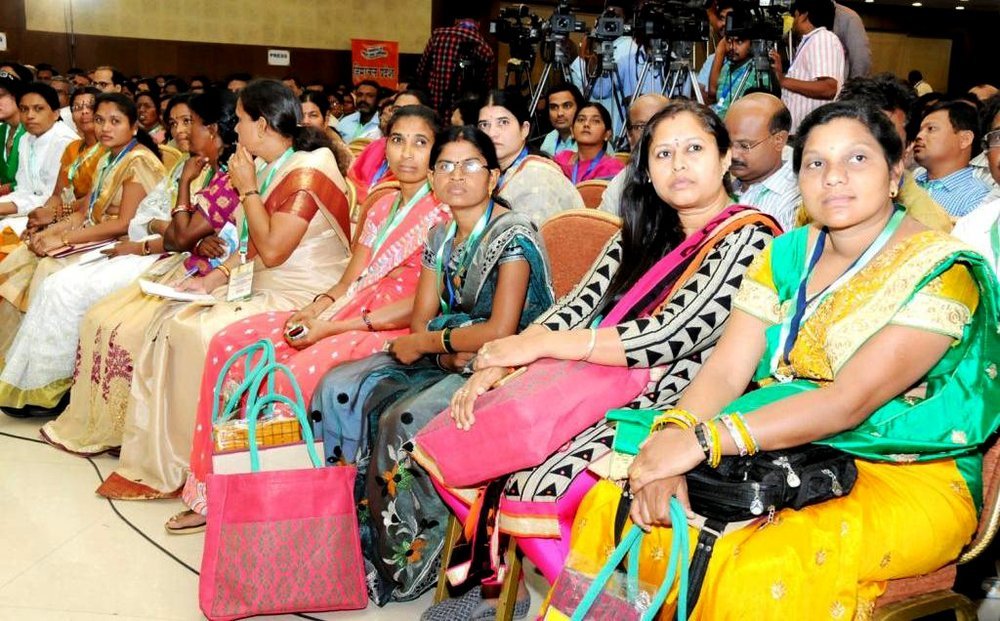
Women’s reservation has also ensured a meaningful presence of women in local bodies: at least 200 women Adhyakshas in Zilla Panchayats, 2,000 women Presidents of block/taluka panchayats, more than 80,000 women Sarpanchas in Gram Panchayats, more than 30 women Mayors in Municipal Corporations, more than 500 women Adhyakshas of Town Municipalities, and nearly 650 Nagar Panchayats headed by women.
Women have gained more power and confidence by asserting control over resources. Their presence in these institutions has given many women a greater understanding of the working of politics, and in many cases they have brought a new perspective and a greater sensitivity to discussions at local bodies. In many cases, however, women were unable to assert their presence or were mere proxies for the male members of their family who sponsored their election, though such instances are becoming fewer.
7 Limitations and Challenges
India’s population is 16.2 percent Scheduled Caste and 8.2 percent Scheduled Tribe, about 6.6 lakh elected members of rural and urban local bodies come from these two communities, this has significantly changed the social composition of local bodies. This sometimes generates tension too, groups that earlier dominated villages are not willing to give up their power easily, but this tension is not always a bad thing, whenever democracy tries to extend power to those who did not earlier have it, some friction is only natural.
Despite the transfer of 29 subjects, local governments enjoy only limited autonomy in practice, many States have not transferred most of these subjects to local bodies, this prevents local bodies from functioning effectively, and the whole exercise of electing so many representatives ends up being somewhat symbolic. Some people also criticise the formation of local bodies because it has not changed the way in which decisions are taken at the central and the State level: people at the local level do not enjoy much power to choose welfare programmes or to decide the allocation of resources.
Bolivia is counted among the most successful examples of democratic decentralisation in Latin America. The 1994 Popular Participation Law decentralised power to the local level, it brought in the direct election of mayors (presidente municipal), divided the country into municipalities, and set up a system to automatically transfer funds to the new municipalities. Bolivia is divided into 314 municipal governments, each headed by a popularly elected mayor and a municipal council (cabildo), and countrywide local elections take place every five years. Bolivian local governments are entrusted with building and maintaining local health and education facilities. 20 percent of nationwide tax collections in Bolivia are distributed to municipalities on a per capita basis. The municipalities may levy taxes on motor vehicles, urban property and large agricultural properties, but fiscal transfers provide the bulk of their operating budget.
Local bodies have very little money of their own, dependence on Central and State grants has considerably weakened their capacity to function. Rural local bodies raise only 0.24 percent of total revenue collected, but account for 4 percent of total government expenditure, that is, they earn very little and spend a lot more, which is why their dependence on grant-givers persists.
8 Conclusion
The experience so far suggests that local governments continue to be agencies implementing the welfare and development schemes of the central and State governments. Giving more power to local government means being prepared for real decentralisation of power. Ultimately, democracy means that power should be shared by the people: people in the villages and urban localities must have the power to decide what policies and programmes they want to adopt. The laws about local governments are an important step in the direction of democratisation, but the true test of democracy is not merely in the legal provisions but in the practice of those provisions.
- Geeta Rathore (Madhya Pradesh, 1995/2000) and Vengaivasal (Tamil Nadu, 1997), both stories are examples of the transformation that followed 1993
- Lord Ripon (1882), the 1919/1935 Acts, Gandhi’s vision of decentralisation, Nehru’s and Ambedkar’s distinct concerns
- 1952 Community Development Programme, 1989 P.K. Thungon Committee
- 73rd (rural/Panchayati Raj) and 74th (urban/Nagarpalika) Amendments, passed in 1992, in force from 1993
- Three-tier structure, 5-year term, women-SC-ST reservation (women’s reservation also applies within SC-ST seats), 29 subjects + Eleventh Schedule, PESA 1996
- State Election Commissioner (independent of the Election Commission) and State Finance Commission (every 5 years)
- Limited autonomy: 0.24% of revenue versus 4% of expenditure; Bolivia’s successful example
- Law versus practice: real democracy lies not in the law but in putting it into practice
- Can I recall both stories (Geeta Rathore and Vengaivasal) with names and dates?
- Can I clearly state Nehru’s and Ambedkar’s distinct concerns?
- Do I remember the difference between the 73rd and 74th Amendments, and which Schedule goes with which?
- Do I remember the “reservation within reservation” rule for women?
- Do I remember the 0.24% versus 4% statistic?