
1 Are Constitutions Static?
Many countries around the world have rewritten their constitutions in response to changed circumstances, changed ideas within society, or political upheavals. But India’s Constitution was adopted on 26 November 1949 and formally came into force on 26 January 1950, and more than 69 years later, the same Constitution continues to function.
Soviet Union: four constitutions changed in 74 years (1918, 1924, 1936 and 1977); Communist Party rule ended in 1991 and the Soviet federation disintegrated; the new Russian federation adopted a new constitution in 1993.
France: adopted numerous constitutions over two centuries, the 1793 post-revolution constitution is called the First French Republic, the Second Republic came in 1848, the Third Republic with a new constitution in 1875, the Fourth in 1946, and the Fifth Republic in 1958.
United States: its Constitution is more than 200 years old, but has been amended only 27 times so far.
So is our Constitution so good that it needs no change, or were our Constitution-makers so far-sighted that they foresaw every future change? To some extent both answers are true, but no constitution can provide solutions for every future situation, no document exists that never needs to be changed.
First, our Constitution accepts the necessity of amendment according to the changing needs of the time. Second, there has been enough scope for interpretation in the Constitution’s practical working, both judicial rulings and political practice have shown maturity and flexibility in implementing it. These are exactly why our Constitution has been able to develop as a living document, rather than becoming a closed and rigid rulebook of laws.
2 The Constitution: Flexible and Rigid
A constitution has a dual role: it also solves the problems of the time it is being written, and it also provides a framework for the future. At the same time, a constitution is not a frozen and unalterable document: it is made by human beings and may need revisions, changes and re-examination. It reflects the dreams and aspirations of society, and it is also a framework for the democratic governance of society.
This dual role raises a difficult question: is the Constitution so sacred a document that no change can ever be made to it, or is it such an ordinary matter that it can be changed whenever we like, just like an ordinary law? India’s Constitution-makers struck a balance between the two: they gave the Constitution a higher status than ordinary law so future generations would respect it, but they also accepted that it might need amendment in the future. In other words, our Constitution is neither rigid and unalterable, nor is it the final word on any single issue.
Some students in the class said these things, be sure to think through your own opinion on each: “the Constitution is just like any other law”, “the Constitution should have a provision to change every 10-15 years”, “the Constitution states the country’s philosophy, it can never be changed”, “the Constitution is a sacred document, talk of changing it is anti-democratic”. None of them is fully right: the first, second and fourth are not correct, and the third is only partly correct (the Constitution does state the country’s philosophy, but it can be amended; only its basic structure cannot). The Constitution can change, but not as easily as an ordinary law, and that is exactly what “flexible and rigid” means.
3 Three Ways to Amend the Constitution
“…Parliament may in exercise of its constituent power amend by way of addition, variation or repeal any provision of this Constitution in accordance with the procedure laid down in this article.”
To make the Constitution both flexible (open to change) and rigid (resistant to unnecessary change), it provides three distinct ways to amend it.
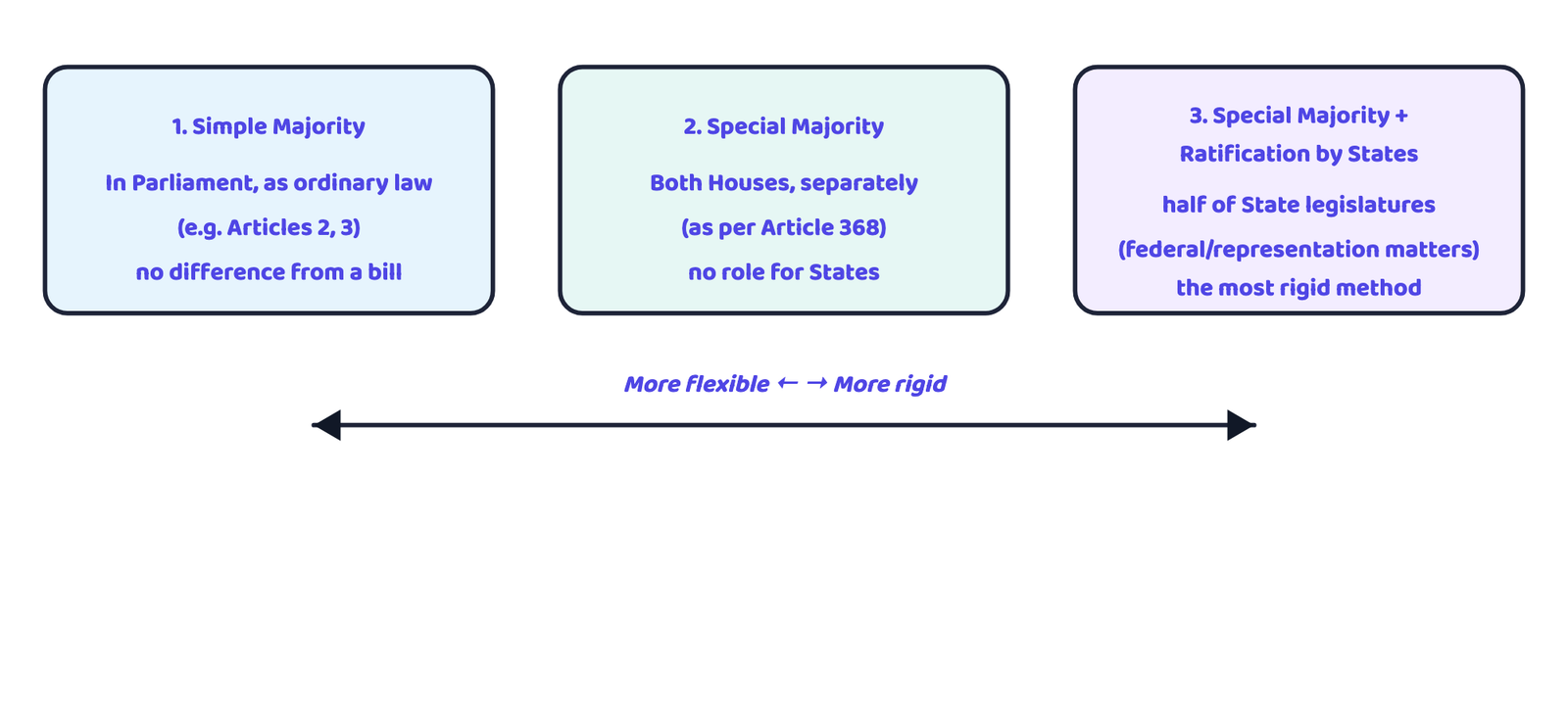
Note: all amendments can only be initiated in Parliament, no outside agency (such as a constitution commission) is needed, no referendum is required to ratify an amendment, and the President cannot send an amendment bill back for reconsideration (unlike ordinary bills). This shows that the basis of the amendment procedure is the sovereignty of elected representatives (parliamentary sovereignty).
4 Special Majority and Ratification by States
Ordinarily, passing a bill needs a simple majority of members present and voting (e.g. if 247 members are present, 124 votes pass it). But an amendment bill must satisfy two separate conditions at once: (1) those voting in favour of the amendment must be at least half of the House’s total membership, and (2) they must also be at least two-thirds of those actually taking part in the voting. Both Houses must pass this separately, there is no provision for a joint session.
The Lok Sabha has 545 members, so any amendment needs the support of at least 273 members, even if only 300 members are present at the time of voting. If 400 members took part in the voting, at least 273 support is still required, because the “half of total membership” condition (272.5, rounded up to 273) is larger than “two-thirds of those voting” (roughly two-thirds of 400 ≈ 267). Whichever of the two conditions demands the larger number is the one that applies.
The principle of special majority: the US requires a two-thirds majority, South Africa and Russia require a three-fourths majority for some amendments.
The principle of people’s participation: in Switzerland, people can even initiate an amendment themselves; in Russia and Italy, people can propose or approve an amendment.
“If those who are dissatisfied with the Constitution have only to obtain a 2/3 majority and if they cannot obtain even (that)…, their dissatisfaction with the Constitution cannot be deemed to be shared by the general public.”
Dr. Ambedkar, CAD, Vol. XI, p. 976, 25 November 1949
Note here that Ambedkar is not talking only of a parliamentary majority, he refers to “sharing (of the views) by the general public”, that is, behind the requirement of a majority lies the principle of public opinion governing decision-making.
4.1 Ratification by States
For articles concerning the distribution of powers between the States and the Centre, or concerning representation, a special majority alone is not sufficient, the States’ consent is also needed: half the State legislatures must pass the amendment bill with a simple majority. This respects the federal structure and gives States participation in the amendment process, while still keeping the procedure somewhat flexible even in this more rigid format, since only half (not all) the States need to consent, and only a simple majority is required within each State legislature.
5 Why So Many Amendments?
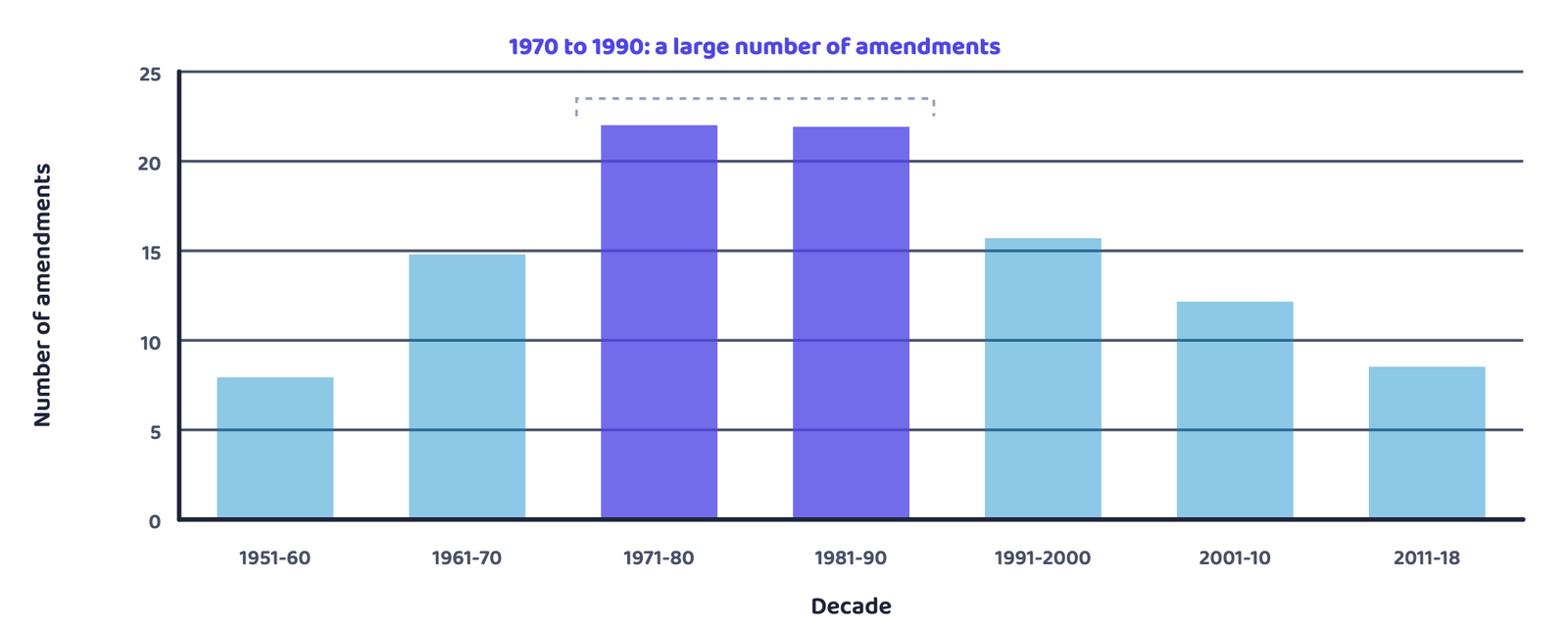
By 26 January 2024, our Constitution completed 74 years of existence, and in these years it has been amended 106 times. Given the relatively difficult amendment procedure, this number appears quite large.
| Period | Amendments | Political Context |
|---|---|---|
| 1974-1976 (3 years) | 10 amendments | Congress dominance, 352 Lok Sabha seats |
| 2001-2003 (3 years) | 10 amendments | Coalition politics, bitter BJP-versus-rivals rivalry |
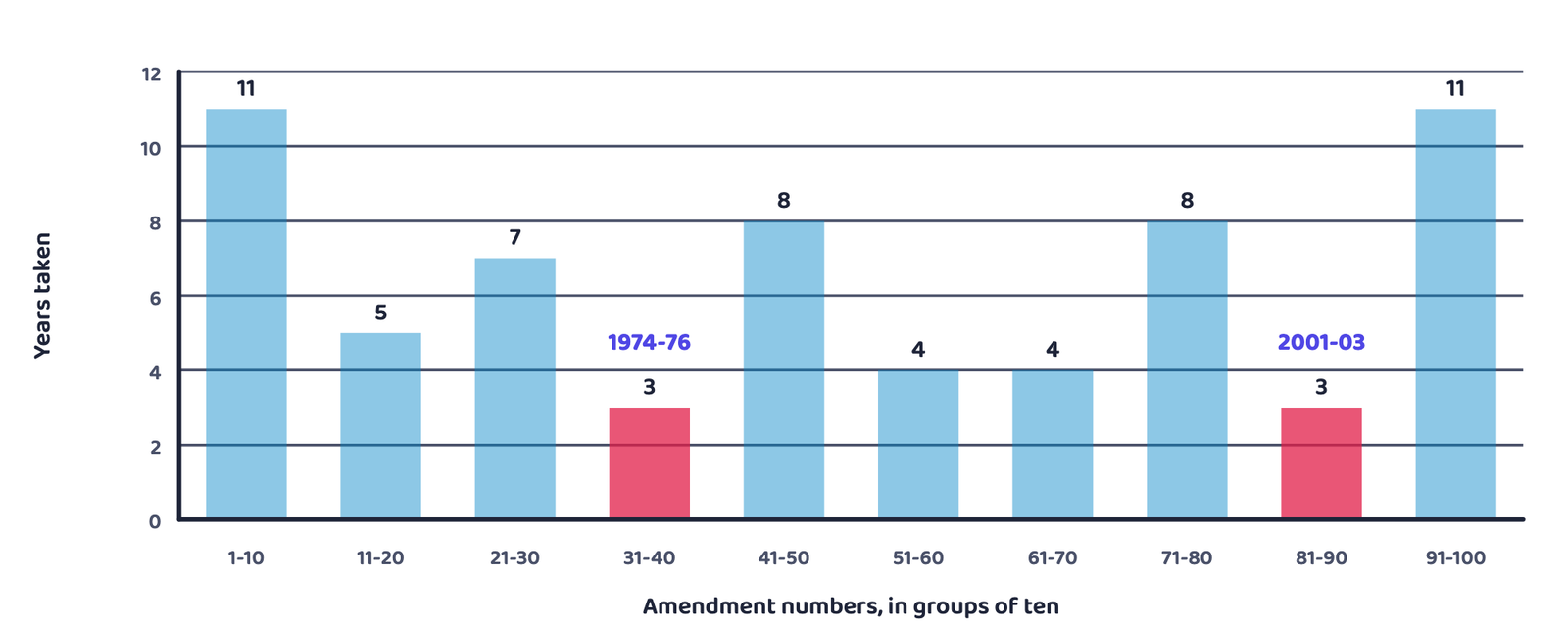
These two periods were politically very different from each other, yet both saw amendments at a similar pace, that is, the number of amendments does not depend merely on the nature of the ruling party’s majority. Barring the Constitution’s first decade, every decade has witnessed a steady stream of amendments, meaning that regardless of which party was in power, amendments were felt necessary from time to time.
Both graphs show the same information in two ways. Figure 2 counts the amendments made in each decade: the two decades from 1970 to 1990 saw a large number of amendments. Figure 3 shows how many years each set of ten amendments took: the two shortest bars, just three years each, are 1974-76 and 2001-03.
6 Types of Amendments and Controversial Ones
Amendments made so far can be classified into three groups:
These three amendments emerged from the backdrop of the Emergency declared in June 1975, and are considered the most controversial. The 42nd amendment in particular went far: it attempted to override the Kesavananda ruling, extended the Lok Sabha’s term from 5 to 6 years, added Fundamental Duties to the Constitution, restricted the Judiciary’s review powers, and changed the Preamble, the Seventh Schedule, and 53 articles. Many opposition MPs were in jail when this bill was passed. After Congress’s defeat in the 1977 elections, the new government used the 43rd and 44th amendments to cancel most of the changes made by the 38th, 39th and 42nd, restoring constitutional balance.
7 The Basic Structure Doctrine
One thing that has had a long-lasting effect on the evolution of India’s Constitution is the doctrine of the basic structure, which the Judiciary put forward in the Kesavananda Bharati case (1973).
1. It set specific limits on Parliament’s power to amend the Constitution: no amendment can violate the basic structure.
2. It allows Parliament to amend any or all parts of the Constitution within this limitation.
3. It places the Judiciary as the final authority in deciding whether an amendment violates the basic structure, and what the basic structure actually is.
Interestingly, the basic structure doctrine is itself an example of a living constitution, there is no mention of this theory anywhere in the Constitution’s own text, it emerged entirely from judicial interpretation, that is, the Judiciary practically amended the Constitution without any formal amendment.
In the late 1990s, efforts were made to review the entire Constitution. In 2000, the Government of India appointed a commission under retired Chief Justice Justice Venkatachaliah, which opposition parties and several organisations boycotted. The commission stuck to the basic structure theory and made no suggestion that would endanger it, showing how much acceptance this doctrine has gained.
Further examples of judicial interpretation: reservations in jobs and education cannot exceed 50 percent of seats (now an accepted principle); the concept of the “creamy layer” in OBC reservations, under which persons in this category are not entitled to reservation benefits; and the Judiciary contributed to informal amendment by interpreting provisions concerning the right to education, right to life and liberty, and the right of minorities to establish and manage educational institutions.
8 Conclusion: A Living Document and Democracy
Almost like a living being, the Constitution keeps responding to the situations and circumstances arising from time to time; like a living being, it responds to experience. This is the answer to the riddle of its durability: even after so many changes in society, it continues to work effectively because of its ability to be dynamic, to be open to interpretations and to respond to the changing situation. This is a hallmark of a democratic constitution. A constitution that protects democracy and yet allows new practices to evolve becomes not only durable but also an object of respect from the citizens. The important question is: has the Constitution been able to protect itself and protect democracy?
The most serious question that has come up again and again since 1950 is: the supremacy of Parliament. Parliament represents the people, so it is expected to have the upper hand over the Executive and Judiciary, but the Constitution has also given powers to other organs of government, so parliamentary supremacy operates within this very framework. Democracy is not only about votes and people’s representation: it is also about the principle of rule of law, and about developing institutions and working through them. All political institutions must be responsible to the people and maintain a balance with each other.
Parliament believed it had the power to make laws (and amendments) in the interest of the poor, backward, and needy. The Judiciary insisted this must all happen within the constitutional framework, because once the excuse of good intentions is allowed to bypass legal limits, power-holders can misuse it too. Democracy is as much about checks on the arbitrary use of power as it is about the well-being of the people. In Kesavananda, the Judiciary decided based on the spirit (soul) of the Constitution rather than its letter (language), that is, the basic structure, which is nowhere written in the Constitution’s text, is the Judiciary’s own discovery.
Maturity of political leadership: after the sharp controversy of 1967-1973, attempts to get the Kesavananda ruling reconsidered having failed, the 42nd amendment asserted parliamentary supremacy, but the Court repeated its earlier stand in the Minerva Mills case (1980). Therefore, even four decades after the Kesavananda ruling, it has dominated our interpretation of the Constitution: political parties, leaders, the government and Parliament accepted the idea of an inviolable basic structure, and even when there was talk of a “review” of the Constitution, that exercise could not cross this limit.
When the Constitution was made, Nehru’s famous “tryst with destiny” speech expressed the shared dream that still holds today: dignity and freedom of the individual, social-economic equality, well-being for all, and unity based on national integrity.
“The ideals on which this draft constitution is framed have no manifest relation to the fundamental spirit of India. …this Constitution …would not prove suitable and would break down soon after being brought into operation.”
Lakshminarayan Sahu, CAD, Vol. XI, p. 613, 17 November 1949
This dissenting voice was also present in the Constituent Assembly, and yet the Constitution remains an object of respect and authority even more than half a century later.
1. There can still be debates about what constitutes the basic structure, and there is nothing wrong in such debates: debates and differences are a sign of diversity, liveliness and openness, and democracy welcomes them.
2. Politics is also about compromises and give-and-take: everyone has to moderate extreme views and sharp positions and reach a common minimum ground. Our parties, leaders and people have shown this maturity, and that has made the working of the democratic Constitution quite successful.
3. The organs of government will always compete over which one is more important, and over what the welfare of the people means, but in the last instance, the final authority lies with the people. People, their freedoms and their well-being are both the purpose and the outcome of democracy.
- India’s Constitution adopted 26 November 1949, in force 26 January 1950; 69+ years of the same Constitution
- Three amendment methods: simple majority (Articles 2, 3), special majority (Article 368), special majority + half the States’ ratification
- Special majority’s two conditions: half of total membership, and two-thirds of those voting
- 106 amendments by 26 January 2024, 74 years; the two decades 1970 to 1990 saw a large number of amendments; 1974-76 and 2001-03 both had 10 amendments in three years, in very different political contexts
- 38th, 39th, 42nd most controversial (Emergency era); 43rd-44th reversed most of them
- Basic structure doctrine: Kesavananda Bharati (1973), reaffirmed by Minerva Mills (1980); nowhere written in the Constitution’s text, the Judiciary’s own discovery
- Living document: like a living being it responds to experience; dynamic, open to interpretation, responsive to change
- Letter versus spirit: the Constitution’s success lies in political maturity and compromise, not in rigid positions; in the last instance, the final authority lies with the people
- Do I remember all three amendment methods and the articles linked to them?
- Are both conditions of special majority (half + two-thirds) clear in my mind?
- Do I remember the difference between the 38th-39th-42nd and the 43rd-44th amendments?
- Can I state the three distinct contributions of the basic structure doctrine separately?
- Do I remember the difference between Kesavananda Bharati (1973) and Minerva Mills (1980)?
- Can I explain why the Constitution is called a living document, and what the two graphs of amendments show?