
Covers T.R. Jain & V.K. Ohri (2026-27) ch 5. Based on NCERT Indian Economic Development, Chapter 5 (Reprint 2026-27) and the CBSE 2026-27 curriculum.
Board note: CBSE teaches this book in Class 12; UP, Bihar, Rajasthan and MP Boards teach it in Class 11.
- Write the meaning of rural development and list its key issues
- Explain why rural credit matters, its institutions (NABARD, cooperatives, RRBs, self-help groups) and appraise rural banking critically
- Explain the problems of agricultural marketing, the four government measures and the alternate marketing channels
- Explain the need for diversification and the role of animal husbandry, fisheries, horticulture and IT
- Define organic farming and write its benefits and limitations
1 Rural development: why and what
1.1 Why rural development matters
- The majority of India’s poor live in rural areas, where they lack access to the basic necessities of life
- Agriculture is the major source of livelihood in the rural sector
- Mahatma Gandhi said the real progress of India meant mainly the development of the villages, not just the growth of industrial urban centres; the idea is relevant even today
- The reason: more than two-third of India’s population depends on agriculture, which is not yet productive enough to provide for them
- One-fourth of rural India still lives in abject poverty
- So the nation can realise real progress only with a developed rural India
1.2 Meaning of rural development
Rural development is a comprehensive term. It essentially focuses on action for the development of areas that are lagging behind in the overall development of the village economy.
The book lists five areas in rural India that are challenging and need fresh initiatives:
Human resources
Literacy (more specifically female literacy), education and skill development; health, addressing both sanitation and public health
Land reforms
Listed by the book as a separate area of initiative
Productive resources
Development of the productive resources of each locality
Infrastructure
Electricity, irrigation, credit, marketing, transport (village roads and feeder roads to highways), agriculture research and extension, information dissemination
Poverty alleviation
Special measures to improve the living conditions of the weaker sections, with access to productive employment
- People in farm and non-farm activities must get the means to increase productivity
- They must get opportunities to diversify into non-farm productive activities such as food processing
- Better and affordable healthcare, sanitation at workplaces and homes, and education for all need top priority
1.3 Agriculture today: the key issues
For “key issues in rural development”, write the five areas above (human resources, land reforms, productive resources, infrastructure, poverty alleviation). Add the chapter’s four core themes: credit, marketing, diversification and organic farming.
2 Rural credit
2.1 Why farmers need credit
- Growth of the rural economy depends on infusion of capital, from time to time, to raise productivity in agriculture and non-agriculture
- The gestation period between sowing a crop and realising income from it is quite long
- So farmers borrow for their initial investment on seeds, fertilisers and implements
- They also borrow for family expenses of marriage, death and religious ceremonies
Debt-trap is the situation in which a borrower can never get out of debt because of high interest rates and manipulated accounts. At independence, moneylenders and traders kept small and marginal farmers and landless labourers in a debt-trap this way.
2.2 Growth of institutional credit
NABARD (National Bank for Agriculture and Rural Development) was set up in 1982 as an apex body to coordinate the activities of all institutions involved in the rural financing system.
The institutional structure of rural banking today is a set of multi-agency institutions, expected to dispense adequate credit at cheaper rates.

2.3 Self-help groups and micro-credit
- The formal credit system proved inadequate and was not fully integrated into overall rural social and community development
- Formal credit needs some kind of collateral, so a vast proportion of poor rural households were automatically out of the credit network
- Self-help groups (SHGs) emerged to fill this gap
- SHGs promote thrift in small proportions through a minimum contribution from each member
- From the pooled money, credit is given to needy members, repayable in small instalments at reasonable interest rates
- By May 2019, nearly 6 crore women had become members of 54 lakh women SHGs
- In recent years about ₹10-15,000 per SHG and another ₹2.5 lakh per SHG as a Community Investment Support Fund (CISF) are provided as a revolving fund, to take up self-employment for income generation
Micro-credit programmes are the small credit provisions given to the poor through self-help groups.
What SHGs achieved
- Credit reached the poor without collateral
- Habit of thrift grew
- Helped in the empowerment of women
Criticism of SHGs
- Borrowing is mainly confined to consumption purposes
- Some borrowers use self-employment loans for other purposes
Kudumbashree is a women-oriented, community-based poverty reduction programme in Kerala. In 1995 a thrift and credit society was started as a small savings bank for poor women, to encourage savings. It mobilised Rs 1 crore as thrift savings. These societies are acclaimed as the largest informal banks in Asia in terms of participation and savings mobilised.
2.4 Rural banking: a critical appraisal
Positive effects
- Rapid expansion of banking raised rural farm and non-farm output, income and employment, especially after the green revolution
- Farmers got services, credit facilities and a variety of loans for production needs
- Famines became events of the past
- Food security achieved, reflected in abundant buffer stocks of grains
Weaknesses
- Except commercial banks, formal institutions failed to develop a culture of deposit mobilisation
- They failed in lending to worthwhile borrowers and in effective loan recovery
- Agricultural loan default rates have been chronically high; it is alleged farmers deliberately refuse to pay back
- Expansion and promotion of rural banking took a backseat after the reforms
2.5 Jan-Dhan Yojana
- To improve the situation, all adults are encouraged to open bank accounts under the Jan-Dhan Yojana
- Account holders can get Rs 1-2 lakh accidental insurance cover and an overdraft facility of Rs 10,000
- Wages for government-related jobs and works under MNREGA (now Viksit Bharat – Guarantee for Rozgar and Ajeevika Mission [Gramin], VB-G RAM G), old age pension and other social security payments are transferred into these accounts
- There is no need to keep a minimum balance
- More than 50 crore people opened accounts; banks could mobilise funds of more than Rs 2,00,000 crore through them
- Indirectly it promoted the thrift habit and efficient allocation of financial resources, particularly in rural areas
Writing “NABARD is a commercial bank that lends to farmers directly” is wrong. The book describes NABARD as the apex body that coordinates all rural financing institutions. Monetary policy is the Reserve Bank’s job, not NABARD’s.
3 Agricultural market system
Agricultural marketing is a process that involves the assembling, storage, processing, transportation, packaging, grading and distribution of different agricultural commodities across the country.
3.1 Problems before government intervention
- Before independence, farmers selling to traders suffered from faulty weighing and manipulation of accounts
- Without information on market prices, they were often forced to sell at low prices
- Without proper storage, they could not hold back produce to sell later at a better price
- Even today, more than 10 per cent of farm goods are wasted due to lack of storage
- So government intervention became necessary to regulate private traders
3.2 The four government measures
Regulation of markets
Orderly and transparent marketing conditions; benefited farmers and consumers. About 27,000 rural periodic markets still need to become regulated market places
Physical infrastructure
Roads, railways, warehouses, godowns, cold storages and processing units; still quite inadequate for growing demand
Cooperative marketing
Fair prices for farmers’ products; milk cooperatives transformed the social and economic landscape of Gujarat and other parts
Policy instruments
(i) minimum support prices (MSP) for agricultural products; (ii) buffer stocks of wheat and rice by the Food Corporation of India; (iii) distribution of food grains and sugar through PDS
| Policy instrument | Aim |
|---|---|
| Minimum support price (MSP) | Protect the income of farmers |
| Buffer stocks (FCI) | Maintain stocks of wheat and rice |
| Public Distribution System (PDS) | Food grains and sugar to the poor at a subsidised rate |
3.3 Role of cooperatives (a separate CBSE syllabus point)
The curriculum names “role of cooperatives” separately. The book brings cooperatives in at four places; write all four:
| Area | Role of cooperatives |
|---|---|
| Credit | Cooperatives and land development banks are part of the multi-agency rural credit system, expected to give adequate credit at cheaper rates |
| Marketing | Cooperative marketing helps farmers realise fair prices (the government’s third measure) |
| Dairy | Operation Flood: farmers pool milk, which is graded, processed and sold to urban centres through cooperatives; Gujarat is the success story |
| Fisheries | Credit through cooperatives and SHGs is needed for fisherwomen’s working capital |
- Inadequate coverage of farmer members
- Lack of appropriate link between marketing and processing cooperatives
- Inefficient financial management
3.4 Private trade still dominates
- Despite intervention, private trade (by moneylenders, rural political elites, big merchants and rich farmers) predominates agricultural markets
- Government intervention is needed particularly when a large share of agricultural products is handled by the private sector
- Some scholars argue that commercialisation of agriculture offers tremendous scope for higher farm incomes, provided government intervention is restricted
3.5 Emerging alternate marketing channels
If farmers sell their produce directly to consumers, their incomes rise. Examples:
| Channel | State / place |
|---|---|
| Apni Mandi | Punjab, Haryana and Rajasthan |
| Hadaspar Mandi | Pune |
| Rythu Bazars (vegetable and fruit markets) | Andhra Pradesh and Telangana |
| Uzhavar Sandies (farmers’ markets) | Tamil Nadu |
- Contracts with fast food chains: national and multinational chains contract with farmers to grow products of the desired quality
- They provide seeds and other inputs and assure procurement at pre-decided prices
- This reduces farmers’ price risk and expands markets for farm products
- In 2016 the Union Government launched the e-National Agriculture Market (e-NAM), a pan-India online portal connecting mandis and regulated market yards
- In 2020 Parliament passed three laws to reform agricultural marketing; some farmers supported them, others opposed, and the Acts were later repealed
Regulated market
- Regulated by government, orderly and transparent
- Farmer sells to traders in the market yard
- Example: regulated market yards, APMC
Alternate channel
- Farmer sells directly to consumers or a company
- Direct sale raises the farmer’s income
- Example: Apni Mandi, Rythu Bazars, contract farming
4 Diversification into productive activities
Diversification has two aspects: (1) a change in cropping pattern; (2) a shift of workforce from agriculture to other allied activities (livestock, poultry, fisheries etc.) and the non-agriculture sector.
4.1 Why diversification is needed
- Depending exclusively on farming for a livelihood carries greater risk
- Diversification reduces the risk from agriculture and provides productive, sustainable livelihood options
- Most agricultural employment is concentrated in the Kharif season
- In the Rabi season, in areas with inadequate irrigation, gainful employment is hard to find
- So expansion into other sectors gives supplementary gainful employment and higher incomes to fight poverty
- Agriculture is already overcrowded, so a major part of the growing labour force needs alternate non-farm jobs
4.2 The non-farm economy
- Most rural women find employment in agriculture, while men generally look for non-farm employment
- In recent times women have also begun looking for non-farm jobs
- Fig. 5.1: Regulated market yards benefit farmers as well as consumers
- Fig. 5.2: Jaggery making is an allied activity of the farming sector
- Fig. 5.3: Sheep rearing is an important income augmenting activity in rural areas
- Fig. 5.4: Poultry has the largest share of total livestock in India
- Fig. 5.5: Women in rural households take up bee-keeping as an entrepreneurial activity
TANWA was a project started in the late 1980s in Tamil Nadu to train women in the latest agricultural techniques and organic farming. At a Farm Women’s Group in Thiruchirapalli, run by Anthoniammal, trained women make and sell vermicompost. Many groups function like mini banks through micro-credit and use the savings for mushroom cultivation, soap manufacture, doll making and other income-generating activities.
4.3 Animal husbandry
- Indian farmers use the mixed crop-livestock farming system: cattle, goats and fowl are the widely held species
- Livestock gives increased stability in income, food security, transport, fuel and nutrition, without disrupting other food-producing activities
- The livestock sector alone gives alternate livelihoods to over 70 million small and marginal farmers including landless labourers
- A significant number of women also find employment in it
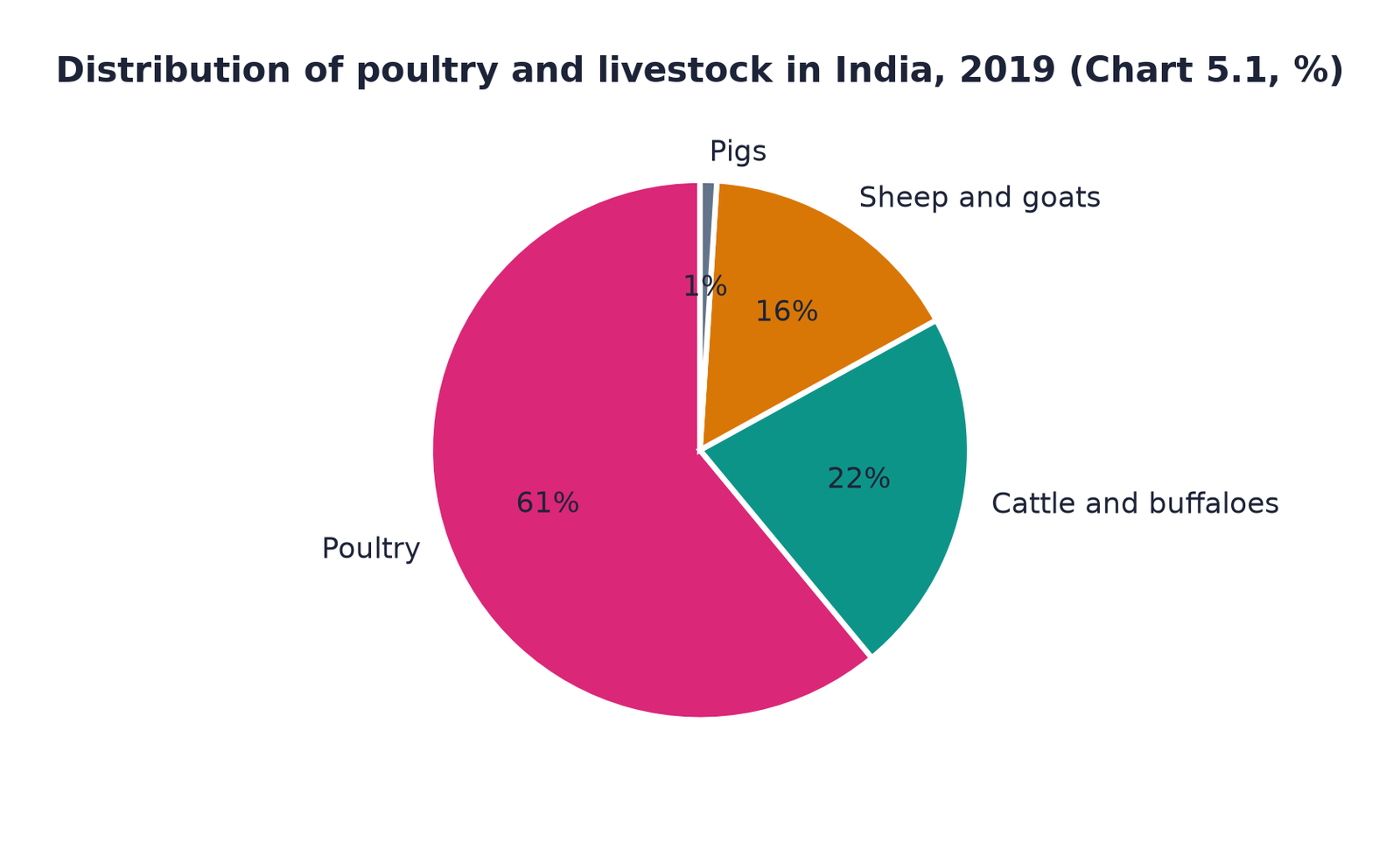
- Poultry accounts for the largest share, 61 per cent, more than all the others together (39%)
- Camels, asses, horses, ponies and mules are in the lowest rung
- India had about 303 million cattle, including 110 million buffaloes, in 2019
Operation Flood is a system in which all farmers pool the milk they produce, which is graded by quality, processed and marketed to urban centres through cooperatives. The farmers are assured of a fair price and income from supplying milk to urban markets.
- The dairy sector’s performance over the last three decades has been impressive: milk production rose about twelve times between 1951 and 2021, mainly due to Operation Flood
- Gujarat is the success story of milk cooperatives, emulated by many states
- Major milk producing states: Gujarat, Madhya Pradesh, Uttar Pradesh, Andhra Pradesh, Maharashtra, Punjab and Rajasthan
- Meat, eggs, wool and other by-products are also emerging as important productive sectors for diversification
- Weakness: livestock numbers are impressive but productivity is low compared with other countries; it needs improved technology, good breeds, better veterinary care and credit for small and marginal farmers and landless labourers
4.4 Fisheries
- The fishing community regards the water body (sea, oceans, rivers, lakes, ponds, streams) as ‘mother’ or ‘provider’
- Higher budgetary allocations and new technology in fisheries and aquaculture have brought great progress
- Major fish producing states: West Bengal, Andhra Pradesh, Kerala, Gujarat, Maharashtra and Tamil Nadu
- A large share of fishworker families are poor
- Problems: rampant underemployment, low per capita earnings, no mobility of labour to other sectors, high illiteracy and indebtedness
- Women do not fish actively, but about 60% of the workforce in export marketing and 40% in internal marketing are women
- Credit through cooperatives and SHGs is needed for fisherwomen’s working capital
- Over-fishing and pollution must be regulated; welfare programmes should give long-term gains
4.5 Horticulture
- With varied climate and soils, India grows fruits, vegetables, tuber crops, flowers, medicinal and aromatic plants, spices and plantation crops
- Horticulture contributes nearly one-third of the value of agricultural output and six per cent of GDP
- India is a world leader in mangoes, bananas, coconuts, cashew nuts and several spices, and is the second largest producer of fruits and vegetables
- It has improved many farmers’ incomes and become a livelihood for many unprivileged classes
- Flower harvesting, nursery maintenance, hybrid seed production, tissue culture, propagation of fruits and flowers and food processing are highly paid work for rural women
- It needs investment in electricity, cold storage, marketing linkages, small processing units and technology
Exercise Q10 asks about the Golden Revolution, a term the present chapter text does not use. It means the phase of rapid growth in horticulture production (fruits, vegetables, flowers, spices and so on), as against the Green Revolution in food grains (wheat and rice) studied in Chapter 2.
| Sector | Importance (book figures) | What it needs |
|---|---|---|
| Animal husbandry | Livelihood for over 70 million; milk up about 12 times | Technology, good breeds, veterinary care, credit |
| Fisheries | About 1.5% of GDP; 75% inland | Control over-fishing and pollution; credit for fisherwomen |
| Horticulture | One-third of agri output; 6% of GDP | Electricity, cold storage, marketing, processing units |
4.6 Other alternate livelihoods: information technology
- IT has revolutionised many sectors of the Indian economy
- IT can play a critical role in achieving sustainable development and food security in the twenty-first century
- With information and software tools, governments can predict areas of food insecurity and vulnerability and act to prevent or reduce an emergency
- It spreads information on emerging technologies, prices, weather and soil conditions for different crops
- IT is by itself no catalyst of change, but a tool for releasing the creative potential and knowledge in society
- It also has potential for employment generation in rural areas
In October 2014 the Government of India introduced the Saansad Adarsh Gram Yojana (SAGY). Each MP must identify and develop one village from the constituency as a model village by 2016, and two more by 2019, covering over 2,500 villages. The village can have a population of 3,000-5,000 in the plains and 1,000-3,000 in the hills, and should not be the MP’s own or spouse’s village. MPs facilitate a village development plan and infrastructure in health, nutrition and education.
5 Sustainable development and organic farming
- Awareness of the harmful effect of chemical fertilisers and pesticides on health is rising
- Conventional agriculture’s chemicals enter the food supply, penetrate water sources, harm livestock, deplete the soil and devastate natural eco-systems
- Eco-friendly technologies are essential for sustainable development; one such technology is organic farming
Organic farming is a whole system of farming that restores, maintains and enhances the ecological balance.
Organic food is growing in popularity worldwide. Many countries have around 10 per cent of their food system under organic farming. Retail chains and supermarkets get green status to sell it. Organic foods command a higher price of around 10-100 per cent than conventional ones.
✓ Benefits of organic farming
- Substitutes costlier inputs (HYV seeds, chemical fertilisers, pesticides) with cheaper locally produced organic inputs, giving good returns on investment
- Income from exports, as world demand is rising
- Studies show organic food has more nutritional value, so it is healthier
- Needs more labour, so it is attractive for India
- Produce is pesticide-free and grown in an environmentally sustainable way
- Demand for organically grown food is rising worldwide to enhance food safety
- It helps in sustainable development of agriculture; India has a clear advantage in producing organic products for domestic and international markets
✗ Limitations of organic farming
- Needs awareness and willingness of farmers to adapt to new technology
- Inadequate infrastructure, marketing problems and the need for an appropriate agriculture policy
- Yields are lower than modern farming in the initial years, so small and marginal farmers find large-scale production difficult
- Produce may have more blemishes and a shorter shelf life than sprayed produce
- Choice of off-season crops is quite limited
In 1995 Kisan Mehta of Prakruti (an NGO) suggested that cotton, the biggest user of chemical pesticides, could be grown organically. The then Director of the Central Institute for Cotton Research, Nagpur, remarked, “Do you want India to go naked?” Now 130 farmers have committed 1,200 hectares to organic cotton on the International Federation of Organic Agriculture Movement’s standards; the German accredited agency AGRECO found it of high quality. Kisan Mehta feels about 78 per cent of Indian farmers are marginal farmers owning less than 0.8 hectare but holding 20 per cent of India’s cultivable land; for them organic farming is more profitable in the long run.
| Basis | Conventional (chemical) farming | Organic farming |
|---|---|---|
| Inputs | HYV seeds, chemical fertilisers, pesticides (costlier) | Locally produced organic inputs, e.g. vermicompost (cheaper) |
| Environment | Depletes soil, poisons water and food | Restores and maintains ecological balance |
| Initial yield | Higher | Lower in the initial years |
| Labour | Less | More |
| Price of produce | Lower | 10-100% higher |
6 Conclusion
- Unless spectacular changes occur, the rural sector may remain backward
- Rural areas need diversification into dairying, poultry, fisheries, vegetables and fruits, linked with urban and foreign (export) markets for higher returns
- Credit and marketing infrastructure, farmer-friendly policies and constant dialogue between farmers’ groups and state agriculture departments are essential
- Environment and rural development cannot be seen as two distinct subjects; eco-friendly technologies are needed
- Each rural community can choose what suits it and learn from ‘best practice’ success stories, speeding up ‘learning by doing’
| Date / term | Remember |
|---|---|
| 1969 | Social banking, multi-agency approach |
| 1982 | NABARD, apex coordinating body |
| Late 1980s | TANWA (Tamil Nadu) |
| 1995 | Kudumbashree (Kerala); Kisan Mehta’s organic cotton idea |
| October 2014 | Saansad Adarsh Gram Yojana |
| 2016 | e-NAM portal |
| 2020 | Three agricultural marketing laws (later repealed) |
| 1951-2021 | Milk production up about 12 times (Operation Flood) |
- Writing only one aspect of diversification: write both (change in cropping pattern and shift of workforce to allied and non-farm activities)
- “Most fish comes from the sea” is wrong: 75% of the value comes from inland sources
- “SHGs need collateral” is wrong: the collateral requirement was the gap in formal credit that SHGs filled
- MSP, buffer stocks and PDS are three different policy instruments, not one
- Calling organic farming “always higher-yielding”: yields are lower in the initial years
- Rural development = action for areas lagging behind in the village economy
- Two-third of the population depends on agriculture; decline in public investment since 1991 is the major reason for slow growth
- Credit: 1969 social banking, 1982 NABARD; commercial banks, RRBs, cooperatives, land development banks
- SHGs: micro-credit without collateral, women’s empowerment; criticism: consumption borrowing
- Rural banking: famines ended, but weak deposit mobilisation and loan recovery; Jan-Dhan Yojana
- Four marketing measures: regulation, infrastructure, cooperative marketing, MSP-buffer stocks-PDS
- Alternate channels: Apni Mandi, Hadaspar, Rythu Bazars, Uzhavar Sandies, contract farming
- Diversification: animal husbandry (poultry 61%), fisheries (75% inland), horticulture (6% of GDP), IT
- Organic farming: cheaper inputs, exports, nutrition; but lower initial yields, shorter shelf life
- Can I draw the structure of rural credit from NABARD down to the farmer?
- Can I write the four government marketing measures and a weakness of each?
- Can I name the four alternate marketing channels with their states?
- Can I write five benefits and five limitations of organic farming?