
- A behind-the-scenes tour of Gemini Studios: the make-up department, the Story Department and its poets
- Kothamangalam Subbu’s many-sided character, ready for the book’s margin question: “List four of his special abilities”
- The two visitor episodes: the MRA army, then the unnamed English “poet” whose visit was an “unexplained mystery”, and how the author later solves it
- One way to read the title “Poets and Pancakes”
- The author’s own comic techniques: gentle humour, irony and a “rambling” style
1 About the Author and the Studio
Asokamitran (1931-2017), a Tamil writer, recounts his years at Gemini Studios in his book My Years with Boss. This chapter is an excerpt from that book, not the whole book. The book’s own unit theme is “An account of the events and personalities in a film company in the early days of Indian cinema”; its sub-theme, “Poets and writers in a film company environment.”
Gemini Studios, Chennai, was set up in 1940 by its founder, S.S. Vasan (“The Boss” throughout). Asokamitran’s own job was cutting out and filing newspaper clippings, sitting in a cubicle “two whole sides of which were French windows”: quiet, unglamorous work that still made him, the book says, “the most well-informed of all the members of the Gemini family.”
Pancake was the brand name of the make-up material Gemini Studios bought in truck-loads. The author jokes that Greta Garbo, Miss Gohar and Vyjayantimala “must have used it,” but Rati Agnihotri “may not have even heard of it,” a joke that suggests the make-up material was used across generations of actresses.
2 How the Chapter Is Organised
Unlike a story with one plot, this chapter is a set of linked anecdotes Asokamitran remembers from Gemini Studios. The book’s own “Noticing transitions” exercise calls the piece “a chatty, rambling style” where “one thought leads to another which is then dwelt upon at length.” This map shows how one anecdote leads into the next.
3 The Make-Up Department: Pancakes
The make-up department sat upstairs in a building believed to have been Robert Clive’s stables (a dozen other Madras buildings separately claim to have been his residence). The room looked like a hair-cutting salon, with incandescent lights around half a dozen large mirrors, hence the “fiery misery” of everyone made up under them.
The department was first headed by a Bengali, then a Maharashtrian assisted by a Dharwar Kannadiga, an Andhra, a Madras Indian Christian, an Anglo-Burmese and “the usual local Tamils”: Asokamitran’s dry comment calls this “national integration” long before A.I.R. and Doordarshan ever broadcast programmes on it, his clearest gentle irony.
Understanding the text, Q1 asks you to “Pick out instances of this to show how this serves to make the piece interesting” (“this” being gentle humour). The “national integration” line is one of the clearest examples, turning something ordinary into a sly point about the studio’s own casual diversity.
A strict hierarchy ran the department: the chief make-up man did the chief actors, his senior assistant the “second” hero and heroine, the junior assistant the main comedian, and the office boy the crowd players, mixing paint in a giant vessel to close every pore on the face.
4 The Office Boy: “a Bit of a Poet”
The “office boy” was not actually a boy: in his early forties, he had joined years before hoping to become a star actor, or a top screenwriter, director or lyricist. He never got there, and the book calls him simply “a bit of a poet.”
Since the author spent his days quietly tearing up newspapers, most people, probably The Boss too, assumed he was “doing next to nothing.” The office boy “enlightened” him on how “great literary talent was being allowed to go waste” in a department fit only “for barbers and perverts,” extended lectures that soon had the author “praying for crowd-shooting all the time,” since nothing short of it could save him from these “epics.”
The author’s own observation about frustration: “In all instances of frustration, you will always find the anger directed towards a single person openly or covertly.” For the office boy, that person was Kothamangalam Subbu.
5 Kothamangalam Subbu: the Real No. 2
The office boy blamed Subbu for all his own “woes, ignominy and neglect.” Yet, the author says, Subbu “couldn’t have had a more encouraging opening in films” than the office boy; on the contrary, he “must have had to face more uncertain and difficult times”, since there were no firmly established film companies or studios when he began, and he had no appreciable lead in education either. His one advantage, the author notes with irony, was being “born a Brahmin — a virtue, indeed! —”, which gave him exposure to more affluent situations and people.
Loyal collaborator
“He always had work for somebody — he could never do things on his own,” yet poured his whole creativity into The Boss’s projects
Story-solver on demand
Given an impossible scene, a rat that kills a tigress but pities her cubs, Subbu supplies four solutions, then fourteen more in a minute when told they weren’t quite good enough
Poet
Wrote original “story poems” in folk refrain and diction, deliberately for the masses though capable of far more complex forms
Novelist
Wrote Thillana Mohanambal, recreating the mood of the early-20th-century Devadasis through dozens of deftly etched characters
Actor
“An amazing actor” who never aspired to lead roles, yet outperformed the main players in every subsidiary part he took
Generous host
His house permanently sheltered dozens of near and far relations; it seemed against his nature to even notice he was supporting them
“Subbu is described as a many-sided genius. List four of his special abilities” is a direct margin question. Use any four of the six cards above: poet, novelist, actor, story-solver, loyal collaborator, generous host, each with its own one-line proof from the text.
Subbu had a separate identity as a poet, but “His success in films overshadowed and dwarfed his literary achievements — or so his critics felt.” Despite being “charitable and improvident,” Subbu had enemies, and the author is not certain why: perhaps his closeness to The Boss, his sycophant-like demeanour, or his readiness to say nice things about everything. The book still calls him the man who “gave direction and definition to Gemini Studios during its golden years.”
6 The Story Department and Its Lawyer
Although always seen with The Boss, Subbu was officially listed under the Story Department, a group of writers and poets that also, oddly, included a lawyer. Everybody wore khadi dhoti and an oversized white shirt except the lawyer, who wore pants, a tie, and sometimes a coat “that looked like a coat of mail.” Often he “looked alone and helpless,” “a man of cold logic in a crowd of dreamers” and “a neutral man in an assembly of Gandhiites and khadiites.” He “was also officially known as the legal adviser, but everybody referred to him as the opposite” (that is, an illegal adviser).
The switched-on-recorder episode: a talented, temperamental actress once “blew over” on the sets. The lawyer quietly switched on the recording equipment; when she paused, he said, “One minute, please,” and played it back. Nothing in it was incriminating, but hearing her own voice left her “struck dumb”: a girl from the countryside, never through the stages of experience that precede the sophistication she found herself catapulted into, she “never quite recovered from the terror she felt that day.” It was “the end of a brief and brilliant acting career” the lawyer had “unwittingly” caused.
Like others close to The Boss, the lawyer was allowed to produce a film of his own; much raw stock and pancake went into it, but “not much came of the film.” One day, The Boss closed the Story Department down, for a reason the text never gives: “this was perhaps the only instance in all human history where a lawyer lost his job because the poets were asked to go home.”
7 The Poets of Gemini Studios
Gemini Studios was “the favourite haunt of poets like” S.D.S. Yogiar (a freedom fighter and national poet), Sangu Subramanyam, Krishna Sastry and Harindranath Chattopadhyaya (a poet and playwright). Barring the office boys and clerks, everybody “radiated leisure,” helped by an excellent mess with good coffee at all hours: Prohibition years under Congress rule made a cup of coffee together satisfying entertainment.
Most people wore khadi and worshipped Gandhiji, but had “not the faintest appreciation for political thought of any kind.” Naturally, they were averse to “Communism,” but only in the vague way the whole of South India feared it then: a Communist as “a godless man” who “had no filial or conjugal love” (no love for parents or for a husband or wife) and “no compunction about killing his own parents or his children”, always out to spread unrest and violence among innocent people. The author presents this as a vague, floating notion of the time and treats it ironically.
8 The Moral Re-Armament (MRA) Visit, 1952
In 1952, Frank Buchman’s Moral Re-Armament (MRA) army, about two hundred strong, visited Madras, and Gemini Studios was a warmer host than any other in India. Someone called the group “an international circus”: not good on the trapeze, but professional enough to stage two plays, Jotham Valley and The Forgotten Factor, watched over and over by the 600-strong Gemini family and other citizens of Madras.
What the plays actually were
- “Plain and simple homilies” as messages
- “The sets and costumes were first-rate”
- Copied in Tamil plays: a sunrise-and-sunset scene with a bare stage, a white background curtain and a tune on the flute
What the author learnt later
- The author learnt only some years later that MRA was “a kind of counter-movement to international Communism”
- Madras’s “big bosses,” including Vasan, “simply played into their hands”
- The author himself is not sure the bosses were indeed played into anyone’s hands, since “the unchangeable aspects of these big bosses and their enterprises remained the same, MRA or no MRA”
Madras and the Tamil drama community were terribly impressed: “for some years almost all Tamil plays had a scene of sunrise and sunset in the manner of ‘Jotham Valley'”. Gemini Studios also enjoyed hosting two hundred visitors “of all hues and sizes of at least twenty nationalities,” a change from slapping pancake onto crowd players.
9 The Unexplained Mystery: an English “Poet”
A few months later, the phones of Madras’s big bosses buzzed again: Gemini Studios cleared a shooting stage for another visitor, described only as “a poet from England.” The simple Gemini staff knew only Wordsworth and Tennyson, with the more literate knowing Keats, Shelley, Byron, and vaguely “someone by the name Eliot.”
Then word went round: “He is not a poet. He is an editor. That’s why The Boss is giving him a big reception.” Vasan was himself editor of the Tamil weekly Ananda Vikatan; since The Hindu‘s senior staff were involved, the surmise was some English daily, though not The Manchester Guardian or the London Times.
“How does the author describe the incongruity of an English poet addressing the audience at Gemini Studios?” (Understanding the Text, Q3): The Boss battling half a dozen pedestal fans to read a speech full of vague words like “freedom” and “democracy,” then the poet’s talk, which nobody understood (“He couldn’t have addressed a more dazed and silent audience”); the whole thing, both speeches, lasted about an hour. The poet himself “looked pretty baffled too, for he too must have felt the sheer incongruity of his talk about the thrills and travails of an English poet” to people “whose lives least afforded them the possibility of cultivating a taste for English poetry”.
“The whole thing lasted about an hour” (The Boss’s speech and the poet’s talk together); the audience dispersed in “utter bafflement,” and the visit remained an “unexplained mystery.”
10 The Author Solves the Mystery: Stephen Spender
The author’s own literary ambitions take over here. He holds a private conviction that prose-writing “is not and cannot be the true pursuit of a genius”: it belongs to “the patient, persistent, persevering drudge” whom rejection slips cannot discourage. “It was for such people”, he says, that The Hindu had published a tiny announcement “in an insignificant corner of an unimportant page”: a short story contest run by a British periodical, The Encounter, unknown to the “Gemini literati.”
Before spending on postage to England, he visited the British Council Library to look at a copy. Reading the editor’s name there, he “heard a bell ringing” in his heart: it was the same “poet” who had visited Gemini Studios. The name was Stephen Spender.
“I felt like I had found a long lost brother and I sang as I sealed the envelope and wrote out his address.”
Asokamitran, on recognising Stephen Spender’s name
11 The Final Piece: The God That Failed
Years later, short of money, the author found a pile of fifty-paise copies, an American paperback, on the footpath outside the Madras Mount Road Post Office: a low-priced student edition of The God That Failed, tied to the 50th anniversary of the Russian Revolution. It collected six essays describing “their journeys into Communism and their disillusioned return”: Andre Gide, Richard Wright, Ignazio Silone, Arthur Koestler, Louis Fischer, and Stephen Spender.
That name lit up “a dark chamber” of the author’s mind: Spender, the poet who had baffled Gemini Studios, was himself a disillusioned ex-Communist. In the author’s words, “The reaction to Stephen Spender at Gemini Studios was no longer a mystery.” The book does not spell out the link. One reading: The Boss, who had warmly hosted the MRA, a counter-movement to Communism, may have welcomed Spender for his break from Communism rather than for his poetry. The closing line puns on “have to do with” and on the book’s title: “The Boss of the Gemini Studios may not have much to do with Spender’s poetry. But not with his god that failed.”
12 The Title: “Poets and Pancakes”
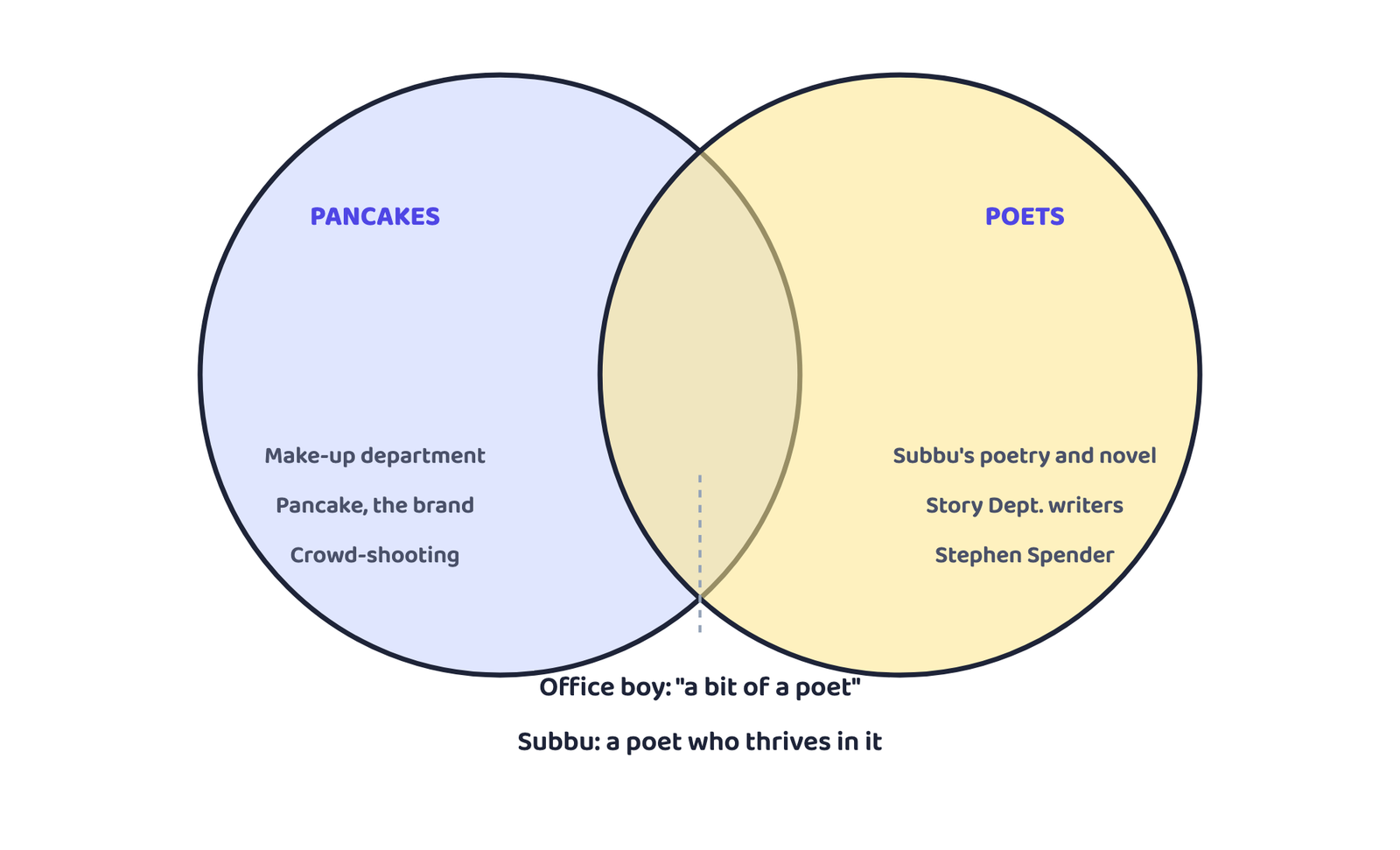
The book never explains its title. One way to read it: “Pancakes” stands for the glamorous, surface-level world of Gemini Studios: make-up, hierarchy, crowd-shooting, manufacturing a screen illusion. “Poets” stands for a different world brushing against it without ever truly belonging: the office boy, who was “a bit of a poet” but had hoped to be a star actor or screenwriter, Subbu who actually was one, the Story Department’s writers, and finally a real English poet who leaves as an “unexplained mystery.” The comic and thoughtful effect comes from these two worlds colliding without really understanding each other.
13 Character Sketches
Kothamangalam Subbu
Gemini’s real “No. 2,” generous and loyal; has enemies despite his charity, for reasons even the author cannot pin down.
The Office Boy (unnamed)
A middle-aged man nursing a young man’s ambitions; his frustration targets Subbu. The book mixes gentle teasing (“praying for crowd-shooting all the time”) with sympathy (“a bit of a poet”).
The Lawyer (unnamed)
The Story Department’s odd one out, dressed and thought differently; his one recorded act of cleverness destroys the actress’s career by accident.
S.S. Vasan (“The Boss”)
Founder of Gemini Studios, also editor of Ananda Vikatan; hosts MRA and the mystery visitor generously; at the reception “he too knew precious little about the poet”.
Stephen Spender
A real English poet and editor of The Encounter; baffles Gemini Studios, later revealed as a disillusioned former Communist.
14 Literary Devices and the Author’s Own Technique
Gentle humour: pokes fun at ordinary human foibles without cruelty. Example: calling a mixed-region make-up team “national integration” “long before A.I.R. and Doordarshan began broadcasting programmes on national integration.”
Irony: saying one thing while quietly meaning, or revealing, another. Example: “born a Brahmin — a virtue, indeed! —”: the exclamation suggests the author does not count birth as a real virtue.
Chatty, rambling style: the book’s own term for a narrative where one thought leads to the next and is “dwelt upon at length”: the make-up department leads to the office boy, who leads to Subbu, who leads to the Story Department, and so on.
The same humour also works as light satire (poking fun at real institutions and people, some of them named) and understatement: calling a career-ending recording incident merely something the lawyer “unwittingly” caused, or a failed production “not much came of the film,” lets the facts carry the irony.
Understanding the text Q1 (“Pick out instances of this to show how this serves to make the piece interesting”) and Q4 (“What do you understand about the author’s literary inclinations from the account?”) are two questions worth practising. For Q4, use the digression on prose-writing as the work of a “persevering drudge” and his instant, emotional recognition of Spender’s name as evidence of how seriously he took literature despite his modest day job.
15 Key Facts Table
| Fact | Detail |
|---|---|
| Author | Asokamitran (1931-2017), Tamil writer |
| Source book | My Years with Boss (this chapter is an excerpt) |
| Gemini Studios founded | 1940, Chennai, by S.S. Vasan |
| Subbu’s novel | Thillana Mohanambal |
| MRA’s visit | 1952, about 200 people; plays: Jotham Valley, The Forgotten Factor |
| Mystery visitor’s real identity | Stephen Spender, editor of The Encounter |
| Book that reveals it | The God That Failed (essays by 6 ex-Communist writers) |
16 Quick Self-Check
- Can I name four of Subbu’s abilities with one line of proof for each?
- Can I explain the switched-on-recorder episode and its consequence?
- Can I explain who Stephen Spender turns out to be, and how the author discovers it, in the correct order?
- Can I give a reading of the title “Poets and Pancakes” in my own words?
- Can I quote at least one example each of the author’s gentle humour and irony?
- Asokamitran’s own memory of Gemini Studios (excerpt from My Years with Boss)
- The make-up department (pancake) and its “office boy”, who had hoped to be a star actor or screenwriter and is “a bit of a poet”, open the chapter
- Kothamangalam Subbu, poet-novelist-actor and the No. 2 at Gemini, is blamed by the office boy for his woes
- The Story Department’s lawyer accidentally ends an actress’s career with a recording
- MRA visits Madras in 1952 with plays whose messages were “plain and simple homilies”; Gemini hosts them warmly; the author learns some years later that MRA was a counter-movement to international Communism
- An unnamed English “poet” baffles the studio; later recognised as Stephen Spender, editor of The Encounter
- A footpath copy of The God That Failed reveals Spender was once a Communist, so the reaction to him at Gemini Studios is “no longer a mystery” (earlier, the staff were told The Boss welcomed him because “He is an editor”)
- Title (one reading): “Pancakes” is the glamorous film world; “Poets” is the literary world brushing against it