
- Key passages from both accounts, with quotations: Zitkala-Sa’s “The Cutting of My Long Hair” and Bama’s “We Too are Human Beings”
- Why the book prints these two very different stories side by side, and what they genuinely share
- What makes each account an autobiography, told in the author’s own remembered voice
- What Zitkala-Sa faces at the school and how untouchability works in Bama’s account
- Why the cutting of Zitkala-Sa’s hair matters so much to her, in her own people’s terms
- The key difficult words, explained in place and in Words to Know
- How to answer an extract-based question from this chapter, with a worked example
1Meet the Authors and Their Worlds
The book’s own introduction describes what the unit presents: “This unit presents autobiographical episodes from the lives of two women from marginalised communities who look back on their childhood, and reflect on their relationship with the mainstream culture. The first account is by an American Indian woman born in the late nineteenth century; the second is by a contemporary Tamil Dalit writer.”
An autobiography is an account of a person’s own life, written by that person. Both pieces in this chapter are autobiographical: Zitkala-Sa and Bama each describe real events from their own childhood, in their own remembered voice.
1.1 About Zitkala-Sa
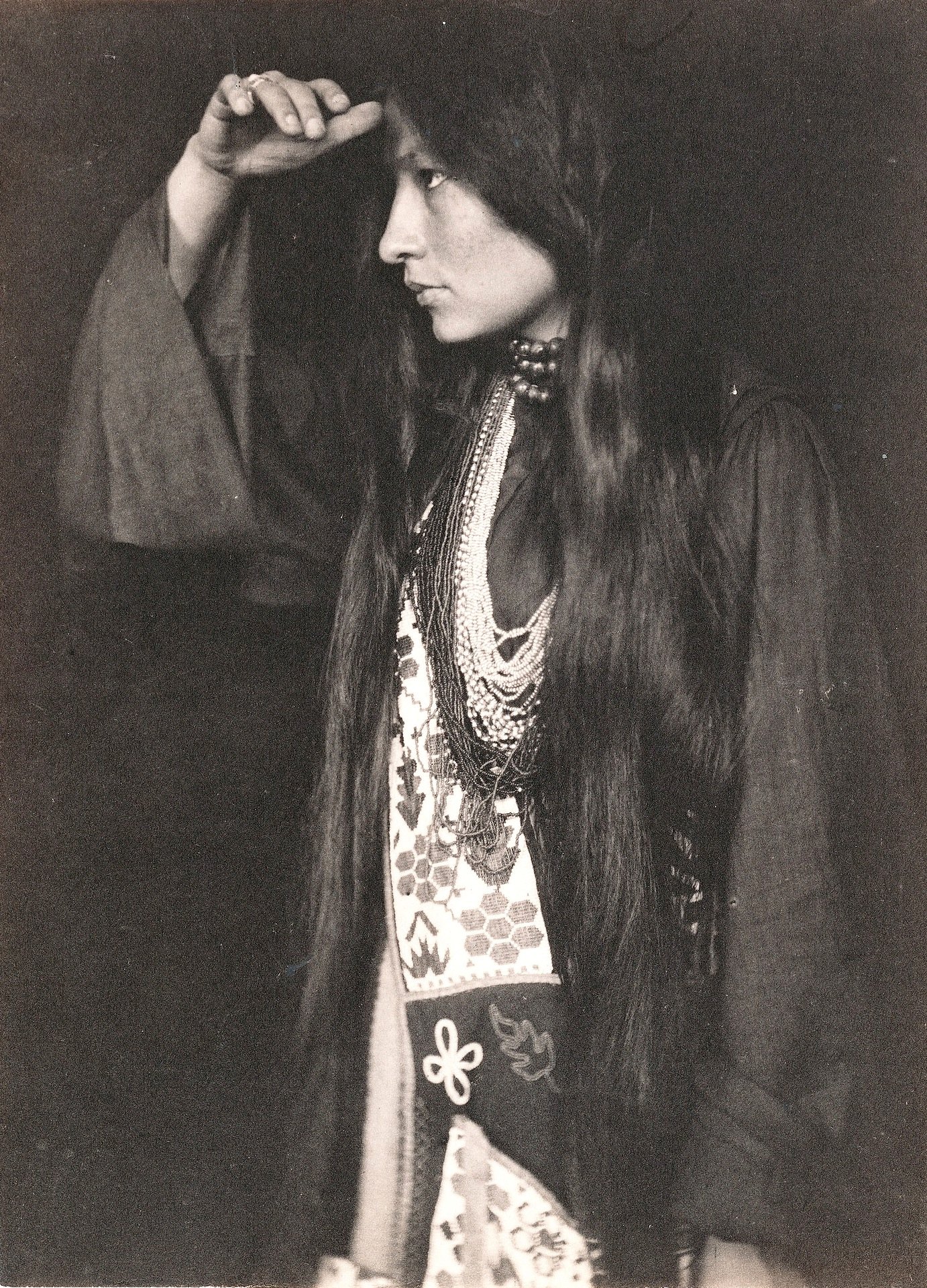
Zitkala-Sa is the pen name of Gertrude Simmons Bonnin, born in 1876. The book describes her as “an extraordinarily talented and educated Native American woman who struggled and triumphed in a time when severe prejudice prevailed towards Native American culture and women.” Writing as Zitkala-Sa, she began publishing articles in 1900 that criticised the Carlisle Indian school, and, in the book’s words, “Her works criticised dogma, and her life as a Native American woman was dedicated against the evils of oppression.”
Always write the author’s name exactly as the book gives it: Zitkala-Sa. It is the pen name adopted by Gertrude Simmons Bonnin (born 1876), so connect the two names when you write about her.
1.2 About Bama
Bama is the pen name of a Tamil Dalit woman from a Roman Catholic family. She has published three main works: the autobiography Karukku (1992), the novel Sangati (1994), and a collection of short stories, Kisumbukkaaran (1996). The chapter’s second account is an excerpt from Karukku.
The book explains the title itself: “‘Karukku’ means ‘Palmyra’ leaves, which with their serrated edges on both sides, are like double-edged swords. By a felicitous pun, the Tamil word ‘Karukku’, containing the word ‘karu’, embryo or seed, also means freshness, newness.” So the single title carries both a sharp, wounding image and a hopeful one of new life.
1.3 Why These Two Accounts Sit Together
Zitkala-Sa’s world is a school where her blanket is stripped from her shoulders, her moccasins are exchanged for shoes, and her braid is cut; Bama’s world is her own street and bazaar, shaped by the invisible rules of caste. The two settings could not look more different, yet the book places them side by side on purpose: both writers are children from a marginalised community, looking back as adults on the moments when they came to recognise the power of a mainstream culture that treated them as lesser.
A marginalised community is a group pushed to the edges of a society’s power and respect, treated as less important than the group that holds most of that power, the mainstream culture. Zitkala-Sa’s Native American community is marginalised against the culture of the school run by the “paleface” women; Bama’s Dalit community is marginalised against the upper-caste social order of her village.
Assimilation (cultural assimilation) is forcing a minority culture to give up its own customs, language and appearance and adopt the dominant culture’s ways instead. The book does not use this word. One reading of Zitkala-Sa’s account fits it: the school strips her of her own people’s dress and, by force, her hair.
2Account I: “The Cutting of My Long Hair” (Zitkala-Sa)
This account covers Zitkala-Sa’s very first day at the school, in “the land of apples”. (The book’s note says that from 1900 she published articles criticising the Carlisle Indian school; the account itself does not name its school.) Here is the shape of the whole account before the details.
2.1 A Bitter-Cold First Day
The first day at “the land of apples” is “bitter-cold”, with snow still covering the ground and the trees bare. A breakfast bell rings, “its loud metallic voice crashing through the belfry overhead”, and Zitkala-Sa is surrounded by the “annoying clatter of shoes on bare floors” and “an undercurrent of many voices murmuring an unknown tongue”. She calls it a “bedlam” within which she was “securely tied”, her spirit tearing itself struggling “for its lost freedom” even though the struggle is useless.
Students often summarise this opening as “she found the school confusing.” The text is more specific than that: every single detail (the bell, the shoes, the strange language) is a small, real assault on a child who cannot understand any of it. Quote at least one exact phrase, such as “an undercurrent of many voices murmuring an unknown tongue”, to show you have read the text closely.
A “paleface woman” with white hair leads the new arrivals in to breakfast. The Indian girls already at the school wear “stiff shoes and closely clinging dresses”; the small girls have “sleeved aprons and shingled hair”. Zitkala-Sa, still in her soft moccasins with her blanket stripped from her shoulders, feels like “sinking to the floor”. Boys enter through an opposite door, and she watches for “the three young braves” from her own travelling party, spotting them looking “as uncomfortable as I felt”.
2.2 “Eating by Formula”
The dining hall runs on a system of bells that nobody has explained to her. A small bell is tapped, and each pupil draws out a chair; Zitkala-Sa, not understanding the signal, sits down at once while everyone else remains standing. A second bell finally seats everyone properly, and she has to “crawl back into my chair again”. A third bell starts the meal itself, and every pupil picks up a knife and fork together. Overwhelmed, she “began crying instead”, by now “afraid to venture anything more”.
Zitkala-Sa’s phrase for this is her own: “eating by formula”. Use it if you are asked what the dining-hall scene shows: a rigid, unexplained ritual imposed on children who have no idea what is expected of them.
2.3 Judewin’s Warning
Later that morning, her friend Judewin, who knew a few words of English, gives her “a terrible warning”: she had overheard a paleface woman talking about cutting their long, heavy hair. The book then explains exactly why this matters to Zitkala-Sa’s people, in its own words: “Our mothers had taught us that only unskilled warriors who were captured had their hair shingled by the enemy. Among our people, short hair was worn by mourners, and shingled hair by cowards!”
Symbolism is when an object or act stands for something larger than itself. The book does not use this word. Among her own people, shingled hair marked a captured, unskilled warrior or a coward, and short hair marked a mourner. One reading: losing her hair by force stands for the loss of her dignity as her own culture understands it. The account links the cut to her sense of loss: “Then I lost my spirit” … “And now my long hair was shingled like a coward’s!”
Faced with the warning, the two girls react in opposite ways:
Judewin: “We have to submit, because they are strong.”
Zitkala-Sa: “No, I will not submit! I will struggle first!”
The two responses to the same warning, side by side
2.4 Hiding, and Being Found
Watching for her chance, Zitkala-Sa slips away unnoticed. She creeps up the stairs in her squeaking shoes, finds an open door leading to a large, dim room with three white beds and dark-green curtains, and crawls under a bed toward “the corner farthest from the door”, huddling in “the dark corner”. From her hiding place she hears her name called through the hall, and knows even Judewin is searching for her, but stays silent. Women and girls enter the room, search the closets and behind the trunks, then throw open the curtains, flooding the room with sudden light.
She is discovered and dragged out, “kicking and scratching wildly” despite the useless resistance, carried downstairs, and “tied fast in a chair”.
2.5 The Cut, and Its Aftermath
The account’s central moment is told in a single, exact line: she cried aloud, shaking her head, “until I felt the cold blades of the scissors against my neck, and heard them gnaw off one of my thick braids. Then I lost my spirit.” She sums up everything that has happened to her since arriving: “Since the day I was taken from my mother I had suffered extreme indignities. People had stared at me. I had been tossed about in the air like a wooden puppet. And now my long hair was shingled like a coward’s!”
3Account II: “We Too are Human Beings” (Bama)
This account is an excerpt from Bama’s autobiography Karukku. It happens in the open, ordinary world of her own street, and the discrimination in it involves no physical violence at all, only enforced distance.
3.1 A Slow Walk Full of Wonders
Bama opens by saying that in the third class she “hadn’t yet heard people speak openly of untouchability”, but had “already seen, felt, experienced and been humiliated by what it is”. Her walk home from school could take ten minutes, but usually took thirty minutes to an hour, because of everything worth stopping for along the way.
Do not summarise this long passage as “she was easily distracted.” The book gives a long, lively list of street life (a performing monkey, a snake-charmer, a cyclist doing a stunt, temple bells, seasonal snacks) before the incident; the contrast with what follows is clear, but the book does not state why it is there.
Among the sights she names: the performing monkey; the snake-charmer’s snake; a cyclist who “had not got off his bike for three days”, rupee notes pinned to his shirt to spur him on; spinning wheels; the Maariyaata temple and its huge bell, with pongal offerings cooking outside it; a dried-fish stall by a statue of Gandhi; sweet and fried-snack stalls; a street light that kept “demonstrating how it could change from blue to violet”; a narikkuravan hunter-gypsy selling needles, clay beads and ear-cleaning instruments, with a wild lemur in cages; political speeches through mikes; street plays, puppet shows and “no magic, no miracle” stunt performances; the coffee clubs, where waiters theatrically poured coffee from one tumbler held high to another; people chopping onions with their eyes turned away; an almond tree; and, depending on the season, mango, cucumber, sugar-cane, sweet-potato, palm-shoots, gram, palm-syrup, palm-fruit, guavas, jack-fruit, payasam, halva, boiled tamarind seeds and iced lollies.
3.2 The Elder and the Packet
Coming to her own street one day, Bama stops to watch a threshing floor: the landlord seated on a piece of sacking spread over a stone ledge, watching her own people drive muzzled cattle round and round to tread the grain out of the straw. Just then an elder of her street comes along from the bazaar, carrying a small packet by its string, without touching it directly. His odd way of walking almost makes her laugh; she guesses the oil-stained packet holds vadai or banana bhajji.
The elder goes straight to the landlord, bows low, and extends the packet, cupping the hand that holds the string with his other hand. The landlord opens the parcel and begins to eat the vadais.
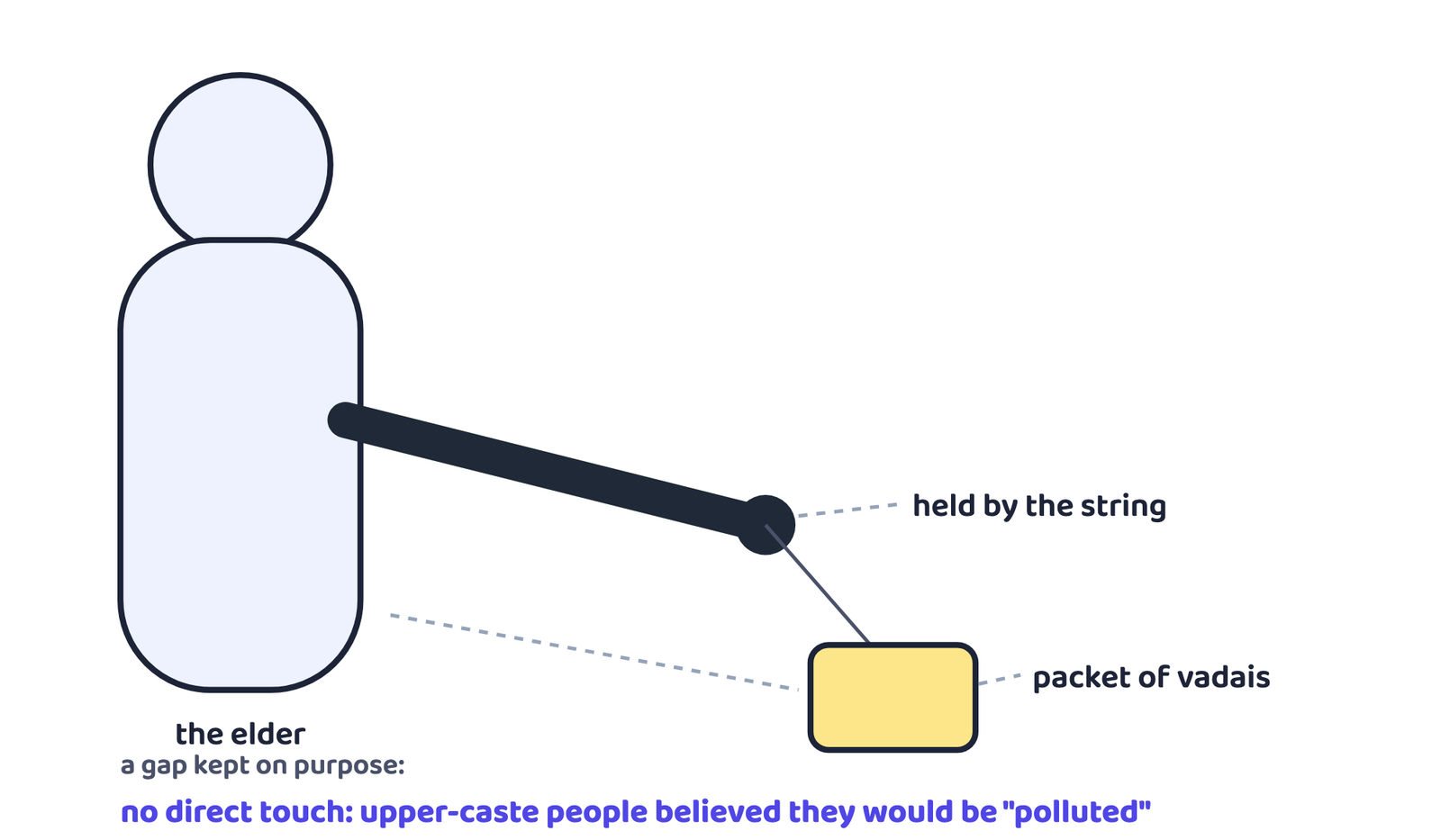
Untouchability is the caste-based practice of treating certain people as untouchable, so that even their touch, or the touch of anything they have touched, is believed to leave an upper-caste person “polluted” (the book’s word). Here it forces the elder to carry food by its string rather than in his hands, purely because of the caste he was born into.
3.3 Annan’s Explanation, and Bama’s Anger
At home, Bama tells her elder brother, Annan, the story “in all its comic detail” and laughs about it; Annan is “not amused”. He explains the real reason: “everybody believed that they were upper caste and therefore must not touch us. If they did, they would be polluted. That’s why he had to carry the package by its string.”
In the caste system this account describes, the belief is that an upper-caste person becomes ritually polluted by direct contact with a lower-caste person. Annan’s explanation is that “everybody believed that they were upper caste and therefore must not touch us. If they did, they would be polluted.” Bama’s own question shows the belief is unreasonable: “How could they believe that it was disgusting if one of us held that package in his hands, even though the vadai had been wrapped first in a banana leaf, and then parcelled in paper?”
Bama had first found the elder’s walk funny (“I wanted to shriek with laughter”). Hearing Annan, she stops wanting to laugh and feels “terribly sad”, then angry enough that she wants to touch the vadais herself. Her own words carry the account’s title and its argument in one line: “Why should we have to fetch and carry for these people, I wondered… But we too are human beings. Our people should never run these petty errands for these fellows. We should work in their fields, take home our wages, and leave it at that.”
3.4 A Second Episode, and Annan’s Advice
Annan, a university student home for the holidays, often goes to the library in a neighbouring village to borrow books; one day, walking home along the banks of the irrigation tank, he is stopped by one of the landlord’s men, who asks his name, then which street he lives on, “the point of this was that if he knew on which street we lived, he would know our caste too”.
Annan turns the whole experience into advice for his sister: “Because we are born into this community, we are never given any honour or dignity or respect; we are stripped of all that. But if we study and make progress, we can throw away these indignities. So study with care, learn all you can. If you are always ahead in your lessons, people will come to you of their own accord and attach themselves to you. Work hard and learn.”
If asked how Bama responds to discrimination, the account gives you a clear, specific answer: she studies “with all my breath and being, in a frenzy almost”, stands first in her class, and gains friends because of it. This is a constructive response through education, not open confrontation, and the book’s own words, “with all my breath and being, in a frenzy almost”, give you that detail.
4Characters at a Glance
Zitkala-Sa
The narrator of Account I, a Native American child on her first day at the school. She resists physically before the hair-cutting and calls the experience the loss of her spirit.
Judewin
Zitkala-Sa’s friend at the school, who knows a little English and overhears the plan to cut their hair. She chooses to submit rather than resist, saying “they are strong”.
Bama
The narrator of Account II, a Dalit schoolgirl who has already seen, felt and been humiliated by untouchability; she first laughs at the elder’s walk, is given its reason by her brother Annan, and later turns her anger into a determination to study hard.
Annan
Bama’s elder brother, a university student. He explains untouchability and pollution to her, is himself questioned about his caste on the banks of the irrigation tank, and advises Bama that education is how they can “throw away these indignities”.
Minor but important figures: the unnamed paleface woman who leads the new pupils at Zitkala-Sa’s school; the landlord in Bama’s account, who watches the threshing floor and eats the vadais the elder brings him; the unnamed elder of the street who must carry the packet by its string; and the landlord’s man who stops Annan by the irrigation tank and asks which street he lives on, to learn his caste.
The book asks: “It may take a long time for oppression to be resisted, but the seeds of rebellion are sowed early in life. Do you agree that injustice in any form cannot escape being noticed even by children?” Zitkala-Sa resists at once: “No, I will not submit! I will struggle first!” Bama, in third class, “hadn’t yet heard people speak openly of untouchability”, but had “already seen, felt, experienced and been humiliated by what it is.” In the vadai episode she first finds the elder’s walk funny; only after Annan’s explanation does she feel “terribly sad” and then “so provoked and angry”. Both children feel the wrong, and both responses grow later: Bama studies “with all my breath and being”.
Read the accounts side by side, not as two separate stories, because the book’s Reading with Insight questions 1 and 3 ask you to compare them directly.
Discrimination is unfair, unequal treatment of a person or group because of their identity rather than anything they have done. It is the umbrella term for both accounts: Zitkala-Sa is discriminated against for her Native American culture, Bama for her caste.
| Point of comparison | Zitkala-Sa’s account | Bama’s account |
|---|---|---|
| Kind of discrimination | Her own people’s dress and hair taken by force at the school | Caste-based untouchability |
| Where it happens | Inside the school | In the open, everyday life of her street and the bazaar |
| Nature of the act | Direct physical force: dragged out, tied to a chair, hair cut against her will | No physical contact at all: the cruelty lies entirely in enforced distance |
| What is violated | A specific custom of her own people (shingled hair marked cowards; short hair, mourners) | A person’s dignity, through the belief that touch would leave upper-caste people “polluted” |
| Response in the moment | Immediate, physical resistance: “I will struggle first!”, followed by kicking and scratching | No open resistance in the moment; the elder complies quietly, and Bama’s own anger surfaces only afterwards |
| Longer-term response | None shown in this extract; the account ends inside the trauma itself | Constructive and delayed: Bama studies hard “as Annan had urged”, and stands first in her class |
Narrative perspective is the position from which a story is told. Both accounts use a first-person, retrospective perspective: an adult writer looking back and narrating events from her own childhood, which is exactly what makes both pieces autobiographies rather than someone else’s biography.
6Words to Know
| Word / Phrase | Meaning as used in the chapter |
|---|---|
| bedlam | a scene of uproar and confusion |
| indignities | humiliating treatment that hurts one’s dignity |
| moccasins | soft leather shoes traditionally worn by Native Americans |
| shingled (hair) | cut very short, close to the head |
| braves | young Native American men (as used of the boys in Zitkala-Sa’s travelling party) |
| paleface | a Native American term for a white person |
| untouchability | the caste-based practice of avoiding physical contact with certain people, in the belief that touching them would leave one “polluted” |
| polluted (caste sense) | the book’s word: upper-caste people believed they would be “polluted” if they touched the elder’s community |
| harangue | to lecture or speak at length, often forcefully, to a crowd |
| vadai / bhajji | fried Indian snacks (a savoury doughnut-shaped snack and a fritter) |
| pongal | a South Indian dish of rice, often offered at temples |
| narikkuravan | a member of a traditional hunter-gypsy community |
| threshing floor | a levelled area where grain is separated from straw, traditionally by driving cattle over it |
7Why “Memories of Childhood”?
Both accounts are exactly this: real memories, held onto into adulthood, of the moments each writer came face to face with the unequal power of a “mainstream culture” over her own community. One reading: the title is plain and personal because both accounts insist that this is not abstract history: it happened, in each writer’s own remembered childhood, in specific, concrete moments.
8Answering Extract-Based Questions
Extract-based questions can be set from either account. The method below works for an extract from either.
Extract: “Then I lost my spirit. Since the day I was taken from my mother I had suffered extreme indignities… And now my long hair was shingled like a coward’s!”
Q. What does the phrase “I lost my spirit” reveal about the effect of the hair-cutting on Zitkala-Sa?
Step 1: Notice that “spirit” here does not mean physical strength; it means her will to resist, which she had shown just before this moment by fighting back.
Step 2: Connect it to the cultural meaning of hair given earlier in the account: among her people, shingled hair marked cowards, so losing her hair by force feels to her like being made into exactly that.
Answer: The phrase shows that the forced hair-cutting broke Zitkala-Sa’s will to resist, not just her physical appearance; because her own culture linked shingled hair to cowardice, the act attacked her identity and dignity as much as her body.
Quote the exact phrase from the extract, because the precise words make your answer specific.
- Zitkala-Sa’s account: her first bitter-cold day at the school, the confusing “eating by formula” ritual, Judewin’s warning about hair-cutting, and the cultural meaning of hair among her people (short hair = mourners; shingled hair = cowards, and captured unskilled warriors)
- Zitkala-Sa resists physically (“I will struggle first!”), hides under a bed, is found and dragged out, and is tied to a chair while one braid is cut by force; the account ends without resolution, inside the trauma itself
- Bama’s account: a joyful, detailed walk home from school, then the threshing-floor scene where an elder must carry food by its string, without touching it, because upper-caste people believed touch would leave them “polluted”
- Bama, who had already been humiliated by untouchability, first laughs at the elder; Annan explains the reason; she feels sad then angry, insisting “we too are human beings”
- A second episode shows Annan questioned about his street (and so his caste); his advice is that education, not confrontation, is the way to “throw away these indignities”, and Bama studies hard and succeeds because of it
- Shared theme: both are autobiographies of a marginalised community’s childhood encounter with a mainstream culture, and both show some form of resistance
- Key difference: Zitkala-Sa faces direct physical force and resists immediately; Bama faces enforced non-contact and resists later, through education
- Key terms: autobiography, untouchability, discrimination, marginalised community/mainstream culture, narrative perspective, “polluted” (assimilation and symbolism are general terms the book does not use)
- Reading with Insight Q2: children notice injustice early: Zitkala-Sa resists at once; Bama had “already seen, felt, experienced and been humiliated”
- Can I narrate Zitkala-Sa’s first day at the school, in order, using at least two exact quotations?
- Can I explain the cultural meaning of hair among Zitkala-Sa’s people, and why the cutting is more than a haircut?
- Can I explain what happens in the threshing-floor scene, and what Annan means when he says they “would be polluted”?
- Can I quote Bama’s own words, “But we too are human beings”, and explain what provoked them?
- Can I state the commonality of theme between the two accounts, in the book’s own terms (marginalised community, mainstream culture)?
- Can I explain at least three real differences between the two accounts, not just that “both faced discrimination”?
- Can I explain Zitkala-Sa’s response and Bama’s response to their situations, and say clearly how the two responses differ?
- Can I use the words “autobiography,” “untouchability,” “discrimination” and “mainstream culture” correctly about this chapter?