
- How Christopher Silvester’s essay (Part I) sets out both the case for and the case against the interview as a form of journalism
- Every named writer’s view on being interviewed, with the exact quote each one is remembered for
- The full Umberto Eco interview (Part II): his ideas on interstices, why he began writing novels late, and his own verdict on the success of The Name of the Rose: “a mystery”
- The difference between a linker and a signaller, with the book’s own worked examples
- The theme and sub-theme of the chapter, in words you can use directly in an answer
The current NCERT Flamingo textbook prints this chapter in two parts: Part I, Christopher Silvester’s essay on the interview as a genre, and Part II, the interview with Umberto Eco. These notes cover both parts in full.
1 About the Editor and the Interviewee
The chapter is an extract “From the Introduction to The Penguin Book of Interviews”, edited by Christopher Silvester (b. 1959), a student of history at Peterhouse, Cambridge, who worked as a reporter for Private Eye for ten years and has written features for Vanity Fair. His book’s full title is The Penguin Book of Interviews, An Anthology from 1859 to the Present Day.
Part II is an edited extract from a real interview with Umberto Eco, a professor at the University of Bologna in Italy, conducted by Mukund Padmanabhan of The Hindu. Before turning to fiction, Eco had “already acquired a formidable reputation as a scholar” for his work on semiotics, literary interpretation and medieval aesthetics. In 1980 he “acquired the equivalent of intellectual superstardom” with The Name of the Rose, which “sold more than 10 million copies.”

Semiotics, as the book itself glosses it: “the study of signs.” It is the academic field Umberto Eco was a recognised scholar in before he became famous as a novelist.
2 The Chapter at a Glance
Before the detailed summary, see the whole chapter as one sequence.
3 Detailed Summary, Part I: The Interview as a Genre
3.1 A Modern, Widespread, and Debated Form
The interview, Silvester writes, was invented “a little over 130 years ago” and has “become a commonplace of journalism”: almost every literate person has read one, and several thousand celebrities have been interviewed, some of them repeatedly. Because of this, opinions about the interview’s functions, methods and merits “vary considerably.”
3.2 The Case For: A Source of Truth and an Art
Some observers make “quite extravagant claims” for the interview: in its highest form, they call it a source of truth, and in its practice, an art.
3.3 The Case Against: Intrusion and the Fear of Being Diminished
Others, usually celebrities who see themselves as the interview’s “victims,” “might despise the interview as an unwarranted intrusion into their lives, or feel that it somehow diminishes them”. The book draws a comparison: just as in some primitive cultures it is believed that taking a photographic portrait of somebody is “stealing that person’s soul”, so celebrities may feel the interview diminishes them.
Answer “what is the belief in some primitive cultures about being photographed” in the book’s own words: if one takes a photographic portrait of somebody, one “is stealing that person’s soul.” The interview is only compared to this belief, not claimed to be identical.
3.4 Five Named Writers and Their Views
The essay names five real writers; the table gives what each one says, as Silvester quotes it.
| Writer | Their view, in the book’s own words | Extra detail from the book’s footnotes |
|---|---|---|
| V. S. Naipaul | “Feels that some people are wounded by interviews and lose a part of themselves” | Cosmopolitan writer who writes about India, his ancestral country; won the Nobel Prize in Literature in 2001 |
| Lewis Carroll | Had “a just horror of the interviewer” and never consented to being interviewed; enjoyed repelling interviewers and autograph-seekers “with much satisfaction and amusement” | Creator of Alice in Wonderland |
| Rudyard Kipling | Told two reporters interviewing is “immoral… a crime… cowardly and vile. No respectable man would ask it, much less give it.” | His wife Caroline recorded this in her diary, 14 October 1892; wrote The Jungle Book; had himself interviewed Mark Twain a few years earlier |
| H. G. Wells | Called it “the interviewing ordeal” in 1894, yet was a frequent interviewee himself | Wrote The Time Machine, The Invisible Man, The War of the Worlds; forty years later, interviewed Joseph Stalin |
| Saul Bellow | Described interviews as being “like thumbprints on his windpipe,” despite consenting to several | Playwright and novelist, characters Augie March and Moses; won the Nobel Prize for Literature in 1976 |
Writers who object most openly
- Lewis Carroll
- Rudyard Kipling
- Saul Bellow
- (Naipaul and Wells also voice discomfort.)
The irony the book points out
- Kipling himself had interviewed Mark Twain “only a few years before” condemning it
- Wells called it an ordeal yet later interviewed Stalin himself
- Bellow “consented… on several occasions” despite disliking it
“Why do most celebrity writers despise being interviewed?” Use the book’s own reasons: they see themselves as its victims, and might see it as an unwarranted intrusion or feel it diminishes them.
3.5 The Conclusion: A Serviceable Medium, and the Interviewer’s Power
Despite every drawback listed above, the essay’s own conclusion is that the interview “is a supremely serviceable medium of communication.” Silvester gives the final word to Denis Brian, whose written words he quotes.
“These days, more than at any other time, our most vivid impressions of our contemporaries are through interviews… Almost everything of moment reaches us through one man asking questions of another. Because of this, the interviewer holds a position of unprecedented power and influence.”
Denis Brian, quoted by Christopher Silvester
3.6 The Margin Comprehension Box (Part I)
The book prints five short questions in the margin beside Part I, numbered as the textbook does (1, 2, 3, 6, 5).
- 1. Positive views: a source of truth, and an art (§3.2)
- 2. Celebrity writers see themselves as its victims; they might despise it as an unwarranted intrusion, or feel it diminishes them (§3.3)
- 3. In some primitive cultures, it is believed a photograph steals the person’s soul (§3.3)
- 6. “Thumbprints on his windpipe”: Saul Bellow’s own description of how an interview feels to him (§3.4)
- 5. The interviewer, according to Denis Brian’s view given at the end of Part I (§3.5)
4 Detailed Summary, Part II: The Umberto Eco Interview
4.1 “I Am Always Doing the Same Thing”
The interview opens with English novelist and academic David Lodge’s remark: “I can’t understand how one man can do all the things he [Eco] does.” Eco’s reply is the key to the whole interview: he is convinced he is “always doing the same thing,” pursuing one set of philosophical and ethical interests through his academic work, his novels, and even his children’s books, which are “about non-violence and peace.”
4.2 Interstices: How Eco Finds the Time
Eco then volunteers an explanation: “And then I have a secret.” It is his idea of interstices. If you eliminated all the empty spaces from the universe, even the empty spaces inside atoms, he says, “the universe will become as big as my fist.” In the same way, he says, “we have a lot of empty spaces in our lives.” He calls these interstices, and he works in them. His example: while waiting for a visitor’s lift to come up from the first floor to the third, “I have already written an article!”
Interstices, in Eco’s own words: “empty spaces” in our lives, such as the time he spends waiting for a visitor’s elevator to come up. “I work in empty spaces,” he says.
“How does Eco find the time to write so much?” Name interstices and give his own elevator example: “I have already written an article!”
4.3 A Playful, Personal Writing Style
Eco’s non-fiction, as Mukund puts it, has “a certain playful and personal quality”, unlike the regular academic style, “invariably depersonalised and often dry and boring.” He explains why through his doctoral dissertation. One of the professors told him that scholars “make a lot of false hypotheses, then they correct them and at the end, they put the conclusions”, and then: “You, on the contrary, told the story of your research. Even including your trials and errors.” The professor still recognised he was right and published it as a book.
At the age of 22, Eco says, this taught him that scholarly books should be written by “telling the story of the research,” which is why his essays “always have a narrative aspect.” He says this is probably why he began writing novels only “at the age of 50, more or less.”
4.4 Roland Barthes, and Why Eco Began Writing Novels by Accident
Eco contrasts himself with his friend Roland Barthes, who “was always frustrated that he was an essayist and not a novelist,” wanted to write fiction, but “died before he could do so.” Eco says he never felt that frustration himself: he “started writing novels by accident,” having “nothing to do one day,” and novels, he says, “probably satisfied my taste for narration.”
“Did Umberto Eco consider himself a novelist first or an academic scholar?” He calls himself “a university professor who writes novels on Sundays,” identifying with the academic community, not writers’ clubs.
4.5 Over 40 Scholarly Works, and Being Called “the Novelist”
By the time of the interview, Eco has written five novels against “over 40” scholarly works, yet, as Mukund puts it, ask most people about Umberto Eco “and they will say, ‘Oh, he’s the novelist.'” Eco admits this does bother him. He participates in academic conferences, not “meetings of Pen Clubs and writers,” but accepts that novels let him “reach a larger audience”: he “cannot expect to have one million readers with stuff on semiotics.”
4.6 The Name of the Rose: A Difficult Novel, and an Unexpected Success
The Name of the Rose is, in Mukund Padmanabhan’s words, “a very serious novel,” a detective story that also explores metaphysics, theology and medieval history, yet it found a huge mass audience. Asked if this puzzled him, Eco’s reply is quoted below. Of six billion people on the planet, he points out, the novel sold “between 10 and 15 million copies,” a small percentage of readers, but exactly the kind who do not always want easy reading. He adds, disarmingly, that he himself watches “Miami Vice” or “Emergency Room” on television after dinner and enjoys it, “but not all day.”
“No. Journalists are puzzled. And sometimes publishers. And this is because journalists and publishers believe that people like trash and don’t like difficult reading experiences.”
Umberto Eco, on why the novel’s mass success did not puzzle him
4.7 Even the Publisher Was Wrong: the American Sales Story
Eco’s American publisher loved the book but expected to sell no more than 3,000 copies “in a country where nobody has seen a cathedral or studies Latin,” and gave him an advance based on that figure. Instead, the novel sold “two or three million” copies in the United States. Asked whether the success had to do with its medieval setting, Eco says, “That’s possible,” but notes that “A lot of books have been written about the medieval past far before mine.” Eco’s own conclusion is that the book’s success is simply “a mystery. Nobody can predict it,” adding that if he had written it ten years earlier or ten years later, “it wouldn’t have been the same. Why it worked at that time is a mystery.”
“What is the reason for the huge success of The Name of the Rose?” Eco himself calls it “a mystery”: “Nobody can predict it.” He grants the medieval setting is “possible” as a reason. Do not invent a reason the book does not give.
5 Linkers and Signallers (Language Focus)
5.1 Two Tools That Hold a Conversation Together
The book teaches two separate tools that hold a conversation together, using real lines from the Eco interview.
Linker, as the book explains it: a word or device that links the utterances of the interviewer and the interviewee to one another, done either through reference pronouns such as that, this, which, or through a repetition of words.
Signaller, as the book explains it: a phrase that prepares the listener for a shift to a new topic.
5.2 The Book’s Own Examples, Side by Side
Linkers (book’s own examples)
- “Which is?” / “…that is more difficult to explain” (reference pronoun)
- “Not everyone can do that of course.” (reference pronoun)
- “…novels” → “Talking about novels,” (repetition)
- “…more than 20 of them” → “Over 40.” (repetition)
- “…one million readers” → “Which brings me to my next question.” (reference pronoun)
- “Were you puzzled at all by this?” → “No. Journalists are puzzled.” (repetition)
Signallers (book’s own examples)
- “Which brings me to another question…”
- “But let me tell you another story…”
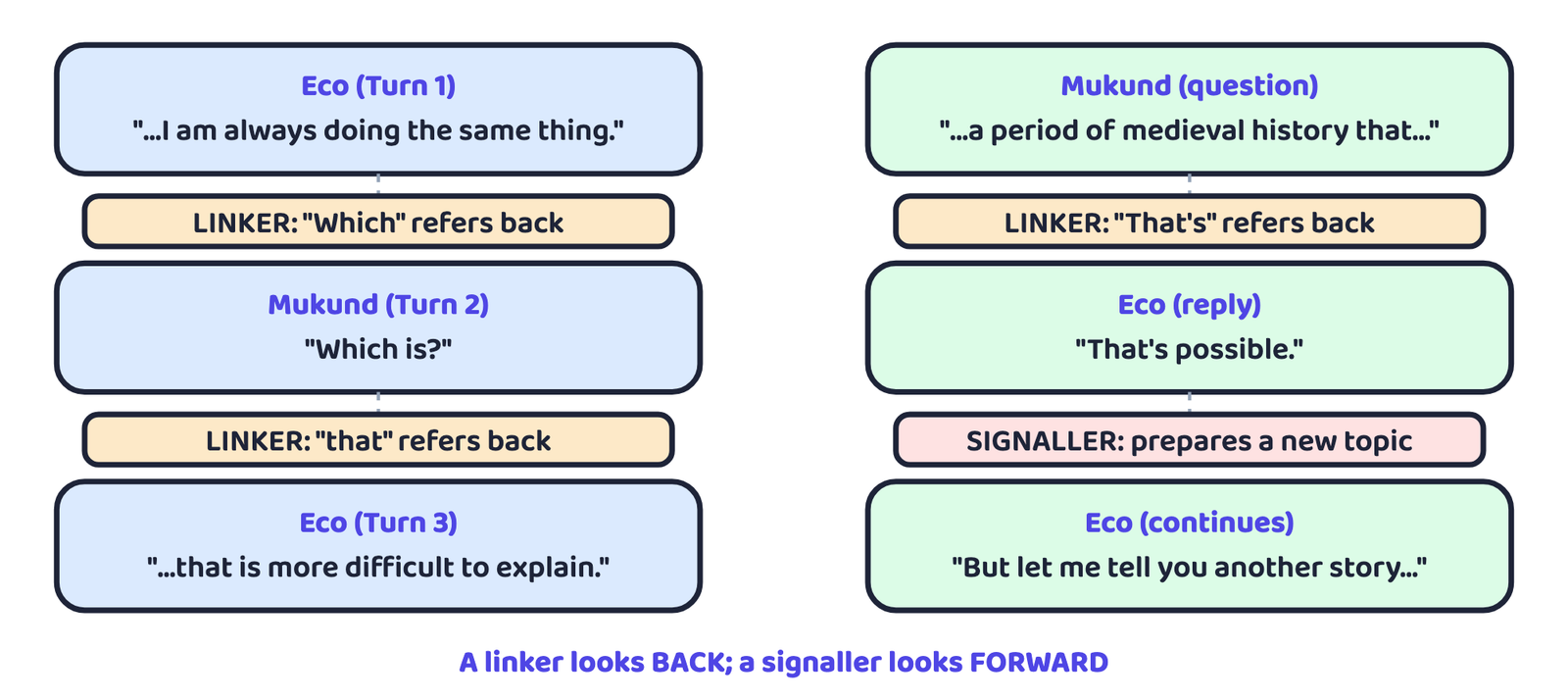
Do not confuse the two: a linker connects a reply back to what was just said (often reusing a word or pronoun); a signaller is used by a speaker to warn the listener that the topic is about to change. The book’s own line is worth learning exactly: without signallers, “the flow of ideas in a conversation will not be smooth and continuous.”
6 Theme and Sub-theme
Theme, in the book’s own words: “The interview as a communication genre.”
Sub-theme, in the book’s own words: “An excerpt from an interview with an author.”
Put simply: the chapter is about the interview itself as a way of communicating. Part I shows how differently people can feel about the interview, from hostility to “quite extravagant claims” for it, and Part II shows the form working at its best, letting Eco explain his own thinking clearly, in his own words, to a wide readership.
Not one of Part I’s named critics of the interview (Naipaul, Carroll, Kipling, Wells, Bellow) is speaking as an interviewer; each is quoted only as a subject who has been interviewed. Silvester’s own conclusion is in the interview’s favour: it is “a supremely serviceable medium of communication”. The closing voice, Denis Brian, says the interviewer “holds a position of unprecedented power and influence”.
7 Writing and Things to Do (Book’s Own Tasks)
Writing
Write a short report of the interview, as if Mukund Padmanabhan had no space to print it verbatim: turning a transcript into a report.
Things to Do
Interview a person you admire and write it up: direct practice at the questioning skills this chapter examines.
8 Quick Self-Check
- Can I name at least three writers from Part I and what each one said about being interviewed?
- Can I explain the irony the book points out about Kipling and about H. G. Wells?
- Can I explain Eco’s idea of “interstices” using his own elevator example?
- Can I give Eco’s own words on the success of The Name of the Rose (“a mystery. Nobody can predict it.”)?
- Can I tell a linker from a signaller, with an example of each from the book?
- Can I state the theme and sub-theme of the chapter in the book’s own words?
- Part I: a source of truth and an art, or an unwarranted intrusion, comparing it to the belief a photograph steals the soul
- Naipaul, Carroll, the Kiplings, Wells and Bellow voice discomfort, yet Kipling interviewed Twain and Wells interviewed Stalin
- Denis Brian closes Part I: the interviewer holds “unprecedented power and influence”
- Part II: Mukund Padmanabhan interviews Eco, who is “always doing the same thing” across academic work, novels and children’s books
- Eco’s “interstices,” the empty spaces in our lives, like waiting for a lift, are how he finds time to write so much
- He began novels only at 50, by accident; friend Roland Barthes wanted to but died before he could
- The Name of the Rose sold 10-15 million copies; his own publisher expected only 3,000 US sales; Eco calls its success simply “a mystery”
- Linkers connect back (pronoun or repetition); signallers warn of a topic shift ahead
- Theme: the interview as a communication genre. Sub-theme: an excerpt from an interview with an author