
- Narrate the play scene by scene: what happens in Mr Lamb’s garden, at Derry’s house, and back in the garden again
- Describe Mr Lamb and Derry as characters, in their own words, and explain how each one changes (or resists changing) across the play
- Explain the play’s central themes: physical disability, social alienation, and how appearance is judged versus what a person actually is
- Identify the play’s dramatic devices, stage directions, irony, symbolism and the parable-within-dialogue, with an exact quotation for each
- Explain why the play is called “On the Face of It” and what its open ending leaves unsaid
- Prepare for the Reading with Insight questions, including Mr Lamb’s loneliness (Q2), and for extract-based questions (full answers are in the NCERT Solutions post)
1Meet the Author and the Play
1.1 About the Author and the Genre
“On the Face of It” is written by Susan Hill, an English author. Unlike the earlier Vistas chapters you may have read, this one is not a short story or a travel essay: it is a one-act play, meant to be read (or performed) almost entirely through dialogue. There is very little description in the whole chapter. Instead, the stage directions tell you what to imagine hearing: birdsong, rustling leaves, footsteps, apples thumping to the ground, and, right at the end, a ladder creaking and crashing.
If a question asks you to name the form of this chapter, write “a one-act play,” not “a short story.” Everything you know about the characters comes only from what they say to each other and from the stage directions. There is no narrator describing anyone’s thoughts directly, which is exactly what a play requires you to infer instead of being told.
1.2 Before You Read
The play opens with the book’s own framing line: “This is a play featuring an old man and a small boy meeting in the former’s garden. The old man strikes up a friendship with the boy who is very withdrawn and defiant. What is the bond that unites the two?” Keep this question in mind through the whole play.
2Meet the Characters
Mr Lamb
An old man who lost his real leg to a bomb blast “in the war” and now wears a tin leg. Children in the street nickname him “Lamey-Lamb.” He lives alone in a big house with no curtains and spends his days sitting in his garden, reading, keeping bees, and growing crab apples, flowers, and deliberate “weeds.” He is talkative, endlessly curious, unafraid of being stared at, and believes the garden gate should always stay open to anyone, “friend” or stranger. His philosophy is to understand the world by “Watching. Listening. Thinking.”
Derry (Derek)
A fourteen-year-old boy whose face was disfigured down one side by acid: “It ate my face up. It ate me up. And now it’s like this and it won’t ever be any different.” He gives his real name as Derek but insists on being called Derry. He is defensive, withdrawn and quick to anger because he is certain everyone who looks at him feels either pity or fear; he says he knows what people think: “I know. I can see.” Underneath the defiance, he is desperately curious about the world and about a place, like Mr Lamb’s garden, that could be “just mine.”
Derry’s Mother
Appears only in Scene Two, at their house. She has heard things about Mr Lamb (“Been told. Warned.”) and forbids Derry from visiting him, though the family has lived in the area for less than three months. She says she “forgives” him for the harsh things he says (“It’s bound to make you feel bad things”), and Derry’s reply, “It’s got nothing to do with my face and what I look like,” suggests she has linked his anger to his face.
Mr Lamb
- Old; lost a leg (tin leg) in the war
- Chooses openness: no curtains, gate always open
- Talks to make sense of the world: “Watching. Listening. Thinking.”
- Accepts his difference; the nickname “doesn’t trouble” him
- Believes “Everything’s the same, but everything is different.”
Derry
- Fourteen years old; face burned by acid
- Chooses withdrawal: expects to be stared at and pitied
- Talks to test people, to catch them out being afraid
- Resents his difference; refuses fairy-tale comfort (“I won’t change”)
- Says that people he passes and never sees again are “just….nothing” (Scene One)
Comparing Mr Lamb and Derry is a useful way to organise an answer on the play’s themes. Make the same point the table above makes: their situations are similar (both are visibly different from other people, both get stared at, both are given a hurtful nickname or comment), but their responses are opposite. This is exactly what Mr Lamb means when he says “You’ve got a burned face, I’ve got a tin leg. Not important… Where’s the difference?”
3The Play, Scene by Scene
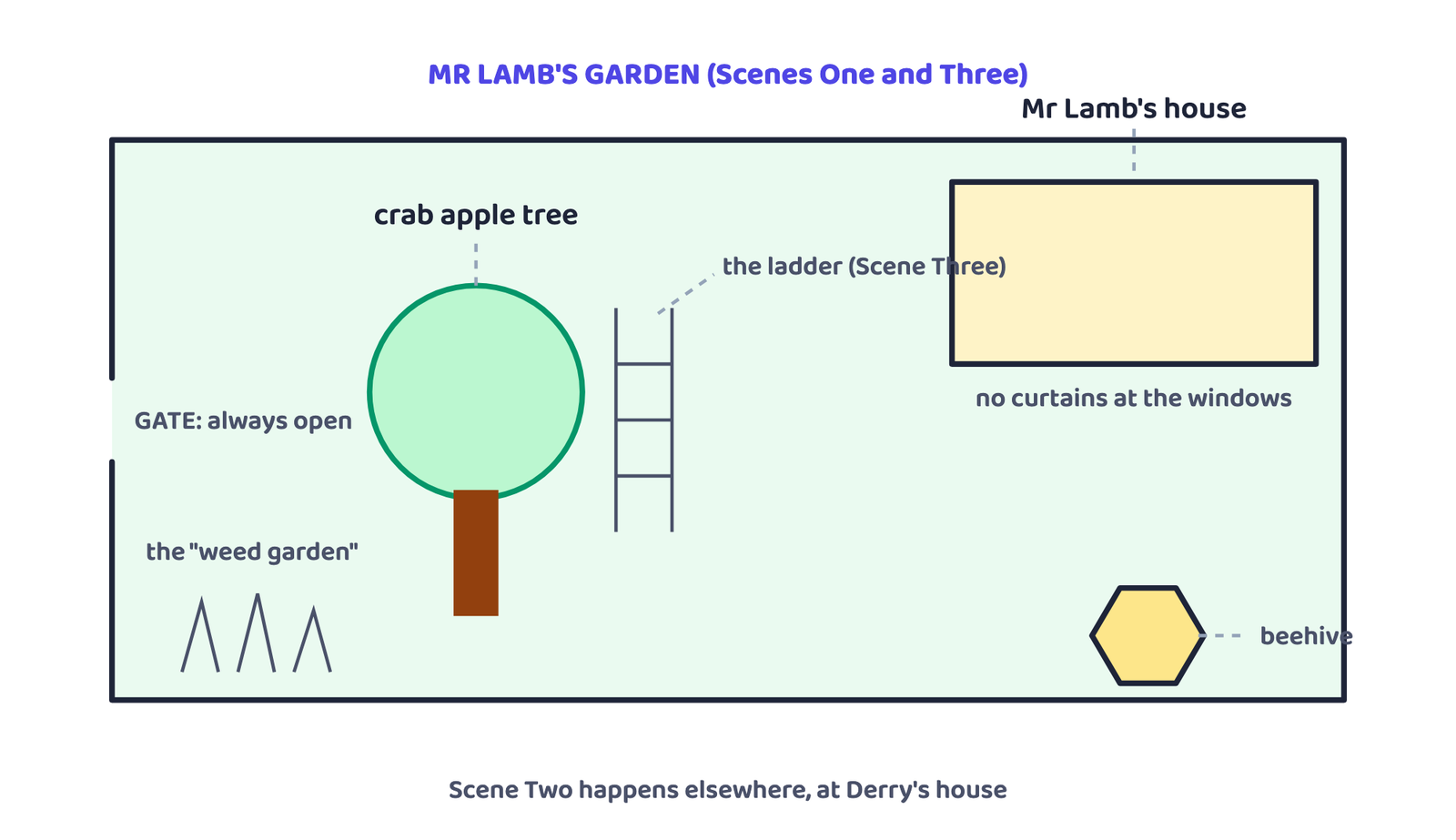
3.1 Scene One: First Meeting in Mr Lamb’s Garden
The play opens on Mr Lamb’s garden in September, with birdsong and rustling leaves. Derry walks in slowly, thinking the place is empty, and is startled when Mr Lamb speaks: “Mind the apples!”, a warning about windfall crab apples in the long grass. Derry panics and tries to leave, but Mr Lamb reassures him: the gate is always open, “All welcome. You’re welcome,” even though Derry climbed the garden wall.
“Who is Mr Lamb? How does Derry get into his garden?”
the play’s own margin question, right at the start of Scene One
Mr Lamb guesses Derry is “Thirteen or so”; Derry corrects him: “Fourteen.” Derry insists he is not a thief, only a boy who wanted to come into the garden. Pressed on why people are afraid of him, Derry delivers his first key speech: he says he knows what people think (“I know. I can see.” … “What they think.”): “That’s bad. That’s a terrible thing… Poor boy,” and admits that, underneath, even he is afraid when he looks in the mirror.
“Underneath, you are afraid. Anybody would be. I am. When I look in the mirror, and see it, I’m afraid of me.” One reading: this line is a key to Derry’s character, since his anger at other people is really a mirror of the fear and disgust he already feels about himself.
Mr Lamb tries to change the subject to picking crab apples for jelly: it is September, and the apples are “ripe… orange and golden… magic fruit.” Derry immediately calls this out as another way adults avoid asking him directly what happened. Mr Lamb then does ask directly, guessing “a fire,” and Derry corrects him with the play’s central fact:
“Not in a fire. I got acid all down that side of my face and it burned it all away. It ate my face up. It ate me up. And now it’s like this and it won’t ever be any different.”
Derry, Scene One
Mr Lamb answers simply, “You’re a boy who came into the garden… I’m interested in anybody. Anything,” and points Derry towards a corner of the garden he deliberately lets grow wild.
Mr Lamb grows an untidy patch on purpose and calls it his “weed garden.” He asks Derry: “Why is one green, growing plant called a weed and another ‘flower’? Where’s the difference. It’s all life… growing. Same as you and me.” One reading takes this as the play’s central argument stated as a metaphor: a “weed” and a “flower” are both simply alive, just as a burned face and a whole one are both simply human. The label, not the plant (or the person), is the problem.
Derry protests, “We’re not the same,” but Mr Lamb answers with a line of comparison: “I’m old. You’re young. You’ve got a burned face, I’ve got a tin leg. Not important… Where’s the difference?” He explains that his real leg “got blown off, years back,” in the war, by a bomb, and that the local children call him “Lamey-Lamb,” a nickname that “doesn’t trouble” him.
Derry points out that a leg can be hidden under trousers, unlike a face; Mr Lamb agrees some people stare, “some don’t. They get tired of it, in the end. There’s plenty of other things to stare at”: crab apples, weeds, a spider climbing a silken ladder, tall sunflowers. He sums up the idea as “It’s all relative. Beauty and the beast,” and Derry angrily rejects the comparison to the fairy tale, where the Beast is rewarded with a transformation into a handsome prince:
Do not write that Derry agrees with the Beauty and the Beast comparison. He explicitly rejects the fairy-tale ending: “Only he wouldn’t [change], he’d have stayed a monstrous beast. I won’t change.” Derry’s whole point is that real life offers no magical transformation. He will have this face for the rest of his life, and he wants to be accepted as he actually is, not comforted with a fantasy.
Derry describes how even his own mother’s kisses feel like an obligation, landing only on the unburned side of his face “because she has to.” Mr Lamb turns this around: “do you care if you never kiss them,” meaning girls Derry might one day love. Derry insists no girl would ever let him, but Mr Lamb only answers, “Who can tell?” Derry then states the one fact he is certain of: he will “still only have half a face” even when he is as old as Mr Lamb. Mr Lamb’s reply widens the whole argument outward: “So you will. But the world won’t. The world’s got a whole face, and the world’s there to be looked at.”
Derry asks if this garden is “the world”; Mr Lamb says it is “as much as anywhere,” when he is in it. Their talk turns briefly to Mr Lamb’s leg pain (“now and then, in wet weather”) before Derry recites, almost by memory, all the empty comforts adults give him: praise for disabled people who are “brave and never cry,” and instructions to think of people “worse off”: blind, deaf, in a wheelchair. He then shares the play’s most painful memory:
Derry recalls a woman at a bus-stop who whispered to a friend, thinking he could not hear: “Look at that, that’s a terrible thing. That’s a face only a mother could love.” Mr Lamb asks, “So you believe everything you hear, then?” When Derry says, “It was cruel,” he replies, “Maybe not meant as such. Just something said between them.”
Called “peculiar” by Derry, Mr Lamb explains his hobby of keeping bees: “when you listen to bees for a long while, they humm….and hum means ‘sing’. I hear them singing, my bees.” Derry admits he liked the garden the moment he first looked over the wall. Mr Lamb then tells the play’s one embedded story: a parable with no title of its own in the text, but central to its meaning.
Mr Lamb describes a man who was afraid of everything in the world: being run over by a bus, breathing in germs, being kicked by a donkey, being struck by lightning, being left by a woman he loved, slipping on a banana skin and being laughed at. So he locked himself in a room, got into bed, and stayed there. Derry asks, “For ever?” Mr Lamb answers, “For a while.” Then a picture fell off the wall on to his head and killed him. The play states no moral. One reading of the parable’s point: hiding from life does not protect a person from its accidents.
Derry laughs a lot.
“Do you think all this will change Derry’s attitude towards Mr Lamb?”
the play’s own margin question, right after this parable
Asked what he does all day, Mr Lamb answers, “Sit in the sun. Read books.” Derry thought it was an empty house; Mr Lamb replies, “Ah, you thought it was an empty house, but inside, it’s full. Books and other things. Full.” Derry then notices there are no curtains at the windows. He explains why he keeps no curtains: “I’m not fond of curtains. Shutting things out, shutting things in. I like the light and the darkness, and the windows open, to hear the wind.” Derry says he too likes hearing rain on a roof, prompting Mr Lamb’s gentle observation: “So you’re not lost, are you? Not altogether? You do hear things. You listen.”
Derry then repeats, almost word for word, what his family says about him when he isn’t in the room: “What’ll he ever do?… How ever will he get on in this world?” Mr Lamb answers firmly that Derry has “two arms, two legs and eyes and ears… a tongue and a brain,” and could get on better than all the rest if he chose, “Same way as I do.” Asked if he has friends, Mr Lamb claims “Hundreds”: everyone knows him, the gate is always open, people sit by his fire in winter, and children come for apples, pears and honey toffee. Derry warns him: “If you fell and broke your neck, you could lie on the grass and die. If you were on your own.” Mr Lamb replies, “I could.”
When Derry protests that he cannot be a friend because Mr Lamb doesn’t even know his name or where he is from, Mr Lamb answers: “Why should that signify? Do I have to write all your particulars down and put them in a filing box, before you can be a friend?” To Mr Lamb, friendship needs no paperwork and no shared history, only two people choosing, in the moment, to be present with each other.
Derry finally gives his name: “Derry. Only it’s Derek… but I hate that. Derry,” but immediately sets the terms of the friendship on his own conditions: “If I’m your friend, you don’t have to be mine. I choose that.” He worries that if he never returns, he “couldn’t still be a friend,” since people you pass and never see again are “just… nothing.” Mr Lamb disagrees sharply: “People are never just nothing. Never.”
When Derry admits there are people he hates, Mr Lamb warns him this is worse than his own injuries: “That’d do you more harm than any bottle of acid. Acid only burns your face… Like a bomb only blew up my leg. There’s worse things can happen. You can burn yourself away inside.” Derry then recalls someone saying he’d be “better off” among “others like himself” in hospital, a segregation Derry initially defends (“there’d be nobody to stare at you”). Mr Lamb exposes the logic by extending it absurdly, asking about “people with no legs altogether,” and then asking the question that answers the segregation idea:
“What kind of a world would that be?” Memorise this exact line. It is Mr Lamb’s rebuttal to the idea that people who are “different” should be kept apart from everyone else, and it is useful for any answer on disability and inclusion.
Mr Lamb sums up his whole philosophy in one exchange. Asked how he sees the world the way he does, he answers with three words:
“Everything’s different. Everything’s the same, but everything is different. Itself.” Asked, “How do you make all that out?”, Mr Lamb answers: “Watching. Listening. Thinking.” Later, when Derry says he wants “something no one else has got,” Mr Lamb extends the formula to: “Waiting. Watching. Listening.” Together, these lines are Mr Lamb’s method for understanding people and the world without judging them by appearance first.
Mr Lamb tells Derry, “Everything’s yours if you want it. What’s mine is anybody’s,” and reassures him that when local children shout “Lamey-Lamb” in the street, they still come freely into his garden: “they’re not afraid of me… because I’m not afraid of them.” Derry, worried about Mr Lamb working alone on a ladder, offers to help pick the crab apples. Before leaving for home, three miles away across the fields, Derry admits he does not fully know what he wants: “I want….something no one else has got or ever will have. Something just mine. Like this garden.”
Unconvinced that Mr Lamb’s other visitors are real, Derry asks their names; Mr Lamb replies, “What are names? Tom, Dick or Harry.” Derry lashes out just as Mr Lamb gets up to go to his bees: “I think you’re daft….crazy….” Mr Lamb, still there, replies, “That’s a good excuse,” meaning a good excuse not to come back, just as Derry’s burned face is other people’s excuse. Derry then accuses him of secretly being repelled by his face: “if you don’t feel sorry for my face, you’re frightened of it… I am a devil. Don’t you?” Mr Lamb has already walked off toward his bees and does not reply. Alone, Derry softens: “No. You don’t. I like it here,” before shouting his promise as he runs off: “I’m going. But I’ll come back. You see. You wait. I can run. I haven’t got a tin leg. I’ll be back.”
Do not end your summary of Scene One on Derry’s promise alone. The scene’s real final line belongs to Mr Lamb, alone, and it matters for the ending: “I’ll come back. They never do, though. Not them. Never do come back.” This bitter, resigned line is what makes Derry’s actual return in Scene Three so significant: Mr Lamb does not expect it to happen.
The book asks: “In which section of the play does Mr Lamb display signs of loneliness and disappointment? What are the ways in which Mr Lamb tries to overcome these feelings?”
Signs, in Scene One: Derry points out, “But you live by yourself in that house. It’s a big house, too,” and later accuses him: “You’re here all by yourself and miserable and no one would know if you were alive or dead and nobody cares.” Mr Lamb only answers, “You think what you please,” and, asked for his visitors’ names, “What are names? Tom, Dick or Harry.” Derry also warns him, “If you fell and broke your neck, you could lie on the grass and die. If you were on your own.” Mr Lamb replies, “I could.” The clearest sign comes at the very end of the scene, when Mr Lamb, alone, answers Derry’s “I’ll be back”: “I’ll come back. They never do, though. Not them. Never do come back.”
How he copes: he keeps the gate open (“The gate’s always open”), welcomes anyone, including children who come for apples, pears and honey toffee; he talks (“I like to talk. Have company.”); he keeps bees and listens to them “singing”; he reads, gardens and makes crab-apple jelly; and he keeps no curtains, so that he can “hear the wind.” He also chooses not to be troubled by the nickname “Lamey-Lamb.”
3.2 Scene Two: Derry’s House
The scene shifts to Derry’s home, where his mother reveals she has already been “told” and “warned” about Mr Lamb, even though the family has lived there less than three months. She forbids Derry from going back. Derry defends Mr Lamb using only plain facts: “An old man with a tin leg and he lives in a huge house without curtains and has a garden,” and explains he wants to sit there and “listen to things.” Asked by his mother what there is to listen to, he answers: “Bees singing. Him talking.” Asked what Mr Lamb has to say to him, Derry continues: “Things that matter. Things nobody else has ever said. Things I want to think about.”
The mother attributes Derry’s outburst to his feelings (“I forgive you… It’s bound to make you feel bad things”), and Derry’s reply suggests she has linked it to his face. Derry corrects her directly: “It’s got nothing to do with my face and what I look like. I don’t care about that and it isn’t important. It’s what I think and feel and what I want to see and find out and hear.” Never write that Derry’s desire to return is “about his face”: the play states, in Derry’s own words, that it is not.
Derry declares he is going back “only to help him with the crab apples. Only to look at things and listen. But I’m going.” When his mother insists, “You’ll stop here,” Derry gives his most defiant line of the play, tying this one visit to his entire future: “Oh no, oh no. Because if I don’t go back there, I’ll never go anywhere in this world again.” The scene ends with the door slamming and Derry running, panting, speaking the scene’s final words:
“And I want the world…. I want it…. I want it….”
Derry, running from the house, end of Scene Two
3.3 Scene Three: Back in the Garden
The final scene returns to Mr Lamb’s garden, told almost entirely through sound. Mr Lamb is up a ladder, talking himself through picking the crab apples he mentioned in Scene One (“Steady….that’s….got it. That’s it….and….”). Then, without warning: “A creak. A crash. The ladder falls back, Mr Lamb with it. A thump. The branch swishes back. Creaks. Then silence.”
Derry opens the gate, still panting from his run, calling out that he has kept his promise: “You see, you see! I came back. You said I wouldn’t and they said…. but I came back, I wanted….” Then he stops dead as he sees what has happened. He runs through the grass, kneels beside Mr Lamb, and speaks the play’s final lines:
“Mr Lamb, It’s all right…. You fell…. I’m here, Mr Lamb, It’s all right…. [Silence] I came back. Lamey-Lamb. I did…..come back.”
Derry, kneeling beside Mr Lamb, the play’s final spoken lines
[Derry begins to weep.] The End.
The play never states in words that Mr Lamb has died. Do not write “Mr Lamb dies” as a flat fact. A reasonable reading is that the ending leaves Mr Lamb’s fate open: the fall, the silence and Derry’s weeping suggest tragedy, but no line states it. This open ending is the backdrop for Reading with Insight Question 4, which asks not about Mr Lamb’s fate but about Derry’s: will he return to his old seclusion, or will this brief association change the life he leads afterwards?
4Themes of the Play
Both Mr Lamb (a tin leg) and Derry (a burned face) are visibly different, and both are given cruel nicknames or remarks by people around them. The book’s own Reading with Insight Q3 puts it this way: “The actual pain or inconvenience caused by a physical impairment is often much less than the sense of alienation felt by the person with disabilities.”
Appearance versus reality
The title itself carries this theme: “on the face of it,” things are not what they seem. A burned face and a tin leg look like the whole story, but one reading of the play is that a person’s worth lies in what they think, feel and do, not in how they look.
Fear versus openness
Mr Lamb’s whole life is built around keeping the gate, and himself, open: no curtains, no fear of strangers, no fear of being stared at. Derry begins the play closed off by fear of other people’s reactions. The parable of the man who locks himself away and still dies shows that hiding from life offers no real safety.
Real friendship needs no conditions
Mr Lamb accepts Derry as a friend without knowing his name, his history or his family. Friendship, to him, is a choice made in the present moment, not something earned through paperwork or a shared past.
The danger of well-meaning pity
Both Derry’s family (talking about him “downstairs”) and his mother (whose reply suggests she has linked his anger to his face) show how sympathy, when it assumes rather than listens, can alienate a person just as much as cruelty does.
Loneliness, and ways of overcoming it
Mr Lamb lives alone and, at the end of Scene One, says, “They never do, though. Not them. Never do come back.” He meets loneliness with an open gate, talk (“I like to talk. Have company.”), his bees, his books and his garden. See the box above (Reading with Insight Q2).
5How the Play Is Told
5.1 Dramatic and Literary Devices
Stage directions as sound design
Because it is a play, almost everything you are told to imagine comes through sound cues in square brackets: birdsong, footsteps in long grass, apples thumping down, and finally the creak-crash-thump-silence sequence that ends the story. These are not decoration: they carry the plot. (Bees are heard only in dialogue: “Bees singing. Him talking.”)
Dramatic and situational irony
Mr Lamb’s parable warns that a man who hides from every danger is killed anyway by an ordinary accident (a falling picture), foreshadowing his own ordinary accident on the ladder. Derry has also warned him: “If you fell and broke your neck, you could lie on the grass and die. If you were on your own.” It is also ironic that Derry, who resists comfort but is drawn to Mr Lamb’s garden from the start, finally chooses to return and trust someone, only to find tragedy waiting.
Symbolism
One reading: the open garden gate stands for Mr Lamb’s openness to the world; the absence of curtains for a life lived without hiding anything; the “weed garden” for the idea that a label (“weed,” “flower,” “disabled,” “burned”) should never decide a living thing’s worth.
Parable / allegory
The story-within-the-play about the man who fears everything and is killed by a falling picture is a short allegory: its point, on one reading (hiding from life does not protect you from it), applies directly to Derry’s own withdrawal from people.
Repetition
“The gate’s always open” recurs again and again, and the “Watching. Listening. Thinking.” formula returns later as “Waiting. Watching. Listening.”, turning Mr Lamb’s philosophy into something closer to a refrain than a single line of dialogue.
The open ending
The play never states whether Mr Lamb survives. One reading: this leaves the reader with the same uncertainty Derry lives with about how people will react to him.
5.2 Why This Title?
“On the Face of It” works on two levels at once. Literally, it points to Derry’s face, the burned half that everyone reacts to first and the subject the whole play keeps circling back to. Idiomatically, “on the face of it” is an English expression meaning “as it appears at first glance,” suggesting that first appearances (a burned face, a tin leg, a house with no curtains that looks “empty”) are misleading, and that the truth about a person or a place lies underneath, not on the surface.
The title has two meanings: literally, it points to Derry’s burned face; idiomatically, “on the face of it” means “as it appears at first glance”, so appearances can mislead. Giving both covers the title fully.
6Words to Know
| Word / Phrase | Meaning in this play |
|---|---|
| Windfall | Fruit that has fallen naturally from a tree (the “windfall” crab apples in the long grass) |
| Scrump | To steal fruit, especially apples, from someone’s garden or orchard |
| Signify | To matter, or to be of importance (“Why should that signify?”) |
| Particulars | Detailed personal facts about someone, such as name and address |
| Alienation | The feeling of being isolated or shut out from other people and society |
| Impairment | A physical or mental condition that limits a person’s senses, movement or activities |
| Seclusion | The state of keeping oneself away from other people; withdrawal |
| Trespassing | Entering someone’s property without permission |
| Peculiar | Strange or unusual |
| Daft | Silly or foolish; Derry’s insult for Mr Lamb (“I think you’re daft….crazy….”) |
7Answering Extract-Based Questions
Extract-based questions may be set on this play. The method below works for any extract from this chapter.
Extract: “Mr Lamb: Why is one green, growing plant called a weed and another ‘flower’? Where’s the difference. It’s all life…. growing. Same as you and me.”
Q. What does Mr Lamb mean by this comparison, and how does it connect to Derry?
Step 1: Identify the device: a rhetorical question followed by an extended metaphor comparing plants to people.
Step 2: Explain the literal comparison: a “weed” and a “flower” are both simply living, growing plants; the difference is only a label humans give them, not a real difference in the plant itself.
Answer: Mr Lamb means that labels like “weed” or “flower” (or, by extension, “normal” or “disfigured”) are human judgements, not real differences in worth. He is telling Derry, without saying so directly, that a burned face makes Derry no less alive or valuable than anyone else: “same as you and me.”
Always quote a short phrase from the extract itself in your answer (“It’s all life… growing,” for instance). Quoting a short phrase from the extract shows that you have read the exact words.
- Can I summarise all three scenes in order, in under a minute, without looking?
- Can I quote the exact line Derry uses to correct Mr Lamb about the acid?
- Can I explain, in my own words, why the ending is called “open” rather than saying Mr Lamb definitely dies?
- Can I say where Mr Lamb shows loneliness and disappointment, and how he tries to overcome it?
- Can I give both meanings of the title, literal and idiomatic?
- Author: Susan Hill. Genre: one-act play, told almost entirely through dialogue and sound-based stage directions
- Setting: Mr Lamb’s garden in September (Scene One); Derry’s house (Scene Two) and the garden again (Scene Three) have no month stated
- Mr Lamb: old man, tin leg lost to a bomb in the war, nicknamed “Lamey-Lamb,” lives without curtains, keeps bees, grows crab apples and deliberate “weeds,” philosophy = “Watching. Listening. Thinking.”
- Derry (real name Derek): fourteen, face burned by acid down one side, believes he can “see” what people think of him, rejects the Beauty and the Beast comparison (“I won’t change”)
- Key exchange: “You’ve got a burned face, I’ve got a tin leg. Not important… Where’s the difference?”
- The parable of the fearful man killed by a falling picture: hiding from life does not protect you from it
- Scene Two: Derry’s mother forbids the visit based on rumours; Derry insists it has “nothing to do with my face”; ends with “I want the world…. I want it…. I want it…”
- Scene Three: Mr Lamb falls from the ladder; Derry returns as promised and finds him fallen; final line “I came back. Lamey-Lamb. I did…..come back,” then Derry weeps
- The ending is open: Mr Lamb’s fate is never confirmed in words
- Mr Lamb’s loneliness: “They never do, though. Not them. Never do come back.”; he copes through the open gate, talk (“I like to talk. Have company.”), bees, books and garden
- Title “On the Face of It”: literally Derry’s face; idiomatically, appearances on the surface can be deceptive
- Key devices: stage directions as sound design, dramatic/situational irony, symbolism (open gate, no curtains, weed garden), parable/allegory, repetition, open ending