
- What a mineral is, and the three characteristics every mineral shares
- India’s three mineral belts, and which minerals cluster in each
- Where India’s major iron ore, manganese, bauxite, copper and mica deposits are found
- How coal, petroleum and natural gas are distributed, and why India needed the ONGC
- The six non-conventional energy sources, and where each works best in India
- Why mineral resources must be conserved, and how
1What Is a Mineral?
India’s varied geological structure has given it a rich variety of mineral resources. Most of the valuable minerals are products of the pre-palaeozoic age and are mainly associated with the metamorphic and igneous rocks of peninsular India. The vast alluvial plains of north India, by contrast, are largely devoid of minerals of economic use. Mineral resources provide the country with the necessary base for industrial development.
A mineral is a natural substance of organic or inorganic origin with definite chemical and physical properties.
1.1 Types of minerals
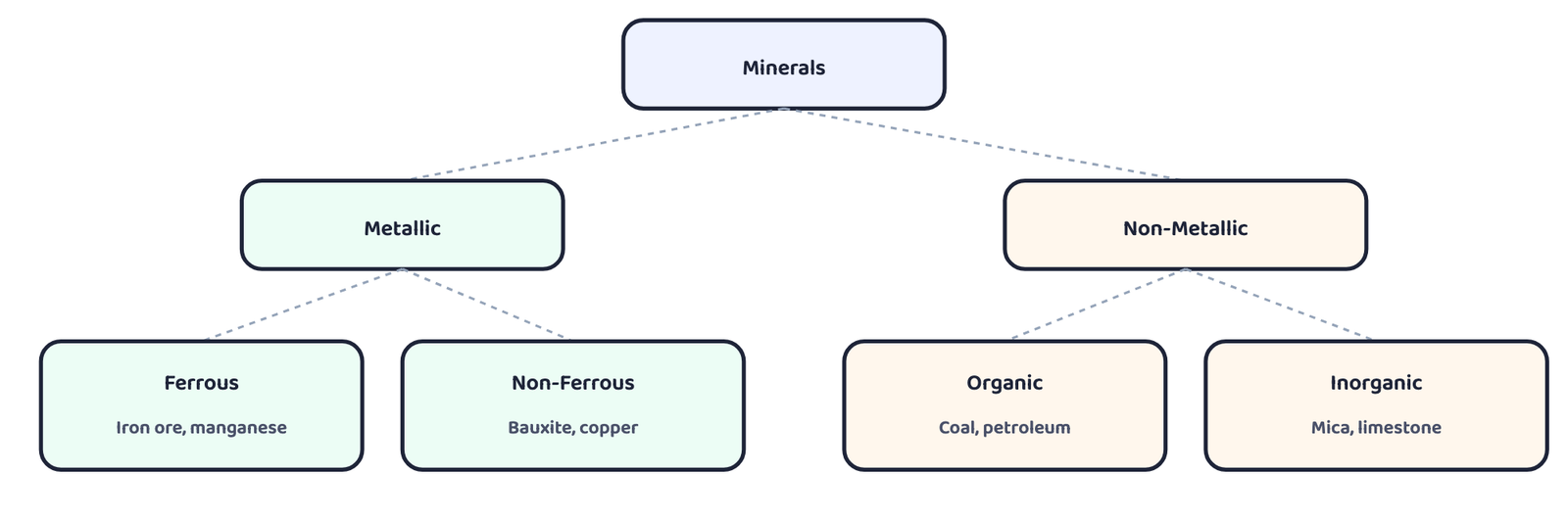
On the basis of chemical and physical properties, minerals are grouped into two main categories.
Ferrous metallic
- Contains iron content
- Example: iron ore itself
Non-ferrous metallic
- No iron content
- Examples: copper, bauxite
Organic non-metallic minerals are fossil fuels (also called mineral fuels), derived from buried animal and plant life, such as coal and petroleum. Inorganic non-metallic minerals include mica, limestone and graphite.
1.2 Three characteristics of minerals
Unevenly distributed
Minerals are not spread evenly over space; they concentrate in a few belts.
Quality vs quantity
There is an inverse relationship: good quality minerals are less in quantity than low quality minerals.
Exhaustible over time
Minerals take geological ages to form and cannot be replenished quickly, and they have no “second crop”, so they must be conserved, not misused.
2Distribution of Minerals in India
Most of India’s metallic minerals occur in the peninsular plateau region, in old crystalline rocks. Over 97% of coal reserves occur in the valleys of the Damodar, Sone, Mahanadi and Godavari rivers. Petroleum reserves lie in the sedimentary basins of Assam, Gujarat and Mumbai High (the offshore region in the Arabian Sea), with new reserves located in the Krishna-Godavari and Kaveri basins. Most of India’s major mineral resources occur to the east of a line linking Mangaluru and Kanpur.
A fourth, less concentrated belt runs along the Himalayas, where copper, lead, zinc, cobalt and tungsten occur on both the eastern and western sides. The Assam valley also has mineral oil deposits, besides the offshore reserves near the Mumbai coast.
2.1 India’s three mineral belts
| Belt | States covered | Key minerals and features |
|---|---|---|
| North-Eastern Plateau | Chhotanagpur (Jharkhand), Odisha Plateau, West Bengal, parts of Chhattisgarh | Iron ore, coal, manganese, bauxite, mica: the belt with the most varied mineral deposits |
| South-Western Plateau | Karnataka, Goa, contiguous Tamil Nadu uplands, Kerala | Ferrous metals, bauxite, high-grade iron ore, manganese, limestone; lacks coal except Neyveli lignite; Kerala has monazite, thorium, bauxite clay; Goa has iron ore |
| North-Western | Along the Aravalis in Rajasthan and part of Gujarat | Copper, zinc (Dharwar rocks); Rajasthan rich in sandstone, granite, marble, gypsum, Fuller’s earth; dolomite and limestone for cement; Gujarat known for petroleum; both states rich in salt |
3Ferrous Minerals
Ferrous minerals such as iron ore, manganese and chromite provide a strong base for metallurgical industries. India is well-placed in both reserves and production of ferrous minerals.
3.1 Iron ore
India has the largest reserve of iron ore in Asia. The two main types found in the country are haematite and magnetite. India’s iron ore has great demand in the international market because of its superior quality. Iron ore mines occur close to coal fields in the north-eastern plateau region, which adds to their advantage. About 95% of total iron ore reserves lie in Odisha, Jharkhand, Chhattisgarh, Karnataka, Goa, Telangana, Andhra Pradesh and Tamil Nadu.
| State | Important belts / mines |
|---|---|
| Odisha | Sundergarh, Mayurbhanj, Jhar hill ranges: Gurumahisani, Sulaipet, Badampahar, Kiruburu (Kendujhar), Bonai |
| Jharkhand | Poorbi and Pashchimi Singhbhum districts: Noamundi, Gua |
| Chhattisgarh | Durg, Dantewara, Bailadila; Dalli and Rajhara (Durg) are important mines |
| Karnataka | Sandur-Hospet (Ballari), Baba Budan hills, Kudremukh (Chikkamagaluru), Shivamogga, Chitradurg, Tumakuru |
| Maharashtra, Telangana, Andhra Pradesh, Tamil Nadu | Chandrapur, Bhandara, Ratnagiri (Maharashtra); Karimnagar, Warangal (Telangana); Kurnool, Cuddapah, Anantapur (Andhra Pradesh); Salem, Nilgiris (Tamil Nadu) |
| Goa | Emerged as an important producer of iron ore |
3.2 Manganese
Manganese is an important raw material for smelting iron ore and for manufacturing ferro-alloys. It is mainly associated with the Dharwar system of rocks. Madhya Pradesh and Odisha are the leading producers.
Telangana, Goa and Jharkhand are other minor producers of manganese.
4Non-Ferrous Minerals
India is poorly endowed with non-ferrous metallic minerals, except bauxite.
4.1 Bauxite
Bauxite is the ore used in manufacturing aluminium. It is found mainly in tertiary deposits and is associated with laterite rocks on the plateaus and hill ranges of peninsular India, and in coastal tracts.
| State | Producing areas |
|---|---|
| Odisha | Largest producer: Kalahandi and Sambalpur lead; also Bolangir and Koraput |
| Jharkhand | Rich deposits in the patlands of Lohardaga |
| Gujarat, Chhattisgarh, Madhya Pradesh | Gujarat: Bhavnagar, Jamnagar; Chhattisgarh: Amarkantak plateau; Madhya Pradesh: Katni-Jabalpur area, Balaghat |
| Maharashtra | Kolaba, Thane, Ratnagiri, Satara, Pune, Kolhapur |
| Tamil Nadu, Karnataka, Goa | Minor producers |
4.2 Copper
Copper is indispensable in the electrical industry for making wires, electric motors, transformers and generators. It is alloyable, malleable and ductile, and is mixed with gold to give jewellery strength.
Minor producers of copper are Agnigundala (Guntur district, Andhra Pradesh), Chitradurg and Hasan districts (Karnataka), and South Arcot district (Tamil Nadu).
5Non-Metallic Minerals: Mica
Among the non-metallic minerals produced in India, mica is the most important. Other minerals extracted mainly for local consumption are limestone, dolomite and phosphate. Mica is used chiefly in the electrical and electronic industries, and it can be split into very thin sheets which are tough and flexible.
| State | Mica belt |
|---|---|
| Jharkhand | High quality: a belt about 150 km long and 22 km wide in the lower Hazaribagh plateau |
| Andhra Pradesh | Nellore district gives the best quality mica |
| Rajasthan | Belt about 320 km, from Jaipur to Bhilwara and around Udaipur |
| Others | Telangana, Tamil Nadu (Coimbatore, Tiruchirapalli, Madurai, Kanniyakumari), West Bengal (Purulia, Bankura), Madhya Pradesh, Mysuru and Hasan (Karnataka), Alleppey (Kerala), Ratnagiri (Maharashtra) |
6Energy Resources: Conventional Sources
Mineral fuels are essential for generating power needed by agriculture, industry, transport and every other sector of the economy. Coal, petroleum and natural gas (fossil fuels), along with nuclear energy minerals, are the conventional sources of energy. All of these are exhaustible resources.
6.1 Coal
Coal is mainly used to generate thermal power and to smelt iron ore. It occurs in rock sequences of two geological ages: Gondwana and tertiary. About 80% of India’s coal deposits are of the bituminous type and non-coking grade.
The most important Gondwana coalfields lie in the Damodar Valley (Jharkhand-Bengal coal belt): Raniganj, Jharia, Bokaro, Giridih and Karanpura. Jharia is the largest coalfield, followed by Raniganj. Other coal-bearing river valleys are the Godavari, Mahanadi and Sone. Important mining centres include Singrauli (Madhya Pradesh, extending into Uttar Pradesh), Korba (Chhattisgarh), Talcher and Rampur (Odisha), Chanda-Wardha, Kamptee and Bander (Maharashtra), Singareni (Telangana) and Pandur (Andhra Pradesh). Tertiary coal occurs in Assam, Arunachal Pradesh, Meghalaya and Nagaland: Darangiri, Cherrapunji, Mewlong and Langrin (Meghalaya); Makum, Jaipur and Nazira in upper Assam; Namchik-Namphuk (Arunachal Pradesh); and Kalakot (Jammu and Kashmir). Brown coal (lignite) occurs in coastal Tamil Nadu, Puducherry, Gujarat and Jammu & Kashmir.
6.2 Petroleum
Crude petroleum consists of hydrocarbons of liquid and gaseous states, varying in chemical composition, colour and specific gravity. It is essential for all internal combustion engines in automobiles, railways and aircraft, and its by-products are processed in petrochemical industries: fertiliser, synthetic rubber, synthetic fibre, medicines, vaseline, lubricants, wax, soap and cosmetics.
Petroleum is referred to as liquid gold because of its scarcity and diversified uses.
NCERT, Mineral and Energy Resources
Crude petroleum occurs in sedimentary rocks of the tertiary period. Oil exploration and production was taken up systematically only after the Oil and Natural Gas Commission (ONGC) was set up in 1956; before that, Digboi in Assam was the only oil-producing region.
| Region | Oilfields |
|---|---|
| Assam | Digboi, Naharkatiya, Moran |
| Gujarat | Ankaleshwar, Kalol, Mehsana, Nawagam, Kosamba, Lunej |
| Offshore (Arabian Sea) | Mumbai High, 160 km off Mumbai, discovered 1973, production started 1976 |
| East coast | Krishna-Godavari and Kaveri basins: exploratory wells |
Crude oil contains impurities and must be refined before use. India has two types of refineries: field-based (e.g. Digboi) and market-based (e.g. Barauni).
6.3 Natural gas
Natural gas is found with petroleum deposits and is released when crude oil is brought to the surface. It is used as a domestic and industrial fuel, to generate electricity, for heating in industries, and as raw material in chemical, petrochemical and fertiliser industries. It is also emerging as a preferred transport fuel (CNG) and cooking fuel (PNG) through city gas distribution networks. India’s major gas reserves are in Mumbai High and allied fields along the west coast, supplemented by finds in the Cambay basin; along the east coast, new reserves have been discovered in the Krishna-Godavari basin.
7Non-Conventional Energy Sources
Fossil fuels and nuclear energy use exhaustible raw materials. Sustainable energy sources are the renewable ones: solar, wind, hydro, geothermal and biomass. These are more equitably distributed and environment-friendly, and provide more sustained, eco-friendly, cheaper energy once the initial cost is met.
7.1 Nuclear energy
The important minerals used for generating nuclear energy are uranium and thorium. Uranium deposits occur in Dharwar rocks, along the Singhbhum copper belt, and in Udaipur, Alwar and Jhunjhunu districts (Rajasthan), Durg district (Chhattisgarh), Bhandara district (Maharashtra) and Kullu district (Himachal Pradesh). Thorium is obtained mainly from monazite and ilmenite in the beach sands of Kerala and Tamil Nadu. The world’s richest monazite deposits occur in Palakkad and Kollam districts (Kerala), near Vishakhapatnam (Andhra Pradesh) and in the Mahanadi river delta (Odisha).
Important nuclear power projects are Tarapur (Maharashtra), Rawatbhata near Kota (Rajasthan), Kalpakkam (Tamil Nadu), Narora (Uttar Pradesh), Kaiga (Karnataka) and Kakarapara (Gujarat).
7.2 Solar, wind, tidal, geothermal and bio-energy
Solar energy
Sun rays are tapped in photovoltaic cells. The two effective methods are photovoltaics and solar thermal technology, used in heaters, crop dryers and cookers. Gujarat and Rajasthan have the greatest potential.
Wind energy
Pollution-free and inexhaustible. Turbines convert the kinetic energy of trade winds, westerlies, monsoon winds, and even local land-sea breezes into electricity. Rajasthan, Gujarat, Maharashtra and Karnataka have favourable conditions.
Tidal and wave energy
Ocean currents are a storehouse of energy. Large tidal waves occur along India’s west coast, giving great potential for tidal energy. Wave energy exists along the coasts too, but is not yet utilised.
Geothermal energy
Magma reaching the surface releases heat that can be converted into electricity; hot water from geyser wells is also used. A geothermal energy plant has been commissioned at Manikaran, Himachal Pradesh.
Bio-energy
Derived from agricultural residues and municipal, industrial and other waste, converted into electricity, heat or cooking gas. It improves rural economic life and reduces pressure on fuel wood. Okhla in Delhi converts municipal waste into energy.
The first successful attempt (1890) to tap underground heat was made in Boise, Idaho (USA), where a hot water pipe network heated surrounding buildings, and that plant is still working. Hot springs and geysers have been used since medieval times.
8Conservation of Mineral Resources
The challenge of sustainable development requires balancing the quest for economic development with environmental concerns. Traditional methods of resource use generate enormous waste and other environmental problems, so there is an urgent need to conserve resources for future generations.
8.1 Steps that make reserves last longer
✓ Steps that conserve resources
- Develop inexhaustible sources such as solar, wind, wave and geothermal, to replace exhaustible ones
- Recycle scrap metals, especially copper, lead and zinc, where India’s reserves are meagre
- Use substitutes for scarce metals to reduce their consumption
- Reduce export of strategic and scarce minerals so reserves last longer
✗ What keeps depleting them
- Using traditional, wasteful methods of resource extraction
- Exporting scarce and strategic minerals faster than reserves can support
- Ignoring recycling for metals whose Indian reserves are already meagre
9Map Work (CBSE 2026-27)
CBSE asks you to locate and label these 19 places from this chapter on an outline political map of India. Learn each with its state and its rough position, then practise on a blank outline map.
| Type | Place | State | Where to mark it |
|---|---|---|---|
| Iron ore mine | Mayurbhanj | Odisha | Odisha iron-ore hill ranges (Sundergarh, Mayurbhanj, Jhar) |
| Iron ore mine | Bailadila | Chhattisgarh | Durg-Dantewara-Bailadila belt, far south of the state |
| Iron ore mine | Ratnagiri | Maharashtra | Konkan coast district, south of Mumbai |
| Iron ore mine | Ballari (Bellary) | Karnataka | Sandur-Hospet area of Ballari district, east Karnataka |
| Manganese mine | Balaghat | Madhya Pradesh | Balaghat-Chhindwara-Nimar-Mandla-Jhabua belt, south-east MP |
| Manganese mine | Shivamogga (Shimoga) | Karnataka | Western Karnataka, on the plateau east of the Western Ghats |
| Copper mine | Hazaribagh | Jharkhand | Hazaribagh plateau, north Jharkhand |
| Copper mine | Singhbhum | Jharkhand | South-east Jharkhand, the Singhbhum copper belt |
| Copper mine | Khetri (Khetari) | Rajasthan | Jhunjhunu district, north-east Rajasthan (Aravali belt) |
| Bauxite mine | Katni | Madhya Pradesh | Katni-Jabalpur area, north-east MP |
| Bauxite mine | Bilaspur | Chhattisgarh | North Chhattisgarh, near the Amarkantak plateau |
| Bauxite mine | Koraput | Odisha | South Odisha (Eastern Ghats area) |
| Coal mine | Jharia | Jharkhand | Damodar valley; India’s largest coalfield |
| Coal mine | Bokaro | Jharkhand | Damodar valley, west of Jharia |
| Coal mine | Raniganj | West Bengal | Damodar valley, just east of the Jharkhand border |
| Coal mine (lignite) | Neyveli | Tamil Nadu | South of Chennai, near the east coast; lignite |
| Oil refinery | Mathura | Uttar Pradesh | South of Delhi, on the Yamuna |
| Oil refinery | Jamnagar | Gujarat | Gulf of Kachchh coast, Saurashtra |
| Oil refinery | Barauni | Bihar | On the Ganga, north Bihar; a market-based refinery |
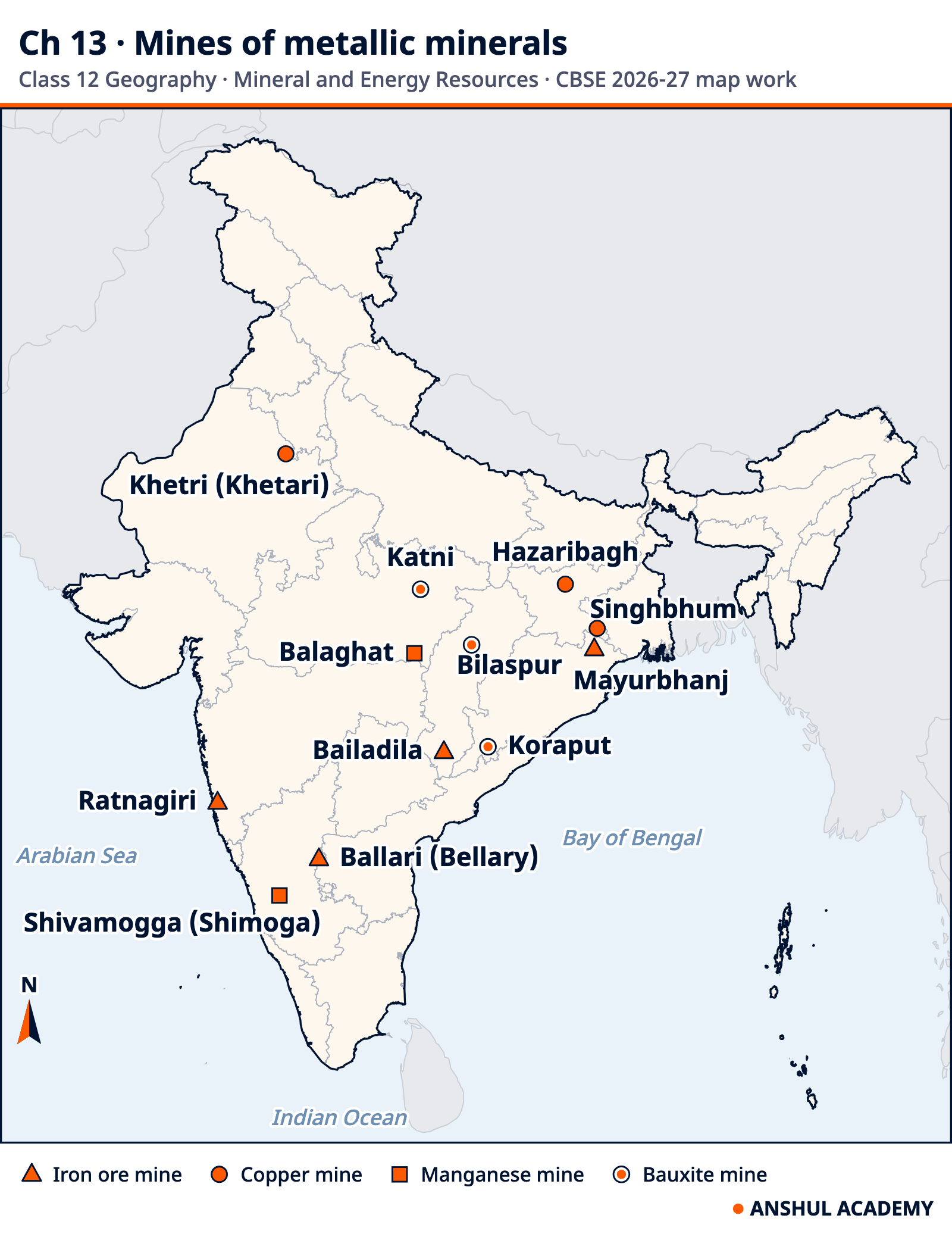
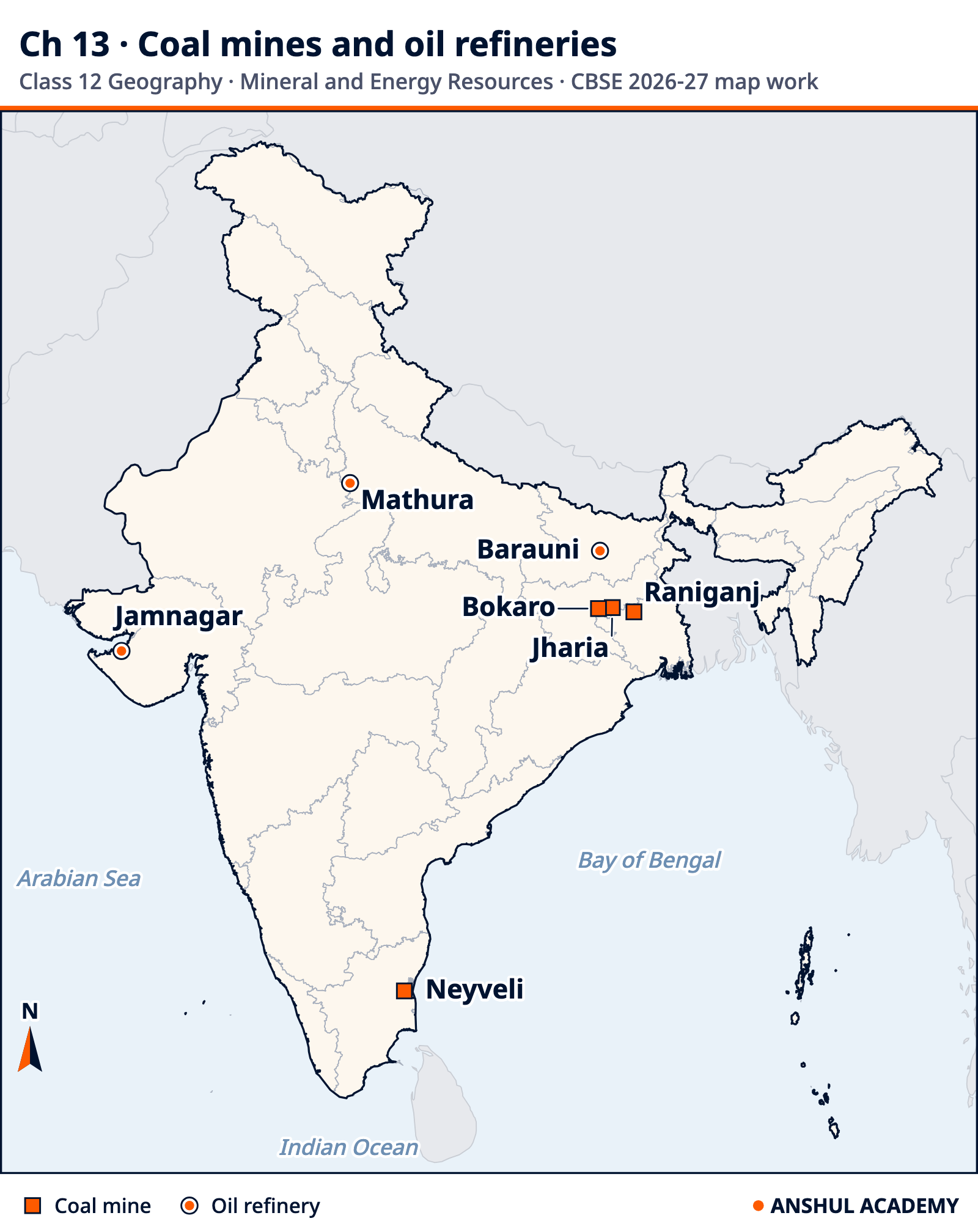
Use a different symbol for each type (for example a triangle for iron ore, a square for manganese, a filled circle for copper) and add a small key. Put a dot in the right state, write the name beside it neatly, and do not let the label cross a state boundary. Jharia, Bokaro and Raniganj lie very close together in the Damodar valley, so label them with short leader lines.
- On an outline political map of India, locate and label: Bailadila, Balaghat, Khetri, Koraput and Barauni.
- On the same map, locate and label: Mayurbhanj, Shivamogga, Singhbhum, Katni and Jamnagar.
- On the same map, locate and label: Ratnagiri, Ballari, Hazaribagh, Bilaspur, Jharia, Bokaro, Raniganj, Neyveli and Mathura.
- A mineral has definite chemical and physical properties; it is unevenly distributed, quality and quantity are inversely related, and it is exhaustible
- Minerals split into metallic (ferrous / non-ferrous) and non-metallic (organic / inorganic)
- India’s minerals cluster in three belts: North-Eastern Plateau, South-Western Plateau, North-Western, plus the smaller Himalayan belt
- India has Asia’s largest iron ore reserve, mainly as haematite and magnetite, about 95% of it in Odisha, Jharkhand, Chhattisgarh, Karnataka, Goa, Telangana, Andhra Pradesh and Tamil Nadu
- Bauxite (for aluminium) is led by Odisha; copper’s main deposits are Singhbhum, Balaghat, and Rajasthan’s Jhunjhunu-Alwar belt
- Mica, India’s leading non-metallic mineral, has its best belts in Jharkhand, Andhra Pradesh (Nellore) and Rajasthan
- Coal occurs in Gondwana (mainly Damodar Valley) and tertiary rock sequences; Jharia is India’s largest coalfield
- Petroleum exploration expanded after ONGC (1956); Mumbai High, discovered 1973, is India’s key offshore field
- Non-conventional sources such as solar, wind, tidal, geothermal and bio-energy are renewable and equitably distributed (nuclear energy is discussed under the same heading, but it uses exhaustible uranium and thorium)
- Conservation means recycling scrap metal, using substitutes, and cutting exports of scarce minerals
- Map work (CBSE 2026-27): 19 places to locate, from Bailadila and Khetri to the Mathura, Jamnagar and Barauni refineries (section 9)
- Can I name all three of India’s mineral belts and one mineral each is known for?
- Can I state the two main types of iron ore and where 95% of India’s reserves lie?
- Can I list all six non-conventional energy sources with one example location for each?
- Can I explain the difference between a field-based and a market-based refinery, with an example?
- Can I explain why minerals must be conserved, in my own words?
- 1 markIn which one of the following States are the major oil fields located?
(a) Assam(b) Bihar(c) Rajasthan(d) Tamil Nadu - 1 markAt which one of the following places was the first atomic power station started?
(a) Kalpakkam(b) Narora(c) Rana Pratap Sagar(d) Tarapur - 1 markWhich one of the following is a non-renewable source of energy?
(a) Hydel(b) Solar(c) Thermal(d) Wind power - 1 markJharia, the largest coalfield in India, lies in which coal belt?
(a) Godavari valley(b) Jharkhand-Bengal coal belt(c) Cambay basin(d) Krishna-Godavari basin - 1 markBauxite, the ore of aluminium, is associated mainly with which kind of rock?
(a) Laterite(b) Granite(c) Basalt(d) Sandstone - 1 markThe Oil and Natural Gas Commission (ONGC) was set up in:
(a) 1948(b) 1954(c) 1956(d) 1967 - 1 markWhich state gives India’s best quality mica?
(a) Jharkhand(b) Rajasthan(c) Andhra Pradesh (Nellore)(d) West Bengal - 1 markIndia’s geothermal energy plant is located at:
(a) Manikaran, Himachal Pradesh(b) Trombay, Maharashtra(c) Okhla, Delhi(d) Digboi, Assam
- 1 mark
Assertion (A): Most of India’s major mineral resources occur to the east of a line linking Mangaluru and Kanpur.
Reason (R): The valuable minerals are mainly associated with the metamorphic and igneous rocks of peninsular India, while the alluvial plains of north India are largely devoid of minerals of economic use.(a) Both A and R are true, and R is the correct explanation of A(b) Both A and R are true, but R is not the correct explanation of A(c) A is true, but R is false(d) A is false, but R is true
- 1 mark
Assertion (A): Minerals do not need to be conserved because new deposits are always found in time.
Reason (R): Minerals take long geological periods to form and cannot be replenished quickly once used, so they have no “second crop”.(a) Both A and R are true, and R is the correct explanation of A(b) Both A and R are true, but R is not the correct explanation of A(c) A is true, but R is false(d) A is false, but R is true
- 1 mark
Assertion (A): Non-conventional energy sources are considered more sustainable than conventional ones.
Reason (R): Sources like solar, wind, tidal and geothermal energy are renewable and more equitably distributed than fossil fuels.(a) Both A and R are true, and R is the correct explanation of A(b) Both A and R are true, but R is not the correct explanation of A(c) A is true, but R is false(d) A is false, but R is true
- 1 markDefine a mineral.
- 1 markName the two main types of iron ore found in India.
- 1 markWhich mineral is used for manufacturing aluminium?
- 1 markName the two minerals used for generating nuclear energy.
- 1 markWhere has a geothermal energy plant been commissioned in India? Name the state.
- 3 marksGive an account of the distribution of mica in India.
- 3 marksWhat is nuclear power? Mention the important nuclear power stations in India.
- 3 marksName the non-ferrous metals discussed in this chapter. Discuss their spatial distribution.
- 3 marksWhat are non-conventional sources of energy?
- 3 marksDescribe the three characteristics common to all minerals.
- 3 marksDifferentiate between a field-based and a market-based refinery, with one example each.
- 5 marksWrite a detailed note on the petroleum resources of India.
- 5 marksDiscuss the non-conventional sources of energy in India named in this chapter.
- 5 marksDescribe India’s three mineral belts, naming the states and minerals of each.
- 1 markName the two types of iron ore India mainly produces.
- 1 markName the coal belt that most likely supplies coal to this steel plant.
- 2 marksExplain, in one or two sentences, why iron ore mines in the north-eastern plateau region are considered advantageously placed for the steel industry.