
- What makes an activity “primary”, and the six primary activities NCERT lists
- The difference between subsistence and commercial farming, and the many named systems in between
- Why nomadic herders move with the seasons, and how that is different from ranching
- How and why mining is done by two very different methods
0 What Are Primary Activities?
Any human activity that earns income is called an economic activity. Economic activities are grouped into four kinds: primary, secondary, tertiary and quaternary.
Primary activities are the ones that depend directly on the environment, because they simply take resources straight from nature, land, water, plants, minerals, without changing them into something else first. Because the people doing this work are almost always outdoors, they are sometimes called red-collar workers.
Primary activities are economic activities directly dependent on the environment, involving the use of earth’s resources such as land, water, vegetation, building materials and minerals.
“Why are the inhabitants of coastal and plain regions engaged in fishing and agriculture respectively?” is a common short-answer question. Answer it with one idea: a primary activity is always shaped by what the local environment offers. Plains give fertile soil for farming, coasts give access to fish.
1 Hunting and Gathering
This is the oldest economic activity known. The earliest humans had no farms and no domesticated animals, so they simply took what their immediate surroundings offered: (a) animals they could hunt, and (b) edible plants they could gather from nearby forests.
1.1 Hunting
Primitive societies, especially those in very cold or very hot climates where farming was impossible, survived by hunting wild animals. Coastal people still catch fish today, though fishing has since been modernised by technology. The early hunters used primitive tools, stone weapons, twigs and arrows, so the number of animals they killed stayed limited. Modern hunting is a different problem: illegal hunting (poaching) has pushed many species to extinction or to the edge of it, which is why hunting is now banned in India.
1.2 Gathering
Gathering is practised mainly by primitive societies in regions with harsh climates. It needs very little capital and very simple technology, so the yield per person stays low and there is little or no surplus to sell. (The book’s Fig. 4.1 shows women gathering oranges in Mizoram.)
| Zone | Where it happens |
|---|---|
| High-latitude zones | Northern Canada, northern Eurasia, southern Chile |
| Low-latitude zones | Amazon Basin, tropical Africa, northern fringe of Australia, interior parts of Southeast Asia |
In modern times some gathering has become market-oriented: gatherers collect valuable plants and, after simple processing, sell the products.
| Plant part | What it is used for |
|---|---|
| Bark | Quinine, tannin extract, cork |
| Leaves | Beverages, drugs, cosmetics, fibres, thatch, fabrics |
| Nuts | Food and oils |
| Tree trunk | Rubber, balata, gums and resins |
Chicle, the part of chewing gum left after the flavour is gone, comes from the milky juice of the zapota tree, gathered exactly the way NCERT describes.
Gathering has little chance of becoming important at a global level, because its products cannot compete in the world market: cheaper, better-quality synthetic goods have replaced many of the items gatherers once supplied.
2 Pastoralism
Once people realised that hunting alone could not support them forever, because it is an unsustainable activity, they began domesticating animals found in their own region. Depending on geography and technology, animal rearing today happens either at the subsistence level or at the commercial level.
2.1 Nomadic Herding (Pastoral Nomadism)
Nomadic herding (pastoral nomadism) is a primitive subsistence activity in which herders depend entirely on animals for food, clothing, shelter, tools and transport, moving from place to place with their livestock according to the availability of pasture and water.
Each nomadic community still has a well-identified territory that belongs to it by tradition, even though the herders keep moving inside it. The animals kept change with the region.
| Region | Animals reared |
|---|---|
| Tropical Africa | Cattle |
| Sahara and Asiatic deserts | Sheep, goats, camel |
| Tibet and the Andes | Yak, llama |
| Arctic and sub-Arctic | Reindeer |
Pastoral nomadism is found in three main regions of the world:
| Region | Extent |
|---|---|
| Core region | Atlantic shores of North Africa, eastward across the Arabian peninsula, into Mongolia and Central China |
| Second region | The tundra region of Eurasia |
| Third region | Small areas of south-west Africa and the island of Madagascar |
Herders move either over vast horizontal distances, or vertically between elevations in mountain regions.
Transhumance is the seasonal movement of herders and their animals between plains and mountain pastures: up to the mountains in summer, and back down to the plains in winter.
In the Himalayas, the Gujjars, Bakarwals, Gaddis and Bhotiyas move from the plains to the mountains in summer and back in winter. In the tundra regions, nomadic herders move south to north in summer and north to south in winter.
Do not say pastoral nomads are disappearing because farming has replaced them. NCERT gives two specific reasons: (a) the imposition of political boundaries, and (b) new settlement plans introduced by different countries. Name both if the question asks for it.
2.2 Commercial Livestock Rearing
Unlike nomadic herding, commercial livestock rearing is far more organised and capital intensive, and is closely associated with western cultures. It is carried out on permanent ranches that cover large areas, divided into fenced parcels: when the grass on one parcel is grazed down, the animals are simply moved to the next one, and the number of animals kept matches the carrying capacity of the pasture.
It is a specialised activity: each ranch usually rears only one type of animal, sheep, cattle, goats or horses, and its products (meat, wool, hides, skin) are processed and packed scientifically before export. Rearing is organised on a scientific basis, with emphasis on breeding, genetic improvement, disease control and health care.
Important countries: New Zealand, Australia, Argentina, Uruguay and the United States of America.
The book’s Fig. 4.5 (commercial livestock rearing) shows reindeer rearing in the northern regions of Alaska, where most of the Eskimos own about two-thirds of the stock.
Nomadic Herding
- Primitive, subsistence level
- Herders move constantly with animals
- No permanent land ownership, only a traditional territory
- Animals give the herder food, clothing, shelter, tools and transport
Commercial Livestock Rearing
- Modern, capital intensive, organised
- Animals kept to the carrying capacity of the pasture
- Permanent ranches divided into fenced parcels
- One specialised animal, reared scientifically for export
3 Agriculture
Farming is shaped by both physical conditions (soil, climate, relief) and socio-economic conditions (labour, capital, markets), and different combinations of these give rise to different agricultural systems.
3.1 Subsistence Agriculture
Subsistence agriculture is farming in which the area consumes all, or nearly all, of what it grows, leaving little or nothing to sell.
It has two categories: Primitive Subsistence Agriculture and Intensive Subsistence Agriculture.
Primitive Subsistence Agriculture (Shifting Cultivation)
Also called slash-and-burn agriculture, this is widely practised by tribes in the tropics, especially in Africa, South and Central America, and South-east Asia.
The cultivated patches are very small and worked with primitive tools such as sticks and hoes. The biggest problem with shifting cultivation is that the “jhum cycle” (the gap before a farmer can return to an old patch) keeps getting shorter, because fertility is being lost across more and more parcels at once.
| Region | Local name for shifting cultivation |
|---|---|
| North-eastern states of India | Jhuming |
| Central America and Mexico | Milpa |
| Indonesia and Malaysia | Ladang |
Intensive Subsistence Agriculture
This is found in the densely populated regions of monsoon Asia, and comes in two types.
| Dominated by wet paddy | Dominated by crops other than paddy | |
|---|---|---|
| Main crop | Rice | Wheat, soyabean, barley, sorghum |
| Why not paddy | Rice thrives here | Relief, climate and soil make paddy impractical |
| Where | Monsoon Asia’s dense river valleys | Northern China, Manchuria, North Korea, North Japan; in India, wheat in the western Indo-Gangetic plains, millets in dry western and southern India |
| Labour and land | Small land holdings, entire family works the land, manual labour, limited machinery | Same as wet-paddy type, except irrigation is often used |
| Fertiliser | Farmyard manure keeps up soil fertility | Same |
| Yield | High yield per unit area, but low yield per worker | Similar |
3.2 Plantation Agriculture
Plantation agriculture is a large-scale, profit-oriented commercial farming system introduced by Europeans in their tropical colonies, growing a single crop such as tea, coffee, cocoa, rubber, cotton, oil palm, sugarcane, bananas or pineapples.
Its features: large estates, heavy capital investment, managerial and technical support, scientific cultivation methods, single-crop specialisation, cheap labour, and a good transport system linking the estates to factories and export markets.
| Coloniser | Crop and colony |
|---|---|
| French | Cocoa and coffee plantations in West Africa |
| British | Tea gardens in India and Sri Lanka; rubber in Malaysia; sugarcane and banana in the West Indies |
| Spanish and Americans | Coconut and sugarcane plantations in the Philippines |
| Dutch | Once held a monopoly over sugarcane plantations in Indonesia |
| Europeans (still) | Manage some coffee fazendas (large plantations) in Brazil |
Today, ownership of most plantations has passed to the government or to nationals of the country where they are located.
3.3 Extensive Commercial Grain Cultivation
Practised in the interior parts of semi-arid mid-latitude lands, where wheat is the principal crop, though corn, barley, oats and rye are also grown. Farm sizes are very large, so every operation from ploughing to harvesting is mechanised.
NCERT itself asks “why does this happen” about the yield: extensive grain farms give a low yield per acre but a high yield per person. That is because machines do almost all the work, so one worker manages a huge area, even though the land itself is not farmed as intensively as a small paddy field.
Regions: the Eurasian steppes, the Canadian and American Prairies, the Pampas of Argentina, the Velds of South Africa, the Australian Downs, and the Canterbury Plains of New Zealand.
3.4 Mixed Farming
Found in the highly developed parts of the world, north-western Europe, eastern North America, parts of Eurasia and the temperate latitudes of the southern continents. Farms are moderate in size, growing wheat, barley, oats, rye, maize, fodder and root crops, with fodder crops an important component. Crop rotation and intercropping keep the soil fertile.
Equal importance is given to crop cultivation and animal husbandry (cattle, sheep, pigs, poultry), which together provide the main income. It needs high capital spending on farm machinery, buildings, chemical fertilisers and green manures, along with real skill from the farmer.
3.5 Dairy Farming
The most advanced and efficient way of rearing milch animals, and highly capital intensive: animal sheds, fodder storage, and feeding and milking machines all add to the cost. Special attention goes into cattle breeding, health care and veterinary services. Unlike crop farming, dairying has no off-season, so it is highly labour intensive all year round.
It is practised near urban and industrial centres, because that is where the market for fresh milk and dairy products is. Better transport, refrigeration and pasteurisation have made it possible to store dairy products for much longer.
| Rank | Region |
|---|---|
| Largest | North-western Europe |
| Second | Canada |
| Third | South-eastern Australia, New Zealand and Tasmania |
3.6 Mediterranean Agriculture
A highly specialised commercial form of agriculture, practised on both sides of the Mediterranean Sea in Europe and north Africa (Tunisia to the Atlantic coast), as well as in southern California, central Chile, the south-western parts of South Africa, and the southern and south-western parts of Australia. This region is an important supplier of citrus fruits.
Viticulture (grape cultivation) is the speciality of the Mediterranean region: the best-quality wines in the world are made from its high-quality grapes, while inferior grapes are dried into raisins and currants. The region also produces olives and figs.
Its big advantage: valuable crops like fruits and vegetables are grown here in winter, exactly when demand for them is highest in the European and North American markets.
3.7 Market Gardening and Horticulture
This means growing high-value crops, vegetables, fruits and flowers, purely for urban markets. Farms are small and located wherever there is good transport to an urban centre with high-income consumers, so the activity is both labour and capital intensive: irrigation, high-yielding variety (HYV) seeds, fertilisers, insecticides, greenhouses, and artificial heating in colder regions are all used.
It is well developed in the densely populated industrial districts of north-west Europe, north-eastern USA and the Mediterranean region. The Netherlands specialises in flowers and horticultural crops, especially tulips, flown out to major European cities.
Truck farming is market gardening in which farmers specialise in vegetables only; the name comes from the distance of the farm from the market being governed by how far a truck can travel overnight.
Factory farming is a further modern step, seen in the industrial regions of Western Europe and North America: livestock, especially poultry and cattle, are reared in stalls and pens on manufactured feed, closely supervised against disease. This needs heavy capital for buildings, machinery, veterinary services, heating and lighting, and puts strong emphasis on breed selection and scientific breeding.
3.8 Farming Organisation
Types of farming can also be classified by how farmers own and organise their land, which is affected by government policy as much as by geography.
Co-operative Farming
A group of farmers voluntarily forms a co-operative society for more efficient, profitable farming, while each individual farm stays intact. The co-operative helps procure inputs, sell produce at the best price, and process it cheaply. The movement originated over a century ago and succeeded in Denmark, the Netherlands, Belgium, Sweden and Italy, most of all in Denmark, where practically every farmer is a member.
Collective Farming
Based on social ownership of the means of production and collective labour. The model, called Kolkhoz, was introduced in the erstwhile Soviet Union to fix the inefficiency of older methods and boost production for self-sufficiency. Farmers pooled their land, livestock and labour, though they were allowed to keep small personal plots to meet their own daily needs. (The book’s Fig. 4.15(b) shows grapes being collected on a collective farm in Kazakhstan.)
3.9 Map Work: the Five CBSE Areas
The CBSE 2026-27 syllabus lists five areas from this chapter for the outline map of the world. Learn each as a set of regions you can shade and label; the book’s own maps are Figs. 4.2, 4.4, 4.6, 4.12 and 4.14.
| CBSE map item | Regions to shade and label (as the book names them) | Book map |
|---|---|---|
| Areas of subsistence gathering | High latitudes: northern Canada, northern Eurasia, southern Chile. Low latitudes: Amazon Basin, tropical Africa, northern fringe of Australia, interior parts of Southeast Asia | Fig. 4.2 |
| Areas of nomadic herding | Core region: Atlantic shores of North Africa, east across the Arabian peninsula into Mongolia and Central China. Second: tundra region of Eurasia. Southern hemisphere: south-west Africa and the island of Madagascar | Fig. 4.4 |
| Areas of commercial livestock rearing | New Zealand, Australia, Argentina, Uruguay, United States of America | Fig. 4.6 |
| Areas of extensive commercial grain farming | Eurasian steppes, Canadian and American Prairies, Pampas of Argentina, Velds of South Africa, Australian Downs, Canterbury Plains of New Zealand | Fig. 4.12 |
| Areas of mixed farming | North-western Europe, eastern North America, parts of Eurasia, temperate latitudes of the southern continents | Fig. 4.14 |
In the map question you either mark one of these areas on a blank world map or name an area already marked. Practise on a blank outline map: shade the area lightly, write its name beside it, and keep labels inside the continent’s outline. The CBSE 2026-27 sample paper marks one such area on the world map and asks you to identify it as “an area of nomadic herding” (visually impaired candidates: “Name one area of nomadic herding of Asia”).
4 Mining
The discovery of minerals is closely tied to the stages of human development itself: the Copper Age, the Bronze Age and the Iron Age are all named after the mineral that mattered most at the time. In ancient times, minerals were mainly used for tools, utensils and weapons; mining only really took off after the Industrial Revolution, and its importance has kept growing since.
4.1 Factors Affecting Mining Activity
Physical factors
- Size of the mineral deposit
- Grade (purity) of the deposit
- Mode of occurrence, how deep or accessible it is
Economic factors
- Demand for the mineral
- Technology available and used
- Capital to build infrastructure
- Labour and transport costs
4.2 Methods of Mining
Depending on how deep the ore lies and the nature of the deposit, mining is of two types: surface (open-cast) mining and underground (shaft) mining.
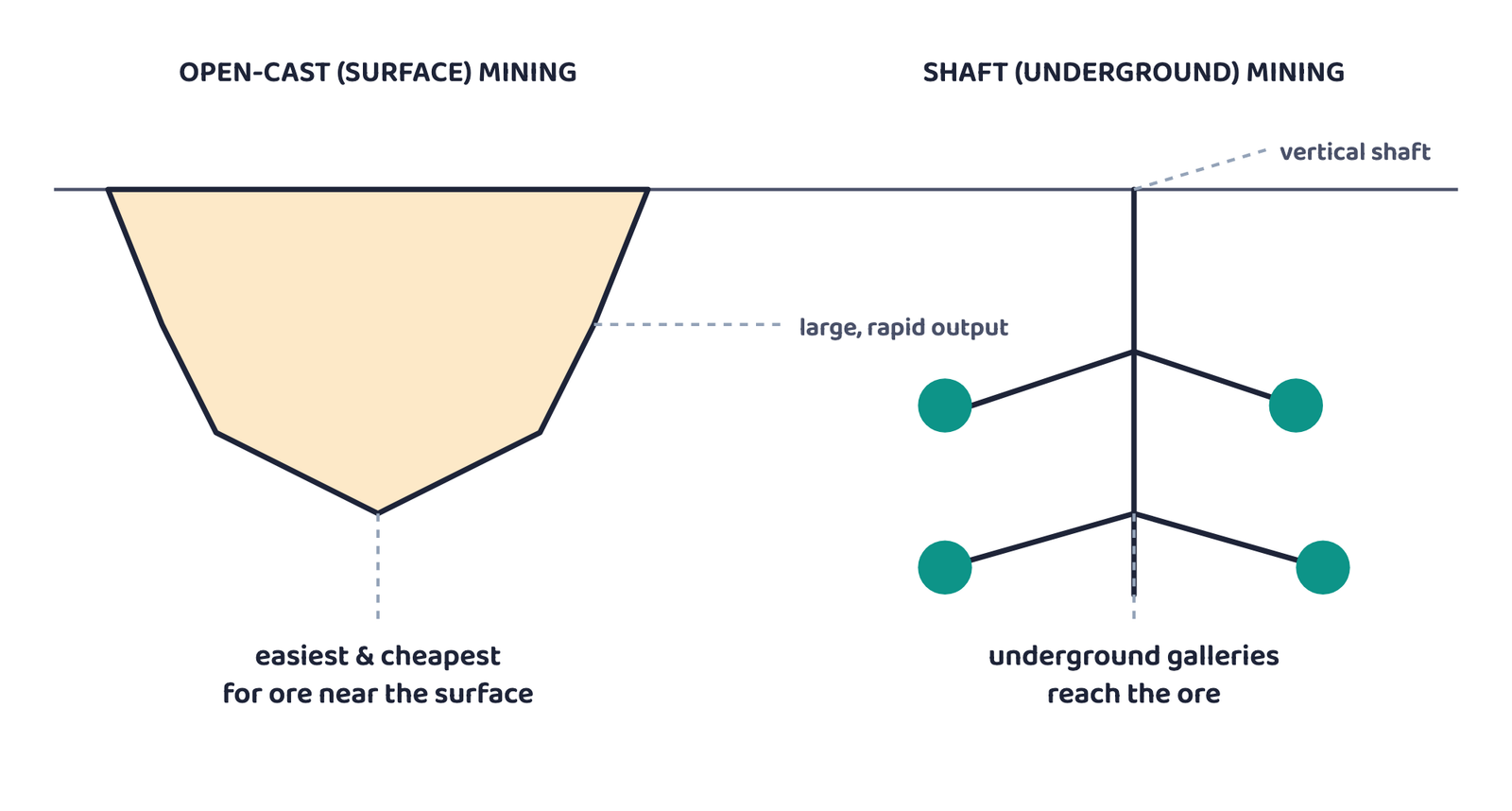
| Surface (open-cast) mining | Underground (shaft) mining | |
|---|---|---|
| Used when | Ore lies close to the surface | Ore lies deep below the surface |
| How it works | Overhead layers are stripped away to reach the ore directly | Vertical shafts are sunk; underground galleries radiate out to reach the ore, and minerals are hauled up through these passages |
| Cost and safety | Cheapest method; safety and equipment costs are relatively low | Needs special lifts, drills, haulage vehicles and a ventilation system |
| Output | Large and rapid | Minerals are extracted and hauled to the surface through the shafts and galleries |
| Risk | The book does not call it risky; overhead costs on safety precautions are relatively low | The book calls it risky: poisonous gases, fires, floods and cave-ins can cause fatal accidents |
“Open-cast” and “shaft” mining are not two names for the same thing; they are opposites, chosen by how deep the ore lies. Open-cast = surface, easiest and cheapest. Shaft = underground, needs specially designed equipment, risky.
Globally, developed economies are moving away from mining, processing and refining, because labour costs there are high. Developing countries, with large labour forces and a need to raise living standards, are becoming more important instead: several countries in Africa, and some in South America and Asia, earn more than half their income from minerals alone.
- Primary activities take resources straight from the environment: hunting & gathering, pastoral activities, fishing, forestry, agriculture, mining
- Hunting and gathering is the oldest economic activity, low capital, low tech, no surplus
- Nomadic herding is subsistence and mobile; commercial livestock rearing is organised, scientific and export-oriented
- Transhumance = seasonal movement between plain and mountain pastures
- Shifting cultivation (slash-and-burn) is Jhuming in NE India, Milpa in Central America, Ladang in Indonesia/Malaysia
- Intensive subsistence agriculture is wet-paddy dominated or non-paddy dominated, both in densely populated monsoon Asia
- Plantation agriculture is single-crop, colonial in origin, capital and labour intensive
- Mixed farming balances crops and animals equally; dairy farming needs urban markets and has no off-season
- Mediterranean agriculture specialises in citrus fruits and viticulture; market gardening and truck farming supply vegetables to nearby cities
- Co-operative farming keeps individual ownership; collective farming (Kolkhoz) pools ownership itself
- Mining is surface (open-cast, easiest and cheapest) or underground (shaft, needs special equipment, risky)
- Can I name all six primary activities without looking?
- Can I explain transhumance and name the Himalayan communities that practise it?
- Can I list the three regional names for shifting cultivation?
- Can I shade and label the five CBSE map areas on a blank world map?
- Can I tell open-cast mining and shaft mining apart in one line each?
- Can I write the difference between co-operative and collective farming?
- 1 markWhich one of the following is not a plantation crop?
(a) Coffee(b) Sugarcane(c) Wheat(d) Rubber - 1 markIn which country was co-operative farming the most successful experiment?
(a) Russia(b) Denmark(c) India(d) The Netherlands - 1 markGrowing of flowers for market is called:
(a) Truck farming(b) Factory farming(c) Mixed farming(d) Floriculture - 1 markWhich type of cultivation was developed by European colonists?
(a) Kolkhoz(b) Viticulture(c) Mixed farming(d) Plantation agriculture - 1 markIn which of these regions is extensive commercial grain cultivation NOT practised?
(a) American and Canadian Prairies(b) European Steppes(c) Pampas of Argentina(d) Amazon Basin - 1 markCitrus fruit cultivation is very important in which type of agriculture?
(a) Market gardening(b) Plantation agriculture(c) Mediterranean agriculture(d) Co-operative farming - 1 markWhich type of agriculture is also called “slash and burn agriculture”?
(a) Extensive subsistence agriculture(b) Primitive subsistence agriculture(c) Extensive commercial grain cultivation(d) Mixed farming - 1 markWhich one of the following does NOT follow monoculture (a single crop or animal)?
(a) Dairy farming(b) Mixed farming(c) Plantation agriculture(d) Commercial grain farming
- 1 mark
Assertion (A): The number of pastoral nomads and the areas they use are shrinking.
Reason (R): The imposition of political boundaries and new settlement plans by different countries have restricted their movement.(a) Both A and R are true, and R is the correct explanation of A(b) Both A and R are true, but R is not the correct explanation of A(c) A is true, but R is false(d) A is false, but R is true
- 1 mark
Assertion (A): Extensive commercial grain farms have a high yield per acre.
Reason (R): These farms are so large that every stage from ploughing to harvesting is done by machines.(a) Both A and R are true, and R is the correct explanation of A(b) Both A and R are true, but R is not the correct explanation of A(c) A is true, but R is false(d) A is false, but R is true
- 1 mark
Assertion (A): Dairy farming is practised close to urban and industrial centres.
Reason (R): These centres provide a ready market for fresh milk and dairy products, which spoil quickly.(a) Both A and R are true, and R is the correct explanation of A(b) Both A and R are true, but R is not the correct explanation of A(c) A is true, but R is false(d) A is false, but R is true
- 2 marksWhy is the future of shifting cultivation considered bleak?
- 2 marksWhy is market gardening practised close to urban areas?
- 3 marksWhy did large-scale dairy farming become possible only after the development of transportation and refrigeration?
- 2 marksWhat is transhumance? Name two communities that practise it in India.
- 2 marksGive any two differences between primitive subsistence agriculture and intensive subsistence agriculture.
- 3 marksList the physical and economic factors that decide whether a mineral deposit is profitable to mine.
- 2 marksWhy is hunting now banned in India?
- 2 marksDistinguish between co-operative farming and collective farming.
- 3 marksExplain why gathering has little chance of becoming an important commercial activity at the global level.
- 2 marksWhat is truck farming, and how did it get its name?
- 5 marksDifferentiate between nomadic herding and commercial livestock rearing.
- 5 marksDiscuss the important characteristic features of plantation agriculture. Name a few important plantation crops and the countries that introduced them.
- 5 marksDescribe the two types of intensive subsistence agriculture practised in monsoon Asia, with examples.
- 5 marksExplain the two methods of mining. Why is underground (shaft) mining considered more risky than surface mining?
- 5 marksDescribe the characteristic features of mixed farming and explain why it needs high capital investment.
- 5 marksWhat is Mediterranean agriculture? Describe the regions where it is practised and its main products.