
1 Growth and Development
“Growth” and “development” sound like the same word to most people, but the chapter uses them very differently. Both describe a change over time, in a country, a city or even a person, but the kind of change is not the same.
Growth is a quantitative change. It is value-neutral, which means it can be positive (an increase) or negative (a decrease).
Development is a qualitative change. It is always value-positive, meaning development can never be negative. Development happens only when growth is positive and that growth also brings a genuine improvement in quality.
So positive growth does not always mean development. A city’s population can grow from one lakh to two lakh people, but if housing, basic services and other facilities stay exactly as poor as before, that growth has not been accompanied by development.
“Which one best describes development?” is the chapter’s own first exercise question. The answer is always a positive change in quality, never “an increase in size”, which describes growth.
2 What Is Human Development?
For many decades, a country’s development was judged only by its economic growth: the bigger the economy, the more “developed” the country was considered. But a bigger economy does not automatically mean a better life for most people, so this idea was too narrow.
Human development, a concept introduced by Dr Mahbub-ul-Haq, is development that enlarges people’s choices and improves their lives. People are placed at the centre of all development. The basic goal is to create conditions in which people can live meaningful lives.
A meaningful life is not simply a long one. It must have a purpose: people must be healthy, able to develop their talents, able to take part in society, and free to achieve their own goals. The chapter links this to the Government of India’s Beti Bachao Beti Padhao programme, introduced to address the issue of decline in child sex ratio.
Dr Mahbub-ul-Haq, a Pakistani economist, created the Human Development Index in 1990. He and his close friend, Nobel Laureate Prof. Amartya Sen, worked together on the earliest Human Development Reports. Haq saw human development as enlarging people’s choices to live long, healthy lives with dignity; Sen saw an increase in freedom (or a decrease in unfreedom) as the main goal of development, and studied how social and political institutions help increase that freedom. Since 1990 the United Nations Development Programme (UNDP) has published the Human Development Report every year, using Haq’s concept.
2.1 The three key areas
Leading a long and healthy life, being able to gain knowledge, and having enough means to live a decent life are the most important aspects of human development. So access to resources, health and education are the key areas the chapter builds everything else on.
Health
Being able to live a long and healthy life.
Education
Being able to gain knowledge.
Resources
Having enough means to live a decent life.
2.2 Why people’s choices get limited
Very often people do not have the capability and freedom to make even basic choices, because of their inability to acquire knowledge, material poverty, social discrimination or the inefficiency of institutions. Building people’s capabilities in health, education and access to resources is what enlarges their choices; without those capabilities, choices stay limited.
An uneducated child cannot choose to become a doctor, because her lack of education has already limited that choice. A poor person often cannot choose to get medical treatment for a disease, because a lack of resources has limited that choice. In India, a large number of women and people from socially and economically backward groups drop out of school, which shows exactly how limited access to knowledge limits a group’s choices.
3 The Four Pillars of Human Development
Just as a building needs pillars to stand, the idea of human development rests on four ideas: equity, sustainability, productivity and empowerment.
3.1 The four pillars, one by one
Equity
Equal access to opportunities for everybody, whatever their gender, race or income, and in India’s case, caste. This is very often not the case, in almost every society.
Sustainability
Continuity in the availability of opportunities. Every generation must have the same opportunities, so environmental, financial and human resources must be used with the future in mind. Not sending girls to school today, for example, costs them opportunities as adults: their career choices are severely curtailed, and this affects other aspects of their lives too.
Productivity
Human labour productivity, constantly enriched by building people’s capabilities. People are the real wealth of nations, so raising their knowledge or health improves how productively they work.
Empowerment
Having the power to make choices, which comes from increasing freedom and capability. Good governance and people-oriented policies empower people, and empowering socially and economically disadvantaged groups matters most of all.
It is people who are the real wealth of nations.
the idea productivity is built on
4 Approaches to Human Development
There are several ways of looking at the problem of human development. NCERT lists four important approaches.
| Approach | What it says |
|---|---|
| (a) Income approach | One of the oldest approaches. Human development is linked directly to income: the level of income reflects the level of freedom a person enjoys, so higher income means higher human development. |
| (b) Welfare approach | Sees people as beneficiaries, or targets, of development, not participants: only passive recipients. It argues for higher government expenditure on education, health, social security and amenities. The government is responsible for raising human development through welfare spending. |
| (c) Basic Needs approach | Proposed by the International Labour Organisation (ILO). It identifies six basic needs: health, education, food, water supply, sanitation and housing. It ignores the question of human choices and stresses only the provision of these basic needs to defined sections of people. |
| (d) Capability approach | Associated with Prof. Amartya Sen. Building human capabilities in health, education and access to resources is the key to increasing human development. |
Students often confuse the welfare approach with the four pillars and pick it as one of them in an MCQ. Welfare is an approach to human development, not one of the four pillars (equity, sustainability, productivity, empowerment). Keep the two lists separate.
5 Measuring Human Development: the HDI
The Human Development Index (HDI) ranks countries on their performance in the key areas of health, education and access to resources. Each country earns a score between 0 and 1; the closer the score is to 1, the greater the level of human development.
| Dimension | Indicator used | Weight |
|---|---|---|
| Health | Life expectancy at birth | 1/3 |
| Knowledge | Adult literacy rate + gross enrolment ratio | 1/3 |
| Access to resources | Purchasing power, in US dollars | 1/3 |
The HDI is the sum total of the weights assigned to all three dimensions. A higher life expectancy means people have a better chance of living longer, healthier lives; the adult literacy rate and gross enrolment ratio together show how easy or hard it is to access knowledge; and purchasing power in US dollars stands for access to resources.
The HDI is not the most reliable measure of human development, even though it measures real attainments. It says nothing about how development is distributed within a country: two countries with the same HDI can have very different levels of inequality.
6 The Human Poverty Index (HPI)
The Human Poverty Index (HPI) is related to the HDI but measures the shortfall in human development instead of its attainment. It is a non-income measure.
The HPI takes into account: the probability of not surviving till the age of 40, the adult illiteracy rate, the number of people without access to clean water, and the number of small children who are underweight. The human poverty index is often more revealing than the human development index, and looking at both measures together gives an accurate picture of a country’s human development situation.
The ways of measuring human development are constantly being refined, and newer ways of capturing its different elements are being researched. Researchers have found links between the level of corruption or political freedom in a particular region, and there is discussion of a political freedom index and of a listing of the most corrupt countries.
6.1 HDI and HPI side by side
Human Development Index
- Measures attainment
- Score is closer to 1 for better development
- Uses life expectancy, literacy/enrolment, purchasing power
Human Poverty Index
- Measures shortfall
- A non-income measure
- Uses survival to 40, illiteracy, clean water access, underweight children
Bhutan is the only country in the world to officially proclaim Gross National Happiness (GNH) as the measure of its progress, instead of an income-based index. Material and technological progress are approached cautiously, so that they do not harm the environment or the Bhutanese people’s cultural and spiritual life. Material progress must never come at the cost of happiness.
7 International Comparisons
International comparisons of human development produce some genuinely interesting results, because the size of a country’s territory and its per capita income are not directly related to its human development. Smaller countries have often done better than larger ones, and relatively poorer nations have sometimes ranked higher than richer neighbours.
Sri Lanka and Trinidad and Tobago rank higher than India in the HDI, despite having smaller economies. Within India, Kerala performs much better than Punjab and Gujarat in human development, despite having a lower per capita income than both.
8 Grouping Countries by Human Development
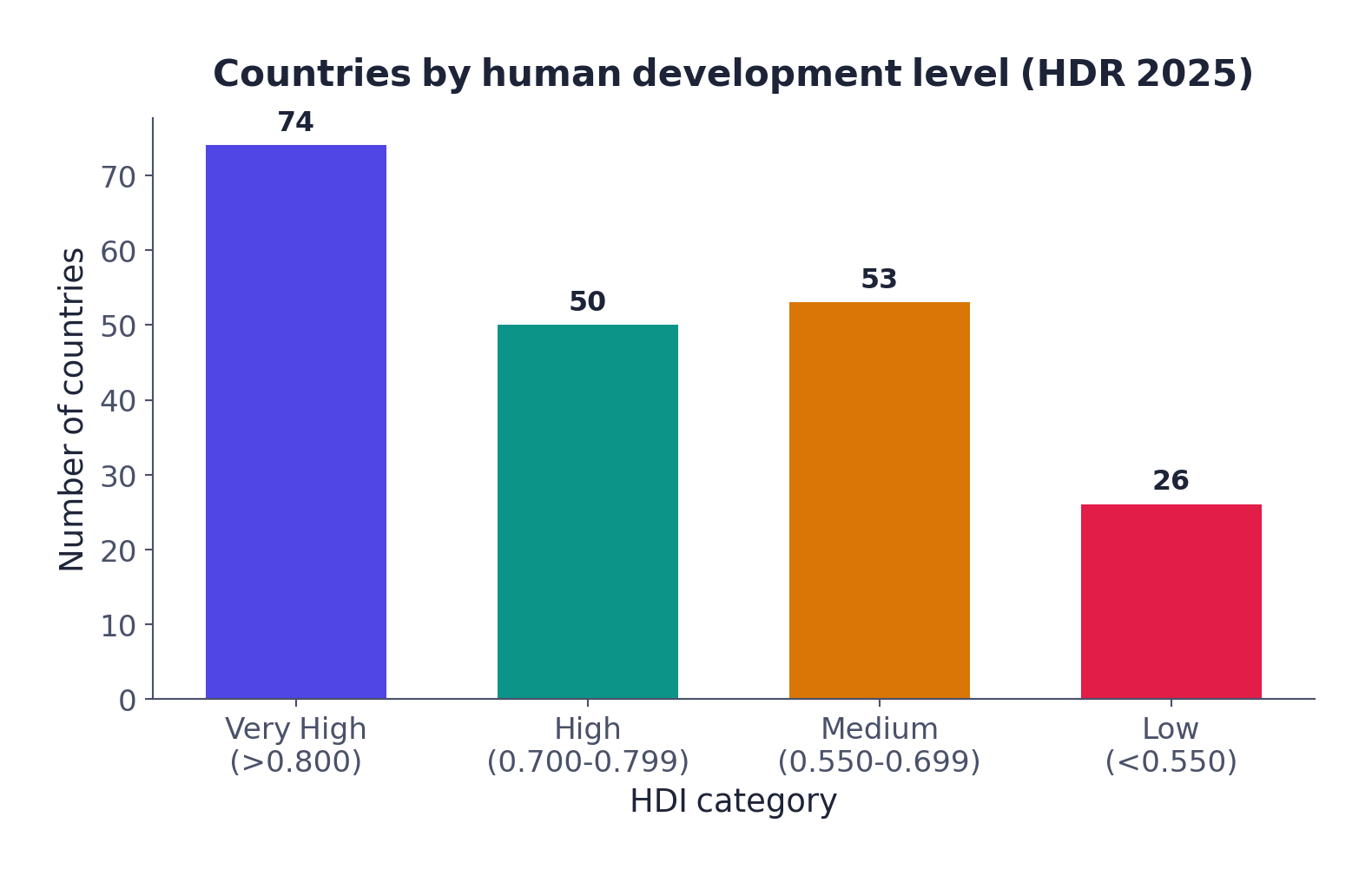
Countries can be classified into four groups on the basis of the human development score they earn. These are the figures the chapter itself gives, sourced from the Human Development Report 2025.
| Level of human development | Score in HDI | Number of countries |
|---|---|---|
| Very High | above 0.800 | 74 |
| High | 0.700 up to 0.799 | 50 |
| Medium | 0.550 up to 0.699 | 53 |
| Low | below 0.550 | 26 |
8.1 Very High human development: 74 countries
These countries score above 0.800. Table 3.3 lists the ten with the highest scores.
| Rank | Country |
|---|---|
| 1 | Iceland |
| 2 | Norway |
| 3 | Switzerland |
| 4 | Denmark |
| 5 | Germany |
| 5 | Sweden |
| 7 | Australia |
| 8 | Hongkong, China (SAR) |
| 8 | Netherlands |
| 10 | Belgium |
Many of these countries have been former imperial powers, are industrialised and located in Europe, and are not very socially diverse. Still, striking numbers of non-European countries have made it onto this list too.
- 1 markAccording to the passage, by how many places did India’s rank improve from 2022 to the 2025 Report?
- 2 marksName the three fields in which India’s HDI performance is described as strong.
8.2 High human development: 50 countries
Providing education and healthcare is an important government priority in this group. Higher investment in the social sector and good governance are what set these countries apart from the others.
8.3 Medium human development: 53 countries
Most of these countries emerged in the period after the Second World War: some were former colonies, and many others emerged after the break-up of the erstwhile Soviet Union. Many are rapidly improving their scores through more people-oriented policies and less social discrimination, but this group also has much higher social diversity than the higher-HDI groups, and many of its countries have faced political instability and social uprisings.
The chapter’s text says the Medium group “form[s] the largest group”, but its own Table 3.2 (HDR 2025) shows more countries in the Very High group (74) than in the Medium group (53). The sentence is left over from an older report. In an answer, quote the four counts from Table 3.2 rather than calling any group the largest.
8.4 Low human development: 26 countries
Most of these are small countries going through political turmoil, civil war, famine or a high incidence of disease. The chapter stresses an urgent need to address their human development requirements through well thought-out policies.
9 Why Do Countries Differ in Human Development?
People often blame low human development on a country’s culture, religion or community: “Country X has lower human development because its people follow religion Y”, or “belong to community Z.” The chapter calls such statements misleading. Never write culture, religion or community as a cause of low HDI in an answer.
To actually understand why a region keeps reporting low or high human development, look at two real factors instead: the pattern of government expenditure on the social sector, and the political environment and freedom people have.
9.1 High-HDI and low-HDI countries compared
High-HDI countries
- Invest more in the social sector
- Are generally free from political turmoil and instability
- Distribute the country’s resources far more equitably
Low-HDI countries
- Spend more on defence than on the social sector
- Tend to be located in areas of political instability
- Have not been able to start accelerated economic development
- Can I explain the difference between growth and development without notes?
- Can I name the four pillars and the four approaches, without mixing them up?
- Can I name the three dimensions the HDI measures, and their weight?
- Can I explain why HDI is not the most reliable measure of development?
- Can I give one example each of a smaller economy and a state beating a richer neighbour in HDI?
- Growth is quantitative and can be + or −; development is always a positive, qualitative change
- Human development (Dr Mahbub-ul-Haq) means enlarging people’s choices; its three key areas are health, education and access to resources
- The four pillars: equity, sustainability, productivity, empowerment
- The four approaches: income, welfare, basic needs (ILO), capability (Amartya Sen)
- HDI = health (life expectancy) + knowledge (literacy + enrolment) + resources (purchasing power in US$), each weighted 1/3; score 0 to 1
- HDI measures attainment but says nothing about distribution; HPI measures the shortfall instead, and is a non-income measure
- Territory size and income don’t decide HDI rank: Sri Lanka and Trinidad and Tobago beat India, and Kerala beats Punjab and Gujarat
- Four HDI groups (HDR 2025): Very High 74, High 50, Medium 53, Low 26 countries
- Culture and religion do not explain low human development: government spending on the social sector and political stability do
- 1 markWhich one of the following best describes development?
(a) an increase in size(b) a constant in size(c) a positive change in quality(d) a simple change in the quality - 1 markThe concept of human development was introduced by:
(a) Prof. Amartya Sen(b) Ellen C. Semple(c) Dr Mahbub-ul-Haq(d) Ratzel - 1 markDr Mahbub-ul-Haq created the Human Development Index in the year:
(a) 1980(b) 1990(c) 2000(d) 2010 - 1 markThe Basic Needs Approach to human development was proposed by:
(a) UNDP(b) the International Labour Organisation(c) the World Bank(d) UNESCO - 1 markThe capability approach to human development is associated with:
(a) Prof. Amartya Sen(b) Dr Mahbub-ul-Haq(c) Ellen C. Semple(d) Ratzel - 1 markWhich of these is NOT one of the four pillars of human development?
(a) Equity(b) Sustainability(c) Welfare(d) Empowerment - 1 markAccording to Table 3.2 of the chapter, a country with an HDI score of 0.62 falls in which category?
(a) Very High(b) High(c) Medium(d) Low - 1 markWhich country is the only one to officially adopt Gross National Happiness as its measure of progress?
(a) Nepal(b) Bhutan(c) India(d) Sri Lanka
- 1 mark
Assertion (A): The Human Development Index is the most reliable measure of human development.
Reason (R): The Human Development Index says nothing about how development is distributed within a country.(a) Both A and R are true, and R is the correct explanation of A(b) Both A and R are true, but R is not the correct explanation of A(c) A is true, but R is false(d) A is false, but R is true
- 1 mark
Assertion (A): The Basic Needs Approach was proposed by the International Labour Organisation.
Reason (R): This approach identified six basic needs: health, education, food, water supply, sanitation and housing.(a) Both A and R are true, and R is the correct explanation of A(b) Both A and R are true, but R is not the correct explanation of A(c) A is true, but R is false(d) A is false, but R is true
- 1 mark
Assertion (A): Kerala performs much better than Punjab and Gujarat in human development.
Reason (R): Kerala has a higher per capita income than Punjab and Gujarat.(a) Both A and R are true, and R is the correct explanation of A(b) Both A and R are true, but R is not the correct explanation of A(c) A is true, but R is false(d) A is false, but R is true
- 1 markDefine human development in one line.
- 1 markWhat is meant by ‘growth’ in the context of development?
- 1 markName the two indices UNDP uses to measure human development.
- 1 markSince which year has the UNDP published the Human Development Report?
- 1 markDoes the HDI measure attainment or shortfall in human development?
- 1 markName the four pillars of human development.
- 1 markWhich country has officially adopted Gross National Happiness as its measure of progress?
- 1 markName one country that ranks higher than India on the HDI despite having a smaller economy.
- 1 markWhat does a country’s HDI score being closer to 1 indicate?
- 3 marksDifferentiate between growth and development.
- 3 marksWhat are the three key areas measured by the Human Development Index? Name the indicator used for each.
- 3 marksWhat is the Human Poverty Index? How is it different from the Human Development Index?
- 3 marksWhat is the Basic Needs Approach to human development?
- 3 marksExplain any three features of the welfare approach to human development.
- 3 marks“Territory size and per capita income are not directly related to human development.” Explain with two examples from the chapter.
- 3 marksWhy do some low-HDI countries spend more on defence than on the social sector?
- 3 marksWhat is the capability approach to human development, and who is it associated with?
- 5 marksWhat is human development? Explain the concept and describe the three basic areas around which it is built.
- 5 marksWhat do equity and sustainability mean in the concept of human development? Explain with examples.
- 5 marksDescribe the four pillars of human development.
- 5 marksExplain the four approaches to human development.
- 5 marksHow are countries classified on the basis of the Human Development Index? Describe the four categories with their score ranges and country counts.