and Its Representations
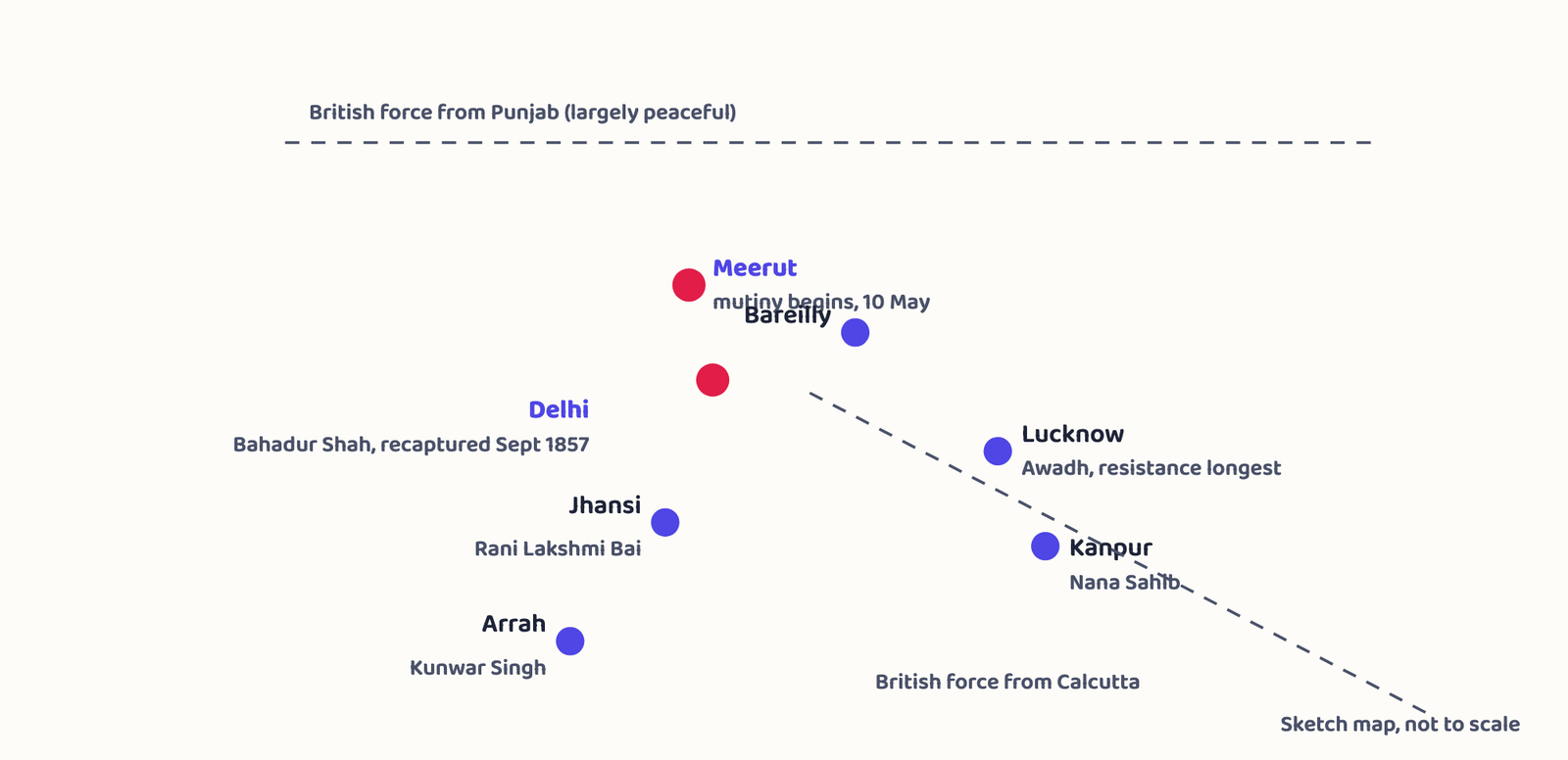
On 10 May 1857, sepoys at Meerut mutinied, burned government buildings and cut the telegraph line to Delhi. The next morning they reached the Red Fort; the old Mughal emperor Bahadur Shah, initially horrified, was pressured into blessing the revolt, which gave it legitimacy far beyond a single cantonment’s mutiny. Once word spread, cantonment after cantonment across the Gangetic valley rose.
1 Pattern of the Uprising
1.1 How the mutinies began
A signal, often the evening gun or a bugle, set off a fixed sequence: seize the bell of arms (the weapons store), plunder the treasury, attack government buildings (jail, treasury, telegraph office, record room), burn records, and target anything connected to the firangi (a Persian-derived, often derogatory term for foreigners). Proclamations in Hindi, Urdu and Persian called on Hindus and Muslims together to rise. As ordinary people joined in, targets widened to moneylenders and the rich, seen both as oppressors and as British allies, in towns like Lucknow, Kanpur and Bareilly. British rule, one officer admitted, “collapsed like a house made of cards.”
Delhi Urdu Akhbar, 14 June 1857: “People have been found to complain that even kaddu (pumpkin) and baingan (brinjal) cannot be found in the bazaars… the water-carriers have stopped filling water… many mohallas have not been able to earn for several days and if this situation continues then decay, death and disease will combine together to spoil the city’s air.”
1.2 Lines of communication
The similarity of pattern across cantonments points to real coordination: after the 7th Awadh Irregular Cavalry refused the new cartridges, they wrote to the 48th Native Infantry that “they had acted for the faith and awaited the 48th’s orders.” Panchayats of native officers, drawn from each regiment, met nightly in places like the Kanpur sepoy lines to decide collective action, evidence that sepoys, sharing barracks life and often caste, were genuinely the makers of their own rebellion.
François Sisten, a native Christian police inspector in Awadh, was asked by a Muslim tahsildar, “What news from Awadh? How does the work progress, brother?” Sisten answered cautiously; the tahsildar replied, “Depend upon it, we will succeed this time. The direction of the business is in able hands.” That tahsildar turned out to be the principal rebel leader of Bijnor, evidence of how plans travelled through casual conversation between strangers who recognised each other as sympathisers.
Mutiny is collective disobedience within the armed forces; revolt (or rebellion) is uprising against established authority generally. In 1857, “revolt” usually refers to the civilian uprising (peasants, zamindars, rajas, jagirdars), “mutiny” to the sepoys’ action specifically.
1.3 Leaders and followers
Rebels often turned to pre-British rulers for leadership, though acceptance was rarely eager. Bahadur Shah’s own first reaction was horror. In Kanpur, sepoys and townspeople gave Nana Sahib (successor to Peshwa Baji Rao II) little choice but to lead; in Jhansi the Rani was pushed into leadership by popular pressure, as was Kunwar Singh, a zamindar of Arrah, Bihar. In Awadh, still raw from Nawab Wajid Ali Shah’s displacement, people rallied around his young son Birjis Qadr.
Leadership was not only aristocratic. From Meerut came reports of a fakir revered by the sepoys; Lucknow saw self-styled prophets preaching British rule’s end. Local, non-elite leaders emerged too.
Shah Mal
- A Jat cultivator of pargana Barout, UP, with kinship ties across chaurasee des (84 villages)
- Mobilised headmen and cultivators against the British land revenue system, moved village to village by night
- Attacked government buildings, destroyed a bridge, dug up metalled roads to block government forces and reject symbols of British rule
- Locally acknowledged as Raja, took over an English officer’s bungalow as a “hall of justice”, set up an intelligence network
- Killed in battle, July 1857
Maulvi Ahmadullah Shah
- Educated in Hyderabad, preached jehad against the British from 1856, village to village
- Called “Danka Shah” for the drumbeaters who led his palanquin
- Jailed in Faizabad in 1857; on release, elected leader by the mutinous 22nd Native Infantry
- Fought at the Battle of Chinhat, defeating the British under Henry Lawrence
- Widely believed invincible and magically protected, a belief that itself underpinned his authority
Elsewhere: Gonoo, a tribal cultivator of Singhbhum in Chotanagpur, led the Kol tribals.
1.4 Rumours and prophecies
The sepoys who reached Bahadur Shah described new Enfield rifle cartridges greased with cow and pig fat, a direct offence to Hindu and Muslim religious practice. British denials made no difference; the rumour spread across North Indian sepoy lines regardless.
Captain Wright reported that a “low-caste” khalasi at the Dum Dum magazine, refused a drink from a Brahmin sepoy’s lota as polluting, retorted: “You will soon lose your caste, as ere long you will have to bite cartridges covered with the fat of cows and pigs.” True or not, the story shows how caste tension itself could seed a rumour that then spread far beyond its origin.
A wider rumour held that bone dust from cows and pigs was mixed into market flour, part of a supposed British plot to destroy Hindu and Muslim caste and religion and force conversion to Christianity, feeding fears people refused to touch atta at all. A further prophecy held British rule would end on 23 June 1857, the centenary of the Battle of Plassey. Chapattis also circulated village to village, an unclear but widely read omen of upheaval.
1.5 Why did people believe in the rumours?
Whether a rumour was factually true matters less than what it reveals about the fears people already held. Since the late 1820s under Lord William Bentinck, British “reform” policies, English-medium education, banning sati (1829), permitting widow remarriage, had already unsettled established custom. Annexations on flimsy pretexts (misgovernment, refusal to recognise adoption) took Awadh, Jhansi, Satara and more, each followed by new British administration, law and revenue systems. To people across North India it felt as if everything cherished, kings, custom, landholding patterns, was being dismantled and replaced by something impersonal and alien, made worse by visible missionary activity. Rumours thrived precisely because this fear was already real.
2 Awadh in Revolt
2.1 “A cherry that will drop into our mouth one day”
Governor General Lord Dalhousie used this phrase for Awadh in 1851; the kingdom was formally annexed in 1856. Conquest came in stages: the Subsidiary Alliance (imposed 1801) forced the Nawab to disband his army, host British troops, and follow the advice of a British Resident, leaving him unable to control his own rebellious chiefs and taluqdars. The British also wanted Awadh directly, good soil for indigo and cotton, a natural market centre for Upper India, and by the early 1850s the last major unconquered region left in North India.
Under the Subsidiary Alliance (Lord Wellesley, 1798), an allied ruler accepted British protection, hosted a British armed contingent (paid for by the ally), and could only make war or treaties with British permission. A Resident was the Governor General’s representative attached to a state not under direct British rule.
2.2 “The life was gone out of the body”
Nawab Wajid Ali Shah was dethroned and exiled to Calcutta, officially for misgovernment, though he was in fact widely loved: many followed him from Lucknow to Kanpur singing laments as he left. A contemporary observer wrote: “The life was gone out of the body, and the body of this town had been left lifeless… there was no street or market and house which did not wail out the cry of agony.” A folk song put it plainly: “the honourable English came and took the country” (Angrez Bahadur ain, mulk lai linho). The court’s dissolution also threw musicians, dancers, poets, artisans, cooks and administrative staff out of work overnight.
2.3 Firangi raj and the end of a world
Annexation dispossessed not only the Nawab but the region’s taluqdars, who had long held armed retainers and forts (bigger ones up to 12,000 foot-soldiers, smaller ones about 200) under the Nawab’s loose suzerainty. The British disarmed them and destroyed their forts immediately. The Summary Settlement of 1856 then assumed taluqdars were mere interlopers with no legitimate stake in land, and stripped them wherever it could: their share of Awadh’s villages fell from 67 per cent to 38 per cent, hardest in southern Awadh, where some lost over half their villages.
Do not assume removing taluqdars actually helped peasants. British officials expected settling directly with “real” cultivators would reduce exploitation and raise revenue. Revenue did rise, but the peasant’s burden did not fall: revenue demand in some areas rose 30 to 70 per cent, so neither taluqdars nor peasants had reason to welcome annexation.
Losing the taluqdar also broke a whole social relationship: taluqdars extracted dues but, as local patrons, often eased demands in hardship or lent support at festival time; the impersonal British revenue system offered no such flexibility. Where 1857 resistance in Awadh was fiercest and longest, taluqdars fought alongside their own peasants, many joining Begum Hazrat Mahal (Wajid Ali Shah’s wife) in Lucknow.
Hanwant Singh, Raja of Kalakankar, to a British officer he had sheltered: “Sahib, your countrymen came into this country and drove out our King… At one blow you took from me lands which from time immemorial had been in my family. I submitted. Suddenly misfortune fell upon you. The people of the land rose against you. You came to me whom you had despoiled. I have saved you. But now… I march at the head of my retainers to Lucknow to try and drive you from the country.”
Sepoy grievances ran parallel and connected: low pay, difficulty getting leave, and, from the 1840s, a sharp change in officer relations. Where 1820s officers had wrestled, hunted and socialised with sepoys, fluent in Hindustani and locally familiar, 1840s officers grew racially superior and abusive, replacing trust with suspicion, exactly the atmosphere in which the cartridge rumour could ignite.
Most Bengal Army sepoys, many Brahmin or “upper” caste, came from Awadh and eastern UP, giving Awadh its nickname, the “nursery of the Bengal Army”. Grievances flowed both ways along that link: sepoys’ fears about cartridges reached their villages, and rural anger over annexation reached the barracks, so once sepoys mutinied, village kin joined almost instantly.
3 What the Rebels Wanted
Because the British won, their accounts dominate the record; rebels left few of their own, mostly illiterate sepoys and villagers, aside from scattered proclamations and ishtahars (notifications). Reconstructing the rebel viewpoint is inevitably harder than reconstructing the official one.
3.1 The vision of unity
Rebel proclamations, even those issued in the name of Muslim princes, deliberately addressed Hindu sentiment too, appealing to a shared pre-British Hindu-Muslim past under the Mughals. A proclamation issued under Bahadur Shah’s name called on people to fight “under the standards of both Muhammad and Mahavir.” Communal division was notably absent even where the British actively tried to manufacture it: at Bareilly in December 1857, the British spent Rs 50,000 to incite Hindus against Muslims, and failed.
This ishtahar addressed distinct social groups by name. On zamindars: British settlements “imposed exorbitant Jumas… and have disgraced and ruined several zemindars, by putting up their estates for public auction.” On merchants: the British “monopolised the trade of all the fine and valuable merchandise… leaving only the trade of trifles to the people.” On public servants: natives “have little respect, low pay, and no manner of influence” under British rule. On artisans: English imports had thrown “weavers, the cotton dressers, the carpenters, the blacksmiths, and the shoemakers… out of employ.” On pundits and fakirs: as “guardians of the Hindoo and Mohammadan religions,” they were bound to join what was framed as a holy war.
Why this matters: it shows the rebellion was consciously pitched across every major social group, each addressed with its own specific economic grievance, not a single undifferentiated appeal.
From a surviving sepoy arzi (petition): “in the year eighteen fifty seven the British issued an order that new cartridges and muskets… were to be issued; in the former of which the fats of cows and pigs were mixed… They gave these cartridges to the sowars of the 3rd Light Cavalry, and ordered them to bite them; the troopers objected to it… upon this the British officers… made 84 new troopers prisoners, and put them in jail with irons on them… we and all our country-men having united together, have fought the British for the preservation of our faith… If the religion of a Hindoo or Mussalman is lost, what remains in the world?”
3.2 Against the symbols of oppression
Proclamations rejected everything associated with firangi raj: broken treaties, land revenue settlements that dispossessed landholders large and small, and foreign trade that ruined artisans and weavers. Widespread fear that the British meant to destroy Hindu and Muslim religion and force Christian conversion runs through them, the same fear that made the rumours believable in the first place. In many places rebellion widened past the British themselves into attacks on local elites seen as collaborators, burnt account books, ransacked moneylender houses, a real if never explicitly stated impulse toward overturning traditional hierarchy, even though the proclamations themselves stayed focused on uniting everyone against the firangi rather than airing this more radical, egalitarian undertone.
3.3 The search for alternative power
Where British rule collapsed, in Delhi, Lucknow, Kanpur, rebels tried to build alternative administration: appointments to posts, revenue collection arrangements, troop payment, orders against looting, chains of military command, all consciously modelled on the eighteenth-century Mughal court, the symbol of what had been lost. Most such structures were short-lived, but in Awadh, where resistance lasted longest, the Lucknow court still had counter-attack plans and a working command hierarchy as late as early 1858.
4 Repression
The British passed emergency Acts in May-June 1857 placing all of North India under martial law, letting even ordinary Britons try and punish suspected rebels, with rebellion carrying only one sentence: death. Recognising Delhi’s symbolic weight just as the rebels did, the British mounted a two-pronged attack, from Calcutta and from the largely peaceful Punjab, but did not retake the city until late September 1857, after heavy losses on both sides, since rebels from across North India had converged there to defend it.
Reconquest of the Gangetic plain was slow and had to happen village by village, since the countryside itself was hostile; in Awadh, British official Forsyth estimated three-fourths of the adult male population was in rebellion, and the region was not controlled again until March 1858. Alongside military force, the British used political division: promising to restore estates to big landholders in UP who had jointly resisted, splitting elite unity by rewarding loyalty and punishing rebellion; many rebel landholders died fighting or fled to Nepal, where they died of illness or starvation.
An officer reporting from rural Awadh: “the Oude people are gradually pressing down on the line of communication from the North… these villagers are nearly intangible to Europeans, melting away before them and collecting again.” This captures precisely why reconquest was so slow: there was no single army to defeat, only a countryside that dispersed and regrouped faster than British forces could pin it down.
5 Images of the Revolt
With so little surviving rebel testimony, historians have largely worked from British-produced material: letters, diaries, official mutiny records, newspaper reports, and, crucially, a large body of pictorial images, paintings, etchings, posters, cartoons, that tell us as much about British emotion and self-image as about the events themselves.
5.1 Celebrating the saviours
Thomas Jones Barker’s “Relief of Lucknow” (1859) commemorates Colin Campbell’s arrival with reinforcements after Henry Lawrence’s death and Colonel Inglis’s prolonged defence, and after Outram and Havelock had earlier cut through to reinforce the garrison. The composition places Campbell, Outram and Havelock centrally, well lit, surrounded by hand gestures leading the eye to them; the dead and wounded in the foreground signal past suffering, while triumphant horses in the middle ground signal restored British control. To British viewers, such images reassured that the crisis had passed and British power had prevailed.
5.2 English women and the honour of Britain
Newspaper reports of violence against women and children fed British public demand for retribution. Joseph Noel Paton’s “In Memoriam” (1859) shows English women and children huddled together, visibly awaiting violence that is never actually shown, only suggested, which is precisely what made it so effective at provoking imagined outrage; rescuing British forces appear arriving in the background. A contrasting genre showed women as heroic defenders: Miss Wheeler, depicted single-handedly fighting off armed rebels in Kanpur, her struggle framed with an explicitly religious layer, a Bible visible on the floor, casting her personal survival as a defence of Christianity itself.
5.3 Vengeance and retribution
As British public anger grew, images increasingly sanctioned brutal reprisal as necessary justice. A Punch cartoon titled “Justice” (12 September 1857) shows an allegorical female figure, sword and shield in hand, trampling sepoys underfoot while Indian women and children cower, captioned: “The news of the terrible massacre at Cawnpore produced an outburst of fiery indignation and wild desire for revenge throughout the whole of England.” Another, “The British Lion’s Vengeance on the Bengal Tiger” (Punch, 1857), used animal allegory to the same end.
5.4 The performance of terror
Executions, rebels blown from guns or hanged, were staged deliberately in the open, not carried out discreetly, and widely illustrated in journals like the Illustrated London News, which on 3 October 1857 depicted the execution of mutineers at Peshawar, twelve rebels hanging in a row surrounded by cannon, with mounted soldiers and uniformed sepoys forced to watch. This was not routine punishment but a public, theatrical performance of terror aimed at deterring further rebellion.
5.5 No time for clemency
Even calls for restraint were mocked. When Governor General Canning argued that leniency might help win back sepoy loyalty, Punch published “The Clemency of Canning” (24 October 1857), showing him as an indulgent father figure shielding a blood-dripping, still-armed sepoy, captioned mockingly: “they shan’t blow him from nasty guns; but he must promise to be a good little sepoy.” Public sentiment in Britain simply had no room, at that moment, for mercy.
5.6 Nationalist imageries
Twentieth-century Indian nationalism reclaimed 1857 as the “First War of Independence”, uniting all communities against imperial rule, and rebel leaders were recast as heroic figures in art, literature and popular memory. Rani Lakshmi Bai became the era’s defining image, sword in hand, riding into battle, immortalised in Subhadra Kumari Chauhan’s line: “Khoob lari mardani woh to Jhansi wali rani thi” (Like a man she fought, she was the Rani of Jhansi).
The core method question this section is really testing: images are never neutral records. Every visual you have studied here, British or nationalist, was made to persuade a specific audience of a specific feeling, and reading one means asking who made it, for whom, and what emotion it was built to provoke.
6 Timeline and Revision
| Key dates | |
|---|---|
| 1801 | Subsidiary Alliance introduced in Awadh by Wellesley |
| 1856 | Nawab Wajid Ali Shah deposed; Awadh annexed |
| 1856-57 | Summary revenue settlements introduced in Awadh |
| 10 May 1857 | Mutiny starts at Meerut |
| 11-12 May 1857 | Delhi garrisons revolt; Bahadur Shah accepts nominal leadership |
| 20-27 May 1857 | Sepoys mutiny in Aligarh, Etawah, Mainpuri, Etah |
| 30 May 1857 | Rising in Lucknow |
| May-June 1857 | Mutiny turns into general popular revolt |
| 30 June 1857 | British defeated at the Battle of Chinhat |
| July 1857 | Shah Mal killed in battle |
| 25 Sept 1857 | Havelock and Outram enter the Lucknow Residency |
| June 1858 | Rani of Jhansi killed in battle |
- The mutiny began at Meerut (10 May 1857) and gained legitimacy once Bahadur Shah, however reluctantly, blessed it from the Red Fort.
- A recurring pattern (signal, arms seizure, attack on government buildings, targeting of firangis and their allies) plus panchayats and cross-cantonment letters show real planning, not spontaneous chaos.
- Leadership came from displaced royalty (Bahadur Shah, Nana Sahib, Rani of Jhansi, Birjis Qadr) and from local figures (Shah Mal, Maulvi Ahmadullah Shah, Gonoo).
- Rumours (greased cartridges, bone-dust flour) mattered not because they were literally true but because they resonated with real fears built up by decades of British “reform” and annexation.
- Awadh’s revolt was especially deep because annexation (1856) and the Summary Settlement broke taluqdar power and peasant welfare together, and most Bengal Army sepoys came from exactly this region.
- Rebel proclamations, especially the Azamgarh Proclamation, appealed to zamindars, merchants, public servants, artisans and religious leaders separately, and consciously avoided communal division.
- Rebels tried, briefly, to rebuild an eighteenth-century Mughal-style administration wherever British rule collapsed.
- British repression combined martial law and mass executions with political strategy: rewarding loyal landholders to split elite unity.
- Visual sources (Barker’s “Relief of Lucknow”, “In Memoriam”, Punch cartoons) shaped British public opinion toward vengeance; twentieth-century nationalist imagery later recast 1857 as the First War of Independence.
- 1 markWhere and on what date did the mutiny of 1857 begin?
- 1 markWhat is a bell of arms?
- 1 markWhat was the Azamgarh Proclamation?
- 1 markWho was Birjis Qadr?
- 1 markWhat was the Summary Settlement of 1856?
- 2 marksDistinguish between “mutiny” and “revolt” as used in the context of 1857.
- 2 marksWhat was the Subsidiary Alliance, and how did it weaken the Nawab of Awadh?
- 2 marksGive two rumours that circulated among sepoys in early 1857, and explain their common theme.
- 2 marksWhat was “The Clemency of Canning” cartoon mocking?
- 3 marksWhy did the mutinous sepoys in many places turn to erstwhile rulers to provide leadership?
- 3 marksDiscuss the evidence that indicates planning and coordination among the rebels.
- 3 marksDiscuss the extent to which religious beliefs shaped the events of 1857.
- 3 marksWhat measures did rebels take to try to ensure Hindu-Muslim unity?
- 3 marksWhat steps did the British take to quell the uprising?
- 3 marksHow does the story of Shah Mal illustrate the way local grievances fed into the 1857 revolt?
- 3 marksWhat does Hanwant Singh’s statement to the British officer reveal about taluqdar attitudes?
- 5 marksWhy was the revolt particularly widespread in Awadh? What prompted peasants, taluqdars and zamindars to join?
- 5 marksWhat did the rebels want? To what extent did the vision of different social groups differ?
- 5 marksWhat do visual representations tell us about the revolt of 1857? How do historians analyse such representations?
- 5 marksExamine any two sources from the chapter, one visual and one text, and discuss how each represents the point of view of the victor or the vanquished.
- 5 marksDiscuss the problems historians face in reconstructing the rebels’ own point of view on 1857.
- 5 marksHow did the relationship between sepoys and their British officers change between the 1820s and the 1850s, and why did this matter for 1857?
- 5 marksOn an outline map of India, mark Calcutta, Bombay and Madras, and the areas where the 1857 revolt was most widespread. Discuss the geographic pattern you notice.
- 1 markThe Battle of Chinhat, which the British lost, was fought under the rebel leadership of:
(a) Nana Sahib(b) Maulvi Ahmadullah Shah(c) Kunwar Singh(d) Shah Mal - 1 markShah Mal mobilised villagers of a region known as:
(a) chaurasee des(b) Damin-i-Koh(c) Santhal Pargana(d) Doab - 1 markUnder the Summary Settlement, the taluqdars’ share of Awadh’s villages fell from:
(a) 90% to 60%(b) 67% to 38%(c) 50% to 25%(d) 75% to 50% - 1 mark“Relief of Lucknow” (1859) was painted by:
(a) Joseph Noel Paton(b) William Hodges(c) Thomas Jones Barker(d) Felice Beato - 1 markDelhi was recaptured by British forces in:
(a) June 1857(b) September 1857(c) March 1858(d) June 1858 - 1 markThe line “Khoob lari mardani woh to Jhansi wali rani thi” was written by:
(a) Rudrangshu Mukherjee(b) Subhadra Kumari Chauhan(c) Tapti Roy(d) Gautam Bhadra
Choose: (a) both A and R are true and R explains A; (b) both true but R does not explain A; (c) A true, R false; (d) A false, R true.
Reason (R): Proclamations deliberately appealed to both communities together, invoking a shared pre-British past, even when issued in the name of Muslim princes.
Reason (R): Almost every surviving written record of 1857 was produced by the British, while the rebels left very few first-hand accounts.