
Great individuals are shaped by history even as they shape it: this chapter follows Gandhiji’s career from 1915 to 1948, his interactions with Indian society, the movements he inspired, and, just as importantly, the kinds of sources historians use to reconstruct a leader’s life and the mass movements around him.
1 A Leader Announces Himself
Gandhiji returned to India in January 1915 after two decades largely in South Africa, where, as historian Chandran Devanesan put it, lay “the making of the Mahatma”: there he developed satyagraha, promoted inter-religious harmony, and first confronted upper-caste Indians with their own discrimination against low castes and women.
The India he returned to was far more politically active than the one he had left in 1893. The Congress now had branches in most major towns, broadened by the Swadeshi movement (1905-07), which produced militant leaders “Lal, Bal and Pal” (Lala Lajpat Rai, Bal Gangadhar Tilak, Bipin Chandra Pal), against a more gradualist “Moderate” wing that included Gandhiji’s mentor Gopal Krishna Gokhale and Mohammad Ali Jinnah. On Gokhale’s advice, Gandhiji spent a year travelling India before his first major public appearance, the opening of Banaras Hindu University in February 1916.
Addressing an audience of princes and philanthropists, Gandhiji called the event “certainly a most gorgeous show” but pointed to the absent “millions of the poor”: “there is no salvation for India unless you strip yourself of this jewellery and hold it in trust for your countrymen in India… Our salvation can only come through the farmer. Neither the lawyers, nor the doctors, nor the rich landlords are going to secure it.”
Why it matters: this was both a statement of fact, that Indian nationalism was still an elite phenomenon, and a statement of intent, Gandhiji’s first public signal that he meant to make it something broader.
At the December 1916 Lucknow Congress, a peasant from Champaran, Bihar, approached Gandhiji about the harsh treatment of indigo cultivators by British planters, the opening that let him begin acting on that intent.
2 The Making and Unmaking of Non-cooperation
Gandhiji spent much of 1917 in Champaran securing peasants’ tenure security and freedom to choose their own crops. In 1918, in his home state of Gujarat, he took up two more local causes: an Ahmedabad textile mill labour dispute and a Kheda peasant campaign for tax remission after a failed harvest. These marked him as a nationalist genuinely sympathetic to the poor, but all three remained localised.
In 1919 the colonial government handed him a much bigger opening. Wartime press censorship and detention without trial, meant to lapse after 1918, were extended on the recommendation of the Rowlatt Committee. Gandhiji called a countrywide protest against the “Rowlatt Act”; shops shut, schools closed, life stopped in towns across North and West India. Punjab, where many men had served the British in the war expecting reward, was hit hardest by disappointment and protest. Gandhiji was detained en route to Punjab; tension there climaxed in the Jallianwala Bagh massacre (Amritsar, April 1919), when a British Brigadier ordered troops to fire on a nationalist meeting, killing over 400 people.
The Rowlatt satyagraha made Gandhiji a genuinely national leader. Emboldened, he launched Non-cooperation: Indians were asked to leave government schools, colleges and courts and to stop paying taxes, a “renunciation of all voluntary association with the Government.” He linked this to the Khilafat Movement, hoping to unite Hindus and Muslims in one struggle.
The Khilafat Movement (1919-1920), led by Muhammad Ali and Shaukat Ali, demanded the Turkish Sultan (Khalifa) retain control of Muslim sacred places in the former Ottoman Empire, that Arabia, Syria, Iraq and Palestine stay under Muslim sovereignty, and that the Khalifa keep enough territory to defend Islam. The Congress supported it, and Gandhiji joined it to Non-cooperation.
2.1 Knitting a popular movement
The combined movements unleashed unprecedented popular action: students left government schools, lawyers boycotted courts, 396 strikes in 1921 involved 600,000 workers and cost 7 million workdays. In the countryside: hill tribes in northern Andhra broke forest laws, Awadh farmers refused to pay taxes, Kumaun peasants refused forced labour for officials, often defying local nationalist leadership entirely and interpreting “non-cooperate” however best suited their own interests.
Gandhiji’s American biographer wrote: “Non-cooperation became the name of an epoch in the life of India and of Gandhiji. Non-cooperation was negative enough to be peaceful but positive enough to be effective. It entailed denial, renunciation, and self-discipline. It was training for self-rule.” It shook the Raj as nothing had since 1857.
In February 1922, peasants attacked and burned a police station at Chauri Chaura, UP, killing several constables. Gandhiji called off the entire movement: “No provocation can possibly justify (the) brutal murder of men who had been rendered defenceless.” He was arrested in March 1922 and tried for sedition.
“It would be impossible to ignore the fact that you are in a different category from any person I have ever tried… in the eyes of millions of your countrymen, you are a great patriot and a leader… If the course of events in India should make it possible for the Government to reduce the period and release you, no one will be better pleased than I.” He was legally obliged to sentence Gandhiji to six years regardless.
2.2 A people’s leader
By 1922 Gandhiji had turned nationalism from an elite affair into one embraced by peasants, workers and artisans, who venerated him as “Mahatma” precisely because he dressed, lived and spoke like them, unlike other leaders. His plain dhoti and daily hours at the charkha (spinning wheel) both symbolised this identification and, through spinning, broke the traditional caste boundary between mental and manual labour.
“What I object to, is the craze for machinery as such… Men go on ‘saving labour’, till thousands are without work… I want to save time and labour, not for a fraction of mankind, but for all” (Young India, 1924). “Khaddar does not seek to destroy all machinery but it does regulate its use… The wheel is itself an exquisite piece of machinery” (Young India, 1927).
Historian Shahid Amin’s study of rumours in the eastern UP press during Gandhiji’s February 1921 tour shows how peasants received him: crowds of 10,000-20,000 at small stations, currency notes and coins showered on him, and widespread rumours of his miraculous powers, punishing crop failures or collapsing houses for critics, protection from a boiling karah splitting in two, wheat turning to sesamum.
These rumours are not evidence of what Gandhiji actually could do; they are evidence of what the peasants of eastern UP believed and hoped at that moment, exactly the same lesson Theme 10 taught about the 1857 rumours. Read a rumour for the mind behind it, not for its literal truth.
Beyond his personal appeal, Gandhian nationalism rested on real organisation: new Congress branches, Praja Mandals in the princely states, and provincial Congress committees reorganised along linguistic rather than colonial administrative lines, carrying the message in local languages rather than English. Prosperous businessmen, such as G.D. Birla, backed the movement too, seeing that British favouritism toward their competitors would end with independence, for reasons quite different from a peasant’s. Between 1917 and 1922 a group of talented associates gathered around him, drawn from across regions and religious traditions: Mahadev Desai, Vallabh Bhai Patel, J.B. Kripalani, Subhas Chandra Bose, Abul Kalam Azad, Jawaharlal Nehru, Sarojini Naidu, Govind Ballabh Pant, C. Rajagopalachari.
Released from prison in February 1924, Gandhiji turned to social reform: promoting khadi and campaigning against untouchability, child marriage and Hindu-Muslim discord, treating these as preconditions for a nation genuinely worthy of freedom.
3 The Salt Satyagraha: a Case Study
Gandhiji re-entered active politics around 1928, blessing (without personally joining) an all-India campaign against the all-White Simon Commission and a peasant satyagraha at Bardoli. At the Lahore Congress (December 1929), Jawaharlal Nehru’s election as President signalled a generational handover, and the Congress committed to “Purna Swaraj”, complete independence. 26 January 1930 was observed as “Independence Day” nationwide, with flag-hoisting and a pledge on the people’s “inalienable right… to have freedom and to enjoy the fruits of their toil.”
3.1 Dandi
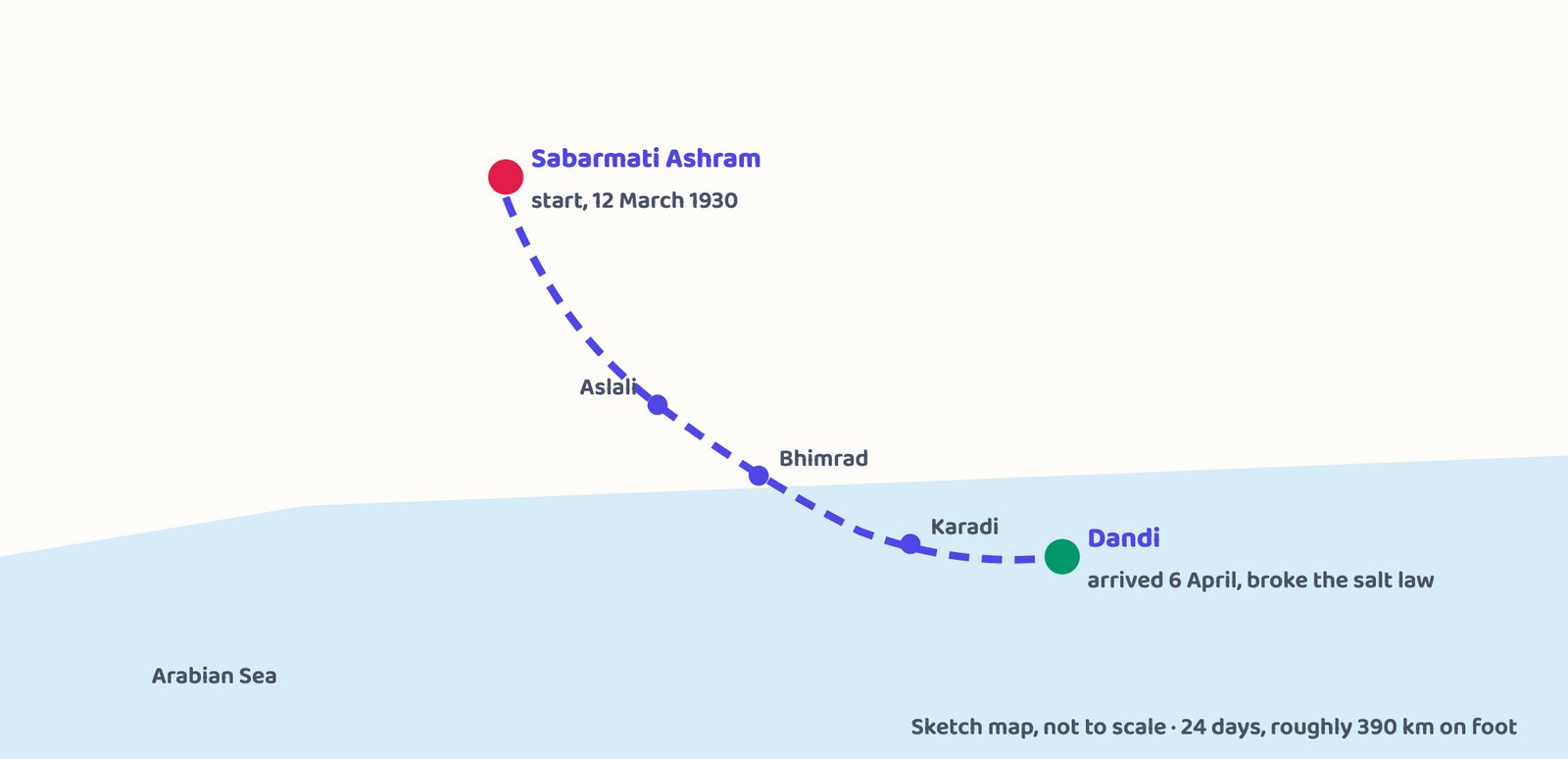
Gandhiji then announced a march to break the salt monopoly law, forbidding Indians from making salt even for their own household use. Salt’s universal, everyday necessity made it a shrewd target: unpopular enough to mobilise broad discontent well beyond politically active circles.
Gandhiji: “the Government destroys the salt it cannot sell profitably… it prevents the public from manufacturing it and destroys what nature manufactures without effort… The salt monopoly is thus a fourfold curse. It deprives the people of a valuable easy village industry, involves wanton destruction of property that nature produces in abundance, the destruction itself means more national expenditure, and fourthly… an unheard-of tax of more than 1,000 per cent is exacted from a starving people.”
On 12 March 1930, Gandhiji began walking from his Sabarmati ashram toward the sea, reaching Dandi three weeks later and breaking the law by making a fistful of salt, while parallel marches took place elsewhere. Viceroy Lord Irwin, despite advance notice, badly underestimated the march’s significance.
At Dandi, 5 April 1930: “The Government may, if it wishes, congratulate itself on acting as it has done, for it could have arrested every one of us… It felt ashamed to arrest such an army… This movement is based on the faith that when a whole nation is roused and on the march no leader is necessary.”
As with Non-cooperation, unauthorised parallel protest spread widely: forest law violations, factory strikes, court boycotts, student walkouts. Nearly 60,000 Indians were arrested in the march’s wake, Gandhiji included. Police secret reports and the American magazine Time both tracked his progress; Time began by mocking his “spindly frame” and “spidery loins” and predicting the march would fail, then within a week called him a “Saint” and “Statesman” using “Christian acts as a weapon against men with Christian beliefs” as his mass following alarmed the British.
Gandhiji told upper castes: “if you are out for Swaraj you must serve untouchables… For Swaraj you must make amends for the wrongs which you did to the untouchables… Hindus, Muslims, Parsis and Sikhs will have to unite.” Police spies confirmed his meetings drew villagers of every caste, women alongside men, and growing numbers of officials resigning colonial posts to join him.
3.2 Dialogues
The Salt March mattered for three reasons: it brought Gandhiji to world attention through heavy European and American press coverage; it was the first mass movement with large-scale women’s participation, thanks partly to socialist activist Kamaladevi Chattopadhyay, who persuaded Gandhiji not to restrict protest to men; and it forced the British to accept that some devolution of power was inevitable, leading to the Round Table Conferences.
The first Round Table Conference (November 1930) proceeded without Gandhiji and achieved little. Released from jail in January 1931, he met Viceroy Irwin repeatedly, producing the Gandhi-Irwin Pact: civil disobedience called off, prisoners released, salt manufacture permitted along the coast, though Gandhiji secured only an assurance of talks toward independence, not independence itself, a compromise radical nationalists criticised sharply.
At the second Round Table Conference (late 1931), Gandhiji’s claim to represent all of India was directly challenged from three sides: the Muslim League (Muslim minority interests), the Princes (their territories fell outside Congress’s stake), and B.R. Ambedkar (the lowest castes were not truly represented by Gandhiji or Congress).
Gandhiji on separate electorates
- “Separate electorates to the ‘Untouchables’ will ensure them bondage in perpetuity… What is needed is destruction of ‘Untouchability’… When you have destroyed the bar-sinister to whom will you give the separate electorates?”
- Believed separate electorates would permanently segregate Depressed Classes from caste Hindus rather than integrate them
Ambedkar’s reply (written later, in his book)
- “The religion, to which they are tied… brands them as lepers, not fit for ordinary intercourse… there is a definite attempt all through our Hindu Society to bolt every possible door”
- Argued political power, via separate electorates, was the “paramount necessity” for a community handicapped this severely to protect itself at all
The Conference ended inconclusively; Gandhiji resumed civil disobedience on his return. The new Viceroy, Lord Willingdon, was openly hostile: he complained privately that the American Press was calling Gandhiji “a wonderful man”, while in fact, he wrote, “we live in the midst of very unpractical, mystical, and superstitious folk who look upon Gandhi as something holy.”
The Government of India Act (1935) promised limited representative government; in the 1937 elections on a restricted franchise, Congress won comprehensively, forming ministries in 8 of 11 provinces. When the Second World War broke out (September 1939), Gandhiji and Nehru, both strongly anti-fascist, offered war support in exchange for a British promise of post-war independence; the offer was refused, and Congress ministries resigned in protest that October.
Map 10, important centres of the National Movement: Champaran, Kheda, Ahmedabad, Benaras, Amritsar, Chauri Chaura, Lahore, Bardoli, Dandi, Bombay (Quit India Resolution), Karachi.
4 Quit India
Through 1940-41 Congress ran individual satyagrahas pressing for a freedom pledge. In March 1940 the Muslim League demanded autonomy for Muslim-majority areas, turning the struggle three-way: Congress, League, and Britain, complicated further by Conservative Prime Minister Winston Churchill’s committed imperialism against a more sympathetic Labour bloc. Sir Stafford Cripps’s 1942 mission to broker compromise failed once Congress insisted on an Indian Defence Member in the Viceroy’s Executive Council.
After Cripps failed, Gandhiji launched Quit India (August 1942), his third major movement. He was jailed immediately, but younger activists, socialists like Jayaprakash Narayan especially, ran an underground campaign of strikes and sabotage. “Independent” governments were briefly proclaimed in districts including Satara (west) and Medinipur (east); it took the British over a year to suppress the movement.
Building on a decades-old non-Brahman movement against caste and landlordism, younger Satara leaders set up a parallel government (prati sarkar) with volunteer corps (seba dals) and village units (tufan dals), running people’s courts and constructive work. Dominated by kunbi peasants and backed by dalits, it functioned until the 1946 elections, despite both government repression and, eventually, Congress disapproval.
Quit India brought hundreds of thousands into active resistance and especially drew the young, who left college for jail in large numbers. With Congress leadership imprisoned, Jinnah’s Muslim League used the gap to expand into Punjab and Sind, provinces where it had barely any prior presence.
Gandhiji was released in June 1944. In 1945, Britain’s new Labour government committed to independence; Viceroy Lord Wavell brought Congress and the League to talks. Early-1946 provincial elections saw Congress sweep the General category while the League swept Muslim reserved seats, an outcome that hardened political polarisation completely. A summer 1946 Cabinet Mission failed to secure a federal compromise, and Jinnah’s “Direct Action Day” (16 August 1946) triggered bloody riots in Calcutta that spread to rural Bengal, Bihar, UP and Punjab, with Muslims the main victims in some places, Hindus in others.
Lord Mountbatten replaced Wavell in February 1947; when his own final talks proved inconclusive, he announced British India would be freed and divided, transfer of power fixed for 15 August. When the day came, the Constituent Assembly opened with prolonged applause invoking “the Father of the Nation”, and crowds outside chanted “Mahatma Gandhi ki jai”.
5 The Last Heroic Days
Gandhiji was not among the Delhi celebrations on 15 August 1947. He was in Calcutta, marking the day with a 24-hour fast, freedom having come at what he judged an unacceptable price: a divided nation with communities at each other’s throats. Through September and October, biographer D.G. Tendulkar writes, he “went round hospitals and refugee camps giving consolation,” urging Sikhs, Hindus and Muslims to “forget the past… and to determine to live in peace.”
At Gandhiji’s and Nehru’s initiative, Congress passed a resolution on minority rights, rejecting the “two-nation theory” even after being forced to accept Partition: India would remain “a democratic secular State where all citizens enjoy full rights… irrespective of the religion to which they belong.”
His last months are often called his “finest hour”. He shifted from Bengal to Delhi, hoping to reach riot-torn Punjab; his meetings were sometimes disrupted by refugees angry that he read from the Koran or did not speak more for Hindus and Sikhs suffering in Pakistan. As Tendulkar records, “he was equally concerned with the sufferings of the minority community in Pakistan… but with what face could he now go there, when he could not guarantee full redress to the Muslims in Delhi?”
After surviving an assassination attempt on 20 January 1948, he spoke on 26 January of trusting “the worst is over” and hoped that “though geographically and politically India is divided into two, at heart we shall ever be friends and brothers.” On the evening of 30 January 1948, at his daily prayer meeting, Gandhiji was shot dead by Nathuram Godse, who surrendered afterwards.
The same magazine that had once mocked Gandhiji’s physical frame now compared his death to Lincoln’s: “The world knew that it had, in a sense too deep, too simple for the world to understand, connived at his (Gandhiji’s) death as it had connived at Lincoln’s”, a bigoted American had killed Lincoln for believing in racial equality, a bigoted Hindu had killed Gandhiji for believing inter-faith friendship was possible and necessary.
6 Knowing Gandhi
6.1 Public voice and private scripts
Speeches give us a public voice; private letters give us private thought, though the line blurs: letters are often written knowing they might later be published (Gandhiji regularly printed others’ letters to him in Harijan; Nehru published A Bunch of Old Letters), which can shape how freely a writer actually speaks.
When Nehru’s socialist rhetoric as Congress President alarmed conservatives Rajendra Prasad and Sardar Patel, Gandhiji mediated. Prasad to Nehru: “There is regular continuous campaign against us treating us as persons whose time is over… we have felt that a great injustice has been and is being done to us.” Nehru to Gandhiji: “I am an intolerable nuisance and the very qualities I possess… become dangerous for they are harnessed to the wrong chariot (socialism).” Gandhiji to Nehru: “I have always pleaded with them to speak to you freely and fearlessly… They have chafed under your rebukes… I have looked at the whole affair as a tragi-comedy.” These letters show Congress’s internal ideological tension and Gandhiji’s constant role as mediator between its socialist and conservative wings.
6.2 Framing a picture
Autobiographies are retrospective, written from memory, shaped by what the author wants remembered and how they want to be seen. Reading one means asking what is left out and why, not just what is told.
6.3 Through police eyes
Colonial officials tracked critics closely; their reports, secret then, are now archival evidence, but reflect what senior officials believed or wanted to believe, not simply raw ground truth. The Home Department’s Fortnightly Reports during the Salt March consistently downplayed its impact, treating it as theatre rather than a genuine popular movement, precisely the frame officials preferred to believe.
Madras: “General opinion inclines to regard his march as theatrical and his programme as impracticable, but as he is held in such personal reverence by the Hindu public generally, the possibility of arrest… is viewed with considerable misgiving.” Bengal: “there is little enthusiasm for the form of civil disobedience favoured by Gandhi… but the prospect of any serious conflagration is at present slight.” By April, however, the same reports record the Salt Act being “openly defied at Agra, Cawnpore, Benaras, Allahabad, Lucknow, Meerut” and Jawaharlal Nehru’s arrest, a visible gap between official reassurance and events on the ground.
6.4 From newspapers
Newspapers, English and vernacular alike, tracked Gandhiji and reflected ordinary opinion, but were never neutral: a London paper and an Indian nationalist paper covering the same event reported it very differently, shaped by the political outlook of who published it. Every source in this chapter, letters, autobiographies, police reports, newspapers, needs to be read for whose interest and anxiety it reflects, not accepted as a plain transcript of what happened.
7 Timeline and Revision
| Key dates | |
|---|---|
| 1915 | Mahatma Gandhi returns from South Africa |
| 1917 | Champaran movement |
| 1918 | Peasant movement in Kheda; workers’ movement in Ahmedabad |
| 1919 | Rowlatt Satyagraha (March-April); Jallianwala Bagh massacre (April) |
| 1921 | Non-cooperation and Khilafat Movements |
| 1928 | Peasant movement in Bardoli |
| 1929 | “Purna Swaraj” adopted at the Lahore Congress (December) |
| 1930 | Civil Disobedience Movement begins; Dandi March (March-April) |
| 1931 | Gandhi-Irwin Pact (March); Second Round Table Conference (December) |
| 1935 | Government of India Act promises limited representative government |
| 1939 | Congress ministries resign |
| 1942 | Quit India Movement begins (August) |
| 1946 | Gandhiji visits Noakhali and other riot-torn areas |
- Gandhiji’s 1916 BHU speech announced his intent to make nationalism represent peasants and workers, not just professionals; Champaran, Kheda and Ahmedabad (1917-18) were the first steps.
- Non-cooperation combined with Khilafat (1920-22) unleashed unprecedented, often locally reinterpreted, mass action, ending after Chauri Chaura.
- The dhoti and charkha were deliberate symbols of identification with the poor; peasant rumours about Gandhiji’s powers reveal their hopes, not his actual abilities.
- The Salt March (1930) targeted a universally felt grievance, brought Gandhiji world attention, drew large-scale women’s participation, and forced the Round Table Conferences.
- Ambedkar’s challenge over separate electorates for the Depressed Classes exposed real limits to Gandhiji’s claim to represent all Indians.
- Quit India (1942) was the last and most explosive mass movement, but Congress’s imprisonment let the Muslim League expand into new territory.
- Partition (15 August 1947) came at what Gandhiji saw as too high a price; his final months were spent trying to stop communal violence, ending in his assassination on 30 January 1948.
- Every kind of source, letters, autobiography, police reports, newspapers, carries its own bias and needs to be read for whose interest it reflects, not taken as neutral fact.
- 1 markIn what year and city did Gandhiji make his first major public speech in India?
- 1 markWhat event caused Gandhiji to call off the Non-cooperation Movement?
- 1 markWhat was the Khilafat Movement?
- 1 markWhat was the Gandhi-Irwin Pact?
- 1 markWho assassinated Mahatma Gandhi, and on what date?
- 2 marksWhy did Gandhiji choose salt as the focus of his 1930 satyagraha?
- 2 marksWhat was Ambedkar’s objection to Gandhiji’s opposition to separate electorates?
- 2 marksWhat was the prati sarkar of Satara?
- 2 marksWhy should newspaper reports not be read as unprejudiced sources?
- 3 marksHow did Mahatma Gandhi seek to identify with the common people?
- 3 marksHow was Mahatma Gandhi perceived by the peasants of eastern UP, according to Shahid Amin’s study?
- 3 marksWhy was the charkha chosen as a symbol of nationalism?
- 3 marksWhy were the dialogues at the Round Table Conference inconclusive?
- 3 marksWhat do private letters and autobiographies tell us about an individual, and how do these sources differ from official accounts?
- 3 marksHow did the Home Department’s Fortnightly Reports frame the Salt March, and why?
- 3 marksWhy did Congress ministries resign in 1939?
- 5 marksHow was Non-cooperation a form of protest? Discuss the variety of ways different social groups participated in it.
- 5 marksIn what ways did Mahatma Gandhi transform the nature of the national movement?
- 5 marksDiscuss the significance of the Salt March for the history of the national movement.
- 5 marksWrite an imaginary dialogue between Ambedkar and Mahatma Gandhi on the issue of separate electorates for the Depressed Classes, drawing on Sources 5 and 6.
- 5 marksDiscuss the events leading up to Partition and Gandhiji’s response to it.
- 5 marksWhat are the different kinds of sources historians use to reconstruct Gandhiji’s career, and what are the limitations of each?
- 5 marksOn a map of Gujarat, plot the route of the Dandi March and the major towns and villages it passed through.
- 1 markGandhiji’s first major campaign in India, over the tenure rights of indigo cultivators, was at:
(a) Kheda(b) Champaran(c) Ahmedabad(d) Bardoli - 1 markThe Jallianwala Bagh massacre took place in:
(a) 1917(b) 1919(c) 1922(d) 1930 - 1 mark“Purna Swaraj” was adopted as the Congress goal at the session held in:
(a) Lucknow(b) Lahore(c) Calcutta(d) Bombay - 1 markKamaladevi Chattopadhyay is associated with:
(a) the Khilafat Movement(b) persuading Gandhiji to include women in the Salt March(c) the Satara prati sarkar(d) the Cripps Mission - 1 markDirect Action Day, called by the Muslim League, fell on:
(a) 15 August 1946(b) 16 August 1946(c) 20 January 1948(d) 30 January 1948 - 1 markNehru’s published collection of letters from the national movement was titled:
(a) Harijan(b) Young India(c) A Bunch of Old Letters(d) The Discovery of India
Choose: (a) both A and R are true and R explains A; (b) both true but R does not explain A; (c) A true, R false; (d) A false, R true.
Reason (R): Peasants at Chauri Chaura had burned a police station and killed several constables, an act of violence that contradicted his commitment to non-violence.
Reason (R): They were written by officials who often reported what they wanted to believe rather than the actual scale of the response.