1946-1949
The Indian Constitution, in force from 26 January 1950, is the longest in the world, understandably so given India’s size, diversity and, at Independence, its deep internal divisions. Framed between December 1946 and November 1949, across eleven sessions and 165 sitting days, it emerged from intense, recorded debate in the Constituent Assembly, debate this chapter uses to trace both the document and the vision behind it.
1 A Tumultuous Time
The years just before the Constitution was framed were a mix of hope and disappointment. India was freed on 15 August 1947, but also divided. Fresh in memory: the Quit India struggle (1942), Subhas Chandra Bose’s armed-struggle bid, and the Royal Indian Navy ratings’ revolt (spring 1946), all showing striking Hindu-Muslim unity even as Congress and the Muslim League repeatedly failed to reach a political settlement. The Great Calcutta Killings (August 1946) opened almost a year of continuous rioting across northern and eastern India, culminating in the mass violence of Partition itself.
Independence Day brought genuine joy, but also a cruel choice for millions: Muslims in India, Hindus and Sikhs in Pakistan, faced sudden violence or a wrenching, forced migration. Millions of refugees crossed in both directions; many died before reaching safety. A second unresolved problem was the princely states, roughly a third of the subcontinent, whose post-British constitutional status remained ambiguous, with some maharajas openly dreaming, as a contemporary put it, “of independent power in an India of many partitions.”
1.1 The making of the Constituent Assembly
Members were not elected by universal franchise: winter 1945-46 provincial elections chose Provincial Legislatures, which then selected Constituent Assembly representatives. Congress swept the general seats and the Muslim League swept most reserved Muslim seats, but the League boycotted the Assembly outright, pressing instead for a separate Pakistan constitution; Socialists too stayed out initially, doubting an Assembly created by the British could be truly autonomous. The result: 82 per cent of Assembly members were Congress members, though the party itself held no single voice, socialists and landlord-defenders, secularists and those closer to communal parties all sat and argued within it, a habit of open public debate carried over directly from the national movement. Public opinion, reported in newspapers, shaped the Assembly’s discussions too, and the public itself was invited to send in views: linguistic minorities wanted mother-tongue protection, religious minorities wanted safeguards, dalits demanded an end to caste oppression and reserved seats.
1.2 The dominant voices
Of 300 members, six stood out. Three were Congress: Jawaharlal Nehru, who moved the crucial Objectives Resolution and the tricolour flag resolution; Vallabh Bhai Patel, who worked mostly behind the scenes reconciling opposing views; and Rajendra Prasad, the Assembly’s President, steering discussion while ensuring everyone got a hearing. B.R. Ambedkar, lawyer, economist and former political opponent of the Congress, was asked by Gandhiji to join the Union Cabinet as law minister and chaired the crucial Drafting Committee, working alongside lawyers K.M. Munshi (Gujarat) and Alladi Krishnaswamy Aiyar (Madras). Two civil servants assisted them closely: B.N. Rau, Constitutional Advisor, who prepared comparative background papers on other countries’ political systems, and Chief Draughtsman S.N. Mukherjee, who turned complex proposals into clear legal language. The whole process took three years and filled eleven bulky volumes of debate.
| Important committee | President |
|---|---|
| Rules of Procedure Committee | Rajendra Prasad |
| Union Power Committee | Jawaharlal Nehru |
| Union Constitution Committee | Jawaharlal Nehru |
| Provincial Constitution Committee | Vallabhbhai Patel |
| Steering Committee | Rajendra Prasad |
| Drafting Committee | Bhimrao Ambedkar |
| Flag Committee | J.B. Kripalani |
| States Committee | Jawaharlal Nehru |
| Advisory Committee | Sardar Vallabhbhai Patel |
| Fundamental Rights Sub-Committee | J.B. Kripalani |
| Minorities Sub-Committee | H.C. Mookerjee |
2 The Vision of the Constitution
On 13 December 1946, Nehru introduced the “Objectives Resolution”, proclaiming India an “Independent Sovereign Republic” guaranteeing justice, equality and freedom, with “adequate safeguards… for minorities, backward and tribal areas, and Depressed and Other Backward Classes.”
Nehru’s speech placed India alongside the American and French Revolutions and the Russian Revolution, “my mind goes back to that mighty revolution… and to that Constituent Assembly that met in that gracious and lovely city of Paris… the Oath of the Tennis Court.” Yet he was careful to add: “We are not going just to copy… whatever system of government we may establish here must fit in with the temper of our people and be acceptable to them.” On why “democratic” was not in the Resolution’s text: “it is conceivable, of course, that a republic may not be democratic but the whole of our past is witness to this fact that we stand for democratic institutions… we have given the content of democracy in this Resolution.”
What Nehru was actually doing: not offering a blueprint to copy, but situating India’s project within a longer global history of struggles for liberty, while insisting the specific shape of Indian democracy had to be worked out on its own terms, fusing liberal democratic ideals with socialist economic justice.
2.1 The will of the people
Communist member Somnath Lahiri argued the Assembly itself remained under British shadow, since Britain was still present and the interim Nehru-led administration answered to the Viceroy and London.
Lahiri: “we are under the shadow of British guns, British Army, their economic and financial stranglehold… As Sardar Vallabh Bhai Patel put it some days ago, we have freedom only to fight among ourselves.” His suggestion: declare independence outright rather than work within the British-designed process.
Nehru conceded the Assembly’s British origin but insisted its real strength came from elsewhere: “Governments do not come into being by State Papers. Governments are, in fact the expression of the will of the people… we shall go as far as the people… shall wish us to go.” This claim linked the Assembly to a much longer history of Indian social reform, nineteenth-century campaigns against child marriage, for widow remarriage, Swami Vivekananda’s reform of Hinduism, Jyotiba Phule’s attention to depressed castes, Communist and Socialist labour organising, all framed as prior chapters in the same struggle for justice and equality.
Do not present the 1909, 1919 and 1935 Acts as a smooth, continuous lead-up to the Constituent Assembly. They expanded Indian participation in provincial government, but were enacted by the colonial government, not debated and framed by Indians themselves; even by 1935 the franchise covered only 10-15 per cent of adults, and elected legislatures still answered to a British-appointed Governor. The Assembly of 1946 was a genuine break from that pattern, not its natural continuation.
3 Defining Rights
3.1 The problem with separate electorates
On 27 August 1947, B. Pocker Bahadur argued for continuing separate electorates: minorities could not be “erased out of existence,” and only separate electorates could guarantee Muslims a meaningful political voice, since non-Muslims, he argued, could not properly represent Muslim needs.
“Can you show me one free country where there are separate electorates?… The British element is gone, but they have left the mischief behind. We do not want to perpetuate that mischief.” R.V. Dhulekar told Bahadur directly: “The English played their game under the cover of safeguards. With the help of it they allured you (the minorities) to a long lull. Give it up now… Now there is no one to misguide you.”
Source 4 · Govind Ballabh Pant. “I believe separate electorates will be suicidal to the minorities… If they are isolated for ever, they can never convert themselves into a majority and the feeling of frustration will cripple them even from the very beginning.”
Most nationalists read separate electorates as a deliberate British tool of division, whose logical endpoint Partition itself had just proven. Pant argued political unity required citizens with undivided loyalty to the State: “There is the unwholesome and to some extent degrading habit of thinking always in terms of communities and never in terms of citizens… It is the citizen that must count.” Cultural rights for communities were acceptable; separate political representation, most feared, was not. Not all Muslim members agreed with separate electorates either, Begum Aizaz Rasul called them self-destructive, and by 1949 most Muslim Assembly members had concluded active participation in a shared democratic process served minorities better than isolation.
3.2 “We will need much more than this Resolution”
Socialist peasant leader N.G. Ranga redefined “minority” in economic rather than religious terms.
“Who are the real minorities? Not the Hindus in the so-called Pakistan provinces, not the Sikhs, not even the Muslims. No, the real minorities are the masses of this country… There is no elementary education even among these people. These are the real minorities that need protection.” He pointed out that even where tribal land was legally protected, merchants and moneylenders still turned villagers into “hereditary bond-slaves” in practice, so legal rights alone, without real capacity to use them, meant little: “They need props. They need a ladder.”
Jaipal Singh, an Adibasi representative, welcomed the Objectives Resolution while insisting tribals, though not a numerical minority, urgently needed protection: “The whole history of my people is one of continuous exploitation and dispossession by the non-aboriginals of India… Our point is that you have got to mix with us. We are willing to mix with you.” He did not ask for separate electorates, but did argue reserved legislative seats were essential so tribal voices would actually be heard.
3.3 “We were suppressed for thousands of years”
During the national movement Ambedkar had demanded separate electorates for the Depressed Castes; Gandhiji opposed this, fearing permanent segregation. Some Depressed Castes members, such as J. Nagappa, argued the real problem was social, not just political: “We have been suffering, but we are prepared to suffer no more… We know how to assert ourselves.” Nagappa also noted the Depressed Castes were 20-25 per cent of the population, not numerically small at all; their marginalisation came from systematic exclusion, not scarcity. K.J. Khanderkar put it starkly: “We were suppressed for thousands of years… to such an extent that neither our minds nor our bodies and now even our hearts work.”
After Partition’s violence, even Ambedkar dropped the demand for separate electorates. The Assembly instead recommended abolishing untouchability, opening Hindu temples to all castes, and reserving legislature seats and government jobs for the lowest castes, changes the democratic public broadly welcomed even while many recognised law alone could not fully change social attitudes.
“We have never asked for privileges. What we have asked for is social justice, economic justice, and political justice… that equality which alone can be the basis of mutual respect and understanding.” Like most women members, Mehta sought equality, not reserved seats or separate electorates.
4 The Powers of the State
Centre-state power division was one of the most fought-over questions. Nehru argued forcefully for a strong Centre: with “partition… a settled fact,” a weak central authority risked failing to keep peace, coordinate national matters, or represent India abroad.
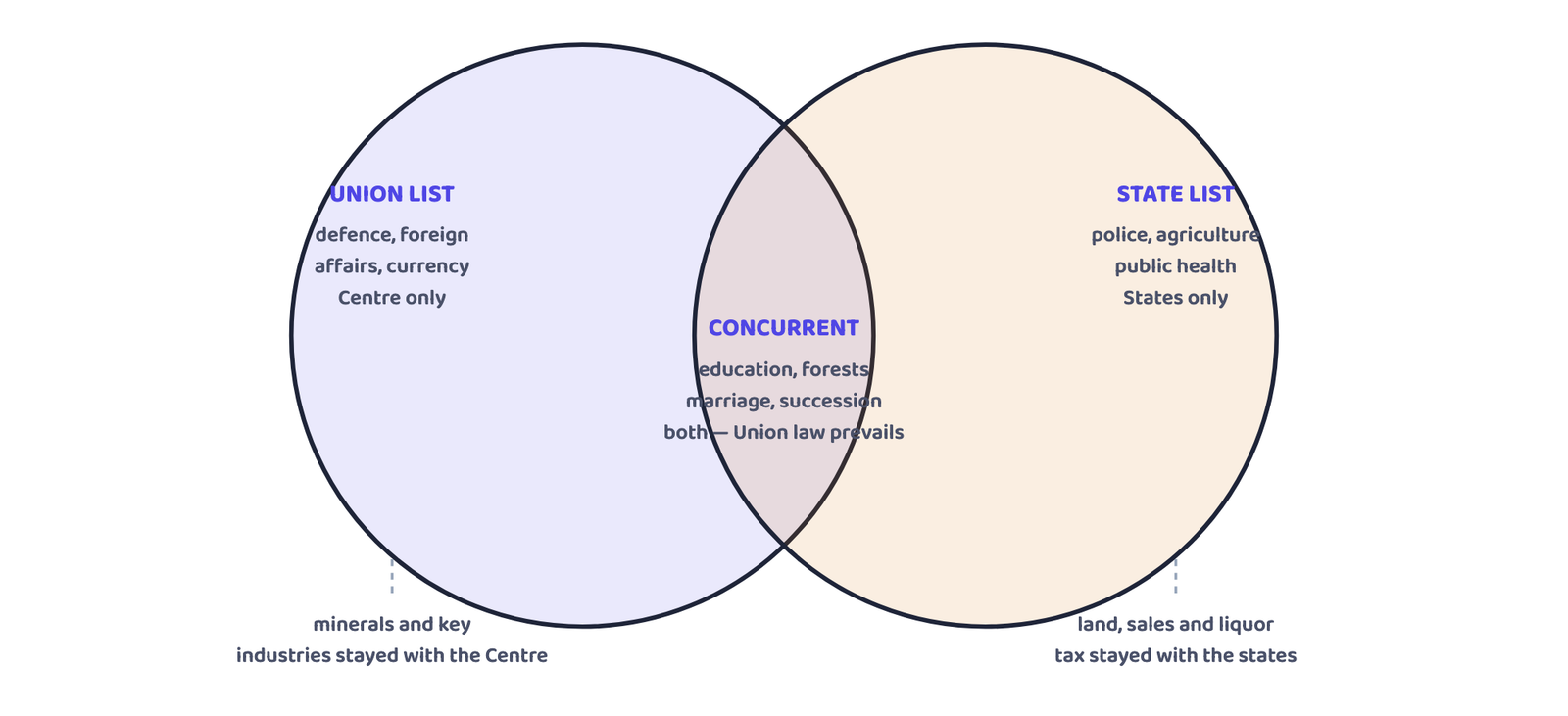
The Draft Constitution created three subject lists: Union (Centre only), State (states only), Concurrent (shared). More subjects went to the Union and Concurrent lists than most other federations allowed, and the Centre kept control of minerals and key industries; Article 356 let the Centre take over a state’s administration on a Governor’s recommendation.
Fiscal federalism was similarly layered: some taxes (customs, company tax) stayed wholly Central; others (income tax, excise) were shared; others (estate duties) went wholly to states, which could independently levy land and property tax, sales tax, and liquor tax.
4.1 “The centre is likely to break”
K. Santhanam argued the proposed distribution would actually weaken, not strengthen, the Centre by overloading it: “There is almost an obsession that by adding all kinds of powers to the Centre we can make it strong.” He warned the fiscal terms would leave states unable to fund education, sanitation or roads, predicting provinces would eventually “rise in revolt against the Centre” if the balance was not revisited.
4.2 “What we want today is a strong Government”
Ambedkar countered directly: he wanted “a strong and united Centre… much stronger than the Centre we had created under the Government of India Act of 1935.” Gopalaswami Ayyangar and Balakrishna Sharma echoed this, arguing only a strong Centre could plan economic development, mobilise resources, run administration, and defend against foreign threats, especially given ongoing communal violence.
Do not treat the pre-Partition Congress commitment to provincial autonomy as unchanged after 1947. That earlier flexibility was a deliberate concession to reassure the Muslim League that Muslim-majority provinces would face no Centre interference. Once Partition removed that political pressure, most nationalists shifted decisively toward centralisation, reinforced by the era’s communal violence, which made a strong Centre look necessary to prevent chaos, not just convenient for planning.
5 The Language of the Nation
How could a nation with so many regional languages, each carrying its own cultural weight, communicate across itself? The Congress had accepted Hindustani, a Hindi-Urdu blend, as the national language since the 1930s; Gandhiji saw it as genuinely composite and widely understood, capable of uniting Hindus and Muslims, north and south.
Shortly before his death: “This Hindustani should be neither Sanskritised Hindi nor Persianised Urdu but a happy combination of both. It should also freely admit words wherever necessary from the different regional languages… To confine oneself to Hindi or Urdu would be a crime against intelligence and the spirit of patriotism.”
But from the late nineteenth century, Hindi and Urdu had been steadily pulling apart, Hindi increasingly Sanskritised, Urdu increasingly Persianised, and language grew entangled with religious identity as communal tension deepened.
5.1 A plea for Hindi
R.V. Dhulekar, in one of the Assembly’s earliest sessions, demanded Hindi as the language of constitution-making itself: “People who are present in this House to fashion a constitution for India and do not know Hindustani are not worthy to be members of this Assembly. They better leave.” Nehru had to intervene to restore order that day. Almost three years later, on 13 September 1949, after the Language Committee proposed a compromise, Hindi in Devanagari script as the official (not national) language, with English continuing for 15 years and provinces free to choose their own regional official language, Dhulekar reignited the storm, rejecting even the word “official”: “nobody can be more happy than myself that Hindi has become the official language of the country… Some say that it is a concession to Hindi language. I say ‘no’. It is a consummation of a historic process.”
5.2 The fear of domination
G. Durgabai of Madras voiced the anxiety this provoked in the south: “the people of non-Hindi-speaking areas have been made to feel that this fight… is a fight for effectively preventing the natural influence of other powerful languages of India.” Having personally promoted Hindi in the south on Gandhiji’s own call, she felt betrayed by the shift away from an inclusive Hindustani toward a narrower Hindi. Shankarrao Deo and T.A. Ramalingam Chettiar both pressed for restraint, warning that pushing Hindi too aggressively, even with good intentions, risked leaving “bitter feelings” and undermining the wider goal of a genuinely united nation.
6 What the Constituent Assembly Debates Reveal
Most provisions of the Constitution emerged through give-and-take between opposed positions, not clean consensus. Two features, though, drew unusually broad agreement.
India granted the vote to every adult citizen at once, where most established democracies had extended it gradually: property first, then education, then working-class and peasant men after long struggle, and women later still after an even longer one. India skipped that whole staged history in a single constitutional act.
The second was secularism, present not as a single ringing declaration in the Preamble but built operationally into specific Fundamental Rights: freedom of religion (Articles 25-28), cultural and educational rights (Articles 29, 30), and equality rights (Articles 14, 16, 17). All religions received equal treatment and the right to run charitable institutions; compulsory religious instruction in state-run institutions was banned, and religious discrimination in employment made illegal. Yet legal space remained for social reform within religious communities, used specifically to ban untouchability and reform personal and family law. Indian secularism, in other words, was never an absolute Church-State separation, but a “judicious distance” between state and religion.
Do not read Constituent Assembly Debates as a fixed record of unchanging positions. Members genuinely changed their minds over the three years, sometimes persuaded by others’ arguments, sometimes reacting to fast-moving events like Partition violence (Ambedkar’s own shift away from separate electorates is the clearest example). Treat the CAD as a live, evolving argument, not a transcript of positions members had already settled before the debate began.
7 Timeline and Revision
| Key dates | |
|---|---|
| 26 July 1945 | Labour Government comes to power in Britain |
| Dec 1945-Jan 1946 | General elections in India |
| 16 May 1946 | Cabinet Mission announces its constitutional scheme |
| 16 June 1946 | Muslim League accepts the Cabinet Mission scheme |
| 16 August 1946 | Muslim League announces Direct Action Day |
| 2 September 1946 | Congress forms the Interim Government, Nehru as Vice-President |
| 13 October 1946 | Muslim League decides to join the Interim Government |
| 3-6 December 1946 | Attlee meets Indian leaders in London; talks fail |
| 9 December 1946 | Constituent Assembly begins its sessions |
| 29 January 1947 | Muslim League demands dissolution of the Constituent Assembly |
| 11 August 1947 | Jinnah elected President of the Constituent Assembly of Pakistan |
| 14-15 August 1947 | Pakistan, then India, celebrate independence |
| December 1949 | Constitution is signed |
- The Constitution (in force 26 January 1950) was framed December 1946-November 1949, over 11 sessions and 165 sitting days.
- 82 per cent of Assembly members were Congress, after the League boycotted and Socialists initially stayed away, but Congress itself held no single ideological voice.
- Six dominant figures: Nehru, Patel, Prasad (Congress trio), Ambedkar (Drafting Committee chair), Munshi and Alladi Krishnaswamy Aiyar, assisted by B.N. Rau and S.N. Mukherjee.
- Nehru’s Objectives Resolution (13 December 1946) placed India within a global history of revolutions while insisting India would not simply copy any of them.
- Separate electorates were rejected almost universally after Partition, seen as a British-sown “mischief” that had already fractured the nation once.
- Ranga redefined “minority” economically; Jaipal Singh secured reserved seats, not separate electorates, for tribals; Ambedkar dropped his own earlier demand for separate Depressed Castes electorates after Partition.
- The Constitution tilted power toward the Centre (three-list system, Article 356, fiscal centralisation), a deliberate post-Partition shift away from earlier pre-Partition promises of provincial autonomy.
- The language debate pitted Dhulekar’s aggressive push for Hindi against Durgabai’s fear of southern domination; the eventual compromise made Hindi the official, not national, language, with English continuing for 15 years.
- Universal adult franchise and Indian secularism (a “judicious distance” from religion, not strict separation) were the Constitution’s two most broadly agreed features.
- Read Constituent Assembly Debates as evolving argument: members’ positions genuinely shifted across the three years, not a fixed transcript of settled views.
- 1 markOn what date did the Indian Constitution come into effect?
- 1 markWho chaired the Drafting Committee of the Constitution?
- 1 markWhat was the Objectives Resolution, and who moved it?
- 1 markWhat percentage of Constituent Assembly members were also Congress members?
- 1 markWhat are the three lists of subjects created by the Draft Constitution?
- 2 marksWhy did the Muslim League boycott the Constituent Assembly?
- 2 marksWhat was Article 356, and what power did it give the Centre?
- 2 marksDistinguish between Hindustani and the Hindi that the Language Committee proposed as official language.
- 2 marksHow is “minority” defined differently by B. Pocker Bahadur and N.G. Ranga?
- 3 marksWhat arguments did Sardar Patel and Govind Ballabh Pant give against separate electorates?
- 3 marksWhat different arguments did Jaipal Singh put forward for protective measures for tribals?
- 3 marksWhy did Ambedkar drop his earlier demand for separate electorates for the Depressed Castes?
- 3 marksWhat arguments were put forward by those advocating a strong Centre?
- 3 marksWhy did the demand for Hindi as the national language provoke such strong reactions from non-Hindi-speaking regions?
- 3 marksWhat ideas did Jawaharlal Nehru outline in his speech introducing the Objectives Resolution?
- 3 marksWhat is meant by the “judicious distance” between the Indian state and religion?
- 5 marksDiscuss how the political situation of 1946-47 may have shaped the nature of debates within the Constituent Assembly.
- 5 marksDiscuss the debate over separate electorates in the Constituent Assembly, and how it was finally resolved.
- 5 marksDiscuss the debate over the powers of the Centre and the states, and explain why the Constitution finally favoured a strong Centre.
- 5 marksTrace the language debate in the Constituent Assembly from Dhulekar’s first speech to the final compromise formula.
- 5 marksWhat were the different visions of India put forward by Nehru, Ranga and Jaipal Singh in their speeches on the Objectives Resolution?
- 5 marksHow does universal adult franchise in the Indian Constitution compare with the way the right to vote developed in other democracies?
- 5 marksWhy should Constituent Assembly Debates be read as an evolving argument rather than a record of fixed positions? Illustrate with an example from the chapter.
- 1 markThe Objectives Resolution was introduced by Nehru on:
(a) 15 August 1947(b) 13 December 1946(c) 26 January 1950(d) 9 December 1946 - 1 markThe Chief Draughtsman of the Constitution, who put complex proposals into clear legal language, was:
(a) B.N. Rau(b) S.N. Mukherjee(c) K.M. Munshi(d) Alladi Krishnaswamy Aiyar - 1 markThe Language Committee’s compromise proposed Hindi in Devanagari script as:
(a) the sole national language, immediately(b) the official language, with English continuing for 15 years(c) one of many equal national languages(d) a language for provincial use only - 1 markWhich member argued that “the real minorities are the masses of this country”?
(a) B. Pocker Bahadur(b) N.G. Ranga(c) Jaipal Singh(d) Somnath Lahiri - 1 markSardar Patel called separate electorates a:
(a) natural right(b) poison in the body politic(c) temporary safeguard(d) foreign concept - 1 markUniversal adult franchise in India was unusual compared to other democracies because:
(a) it was granted only to property owners first(b) it was granted to all adults at once, without staged extension(c) it excluded women initially(d) it was granted only after a long working-class struggle
Choose: (a) both A and R are true and R explains A; (b) both true but R does not explain A; (c) A true, R false; (d) A false, R true.
Reason (R): They believed separate electorates, introduced by the British, had contributed to communal division and ultimately to the tragedy of Partition.
Reason (R): That commitment had been a deliberate concession to reassure the Muslim League, and the political pressure behind it disappeared once Partition occurred.