
- What stress really is, and why the same event can feel like a challenge to one person and a threat to another
- How the body reacts to stress physiologically, emotionally, cognitively and behaviourally, and what General Adaptation Syndrome is
- How stress weakens the immune system and damages long-term health
- The different ways people cope with stress, and the techniques that actually manage it
- The life skills and factors that build positive health and resilience
This chapter’s theory carries 9 marks in the CBSE Class 12 Psychology board exam (Unit III of VII). Class 12 Psychology also has a 30-mark Practical component (a case profile file, five psychological tests administered and interpreted, and a viva voce, a spoken/oral exam where an examiner asks questions face-to-face instead of a written paper); these notes cover only the 70-mark theory paper.
1Nature, Types and Sources of Stress
Raj studies past 1 a.m. before his final exam, cannot sleep, blames himself for not preparing properly, and walks into the exam hall with a pounding heart and a “blank” mind.
Some of you may have lived through an experience like Raj’s. Life poses challenges all the time, but challenges are not necessarily stressful: much depends on how a challenge is viewed.
1.1 What is stress?
The word stress comes from two Latin words: strictus (tight or narrow) and stringere (to tighten). These root words match how people under stress actually describe feeling: a tightness and constriction in their muscles and in their breathing.
Stressors are events that cause the body to give the stress response. The reaction to an external stressor is called strain.
Stress can be described as the pattern of responses an organism makes to a stimulus event that disturbs its equilibrium (its stable, balanced internal state, also called homeostasis) and exceeds its ability to cope. Hans Selye, “the father of modern stress research,” defined stress as “the non-specific response of the body to any demand”, meaning the body reacts with the same physiological pattern regardless of the cause. Many researchers do not agree with this definition, as they feel the stress response is not nearly as general and non-specific as Selye suggests: different stressors may produce somewhat different patterns of stress reaction, and different people may have different modes of response. The book’s own description of stress is the first sentence of this box.
The book’s Fig. 3.1 (Psychological Meaning of Stress) shows the chain in three words: a stressor (the event) produces stress, and the reaction to the external stressor is strain.
Eustress
- The level of stress that is good for you
- One of a person’s best assets for peak performance
- Helps manage minor crises
Distress
- Eustress can turn into distress
- Causes the body’s wear and tear
- The harmful, damaging manifestation of stress
Stress is like electricity: it gives energy, increases arousal and affects performance. But if the current is too high, it can fuse bulbs and damage appliances; in the same way high stress makes performance deteriorate, while too little stress leaves you listless and low on motivation. Not all stress is bad; write this analogy if asked “is stress always harmful?”
Stress is not something that sits only inside a person or only in the environment. It is embedded in an ongoing process: a person keeps transacting (interacting back and forth, giving and receiving effects) with their social and cultural environment, appraising each encounter, and trying to cope with what comes up.
1.2 The stress process: appraisal and the event’s dimensions
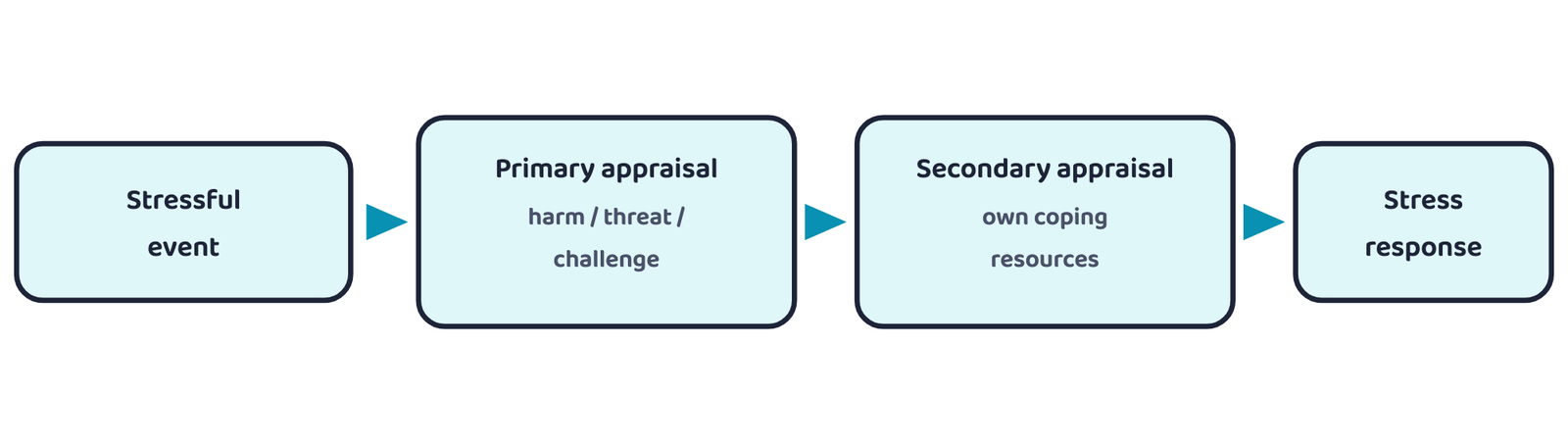
Lazarus’s cognitive theory of stress explains why the same event stresses one person and not another: a person’s response largely depends on how the event is perceived and appraised and on the resources available to deal with it. The outcome also depends on the event itself: on its intensity, duration, complexity and predictability (the four dimensions below).
Primary appraisal is the perception of a new or changing environment as positive, neutral or negative. Negative events are appraised for harm (damage already done), threat (possible future damage) or challenge (confident expectation of coping, even profiting from the event). Secondary appraisal is the assessment of one’s own coping abilities and resources to meet that harm, threat or challenge.
These appraisals are subjective and depend on: past experience of similar situations (handled it well before → feels less threatening now), perceived controllability (believing you can control the onset or outcome lowers stress), and self-confidence/efficacy (efficacy = belief in one’s own ability to succeed at a task, which tips the same event towards feeling like a “threat” or a “challenge”).
Intensity
Low intensity vs high intensity. More intense stress is worse.
Duration
Short-term vs long-term. Prolonged stress is worse.
Complexity
Less complex vs more complex. Complex stress is worse.
Predictability
Unexpected vs predictable. Unanticipated stress is worse.
The outcome of stress depends on where a particular stressful experience lies along these four dimensions: usually more intense, prolonged or chronic, complex and unanticipated stresses have more negative consequences. A person’s vulnerability to stress also depends on physical health and constitution (a person’s basic bodily build and natural stamina, not the legal/political sense of the word), psychological traits (mental health, temperament, self-concept), the cultural context that defines what response is “expected,” and available resources (money, social skills, coping style, support networks).
1.3 How the body reacts: the physiological pathway
At the physiological level, the hypothalamus (a small structure at the base of the brain that controls automatic body functions like heart rate and hormone release) initiates the stress response along two pathways:
Physiological
Rise in adrenaline and cortisol; raised heart rate, blood pressure, metabolism.
Emotional
Fear, anxiety, embarrassment, anger, depression, even denial.
Behavioural
Fight (confrontative action against the stressor) or flight (withdrawal): the exact form this takes is almost unlimited in variety, depending on the situation.
Cognitive
Beliefs about the harm/threat/controllability of the event; inability to concentrate; intrusive or morbid thoughts.
Physical, emotional and behavioural warning signs vary from person to person: lack of concentration, memory loss, poor decision-making, inconsistency, irregular attendance and timekeeping, low self-esteem, poor long-term planning, frantic bursts of energy, extreme mood swings, emotional outbursts, worry, anxiety, fear, depression, sleep and eating difficulties, misuse of drugs, and physical illness such as stomach upset, headache or backache. Any of these can indicate a degree of stress which, if left unresolved, might have serious implications. (Activity 3.1: tick the signs that apply to you and discuss in small groups how to reduce them.)
1.4 Types of stress
All three types are interrelated. Frustration results from the blocking of needs and motives (social discrimination, low grades). Conflict occurs between incompatible needs, motives or values (study dance or psychology?). Social stress varies widely from person to person: a party stresses an introvert while staying home stresses an extrovert.
1.5 Sources of stress
Life events
Big changes, planned (moving house) or unpredicted (a break-up), that disturb routine. Several bunched together in a short period are hardest to cope with.
Hassles
Personal, daily annoyances: noisy surroundings, commuting, quarrelsome neighbours, traffic. Each is minor alone, but they pile up, and can feel devastating when faced with no one to share them with.
Traumatic events
Fire, accidents, robbery, earthquake, tsunami. Effects may appear after a delay and persist as anxiety, flashbacks or intrusive thoughts; professional help may be needed.
Holmes and Rahe developed the original life-event measure of stress. Singh, Kaur and Kaur adapted it for the Indian population as the Presumptive Stressful Life Events Scale (PSLES), a 51-item self-rating questionnaire; each life event carries a numerical “mean stress score” based on severity.
| Life event | Mean stress score |
|---|---|
| Death of a close family member | 66 |
| Unexpected accident or trauma | 53 |
| Illness of a family member | 52 |
| Break-up with a friend | 47 |
| Appearing for examinations | 43 |
| Change in eating habits | 27 |
(The same scale also assigns death of one’s spouse 95, personal illness or injury 56, failure in examination 43 and change in sleeping habits 33.) The mean number of stressful life events tolerated per year without producing illness is about two. Both positive and negative events are included, since both kinds of change cause stress. The correlation between life events and any particular illness is low, so the association is weak, and it is debated whether life events cause stress-related illness or stress causes the life events and illness. The impact of most life events varies from person to person: age at which the event was first experienced, frequency, duration and social support must all be studied.
Activity 3.2: with two classmates, rank from 1 to 5 the stressful events of the past year, find those common to all three, and discuss the ability, skill and family support each of you has to deal with them.
2Effects of Stress on Psychological Functioning and Health
2.1 The four effects of stress
Emotional
Mood swings, erratic behaviour that alienates family and friends; can spiral into a vicious circle of decreasing confidence and more serious emotional problems.
Physiological
Raised adrenaline and cortisol change heart rate, blood pressure, metabolism: helpful briefly, damaging long-term. Examples: release of epinephrine and norepinephrine, slowing of the digestive system, expansion of air passages in the lungs, increased heart rate, constriction of blood vessels.
Cognitive
Mental overload, poor concentration, reduced short-term memory; faulty decisions at home, career or work.
Behavioural
Poorer eating, more caffeine/cigarettes/alcohol/tranquillisers; disrupted sleep, absenteeism, reduced performance. Tranquillisers can be addictive, with side effects such as loss of concentration, poor coordination and dizziness.
A fairly common phenomenon: tension or uneasiness before, during or after an exam. In moderation it can motivate and sharpen focus. Examination stress has been characterised as “evaluative apprehension” or “evaluative stress”, and it produces debilitating behavioural, cognitive and physiological effects. Examination stress can cause test anxiety, which adversely affects performance: high-test-anxious students perceive evaluative situations as personally threatening, stay tense and emotionally aroused, and their negative self-centred thoughts distract concentration. Instead of focusing outward on the task, they “plunge inward,” turning attention onto their own anxious thoughts instead of the exam question in front of them, neglecting or misreading available cues, or experiencing attentional blocks, which lowers performance below their real ability.
To manage examination anxiety, the book recommends: give enough time to study, review your own strengths and weaknesses, discuss difficulties with teachers/classmates, plan a revision timetable, condense your notes, space out revision, and, most importantly, stay calm on the exam day.
Stress and health
Many students fall sick around examination time (stomach upsets, body aches, nausea, diarrhoea, fever), and people who are unhappy in their personal lives fall sick more often than those who are happy. Chronic daily stress can divert a person’s attention from caring for herself or himself. Prolonged stress causes exhaustion (chronic fatigue, weakness, low energy: physical) and irritability, anxiety, helplessness, hopelessness (mental). This state of physical, emotional and psychological exhaustion is called burnout. Stress can also change the immune system and increase the chances of becoming ill: it has been implicated in cardiovascular disorders, high blood pressure and psychosomatic disorders including ulcers, asthma, allergies and headaches.
2.2 General Adaptation Syndrome (GAS)
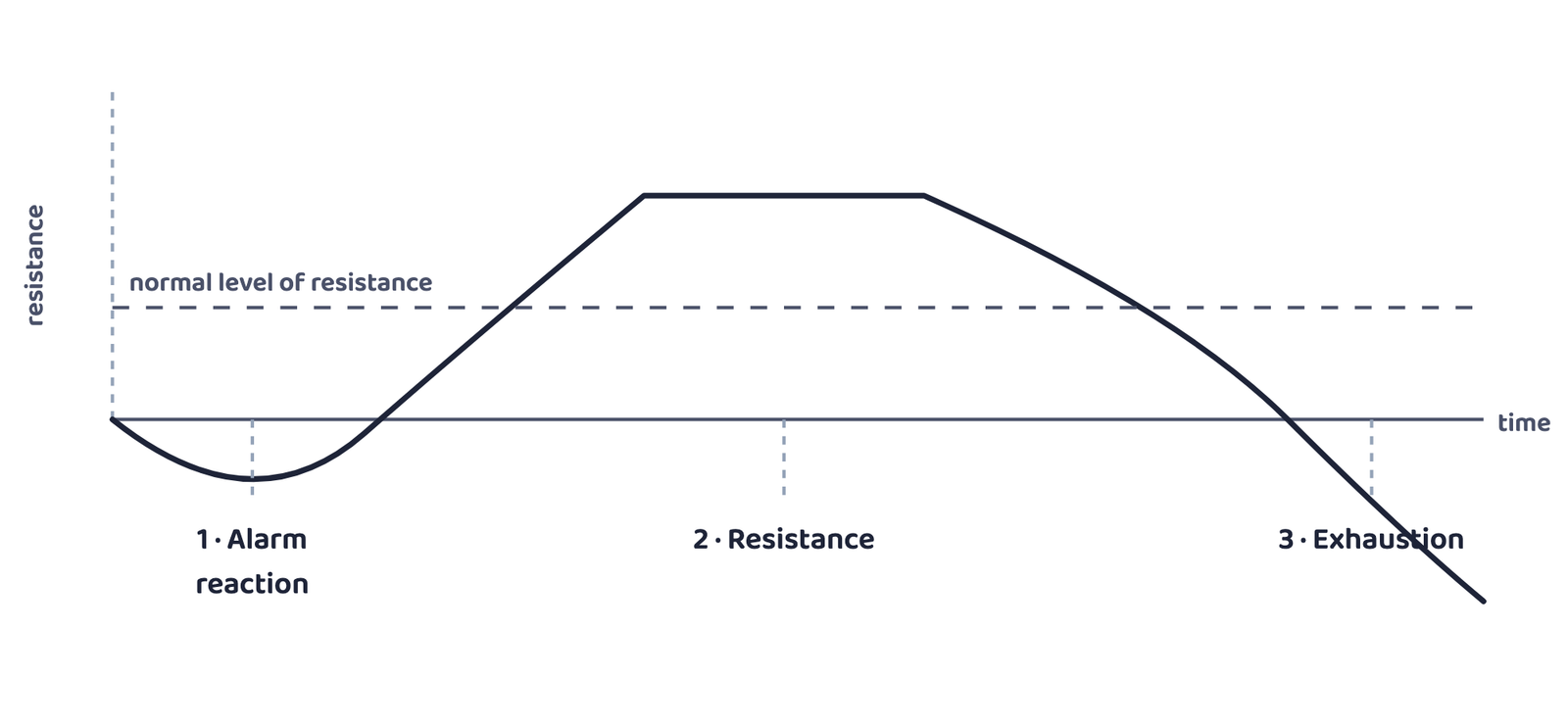
Selye studied how the body responds to prolonged stress by exposing animals to stressors (heat, X-rays, insulin injections) over time and observing hospital patients: the same pattern of bodily response appeared in all of them. He called this the General Adaptation Syndrome.
Do not present Selye’s model as the final word: it has been criticised for giving too small a role to psychological factors. How a person actually responds to stress is heavily shaped by their perception, personality and biological constitution.
2.3 Stress and the immune system
Psychoneuroimmunology studies the links between mind, brain and the immune system, specifically the effect of stress on immunity. The immune system’s white blood cells (leucocytes) identify and destroy antigens like viruses, and produce antibodies.
T cells
Destroy invaders directly.
T-helper cells
Increase immunological activity, the cells attacked by HIV, the virus that causes AIDS.
B cells
Produce antibodies.
Natural killer cells
Fight both viruses and tumours.
Stress can affect natural killer cell cytotoxicity, which is of major importance in the defence against various infections and cancer. Reduced cytotoxicity is found in highly stressed people: students facing important exams, bereaved people (people who have recently lost a loved one), and the severely depressed. Immune functioning is better in people who receive social support, and immune changes affect health more in those whose immune systems are already weakened. The book’s Fig. 3.4 (Relation of Stress with Illness) shows the sequence: negative emotions → release of stress hormones → weakening of the immune system → effects on mental and physical health. Negative emotions that accompany psychological stress (depression, hostility, anger, aggression) build up over time and can trigger panic attacks or obsessive behaviour; worry can even surface as a physical sensation mistaken for a heart attack. Negative moods are associated with poorer health outcomes, and feelings of hopelessness are related to worsening of disease, increased risk of injury and death.
2.4 Lifestyle
Stress can push a person toward an unhealthy lifestyle, the overall pattern of decisions and behaviours that determines health and quality of life. Stressed individuals expose themselves more to pathogens, eat less nutritiously, sleep less, and are more likely to smoke or misuse alcohol. Such habits develop gradually because they bring temporary relief, while their long-term damage is ignored. Studies show that health-promoting behaviours (balanced diet, regular exercise, family support) play an important role in good health.
3Coping with Stress
3.1 Problem-focused vs emotion-focused coping
It is increasingly believed that psychological well-being, social functioning and health depend on how a person copes with stress, not on the amount of stress itself.
Coping is a dynamic, situation-specific reaction to stress: a set of concrete responses to stressful situations or events, intended to resolve the problem and reduce stress. Lazarus and Folkman conceptualised coping as a dynamic process, not a fixed personality trait: constantly changing cognitive and behavioural efforts to master, reduce or tolerate the demands created by a stressful event.
Problem-focused coping
- Attacks the problem itself
- Gains information, alters the event or one’s beliefs/commitments
- Reduces the threat value of the event
- e.g. “I made a plan of action and followed it”
Emotion-focused coping
- Aims to limit emotional disruption
- Minimal effort to change the event itself
- Maintains hope, manages emotional reaction
- e.g. “I did some things to let it out of my system”
Both are necessary in a stressful situation, but research suggests people generally tend to use problem-focused coping more often.
Activity 3.3 rates five statements (e.g. “I express emotions openly and directly”) from 5 = always to 1 = never; the higher the score, the better the ability to cope. Activity 3.4 asks which of eight coping behaviours are problem-focused: reading essential books for the annual examination and making efforts to improve after a setback clearly are; discussing a problem with a friend is problem-focused when the aim is information or advice, and emotion-focused when it is only venting.
3.2 Three coping strategies (Endler and Parker)
Endler and Parker give a separate list of three coping strategies:
Task-oriented
Gathering information about the situation and alternatives, deciding priorities, and acting directly on the problem.
Emotion-oriented
Maintaining hope, controlling emotions, venting anger/frustration, or accepting nothing can be changed.
Avoidance-oriented
Denying or minimising the seriousness of the situation; suppressing stressful thoughts and replacing them with self-protective ones.
3.3 Stress management techniques
Stress is called “a silent killer”: it is linked to hypertension, heart disease, ulcers, diabetes and even cancer, which is why schools, offices and communities are increasingly interested in managing it.
Relaxation techniques
An active skill that reduces symptoms of stress and decreases the incidence of illnesses such as high blood pressure and heart disease; starts from the lower body and progresses to the facial muscles; deep breathing plus muscle relaxation.
Meditation
The yogic method: learned techniques for refocusing attention to reach an altered state of consciousness, with attention so fully absorbed that outside stimulation barely registers.
Biofeedback
Three stages: develop awareness of a response (e.g. heart rate) → learn to control it in quiet conditions → transfer that control into everyday life.
Creative visualisation
Using imagery and imagination toward a realistic goal, with a quiet mind and closed eyes, to build confidence and creative energy.
Cognitive Behavioural Techniques
Meichenbaum’s Stress Inoculation Training, which replaces negative/irrational thoughts with positive/rational ones in three phases: assessment, stress reduction techniques, and application and follow-through.
Exercise
Improves heart efficiency, lung function, circulation and immunity. At least 4 times a week, 30 minutes, with warm-up, exercise and cool-down phases.
4Promoting Positive Health and Well-being
4.1 Hardiness: the stress-resistant personality
It is unlikely that anyone goes through life without some personal crisis causing acute pressure for a while. People who sail through positively tend to have constructive attitudes and strong emotional/social support. Managing pressure this way is like being immunised against the dangers of unhealthy stress, leaving a person “stress fit” for future crises.
Hardiness (Kobasa) is a stress-resistant personality trait, a set of beliefs about oneself, the world, and how the two interact, found in people who have high stress but low illness. It consists of “the three Cs”:
Commitment
Personal commitment to work, family, hobbies and social life.
Control
A sense of purpose and direction over one’s own life.
Challenge
Seeing life changes as normal and positive rather than as a threat.
Not everyone has these traits by nature; many people have to relearn specific life skills.
4.2 Life skills
Assertiveness
Clearly and confidently communicating feelings, needs and thoughts: the ability to say no, or express emotions openly without self-consciousness.
Time management
The way you spend your time determines the quality of your life. Learning to plan time and delegate relieves pressure; the major way to reduce time stress is to change one’s perception of time. Central principle: spend your time on what you value or what helps you achieve your goals, being realistic and keeping a balance.
Rational thinking
Challenge distorted thinking and irrational beliefs; drive out intrusive negative thoughts; make positive statements.
Improving relationships
Communication is the key: listening, expressing your own feelings, and accepting others’ views even when different.
Self-care
Staying healthy, fit and relaxed prepares the body and mind; slow, stomach-centred (diaphragmatic) breathing is the most relaxed pattern.
Overcoming unhelpful habits
Perfectionism, avoidance and procrastination help in the short term but make a person more vulnerable to stress long-term.
Resilience is a dynamic developmental process: the maintenance of positive adjustment under challenging life conditions, or the capacity to “bounce back” in the face of stress and adversity. It has recently been defined in terms of three resources:
A resilient child needs more than one of these; plenty of self-esteem (I AM) alone, with no one to turn to (I HAVE) and no problem-solving ability (I CAN), does not make a child resilient. Studies show that even amid poverty and social disadvantage, many children still grow into capable, caring adults.
4.3 Positive health
Health is a state of complete physical, mental, social and spiritual well-being, and not merely the absence of disease or infirmity. Positive health comprises: a healthy body; high-quality personal relationships; a sense of purpose in life; self-regard and mastery of life’s tasks; and resilience to stress, trauma and change.
Diet
A balanced diet lifts mood, gives energy, strengthens immunity. Three main, varied meals a day. Under stress people crave high-fat, high-salt, high-sugar “comfort foods.”
Exercise
Consistently linked to better health and reduced tension/anxiety/depression. Stretching (yoga) calms; aerobic exercise (jogging, swimming) raises arousal.
Positive attitude
An accurate view of reality, sense of purpose, tolerance of others’ viewpoints, taking credit for success and accepting blame for failure, being open to new ideas, and a sense of humour.
Positive thinking
Optimists expect favourable outcomes, use problem-focused coping and seek help. Pessimists anticipate disaster and give up the goal, or deny the stress exists.
Social support
The existence of people who care about, value and love you. Perceived support (quality) is linked to well-being; social network (quantity) is not, because maintaining a large network is itself demanding.
Tangible support
- Material aid: money, goods, services
- e.g. lending class notes to a friend who was absent
Informational support
- Facts about the stressful event
- e.g. advice from a friend who has already given a similar exam
Social support can help to provide protection against stress: people with high social support from family and friends may experience less stress when they confront a stressful experience, and may cope with it more successfully. A third kind, emotional support, is reassurance that one is loved, valued and cared for. Social support has been shown to effectively reduce psychological distress such as depression or anxiety during stressful times, and its mental-health benefits reach both the person giving support and the person receiving it.
Positive health also needs overall harmonious conditions in society, and we must avoid taking unhealthy escape routes of smoking, alcohol, drugs and other harmful behaviours.
Activity 3.5: talk to a child in your neighbourhood who has been through a serious accident or trauma, and identify the factors that helped her or him cope.
- Stress is an ongoing transaction between the person and the environment, not just a stimulus or a response; Selye called it “the non-specific response of the body to any demand.”
- Primary appraisal reads an event as harm/threat/challenge; secondary appraisal checks your own resources against it.
- Three types of stress: physical/environmental, psychological, social. Three sources: life events, hassles, traumatic events.
- Four effects of stress: emotional, physiological, cognitive, behavioural.
- GAS has three stages: alarm reaction → resistance → exhaustion.
- Stress weakens the immune system (psychoneuroimmunology), reducing natural-killer-cell activity.
- Coping can be problem-focused or emotion-focused (Lazarus and Folkman); Endler and Parker give three strategies: task-, emotion- and avoidance-oriented.
- Stress management: relaxation, meditation, biofeedback, creative visualisation, cognitive-behavioural techniques (Meichenbaum), exercise.
- Hardiness = the three Cs (commitment, control, challenge). Resilience = I HAVE, I AM, I CAN.
- Positive health rests on diet, exercise, positive attitude, positive thinking and social support, plus harmonious conditions in society and avoiding escape routes like smoking, alcohol and drugs.
- Can I state Selye’s definition of stress and one criticism of it?
- Can I distinguish primary from secondary appraisal with an example?
- Can I list all three stages of GAS in order?
- Can I name all four immune-system cell types and what each does?
- Can I explain the difference between problem-focused and emotion-focused coping?
- Can I name all three Cs of hardiness and all three resources of resilience?