
- What psychologists mean by “self”, and how the Indian and Western ideas of self differ
- What self-esteem, self-efficacy and self-regulation actually mean, and how to tell them apart
- What “personality” means in psychology, and its four defining features
- Six approaches to studying personality: type, trait, psychodynamic, behavioural, cultural and humanistic
- How psychologists actually measure personality: self-report tests and projective techniques
This chapter (Unit II) carries 13 marks in the CBSE theory paper (70 marks
total). The official 2026-27 CBSE syllabus lists every section of this chapter: self,
personality, the six approaches and assessment. Psychology Class 12 also has a 30-mark Practical component (a case
profile file, five psychological tests administered and interpreted, and a viva voce,
a face-to-face oral exam where you answer questions about your practical work out loud).
These notes cover the 70-mark theory only; ask your teacher for the practical file
format separately.
self-esteemself-efficacyself-regulation
personalitytraittypeid, ego, superego
defence mechanismsself-actualisationprojective technique
1Introduction
You constantly think about your own behaviour and other people’s: why you react
differently from a friend in the same situation, or why your relationships with people
turn out the way they do. Psychologists use the idea of self to answer the first
kind of question, and the idea of personality to answer the second. The two
ideas are closely linked, and this NCERT chapter’s own opening line is worth
remembering word for word.
Self, in fact, lies at the core of personality.
NCERT, Chapter 2 opening
Studying self and personality helps us understand not just who we are, but also
what makes us unique and what makes us similar to others.
2Concept of Self
A newborn has no idea of a “self” at all: the sense of “I” develops gradually as a
child grows, shaped by parents, friends, teachers and every other significant person
around them. The structure of self keeps changing in the light of new experiences.
Personal identity
- Attributes that make a person different from others
- Name (“I am Karim”), qualities (“I am hardworking”), capabilities
(“I am a singer”), beliefs (“I am a believer in destiny”)
Social identity
- Attributes that link a person to a social or cultural group
- “I am a Hindu”, “I am a Brahmin”, “I am a North Indian”: group-derived
descriptions
2.2 Self as subject and self as object
When the self is the one acting (e.g. “I am a dancer”, I am the one doing
the dancing), it is described as a subject. When the self is the one
something happens to (e.g. “I am one who easily gets hurt”, I am the one
the hurt happens to), it is described as an object. Self is both at once: a
“knower” (subject) and something that can be “known” (object).
2.3 Kinds of self
The very first sign of a “self” a newborn shows is purely biological: crying for
milk when hungry. There is no awareness in this reflex yet; awareness (“I am hungry”)
develops only afterwards.
3Cognitive and Behavioural Aspects of Self
3.1 Self-concept
Self-concept is the way we perceive ourselves: the ideas we hold about our
own competencies and attributes. At the most general level it is simply either
positive or negative overall (“I am a good person”). Looking closer, it becomes more
specific to particular areas of life (e.g. positive about athletic ability
but negative about mathematics).
Activity 2.1 (book): complete sentences starting with “I am”; the answers show both your personal and your social identity.
3.2 Self-esteem
Self-esteem is the value judgment a person makes about her/his own worth.
It is assessed by asking a person to indicate how true statements like “I am good at
homework” are for her/him.
Children with high academic self-esteem perform better in school; children with
high social self-esteem are more liked by their peers. Low self-esteem in all areas is linked to anxiety,
depression and antisocial behaviour. Warm, positive parenting builds high
self-esteem; parents who make every decision for a child (even when not needed) tend
to produce low self-esteem.
3.3 Self-efficacy
Self-efficacy is a person’s belief in her/his own ability to succeed in a
particular situation, rather than believing that outcomes are controlled by luck,
fate or other external factors. The concept comes from Bandura’s social learning
theory, the idea that people learn behaviour by watching and copying others
(you will meet this theory again as “observational learning” in section 6.4).
People with strong self-efficacy feel less fearful, and find it easier to change
habits (e.g. quit smoking) once they decide to. Seeing other people succeed
(“positive models”) through society, parents, and one’s own past successes, builds
self-efficacy in a person’s growing-up years (“formative years”).
3.4 Self-regulation
Self-regulation is our ability to organise and monitor our own behaviour.
People who can change their behaviour to suit the demands of the outside world are
said to be high on self-monitoring. Self-control is the specific ability
to delay or defer the gratification (satisfaction) of a need, waiting instead of
getting it right away. This plays a key role in achieving long-term goals.
Indian cultural tradition provides ready mechanisms for self-control:
fasting in vrata or roza, and practising non-attachment
(not letting yourself get too attached) to worldly things.
Observation of own behaviour
Provides information to change, modify or strengthen an aspect of self.
Self-instruction
Instructing yourself to do something and behave the way you want.
Self-reinforcement
Rewarding your own behaviour that has a pleasant outcome: e.g. treating
yourself to a movie after doing well in an exam.
4Culture and Self
4.1 The self-group boundary
The most important distinction between the Indian and Western views of self is
where the boundary is drawn between self and other.
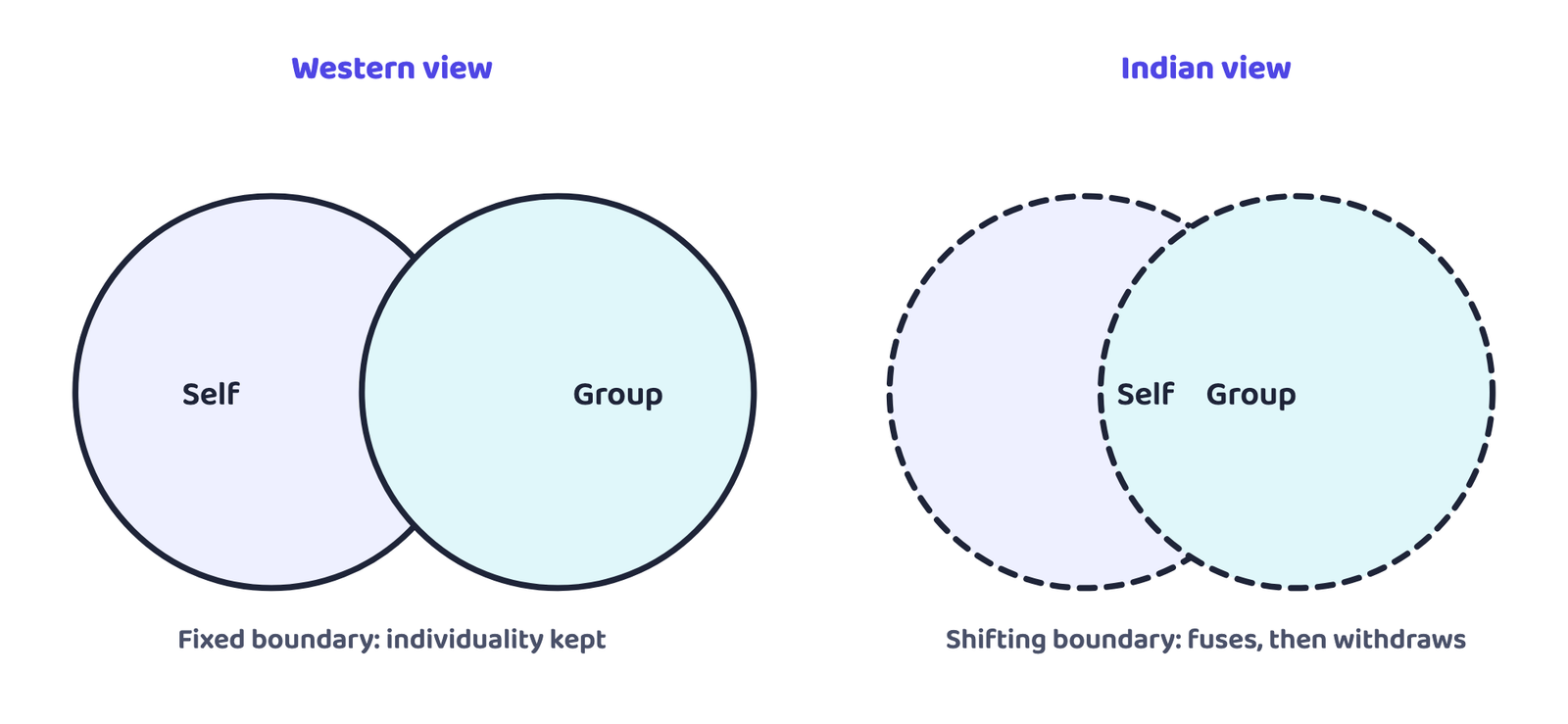
Western view
- Self and group are two separate entities with clearly defined boundaries
- Individual keeps their individuality inside the group
- Sharp either/or splits (called dichotomies) between self and other, man
and nature, subjective and objective - Self and group often remain at a distance: many Western cultures are
characterised as individualistic
Indian view
- Boundary between self and other keeps shifting
- At one moment a person feels part of something much bigger than themselves,
their family, community, even “the whole universe”; at the next moment the same
person is fully focused on their own personal needs and goals - Self and group live side by side comfortably, without a sharp either/or split
- Self and group remain in harmonious co-existence: many Asian cultures are
characterised as collectivistic
5Concept of Personality
The word “personality” comes from the Latin persona, the mask Roman
theatre actors wore to change their facial appearance for a role. Wearing the mask
did not mean the actor actually had those qualities. In the same way, everyday
we often assume that a “good-looking” person also has a “charming personality”,
but that is just a superficial (surface-level) impression, not what personality
actually means in psychology.
Personality refers to relatively stable and unique qualities that
characterise an individual’s behaviour across different situations, over a period of
time.
5.1 Four features of personality
Physical + psychological
Personality has both bodily and mental components.
Unique
Its expression through behaviour is fairly unique to each individual.
Stable over time
Its main features do not easily change with time.
Dynamic (adaptive)
Some features do change, in response to internal urges or the demands of a
situation: personality adapts.
| Term | Meaning |
|---|---|
| Temperament | Biologically based characteristic way of reacting |
| Trait | Stable, persistent and specific way of behaving |
| Disposition | Tendency to react to a given situation in a particular way |
| Character | Overall pattern of regularly occurring behaviour |
| Habit | A way of behaving practised so many times it now happens automatically |
| Values | Goals and ideals considered important and worthwhile |
6Major Approaches to the Study of Personality
Situational characteristics play an important role in determining our behaviour:
people may behave as dependent or independent because of external rewards or threats
in a situation, not because of an internal trait. The cross-situational consistency of
traits is found to be quite low (see behaviour in a market, a courtroom or a place of
worship).
6.1 Type approaches
A type approach places a person into one broad category based on a cluster of
behavioural characteristics: everyone in that category is assumed to behave in
roughly the same expected way.
| Theorist / system | Types proposed |
|---|---|
| Hippocrates (Greek physician) | Four humours (bodily fluids he believed shaped temperament): sanguine (cheerful), phlegmatic (calm), melancholic (sad), choleric (irritable) |
| Charak Samhita (Ayurveda): tridosha | Vata, pitta, kapha, three bodily “doshas” or humours → the person’s prakriti (basic nature) |
| Trigunas (a separate Indian typology, apart from Charak Samhita’s tridosha) | Sattva (cleanliness, truthfulness, discipline), Rajas (intense activity, desire, envy), Tamas (anger, laziness, helplessness). All three are present in everyone, just in different amounts |
| Sheldon (body build + temperament) | Endomorphic (fat, soft, round body: relaxed, sociable), Mesomorphic (strong build: energetic, courageous), Ectomorphic (thin, fragile body: brainy, artistic, prefers being alone) |
| Jung | Introverts (prefer solitude, withdraw, shy) vs Extraverts (sociable, outgoing) |
| Friedman & Rosenman | Type A (impatient, hurried, high risk of CHD, coronary heart disease, i.e. heart disease) vs Type B (absence of Type-A traits) |
| Morris (extension) | Type C, prone to cancer: cooperative, unassertive, suppresses negative emotion |
| Recent extension | Type D: prone to depression |
Do not call Sheldon’s body types, Hippocrates’ humours, or the tridosha a “trait
theory”: the book keeps type approaches (broad categories) strictly separate
from trait approaches (specific attributes), which come next.
Personality typologies are appealing but too simplistic: human behaviour is too
complex and variable to fit people into such neat categories.
6.2 Trait approaches
A trait is a relatively enduring (long-lasting) quality on which one person
differs from another, e.g. how shy or how friendly someone is. Traits are (a)
relatively stable over time, (b) generally consistent (the same) across situations,
and (c) present in different strengths and combinations in different people.
Allport’s trait theory
Allport analysed the words of the English language to look for traits which
describe a person. He acknowledged the influence of situations on behaviour, but held
that the way a person reacts to a situation depends on her/his traits.
Cattell and Eysenck
| Theorist | Method / structure | Test |
|---|---|---|
| Raymond Cattell | Used factor analysis, a statistical method that groups a huge list of describing-words into a small number of underlying groups, on the adjectives people use to describe personality. This gave 16 primary/source traits (stable, building blocks) + surface traits (which result from source traits interacting with each other) | Sixteen Personality Factor Questionnaire (16PF) |
| H.J. Eysenck | Three biologically-based dimensions: (1) Neuroticism (emotional instability) vs emotional stability, (2) Extraversion vs introversion, (3) Psychoticism vs sociability, added later: a high scorer here is hostile, self-centred (“egocentric”), and antisocial | Eysenck Personality Questionnaire (EPQ) |
If asked to name and explain Eysenck’s three dimensions of personality, write all
three, in order, with one line each.
Box 2.2: Five-Factor Model (Big Five)
Paul Costa and Robert McCrae studied a very wide range of personality traits and
found they could all be grouped under five factors. This is considered today’s most
promising empirical (evidence-based, tested through real studies rather than just
argued in theory) approach to personality, supported across cultures and across
different research methods.
Openness to experience
One end: imaginative, curious, open to new ideas. Other end: rigid
Conscientiousness
One end: achievement-oriented, dependable, self-controlled. Other end: impulsive
Extraversion
One end: socially active, assertive, talkative. Other end: shy
Agreeableness
One end: helpful, cooperative, caring. Other end: hostile, self-centred
Neuroticism
One end: anxious, worried, irritable. Other end: well-adjusted
OCEAN: Openness, Conscientiousness, Extraversion, Agreeableness, Neuroticism
The first letters of the Big Five spell OCEAN: that order is easy to write out
fast in an exam.
6.3 Psychodynamic approach (Freud)
Sigmund Freud, a physician, developed this theory from his clinical practice,
using hypnosis, free association (sharing all thoughts that come to mind),
dream analysis and analysis of everyday errors.
Levels of consciousness

Conscious
Thoughts, feelings, actions we are aware of right now.
Preconscious
Mental activity we become aware of only if we attend to it closely.
Unconscious
A reservoir of instinctive drives and repressed (mostly sexual) wishes we are unaware of.
Unsuccessful resolution of these conflicts results in abnormal behaviour. Freud
developed a therapeutic procedure called psychoanalysis: its basic goal is to
bring repressed unconscious material to consciousness, so that people live in a more
self-aware and integrated manner.
Structure of personality: id, ego, superego
These are concepts, not physical structures: they reside in the unconscious
as forces and can be inferred from how people behave.
A boy wants an ice-cream. His id tells him to grab the cone and eat it. His
ego tells him he may be punished if he grabs it without asking, so the best way
to get gratification is to ask permission. If he asks his mother and gets the cone,
his superego confirms this behaviour was morally correct, so no guilt or
anxiety follows.
Always name all three principles exactly: Id = pleasure principle, Ego =
reality principle, Superego = the moral branch of mental functioning.
Freud held that the id gets its energy from two basic drives (“instincts”): the
life instinct (the drive to survive and reproduce, which Freud wrote about far
more) and the death instinct (a drive towards destruction, which he wrote about
much less). The specific energy of the life instinct is called libido.
Ego defence mechanisms
A defence mechanism is a way the ego reduces anxiety by distorting reality,
used to avoid awareness of instinctual needs.
| Mechanism | What happens |
|---|---|
| Repression (the most important) | Anxiety-provoking thoughts are totally dismissed into the unconscious: “I don’t know why I did that” |
| Projection | A person attributes her/his own traits to others (e.g. an aggressive person sees others as aggressive towards them) |
| Denial | Totally refusing to accept reality (e.g. denying a serious illness) |
| Reaction formation | Adopting behaviour opposite to one’s true feelings (e.g. someone with strong sexual urges channels that energy into intense religious devotion instead) |
| Rationalisation | Making an unreasonable feeling or behaviour seem reasonable (e.g. “I’ll do much better with these new pens” after doing poorly in an exam) |
Freud’s own claim that projection reduces anxiety and stress has been questioned:
several later studies have not found support for it. The book itself flags this.
Stages of psychosexual development
Fixation is the arrest of development at a stage the child could not
resolve successfully. Regression is a return to an earlier, less mature stage
when a later problem is not resolved adequately.
Oedipus was a Greek king who unknowingly killed his father and married his
mother; the male child’s love for the mother and hostility to the father is named
after him. Electra was a Greek character who induced her brother to kill their
mother; the girl child’s version is named after her.
Post-Freudian (neo-analytic) theorists
Some of these theorists worked with Freud early on, then all of them developed their
own theories, giving less weight to sex/aggression and more weight to the
ego and social/rational forces.
Carl Jung
People are guided as much by aims and aspirations as by sex and aggression.
Analytical psychology: personality is competing forces within the
individual. The self strives for unity and oneness. Proposed a collective unconscious of inherited archetypes
(e.g. the God or the Mother Earth image), found in myths, dreams and art of all
mankind.
Karen Horney
Optimistic view; challenged Freud’s treatment of women as inferior: neither sex
is superior. Disturbed childhood relationships (indifferent/erratic parenting)
cause basic anxiety and deep resentment toward parents.
Alfred Adler
Individual psychology: behaviour is purposeful and goal-directed. Every person
has feelings of inadequacy from childhood, called the inferiority complex;
overcoming it drives personality development.
Erich Fromm
Social orientation (not biological, unlike Freud): humans are basically social
beings understood through their relationships with others; growth comes from a
desire for freedom, justice and truth. Character traits (personality) develop
from our experiences with other individuals.
Erik Erikson
Stresses rational, conscious ego processes; development is a lifelong
process with ego identity central to it. Known for the identity crisis of
adolescence.
Do not mix up Horney’s and Adler’s explanations: both discuss disorders rooted in
childhood, but Horney ties them to disturbed parent-child relationships
causing basic anxiety, while Adler ties them to unresolved inferiority
complex. (Review Question 6 asks this directly.)
Criticisms of psychodynamic theories
The book’s own 4 criticisms
- Based on case studies: lack a rigorous scientific basis
- Use small and atypical samples for generalisation
- Concepts are not properly defined, hard to test scientifically
- Freud used males as the prototype and overlooked female experience
Don’t write instead
- Vague statements like “Freud’s theory is outdated”: write the four points
instead
6.4 Behavioural approach
This approach does not give importance to the internal dynamics of behaviour
(the unconscious, the id or ego); behaviourists believe in data that are definable,
observable and measurable. Personality is understood as the response of an
individual to the environment: each response is a single piece of behaviour, produced
(“emitted”) to satisfy one specific need, and it is this response that behaviourists
treat as the basic building block (“structural unit”) of personality.
Activity 2.2 (book): which one aspect of your personality would you change, and which never, and why. Activity 2.3 (book): note behaviour you and your friends have picked up from popular youth icons.
6.5 Cultural approach
Personality is seen as an adaptation to a group’s ecology and culture. A
group’s “economic maintenance system” plays a vital role in the origin of
cultural and behavioural variations. The climate, the terrain and the availability of
food determine not only people’s economic activities but also their settlement
patterns, social structures, division of labour and child-rearing practices. Rituals,
ceremonies, religious practices, arts, recreational activities, games and play are the
means through which people’s personality gets projected in a culture.
The Birhor, a tribal group of Jharkhand, live a nomadic hunting-gathering
life. Their children are given enormous early freedom and socialised to be
independent, autonomous and achievement-oriented: exactly the qualities
their way of life needs. In contrast, agricultural societies socialise children to
be obedient, caring towards younger children (“nurturant”) and responsible:
the qualities their way of life needs.
6.6 Humanistic approach
Developed largely in reaction to Freud’s theory, by Carl Rogers and Abraham
Maslow.
Rogers‘ most important idea is the fully functioning person;
fulfilment is the motivating force for personality development. Every person has a
real self (who they actually are) and an ideal self (the self a person
would like to be). The congruence of these two selves makes a person fully
functioning: when they correspond, a person is generally happy; a discrepancy often
results in unhappiness and dissatisfaction.
Rogers makes two basic assumptions about human behaviour: (1) behaviour is
goal-directed and worthwhile; (2) people (who are innately good) will almost always
choose adaptive, self-actualising behaviour.
Rogers held that a person needs to feel accepted and valued without conditions,
what he called unconditional positive regard, for their self-concept to grow in
a healthy way. His client-centred therapy tries to give the client exactly this
kind of acceptance.
Maslow‘s self-actualisation is the state of having reached one’s
own fullest potential. He held that survival needs (biological, security,
belongingness) are shared with animals: the real journey of human life begins with the
pursuit of self-esteem and self-actualisation needs.
Maslow’s hierarchy of needs: recap from Class XI; the bottom three are “survival needs”, shared with animals
Box 2.3: Healthy personality lies in not mere adjustment to society. It
involves a quest to know oneself deeply, to be true to one’s own feelings without
disguise, and to be oneself in the here-and-now.
| # | Characteristic |
|---|---|
| 1 | Is aware of their own self, feelings and limits, and accepts themselves and what they make of their lives as their own responsibility (the book calls this having “the courage to be”) |
| 2 | Lives fully in the present moment (“here-and-now”) instead of feeling stuck or held back (“not trapped”) |
| 3 | Does not live in the past or dwell in the future through anxious expectations and distorted defences |
7Assessment of Personality
Personality assessment is a formal effort aimed at understanding the
personality of an individual: used for diagnosis, training, placement and
counselling, aiming to predict behaviour with minimum error and maximum accuracy.
7.1 Self-report measures
Direct, structured measures: the subject openly reports her/his own feelings, and
the answers are scored in quantitative terms and interpreted on the basis of norms
developed for the test.
| Test | Developed by | Key facts |
|---|---|---|
| MMPI (Minnesota Multiphasic Personality Inventory) | Hathaway & McKinley | 567 true/false statements; scored on 10 separate sub-scales, each measuring a different area, several of them psychiatric conditions (e.g. depression, paranoia meaning extreme suspicion of others, schizophrenia); revised as MMPI-2 |
| JMPI (Jodhpur Multiphasic Personality Inventory) | Mallick & Joshi | Indian test, built along the lines of MMPI |
| EPQ (Eysenck Personality Questionnaire) | Eysenck | Started out measuring the first two of Eysenck’s dimensions, introverted-extraverted and emotionally stable-unstable, broken down into 32 specific traits; psychoticism was added later as a third dimension |
| 16PF | Cattell | Presents statements about oneself, and the subject picks the one option out of several given choices that fits them best; used in career guidance and occupational testing |
Self-report measures suffer from a number of problems, including social desirability
(endorsing items in a socially acceptable way) and acquiescence (agreeing with
items regardless of content, “yes-saying”). Name both if asked “problems with
self-report measures”.
7.2 Projective techniques
Self-report measures are direct techniques: the person knows her/his personality
is being assessed. Projective techniques are indirect methods: an unstructured
stimulus lets the person project her/his own feelings, desires and needs onto it,
revealing unconscious motives. All projective techniques share five features:
- The stimuli are relatively or fully unstructured and poorly defined.
- The person is usually not told the purpose of assessment or the method of scoring and interpretation.
- The person is told there are no correct or incorrect responses.
- Each response is considered to reveal a significant aspect of personality.
- Scoring and interpretation are lengthy and sometimes subjective.
Rorschach Inkblot Test
Hermann Rorschach; 10 symmetrical inkblots (5 black & white, 2 with red ink,
3 pastel), on ~7″×10″ cards. Two phases: performance proper (what do you see) and
inquiry (where/how/why).
Thematic Apperception Test (TAT)
Morgan & Murray; 30 black & white picture cards + 1 blank card. Subject
tells a story about what led up to, is happening in, and will follow the picture.
Indian adaptation by Uma Chaudhury.
Rosenzweig’s P-F Study
Cartoon pictures of a frustrating situation; subject says what the frustrated
person will do. Analyses the type and direction of aggression. Indian adaptation
by Pareek.
Sentence Completion Test
Subject completes incomplete sentences (“My father ___”, “My greatest fear is ___”).
The endings used reveal attitudes, motivation and conflicts.
Draw-a-Person Test
Subject draws a person, then (generally) an opposite-sex person, then tells a
story about them. E.g. a disproportionately large head suggests organic brain
disease and pre-occupation with headaches.
7.3 Behavioural analysis (observer reports)
| Method | What it involves |
|---|---|
| Interview | Structured (specific questions, fixed procedure) or unstructured (open impression-building) |
| Behavioural ratings | People who know the person well place them into categories. Watch for the halo effect (one trait colours the whole judgment), middle-category bias (a rater’s tendency to place people in the middle of the scale) and extreme-response bias (a tendency to place them in the extreme positions) |
| Observation | Careful, trained observation of behaviour. Limitations (also of interviews): (1) the professional training needed is demanding and time-consuming; (2) maturity of the psychologist is a precondition for valid data; (3) the mere presence of the observer may contaminate the results |
| Nomination | Peer assessment: each person names who they’d like to work/study/play with. Highly dependable, but can carry personal bias |
| Situational tests | e.g. the situational stress test: a role-play task performed with non-cooperative others, to see behaviour under stress |
- Self lies at the core of personality; kinds of self: biological, personal, social
- Self-esteem (worth), self-efficacy (Bandura, belief in ability), self-regulation (self-control, self-instruction, self-reinforcement)
- Indian self: shifting boundary, collectivistic. Western self: fixed boundary, individualistic
- Personality = stable, unique, adaptive; four features from the book
- Type approaches: Hippocrates, tridosha/trigunas, Sheldon, Jung, Type A/B/C/D
- Trait approaches: Allport (cardinal/central/secondary), Cattell (16PF), Eysenck (EPQ, 3 dimensions), Big Five (OCEAN)
- Freud: conscious/preconscious/unconscious; id (pleasure)/ego (reality)/superego (morality); 5 defence mechanisms; 5 psychosexual stages; post-Freudians (Jung, Horney, Adler, Fromm, Erikson)
- Behavioural: response is the unit; Pavlov, Skinner, Bandura
- Cultural: Birhor example (hunting-gathering vs agricultural)
- Humanistic: Rogers (real vs ideal self), Maslow (self-actualisation)
- Assessment: self-report (MMPI, JMPI, EPQ, 16PF) vs projective (Rorschach, TAT, P-F Study) vs behavioural analysis (interview, ratings, observation, nomination, situational tests)
- Can I state, in one line each, how Indian and Western views of self differ?
- Can I name all three of Freud’s structures and their principles, without looking?
- Can I list all five ego defence mechanisms with one example each?
- Can I name and order all five psychosexual stages?
- Can I name the Big Five factors and spell OCEAN?
- Can I name two self-report tests and two projective techniques, with their developers?