
| Board | Marks for this chapter | What this means for you |
|---|---|---|
| CBSE | 10 marks | Unit 3 of the CBSE 2026-27 syllabus (theory paper 80 marks, project 20). The unit covers all three institutions: caste, tribe, and family and kinship. |
| Other boards | Check your board | Marks differ by board. Check your board’s current syllabus for this chapter. |
- What caste is, how ancient texts prescribed it to work, and the six features the book lists for it
- How British rule and the Indian Constitution both reshaped caste, and why it still survives in politics and marriage
- The difference between “sanskritisation” and “dominant caste”, and why caste feels invisible to some Indians and inescapable to others
- How tribes are classified in India, and why the idea of the “untouched primitive tribe” has not been true for a long time
- Why national development has cost tribal communities so much, and how tribal identity is asserted today
- The different forms a family can take, and the real difference between matriliny and matriarchy
3.1 Caste and the Caste System
Population is not just a pile of separate people. It is a society built out of communities and classes that are linked to each other, and held together by social institutions. This chapter looks at three institutions that are central to Indian society: caste, tribe and family.
You already know that caste is an ancient institution. You also know that caste is very much a part of India today. This section asks a simple question: is the “caste” of the past the same thing as the “caste” of the present?
Caste in the Past
Caste is unique to the Indian sub-continent. Other parts of the world have social arrangements that produce similar effects, but the exact form of caste has not been found anywhere else. Caste is characteristic of Hindu society, but it has spread to the major non-Hindu communities of the sub-continent too, especially Muslims, Christians and Sikhs.
The English word caste comes from the Portuguese word casta, meaning “pure breed”. In Indian languages, the same broad institution is referred to by two different words: varna and jati.
Varna
- Literally means “colour”
- A four-fold, all-India division: brahmana, kshatriya, vaishya, shudra
- Excludes “outcastes”, foreigners, slaves and conquered peoples, sometimes called the panchamas (fifth category)
Jati
- A generic word for “species” or “kind”, used for plants, animals, objects and people
- The word most commonly used for caste in Indian languages
- A regional or local sub-classification, made up of hundreds or thousands of castes and sub-castes
So while the four-varna classification is common to all of India, the jati hierarchy is local, and changes from region to region.
The four-varna classification is roughly 3,000 years old. But scholars agree the “caste system” was not the same thing for all of those years. In the late Vedic period (roughly 900 to 500 BC), it was really just the varna system: only four loose divisions, not fixed by birth, and movement across them was common. Caste became the rigid, birth-based institution we recognise today only in the post-Vedic period.
The six features that define caste
These are the book’s own list of the most commonly cited defining features of caste. Learn all six separately, so that you can name each one on its own.
Determined by birth
A child is “born into” the caste of its parents. Caste is never a matter of choice. You cannot choose, change or leave your caste, although there are instances where a person may be expelled from their caste.
Endogamous
Marriage is restricted to members of the same caste group. Caste membership involves strict rules about marriage.
Rules on food and food-sharing
What kind of food may or may not be eaten, and who one may share food with, is specified by caste.
A hierarchy of rank
Every caste has its own place in a system where all castes are ranked. Middle-ranking castes’ exact position can vary by region, but a hierarchy always exists.
Segmental organisation
Castes have sub-castes, and sub-castes can sometimes have their own sub-castes: a system of divisions inside divisions.
Hereditary occupation
A person born into a caste could traditionally only practise that caste’s occupation, and that occupation could only be practised by that caste. Occupation passed from generation to generation.
These six features are the prescribed rules found in ancient scriptural texts, not proof of what actually happened in every village. The book is careful to say we cannot know how strictly these rules were followed in real life. Do not write “caste always worked exactly like this” as if it were an observed fact. Write “these are the rules caste prescribed.”
The historical evidence shows that caste was a very unequal institution: some castes benefited greatly from the system, while others were condemned to a life of endless labour and subordination. Once caste became rigidly determined by birth, it was in principle impossible for a person to ever change their life circumstances: an upper-caste person would always have high status, and a lower-caste person would always have low status.
Why caste is unequal: two organising ideas
Theoretically, the caste system combines two sets of principles.
Purity and pollution is the belief that decides caste rank. Castes seen as ritually “pure” (closer to the sacred) get high status; castes seen as ritually “impure” or “polluting” get low status. As in all societies, material power (economic or military) is closely tied to social status, so those in power tend to have high status. Historians believe that those defeated in wars were often assigned low caste status.
Finally, castes are not just unequal in ritual terms, they are also meant to be complementary and non-competing. Each caste has its own fixed place that no other caste can take. Because caste is linked to occupation, the system works like a social division of labour, except that in principle it allows no upward or downward movement at all.
Colonialism and Caste
If modern history starts in the 19th century, then 1947 splits it neatly into two: the colonial period (roughly 1800 to 1947) and the post-Independence period (1947 to today). Some scholars go so far as to argue that what we call “caste” today owes more to colonialism than to ancient Indian tradition. Not all of the colonial changes were intended or deliberate. British administrators first tried to understand caste in order to govern efficiently, through methodical and intensive surveys and reports on the “customs and manners” of tribes and castes; the census then put caste on official record.
Before the census, caste identities were fairly fluid and not very rigid. Once the British began counting and officially recording caste, caste “began to take on a new life”: a person’s rank was now something to be argued for in writing, with historical or scriptural evidence, in front of a government official. The very act of counting caste changed the institution itself.
Perhaps it would be more accurate, the book says, to call these fundamental changes in the institution of caste. Not just India but the whole world was changing rapidly in this period, due to the spread of capitalism and modernity.
The fight against untouchability began even before the nationalist movement, in the second half of the 19th century, from both ends of the caste spectrum: upper-caste reformers on one side, and members of the lower castes on the other.
Jotirao Govindrao Phule (1827-1890)
Denounced the injustice of the caste system and its purity/pollution rules. Founded the Satyashodhak Samaj (Truth Seekers’ Society) in 1873 for the human rights and social justice of low-caste people.
Savitribai Phule (1831-1897)
The first headmistress of the country’s first school for girls, in Pune. Devoted her life to educating Shudras and Ati-Shudras, and started a night school for farmers and labourers. She died while serving plague patients.
Ayyankali (1863-1914)
Born in Kerala, a leader of the lower castes and Dalits. Because of his efforts, Dalits won the freedom to walk on public roads, and Dalit children were allowed into schools.
Sri Narayana Guru (1856-1928)
Born in Kerala, preached brotherhood for all and fought the ill effects of caste. Led a quiet but significant social revolution with the watchword: “One Caste, One Religion, One God for all men.”
Periyar, E.V. Ramasami Naickar (1879-1973)
A rationalist and the leader of the lower-caste movement in South India. He argued that all men are equal, and that liberty and equality are every individual’s birthright.
Alongside these, Mahatma Jotiba Phule and Babasaheb Ambedkar led the movement in western India, while Ayyankali, Sri Narayana Guru, Iyotheedass and Periyar led it in the South. Anti-untouchability programmes became a significant part of the Congress agenda, and by the time Independence was near, the nationalist movement broadly agreed that caste distinctions should be abolished. The dominant view in the nationalist movement was to treat caste as a social evil and as a colonial ploy to divide Indians. Gandhi’s position was distinctive: he worked for the upliftment of lower castes and the abolition of untouchability, while also reassuring landowning upper castes that their interests would be protected.
Caste in the Present
The post-Independence Indian state inherited this contradiction. On one hand, it was constitutionally committed to abolishing caste. On the other, it was both unable and unwilling to push through the radical economic reforms that would have actually undermined caste-based inequality. The state assumed that simply being “caste-blind” would automatically weaken caste privilege over time. For example, appointments to government jobs took no account of caste, which left the well-educated upper castes and the ill-educated or often illiterate lower castes to compete on “equal” terms. The only exception to this was reservation for Scheduled Castes and Scheduled Tribes.
Development and industry changed caste only indirectly. Modern industry created new jobs that had no caste rules attached, and city living made caste-segregated social patterns harder to maintain. Educated Indians drawn to individualism and “meritocracy” began dropping the more extreme caste practices.
Do not write “modernisation ended caste in India.” The book’s own evidence says the opposite in several spheres. Recruitment to industrial jobs, in the textile mills of Mumbai (then Bombay) and the jute mills of Kolkata (then Calcutta), stayed organised along caste and kinship lines, because the middlemen who recruited workers hired from their own caste and region. Prejudice against untouchables remained strong in cities too, just somewhat less extreme than in villages.
Caste has proved most resilient in the cultural and domestic sphere. Endogamy (marrying within one’s own caste) has been largely unaffected by modernisation: most marriages still happen within caste boundaries, even though inter-caste marriages are now more common than before. The boundaries between castes of similar social and economic status are still heavily guarded.
The most eventful sphere of change has been politics. Democratic politics in India has been deeply shaped by caste from the very start. Since the 1980s, explicitly caste-based political parties have emerged. In early elections, caste solidarity looked decisive, but the picture got complicated once every party started using the same caste-based calculations to win votes.
Sanskritisation (M.N. Srinivas): the process by which members of a middle or lower caste try to raise their own social status by adopting the ritual, domestic and social practices of a higher-status caste.
Dominant caste (M.N. Srinivas): a caste with a large population that was granted land rights through India’s partial post-Independence land reforms. These reforms took land away from the old upper castes, who were “absentee landlords” (they lived in towns and cities, played no real part in farming, and simply collected rent from a distance). The land instead went to the next layer down: castes that managed farming but did not till the soil themselves, and who depended on lower-caste (including “untouchable” caste) labour for actual cultivation. Once these castes held both land rights and large numbers, they gained real economic AND political power under universal adult franchise (every adult citizen’s right to vote, regardless of caste, wealth or education), becoming “dominant” in the countryside and in regional politics.
| Dominant caste | Region |
|---|---|
| Yadavs | Bihar and Uttar Pradesh |
| Vokkaligas | Karnataka |
| Reddys and Khammas | Andhra Pradesh |
| Marathas | Maharashtra |
| Jats | Punjab, Haryana and Western Uttar Pradesh |
| Patidars | Gujarat |
Be able to tell sanskritisation and dominant caste apart in one line: sanskritisation is about adopting a higher caste’s ritual, domestic and social practices to raise status; dominant caste is about castes that gained land rights and numbers, and with them real economic and political power. One is cultural, the other is material and political.
M.N. Srinivas (Mysore Narasimhachar Srinivas, 1916-1999) was one of India’s foremost sociologists and social anthropologists, known for his work on the caste system and for coining the terms “sanskritisation” and “dominant caste”. His book The Remembered Village is one of the best-known village studies in social anthropology.
Why caste feels “invisible” to some Indians, and inescapable to others
One of the most paradoxical changes in contemporary caste is that it has become almost invisible for the upper-caste, urban middle and upper classes, precisely because caste did its job so well for them. Their caste status gave them the economic and educational resources (subsidised public education, professional courses in science, technology, medicine and management, and public-sector jobs in the early decades after Independence) to take full advantage of development. By the second and third generation, these families came to believe their advancement had little to do with caste: for them, caste now feels limited to the private sphere of religion, marriage and kinship. But this group is not uniform: not every upper-caste person is privileged, and some are poor.
Caste feels invisible
- Upper-caste, urban, middle/upper-class Indians
- Benefited most from post-colonial development policy
- Caste now feels confined to religion, marriage and kinship
Caste feels inescapable
- Scheduled Castes, Scheduled Tribes, backward castes
- No inherited educational or social capital to compete with an already-entrenched upper caste
- Cannot afford to abandon caste identity: it is one of the few collective assets they have
- Reservation and protective discrimination are their “lifeline”, but using it tends to make caste the all-important, and often the only, aspect of their identity that the world recognises
3.2 Tribal Communities
“Tribe” is a modern term for communities that are actually very old, among the oldest inhabitants of the Indian sub-continent. Indian tribes have usually been defined negatively, by what they were not.
Tribes were traditionally defined as communities that: (1) did not practise a religion with a written text, (2) did not have a state or political form of the “normal” kind, and (3) did not have sharp class divisions.
Classifications of Tribal Societies
In terms of positive characteristics, tribes are classified by two kinds of traits: “permanent” and “acquired”.
| Permanent trait | What the book says |
|---|---|
| Region | Widely dispersed, but concentrated in certain areas (see the chart and table below) |
| Language | Four language categories, see below |
| Physical characteristics | Negrito, Australoid, Mongoloid, Dravidian and Aryan categories (the last two shared with the rest of India’s population) |
| Ecological habitat | Hills, forests, rural plains, and urban industrial areas |
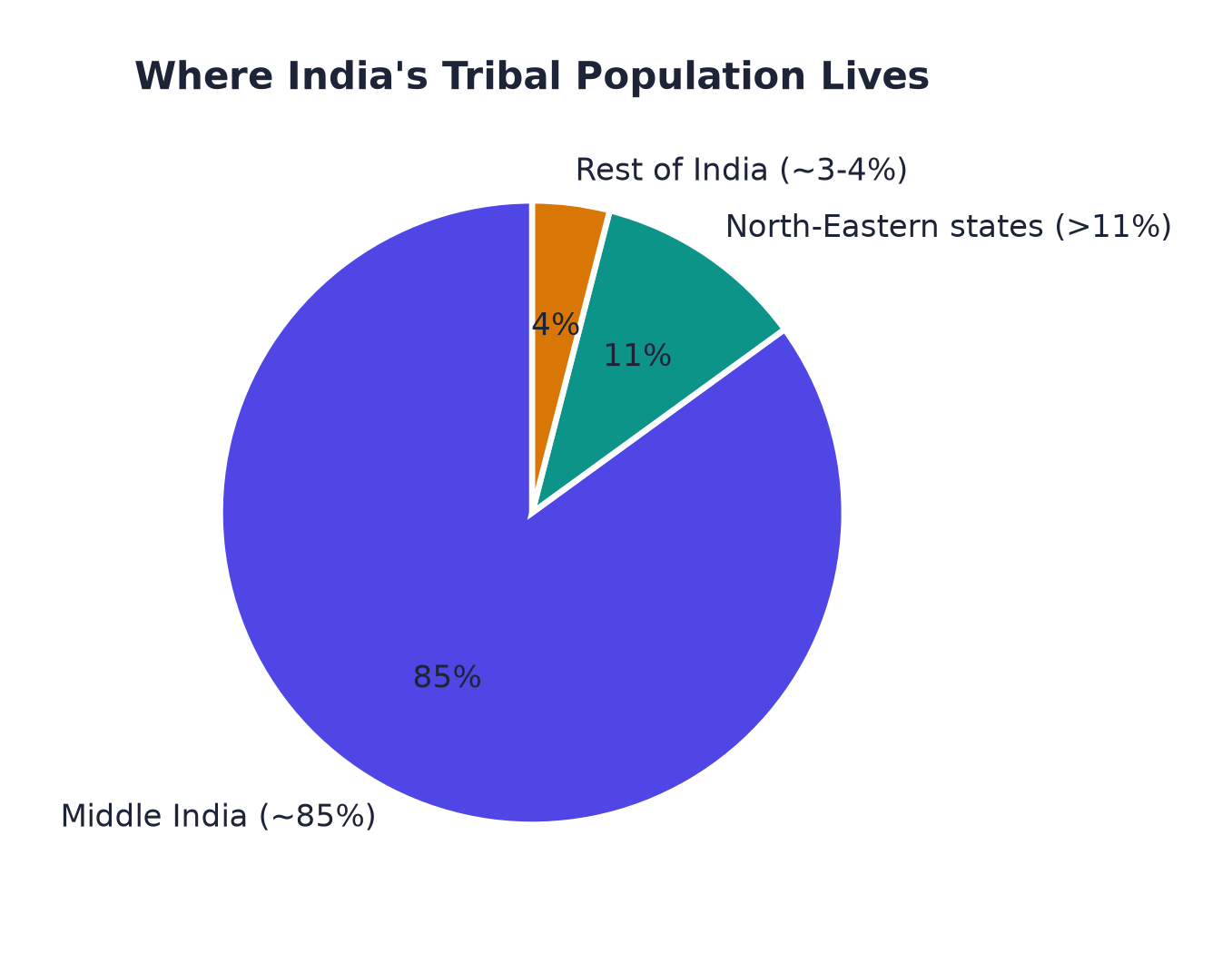
Never draw a map of India’s tribal regions in an exam answer, describe the geography in words or a table instead, exactly as this table does.
| Where | Share of the STATE’s own population that is tribal |
|---|---|
| All North-Eastern states except Assam | More than 30% |
| Arunachal Pradesh, Meghalaya, Mizoram, Nagaland | More than 60%, up to 95% |
| Rest of India (outside the North-East) | Less than 12% in all states, except Odisha and Madhya Pradesh |
Indo-Aryan and Dravidian languages are shared with the rest of India’s population: tribes make up only about 1% of Indo-Aryan speakers and about 3% of Dravidian speakers. Austric and Tibeto-Burman languages, on the other hand, are spoken mainly by tribal people. Tribes account for all Austric speakers and over 80% of Tibeto-Burman speakers.
By size, the biggest tribes, all at least a million strong, are the Gonds, Bhils, Santhals, Oraons, Minas, Bodos and Mundas.
Acquired traits classify tribes by two main criteria: (1) mode of livelihood, fishermen, food gatherers and hunters, shifting cultivators, peasants, and plantation or industrial workers; and (2) the extent of assimilation into Hindu society, which can be judged either from the tribes’ own point of view (how much they have assimilated, and their attitude to Hinduism) or from the Hindu mainstream’s point of view (the status it accords them, ranging from high to generally low).
Tribe: The Career of a Concept
In the 1960s, scholars debated whether tribes should be seen as one end of a continuum with caste-based (Hindu) peasant society, or as a completely different kind of community.
By the 1970s, all the major definitions of “tribe” were shown to be faulty. The tribe-versus-peasantry distinction did not hold up against any of the usual criteria: size, isolation, religion, or way of earning a living.
Learn the book’s own counter-evidence exactly:
- Some Indian “tribes” like Santhal, Gonds and Bhils are very large and spread over huge territories, not small isolated bands.
- Tribes like Munda and Hos turned to settled agriculture long ago. They are not all hunter-gatherers.
- Even a hunting-gathering tribe like the Birhors of Bihar employs specialised households to make baskets and press oil, a form of division of labour, not primitive isolation.
- In the absence of other options, some non-tribal “castes” have themselves turned to hunting and gathering, so livelihood alone cannot define “tribe”.
Tribes were absorbed into Hindu society over the centuries through several mechanisms: Sanskritisation, acceptance into the Shudra fold after conquest by caste Hindus, and acculturation (a group gradually taking on the culture of another group it is in prolonged contact with). Early anthropologists stressed the cultural side of this absorption; later writers focused on its exploitative and political character, as tribal lands were colonised and forests cut down.
Some scholars reject the idea that tribes are “pristine” (original, pure, untouched by civilisation) societies. Instead, they argue tribes are “secondary” phenomena, created by exploitative and colonial contact between pre-existing states and non-state groups. This very contact produces an ideology of “tribalism“: tribal groups begin defining themselves as “tribal” specifically to mark themselves off from the new people they have encountered.
Adivasis were not always the oppressed groups they are today. Central India had several Gond kingdoms, such as those of Garha Mandla and Chanda. Many so-called “Rajput” kingdoms of central and western India actually emerged out of stratification within adivasi communities themselves. Adivasis often dominated plains people through raiding and by serving as local militias, and they occupied a special trading niche in forest produce, salt and elephants.
National Development versus Tribal Development
The idea of “development” has shaped state policy and attitudes towards tribes. In the Nehruvian era especially, national development meant large dams, factories and mines. Because tribal areas happened to be mineral-rich and forest-covered, tribal communities paid a disproportionate price for the rest of society’s development.
The industrial areas of Jharkhand have seen the tribal share of the population shrink. The most dramatic cases are probably in the North-East: in Tripura the tribal share of the state’s population was cut in half within a single decade, turning tribals into a minority in their own state. Arunachal Pradesh is under similar pressure today.
Tribal Identity Today
Tribal identities today are shaped by this ongoing interaction with the mainstream, not by any “primordial” (original, ancient) tribal trait. Because this interaction has mostly happened on terms unfavourable to tribal communities, many tribal identities today are centred on resisting the “overwhelming force of the non-tribal world”.
Positive developments
- Jharkhand and Chattisgarh won separate statehood after a long struggle
- An educated tribal middle class is emerging, most visibly in the North-East
- Reservation policies plus education are creating an urbanised, professional tribal class
Continuing problems
- Many North-Eastern states have lived for decades under special laws that limit citizens’ civil liberties
- Development pressure continues to bring in-migration and land loss
As tribal societies get more internally differentiated, developing their own class divisions, different groups within them find different reasons to assert a tribal identity.
Two broad sets of issues drive tribal movements: (1) control over vital economic resources, especially land and forests, and (2) issues of ethnic-cultural identity. The two can go together, but as tribal society becomes more differentiated, they can also pull apart. The middle class’s reasons for asserting tribal identity may differ from why poor, uneducated tribals join a tribal movement.
“Assertions of tribal identity are on the rise. This can be laid at the door of the emergence of a middle class within the tribal society… issues of culture, tradition, livelihood, even control over land and resources, as well as demands for a share in the benefits of the projects of modernity, have become an integral part of the articulation of identity among the tribes… There is, therefore, a new consciousness among tribes now, coming from its middle classes. The middle classes themselves are a consequence of modern education and modern occupations, aided in turn by the reservation policies.”
Virginius Xaxa, “Culture, Politics and Identity: The Case of the Tribes in India”, in John et al 2006 (Box 3.1)
3.3 Family and Kinship
Every one of us is born into a family, and most of us spend years of our life inside one. A family can be a place of warmth and care, and just as truly, a site of conflict, injustice and even violence. Female infanticide, bitter property disputes between brothers, and ugly legal battles are as much a part of family and kinship as love, sacrifice and care are.
A family can be studied both as an institution in itself, and in how it connects to other institutions in society.
In itself, a family can be nuclear or extended; it can be male-headed or female-headed; and its line of descent can be matrilineal or patrilineal.
Family in Relation to Other Institutions
The internal structure of a family is usually connected to other structures in society: political, economic and cultural.
Himalayan villages
When men from Himalayan-region villages migrate for work, the village can end up with an unusually high proportion of women-headed households.
India’s software industry
When young parents working in the software industry have demanding work schedules, more grandparents move in as caregivers for their grandchildren.
The family (the private sphere) is linked to the economic, political, cultural and educational spheres (the public). Some changes to family structure happen by accident: a war, or migration in search of work. Others are deliberate: young people choosing their own spouses instead of letting elders decide, or same-sex love being expressed openly. Both history and the present suggest that changes to family and marriage norms are often resisted violently.
Nuclear and Extended Family
In India, discussions of the family have mostly revolved around the nuclear and the extended family.
Nuclear family
- Only one set of parents and their children
Extended family (“joint family”)
- More than one couple, often more than two generations, living together
- Could be several brothers with their own families, or an elderly couple with their sons, grandsons and their families
The extended family is popularly seen as “symptomatic of India”, but the book is explicit that this is not the dominant family form in India, either now or in the past. It was confined to certain sections and certain regions.
“The expression ‘joint family’ is not the translation of any Indian word like that. It is interesting to note that the words used for joint family in most of the Indian languages are the equivalents of translations of the English word ‘joint family.'”
I.P. Desai (Desai 1964:40)
The Diverse Forms of the Family
Family forms differ across societies along three separate dimensions: the rule of residence, the rule of inheritance, and who holds authority. Do not mix these three up.
| Rule | Type A | Type B |
|---|---|---|
| Residence: where the couple lives | Matrilocal: the couple lives with the wife’s parents | Patrilocal: the couple lives with the husband’s parents |
| Inheritance: how property passes on | Matrilineal: property passes from mother to daughter | Patrilineal: property passes from father to son |
| Authority: who holds power | Patriarchy: men hold authority and dominance | Matriarchy: women play a similarly dominant role |
Never confuse matriliny with matriarchy. This is Question 10 of the chapter: “Explain the difference between matriliny and matriarchy.”
- Matriarchy is theoretical, not empirical. The book states plainly that there is no historical or anthropological evidence of any society where women hold dominance the way patriarchal societies give it to men.
- Matrilineal societies DO exist, real societies where women inherit property from their mothers. But in these societies, women do not control that property, and they are not the decision-makers in public affairs.
In one line: matriliny is about who property passes to; matriarchy is about who holds power. Matrilineal societies do exist. Matriarchy has no historical or anthropological evidence anywhere.
- Caste = varna (all-India, 4-fold) + jati (local, hundreds of sub-castes). Rigid only from the post-Vedic period
- Six features of caste: birth, endogamy, food rules, hierarchy, segmental organisation, hereditary occupation, all “prescribed”, not proof of practice
- Caste hierarchy rests on purity and pollution; the system is both “separation” and “hierarchy” at once
- The 1901 Census (Herbert Risley) and the Government of India Act 1935 (Scheduled Castes/Tribes) show how British rule reshaped caste
- Sanskritisation = adopting a higher caste’s practices to rise. Dominant caste = castes with land rights and large numbers, and so real power (Yadavs, Vokkaligas, Reddys/Khammas, Marathas, Jats, Patidars)
- Caste is “invisible” for privileged urban upper castes, but the opposite, inescapable, for SC/ST/backward castes
- Tribes are defined by what they are NOT (no written-text religion, no state, no sharp classes). The “primitive, untouched tribe” idea has not been true for a long time (Santhal/Gonds/Bhils are huge; Munda/Hos farm; Birhors specialise)
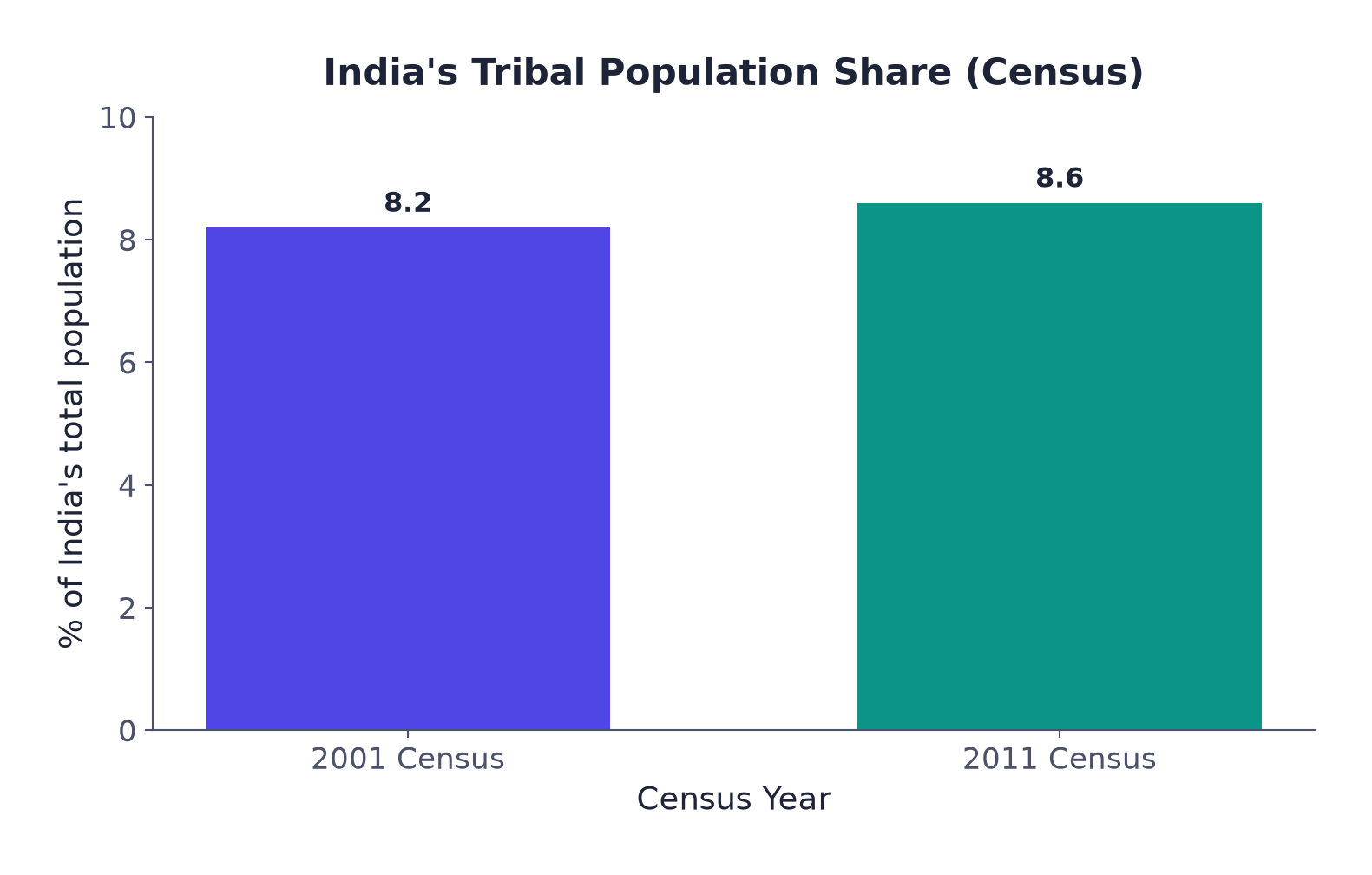
- India’s tribal population: 8.2% in 2001, 8.6% in 2011. About 85% live in “middle India”
- National development (dams, mines, factories) cost tribal communities disproportionately. Tripura’s tribal share halved in a decade
- Family can be nuclear or extended, matrilocal/patrilocal, matrilineal/patrilineal, patriarchal, but matriarchy is theoretical and has no evidence, unlike matriliny
- Can I list all six defining features of caste, without looking?
- Can I explain sanskritisation and dominant caste with an example each?
- Can I name three pieces of evidence against the “primitive, untouched tribe” idea?
- Can I explain, in one line, why matriliny and matriarchy are NOT the same thing?
- Can I name at least four of the six dominant castes with their states?