- Why exactly one circle passes through any three non-collinear points
- How equal chords, equal central angles, and equal distances from the centre are all connected
- Why an arc’s angle at the centre is always twice its angle at the circle’s edge
- What makes four points concyclic, and why opposite angles of a cyclic quadrilateral add to 180°
1Definitions and Symmetry
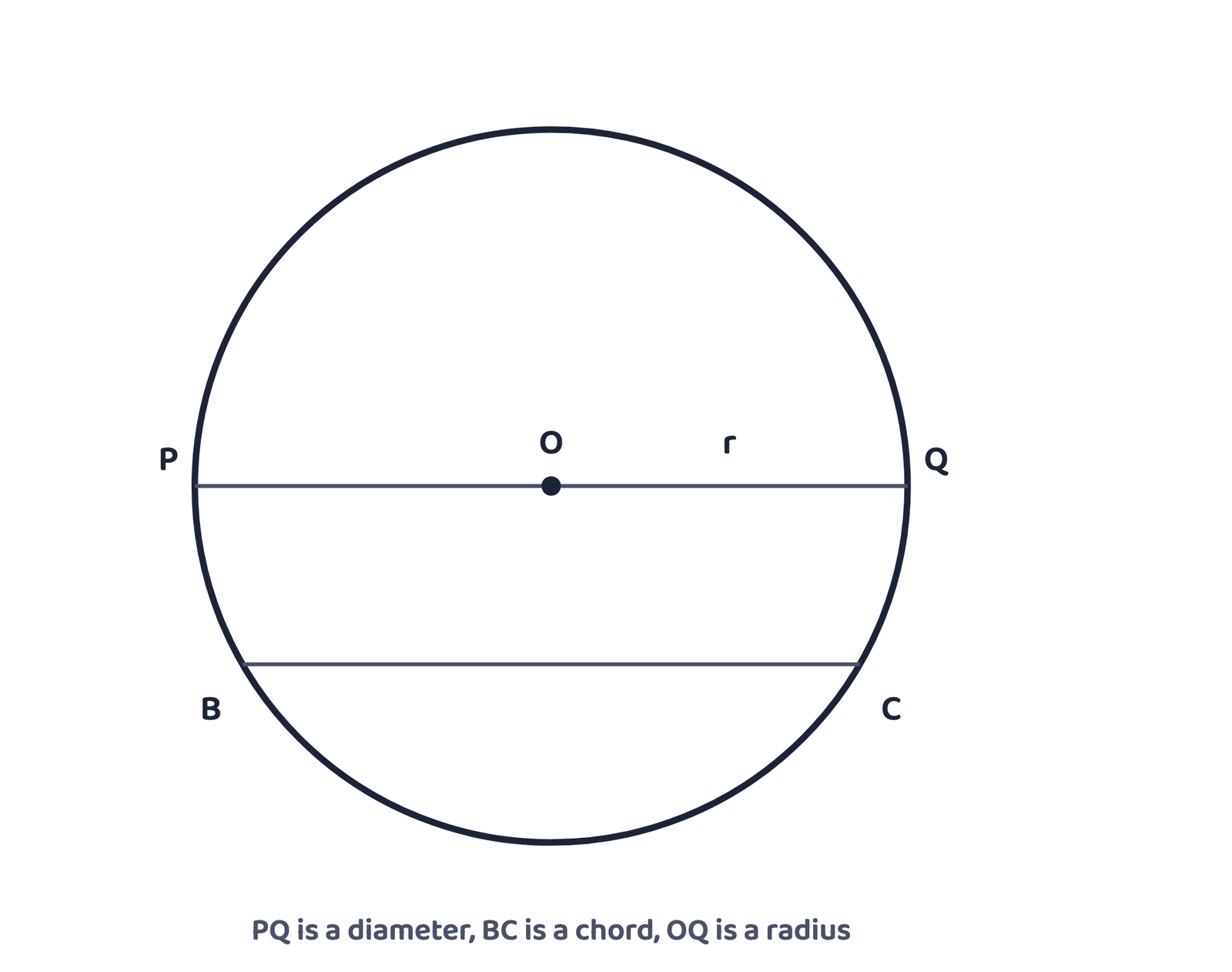
A circle is the locus (set) of all points in a plane at a fixed distance, the radius, from a fixed point, the centre. A chord joins any two points on the circle; a diameter is a chord through the centre, the longest possible chord.
A circle has complete rotational symmetry about its centre (rotating by any angle leaves it unchanged) and reflection symmetry across every diameter.
2Circles Through Points
Through two points A, B, infinitely many circles pass, one for every point on the perpendicular bisector of AB chosen as centre (since every point on it is equidistant from A and B).
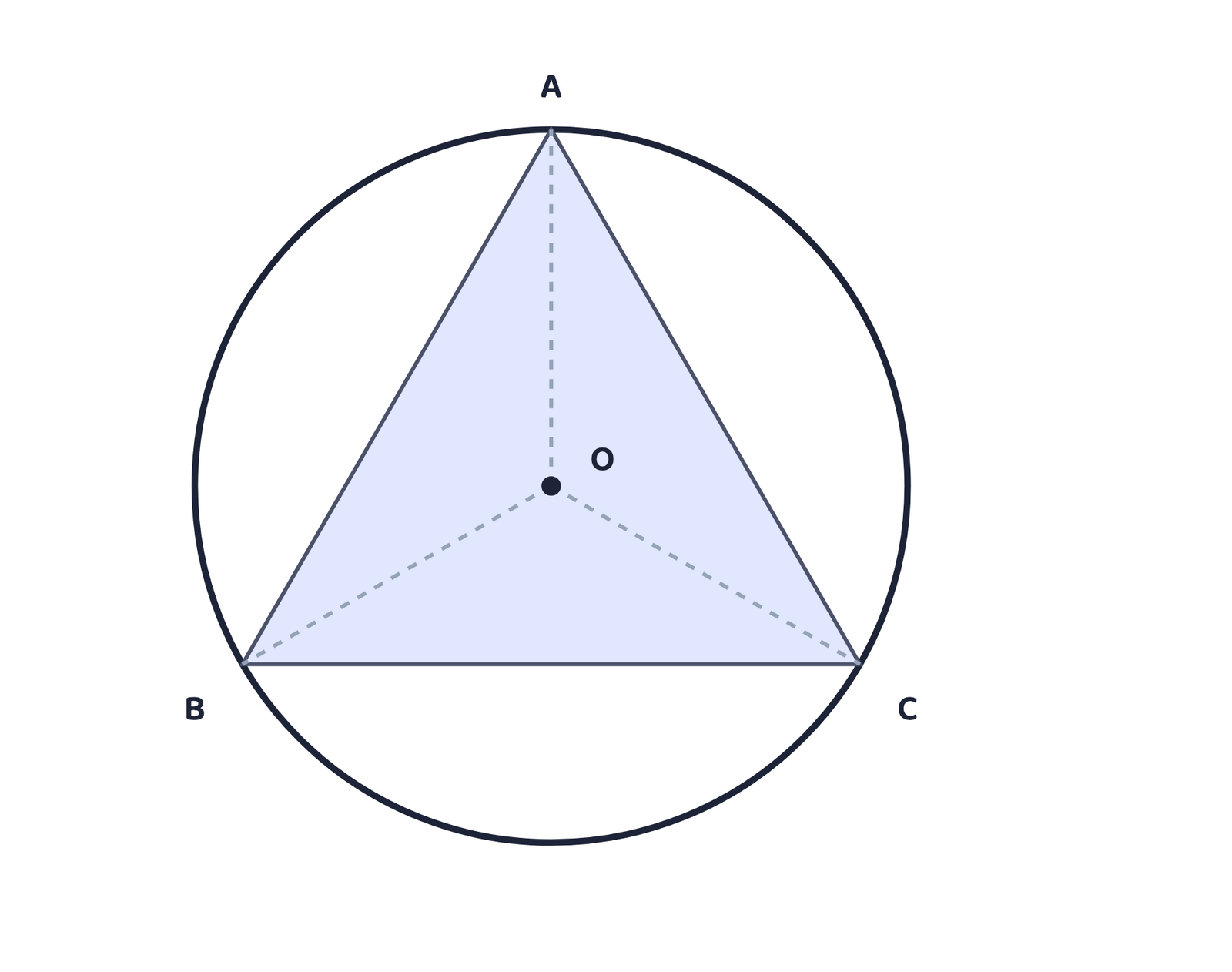
For an acute triangle, the circumcentre O is inside the triangle. For an obtuse triangle, O is outside. For a right triangle, O sits exactly at the midpoint of the hypotenuse.
3Chords, Angles, and Distance from the Centre
Equal chords → equal central angles
If AB = DE, then △CAB ≅ △CDE by SSS (all radii equal, given chords equal), so ∠ACB = ∠DCE.
Equal central angles → equal chords
The converse: if ∠ACB = ∠DCE, then △ACB ≅ △DCE by SAS (two radii and the included angle), so AB = DE.
Centre to midpoint ⊥ chord
△CAB is isosceles (CA = CB), so if M is the midpoint of AB, △CMA ≅ △CMB by SAS, giving ∠CMA = ∠CMB = 90°.
Perpendicular from centre bisects chord
The converse of Theorem 4: drop a perpendicular from the centre to any chord, and it lands exactly at the midpoint.
Th 7: Chords equidistant from the centre are equal in length. Th 8: Of two unequal chords, the longer one is closer to the centre, proved using the Baudhāyana-Pythagoras theorem on the two right triangles formed by the radius, the half-chord, and the perpendicular distance.
Given
Radius cm, chord is 5 cm from the centre
Find
Length of the chord
Chord cm
4Angles Subtended by an Arc
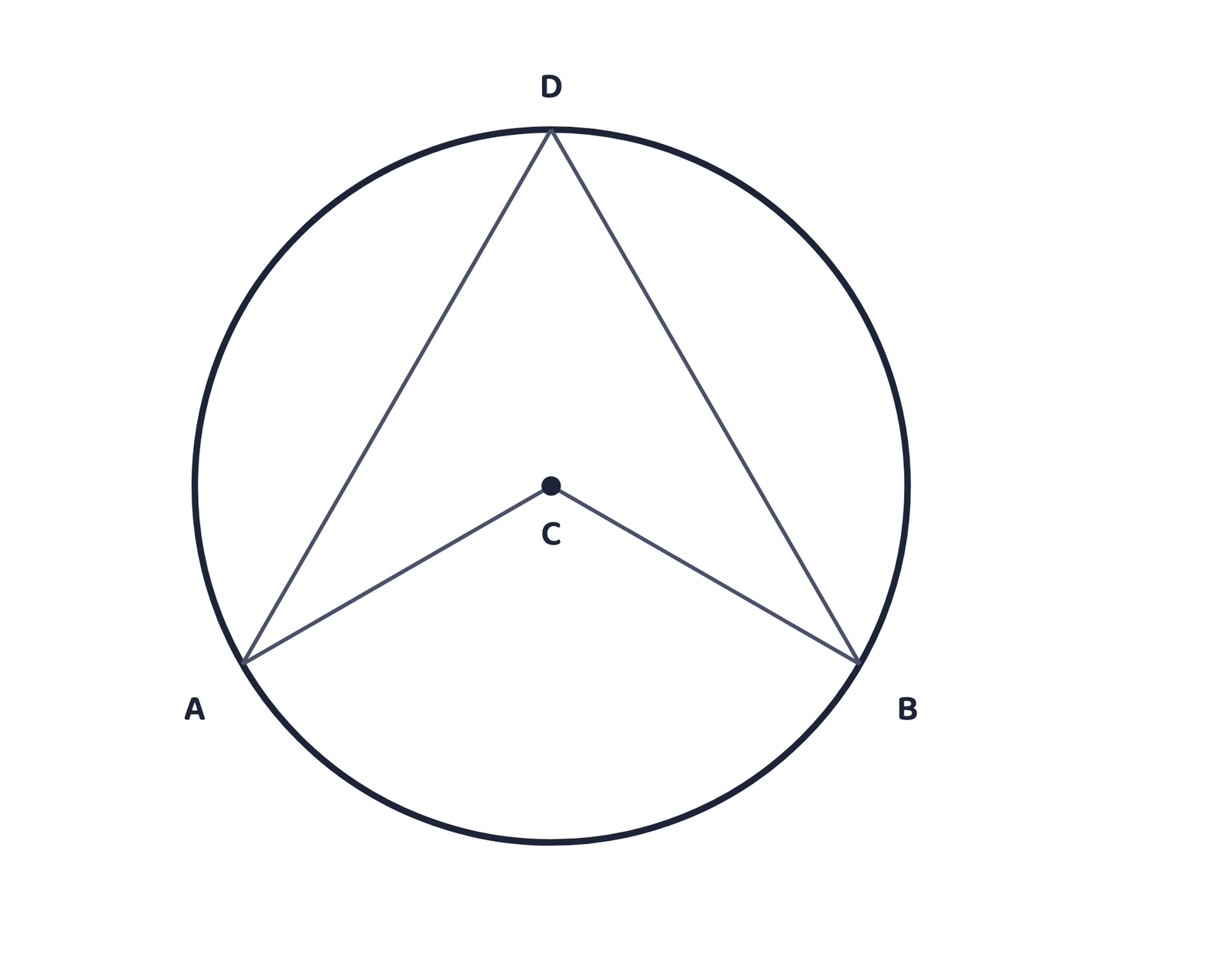
If AB is a diameter, the arc from A to B (not through D) subtends a straight angle (180°) at the centre. So the angle it subtends at D is half that: ∠ADB = 90°, for any point D on the circle.
Every point on the same arc sees a given chord at the same angle. This follows directly from Theorem 9, since all such points are “outside the arc” and share the same central angle.
Given
An arc subtends 70° at the centre
Find
The angle it subtends at a point on the circle
Angle at the circle
5Concyclic Points and Cyclic Quadrilaterals
Points that lie on the same circle are concyclic. A quadrilateral whose vertices are concyclic is a cyclic quadrilateral.
If AB subtends equal angles at two points C, D on the same side of AB, then A, B, C, D are concyclic. Proved by contradiction: placing D off the circle through A, B, C forces an angle to be both equal to and strictly greater than itself.
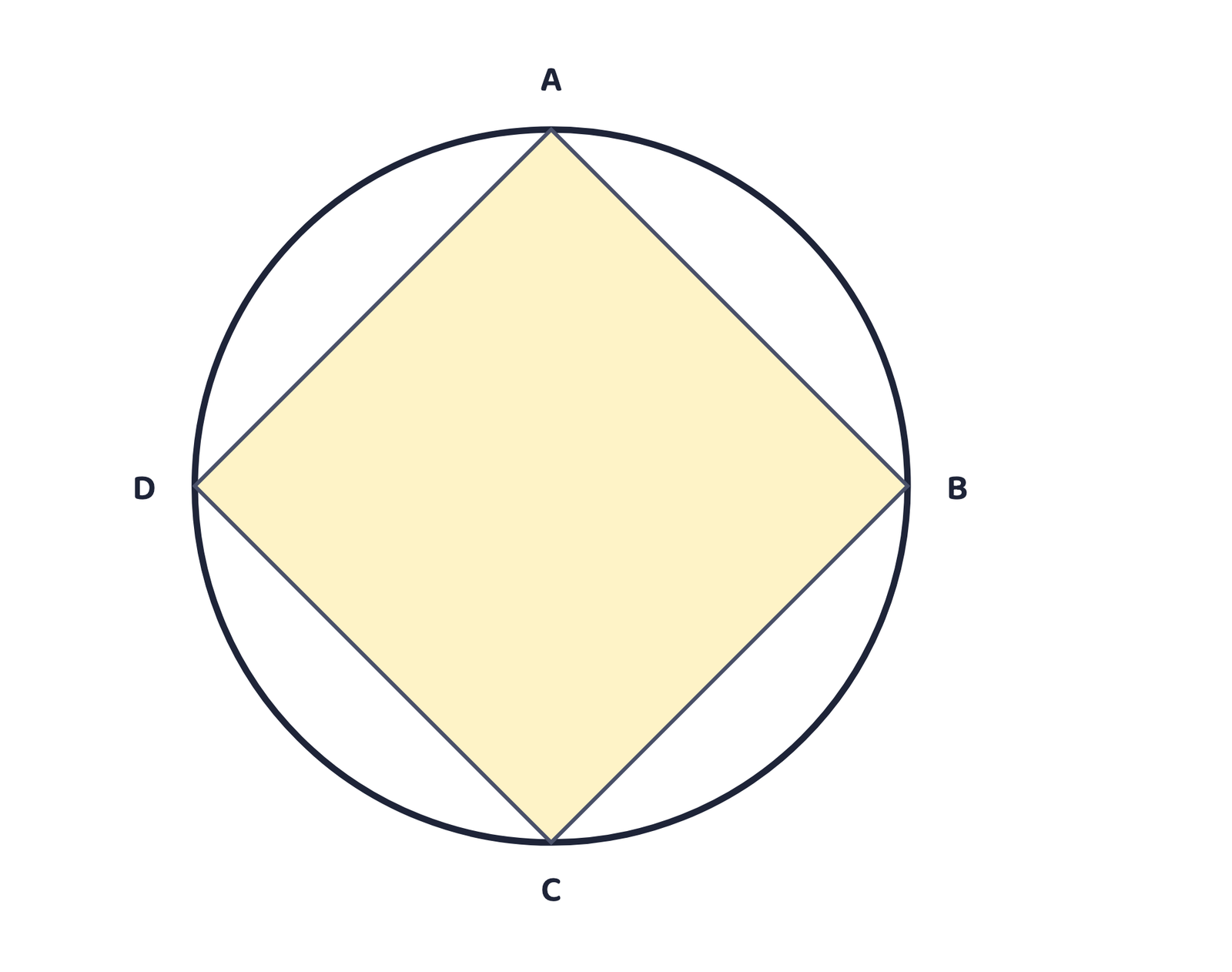
Th 12: If a quadrilateral’s opposite angles sum to 180°, it is cyclic (proved by contradiction, similar to Theorem 10). Corollary: the exterior angle at any vertex of a cyclic quadrilateral equals the interior opposite angle, since both are supplementary to the same interior angle.
Given
Cyclic quadrilateral PQRS with ∠P = (2x+10)°, ∠R = (3x−20)°
Find
, and the measures of ∠P and ∠R
Opposite angles:
∠P , ∠R
Every circle theorem in this chapter reduces to the same fact: any two radii are equal, which makes triangle after triangle isosceles.
the single idea to carry out of this chapter
- Can I construct the circumcircle of a triangle and say where its centre lies?
- Can I move between “equal chords”, “equal central angles” and “equidistant from centre”?
- Can I state and apply “angle at centre = 2 × angle at circle”, including the 90°-in-a-semicircle corollary?
- Can I prove that opposite angles of a cyclic quadrilateral sum to 180°, and use it in numericals?
- Circle = locus equidistant from centre; diameter = longest chord
- 3 non-collinear points → unique circumcircle; centre = meeting point of perpendicular bisectors of the sides
- Equal chords ⟺ equal central angles ⟺ equidistant from centre; longer chord is always closer to centre
- Chord length
- Angle at centre = 2 × angle at circle (same arc); angle in a semicircle = 90°
- Cyclic quadrilateral: opposite angles sum to 180°; exterior angle = interior opposite angle
- 2 marksA chord is 8 cm from the centre of a circle of radius 17 cm. Find the chord’s length.
- 1 markAn arc subtends 96° at the centre. What angle does it subtend at a point on the circle?
- 2 marksA circle of diameter 20 cm has a chord of length 16 cm. Find its distance from the centre.
- 3 marksProve that the perpendicular bisector of any chord of a circle always passes through the centre.
- 1 markAB is a diameter of a circle and C is any point on the circle. What is ∠ACB? Why?
- 2 marksIn cyclic quadrilateral WXYZ, ∠W = 85°. Find ∠Y. If ∠X = 100°, find ∠Z.
- 3 marksQuadrilateral EFGH is cyclic with ∠E = (3x+5)° and ∠G = (2x+15)°. Find x, ∠E and ∠G.
- 2 marksA chord of length 24 cm is 5 cm from the centre. Find the circle’s radius.
- 4 marksTwo parallel chords of length 10 cm and 24 cm lie on opposite sides of the centre of a circle of radius 13 cm. Find the distance between them.
- 3 marksExplain, with reasons, why no chord of a circle can ever be longer than the diameter.
- 1 markThe circumcentre of an obtuse-angled triangle lies:
(a) inside the triangle(b) outside the triangle(c) at the midpoint of a side(d) at a vertex - 1 markIn a cyclic quadrilateral, if one angle is 65°, its opposite angle is:
(a) 65°(b) 115°(c) 25°(d) 180° - 1 markThe angle in a semicircle is always:
(a) 45°(b) 60°(c) 90°(d) 180°
Reason (R): Equal chords subtend equal angles at the centre, and this forces their perpendicular distances from the centre to be equal too.
- 1 markWhy must ABCD be a cyclic quadrilateral?
- 1 markFind ∠C.
- 2 marksFind ∠D.