
- Turn a two-condition word problem into a pair of linear equations
- Tell whether a pair has one, infinitely many or no solutions, from a graph or by comparing the numbers in its two equations
- Solve any pair graphically, by substitution and by elimination
intersecting linesparallel linescoincident lines
substitution methodelimination method
1 What a Pair of Linear Equations Is
The book opens with Akhila at a fair: each Giant Wheel ride costs ₹3, each game of Hoopla
costs ₹4, she plays Hoopla half as many times as she rides, and she spends ₹20 in all. Call the
number of rides and the number of Hoopla games . The two facts become two equations:
…(1)
…(2)
Each is a linear equation in two variables (two unknowns, no power above 1). Taken
together they form a pair.
Two linear equations in the same two variables, considered together, form a pair of
linear equations in two variables. Its general form is
zero, and neither are and , so each equation really has an or a term. The numbers
multiplying and () are the coefficients; and are the
constant terms.
A solution of the pair is a pair of values of and that makes both
equations true at the same time (we say it satisfies both). Each equation draws a straight
line, so on a graph the solution is the point where the two lines meet.
2 Three Ways Two Lines Can Meet
The graph of every linear equation in two variables is a straight line, so a pair of
equations is always drawn as two lines. Two lines drawn on the same graph paper can only intersect at one
point (one solution), be parallel (no solution) or be coincident, lying on top of
each other (every point is a solution, so infinitely many).
Learn these three names exactly as the book defines them:
A pair of linear equations which has no solution is called an inconsistent pair of
linear equations.
A pair of linear equations in two variables which has a solution is called a
consistent pair of linear equations.
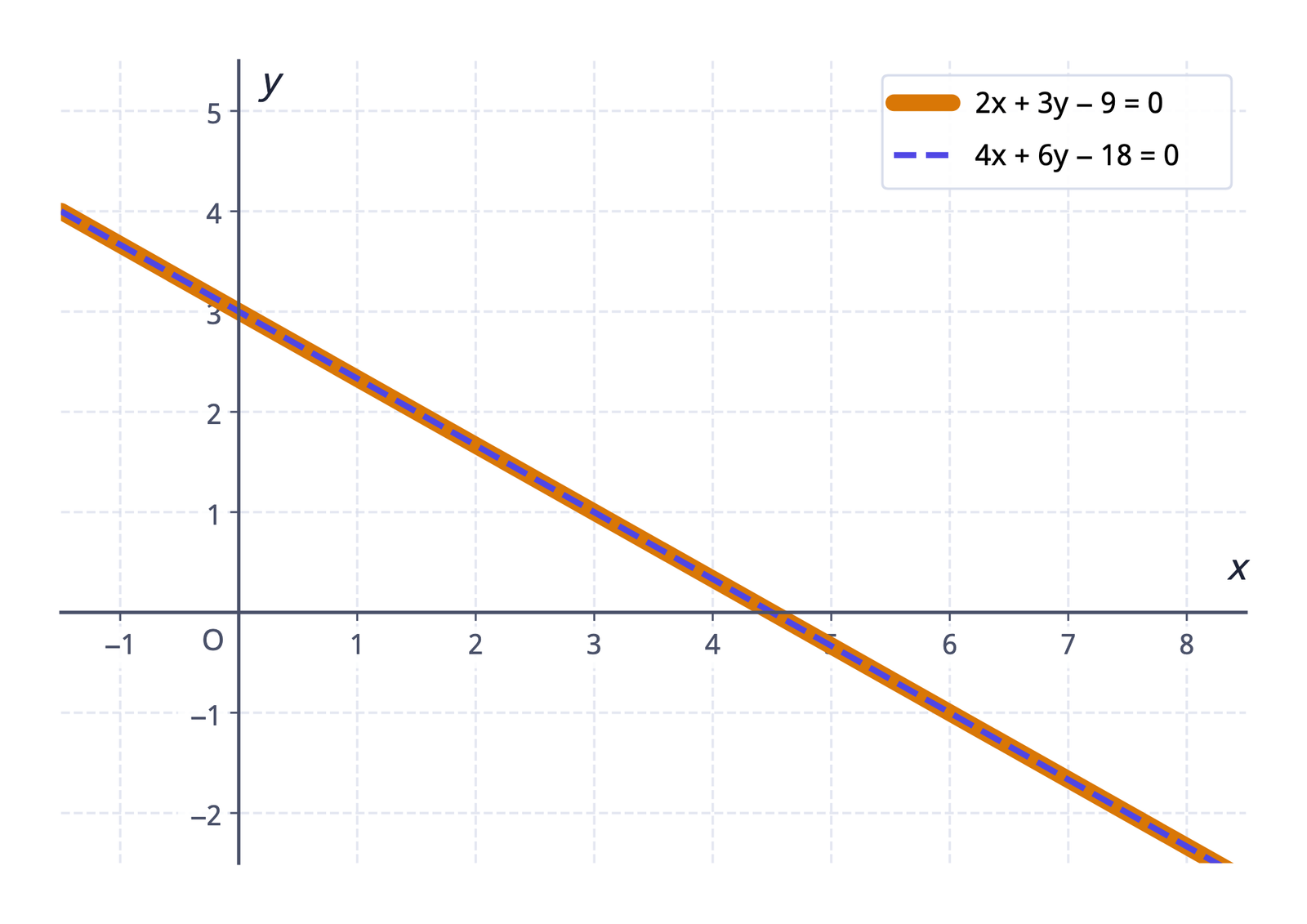
A pair of linear equations which are equivalent (one is just the other multiplied by a number, like and ) has infinitely many distinct common solutions. Such a pair is called a dependent pair
of linear equations in two variables. A dependent pair is always consistent.
Every dependent pair is consistent, but not every consistent pair is dependent. A pair
with exactly one solution is consistent and not dependent.


3 The Ratio Test: Knowing the Answer Without Drawing
Write both equations in the general form and divide matching numbers: by (the
-coefficients), by (the -coefficients) and by (the constants). For
the three pairs drawn above this gives the table below. It works both ways: the ratios tell you
the type of lines, and the type of lines tells you the ratios. (The book says “the converse is
also true”, meaning the rule can be read in the reverse direction.)
| Condition on the ratios | Book’s pair | Lines | Solutions | Pair is |
|---|---|---|---|---|
| , : | Intersecting | Exactly one (unique) | Consistent | |
| , : | Coincident | Infinitely many | Dependent (consistent) | |
| , : | Parallel | None | Inconsistent |
First two differ: they cross. All three equal: one line. First two equal, third differs: parallel.
Compare with first; only if they are equal do you need .
Comparing constants from equations written in two different ways. If one equation is
and the other is , would be taken as but as ,
because 8 sits on the other side of the equals sign. Write both as (or both as ) before comparing.
Q. For what value of will the pair and have
no solution?
Solution: No solution means parallel lines, so we need
.
or .
Now check the third ratio, .
For : , equal to , so the lines
would be coincident. Reject.
For : . Parallel.
So .
Q. (Type of NCERT Exercise 3.1, Q6.) Given , write a second linear equation so that the pair
gives (i) intersecting lines, (ii) parallel lines, (iii) coincident lines.
Solution: Here , , . Many answers are possible.
(i) Intersecting: , since and , so .
(ii) Parallel: , since but .
(iii) Coincident: (the given equation times 2), since .
4 Solving a Pair Graphically
Q. Is the pair and consistent? If so, solve it graphically.
Solution: First find two points on each line:
| 0 | 6 | 0 | 3 | |||
|---|---|---|---|---|---|---|
| 2 | 0 |
Plot A(0, 2), B(6, 0) and P(0, −4), Q(3, −2), and draw lines AB and PQ. Both lines pass
through B(6, 0), so the pair is consistent and the solution is , .

and Q) meet at B(6, 0), so , .
Q. Find whether and have no
solution, a unique solution or infinitely many solutions.
Solution: Multiply the second equation by : it becomes
, the first equation exactly. The lines are coincident, so the pair has
infinitely many solutions.
Q. At a sale, Champa’s skirts are two less than twice her pants, and also four less
than four times her pants. How many of each did she buy?
Solution: Let pants , skirts . Then and .
Points for the first line: (2, 2), (0, −2). Points for the second: (0, −4), (1, 0).
The lines meet at (1, 0), so , : she bought 1 pant and no skirt.
Check: and .

one pant, no skirt.
Pick table values that give whole numbers ( for ), plot a third point
as a check, and label each line with its equation.
5 Why We Need Algebraic Methods
The graphical method is not convenient when the solution has non-integral coordinates, such as
, or : there is every
possibility of making mistakes while reading such points off graph paper. So we use the two algebraic methods below.
6 Substitution Method
First write one variable in terms of the other: for example, becomes ,
so is expressed using . Then substitute (put) this expression into the other
equation; that is where the name comes from.
Given (Example 4)
…(1) and …(2)
To find
and by substitution
So , . A graph could give only an approximate reading of this point; the exact values come from the algebra.
Q. Aftab tells his daughter, “Seven years ago, I was seven times as old as you were
then. Also, three years from now, I shall be three times as old as you will be.” Find their ages.
Solution: Let Aftab’s age be years and his daughter’s years.
Seven years ago: , i.e. …(1)
Three years from now: , i.e. …(2)
From (2), . Put in (1): .
Then . Aftab is 42 years and his daughter
12 years old.
6.1 When the variable disappears
Sometimes Step 2 leaves a statement with no variable at all:
True statement (like 18 = 18)
- Example 6: 2 pencils + 3 erasers cost ₹9; 4 pencils + 6 erasers cost ₹18
- in gives
- True for every : infinitely many solutions, no unique price
False statement (like −4 = 0)
- Example 7: two rails lie along and . Will they cross?
- in the second gives , i.e. , i.e.
- A false statement: no solution, so the rails will not cross
Q. (NCERT Exercise 3.2, Q2.) Solve and and hence find the value of ‘m’ for which .
Solution: From the first, . Put this in the second: ,
and then , so .
The line passes through : .
Check: and .
7 Elimination Method
Make the coefficients of one variable equal, then add or subtract the equations so that
variable is eliminated (removed).
Q. The ratio of incomes of two persons is 9 : 7 and the ratio of their expenditures (money
spent) is 4 : 3. If each saves ₹2000 per month, find their monthly incomes.
Solution: Let the incomes be ₹ and ₹, the expenditures ₹ and ₹.
Saving = income − expenditure, so
Monthly incomes: ₹18,000 and
₹14,000. Check: expenditures are ₹16,000 and ₹12,000, and .
The book adds two remarks: we could just as well have eliminated instead of , and the
same pair can also be solved by substitution or by drawing the graph; it asks you to try these
and see which method is more convenient.
Tip (not from the NCERT text): substitution is usually quicker when a variable has coefficient 1
(like ); elimination avoids fractions with coefficients like .
Q. Find all solutions of and .
Solution: Multiply the first by 2: . Subtract :
, which is false. The pair has no solution.
Q. The sum of a two-digit number and the number obtained by reversing its digits is 66.
If the digits differ by 2, find the number. How many such numbers are there?
Solution: Let the tens digit be and the units digit : the number is
(e.g. ), the reversed number .
…(1)
“Differ by 2” gives two cases: …(2) or …(3).
(1) with (2): , , number 42. (1) with (3): , , number 24.
There are two such numbers, 42 and 24.
A sign slip while subtracting. When you take one equation from another, every term of the
second one changes sign. In Example 8: .
Put the equation you subtract in brackets, and when you multiply an equation, multiply
every term, the constant too.
8 Fractions, Decimals and Square Roots as Coefficients
Some situations give equations that are not in a neat linear form to start with; we first
rewrite them so they become a pair of linear equations of the form . In your
syllabus this means clearing fractions and decimals from the coefficients.
If an equation has fractions, multiply every term by the LCM of the denominators; if it has
decimals, multiply by 10 (or 100). Then solve as usual.
Given
…(1) and …(2)
To find
and
So , . Check in (1): . Correct.
Decimals: becomes after multiplying by 10. Square roots
(surds) such as need not be removed; just use
and while simplifying.
9 Word Problems: From Sentences to a Pair
Word problems use the same method every time; only what and stand for changes.
| Type | Take and as | How a condition becomes an equation |
|---|---|---|
| Ages | present ages of the two people | “ years ago”: , ; “ years hence” (from now): , |
| Two-digit number | tens digit, units digit | number , reversed |
| Fraction | numerator, denominator | fraction ; “add 2 to both” gives |
| Cost (bats and balls, pencils and pens) | price of one of each item | bats balls gives |
| Fixed + variable charge (taxi, library) | fixed charge, charge per unit | total |
| Notes / coins | number of each kind | ₹50 and ₹100 notes: count , value |
| Geometry | length and breadth, or two angles | perimeter ; supplementary angles add to |
Q. The denominator of a fraction is 3 more than its numerator. If 1 is added to both,
the fraction becomes . Find the fraction.
Solution: Let the fraction be . Then …(1) and
…(2).
Put (1) in (2): , so . The fraction is
. Check: .
Q. (Type of NCERT Exercise 3.3, Q2(iv).) A taxi charge has a fixed part and a part per km. For 10 km the charge is ₹105 and
for 15 km it is ₹155. Find the fixed charge and the charge per km.
Solution: Take ₹ as the fixed charge and ₹ as the charge for each km.
…(1) and …(2).
(2) − (1): , so ; then .
Fixed charge ₹5, charge per km ₹10.
Check: and .
9.1 The triangle formed by two lines and the x-axis
The triangle’s vertices are the two points where the lines cut the axis, plus the point where
they cut each other.
Q. Draw and . Find the vertices of the triangle these lines
form with the -axis.
Solution: On the -axis, .
cuts it at ; cuts it at .
The lines meet where and : adding, , so and .
The vertices are , and ; shade the region
between them.
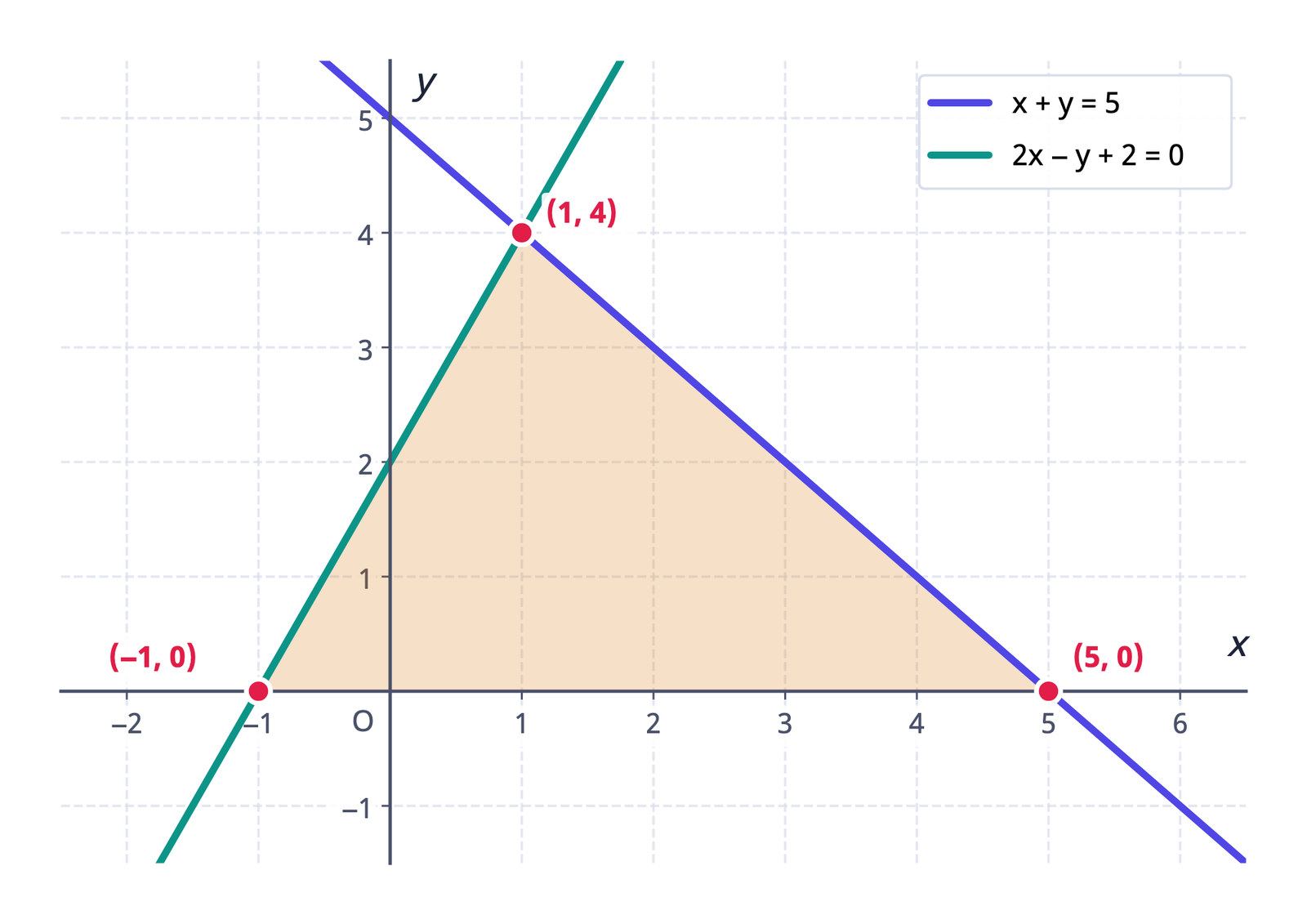
shaded triangle with vertices , and .
- Intersecting = unique solution (consistent); coincident = infinitely many (dependent, consistent); parallel = none (inconsistent)
- Ratio test: compare with first, then only if the first two are equal
- Variable vanishes: true statement means infinitely many solutions, false statement means none
- Substitution has 3 steps; elimination has 4, starting with making one coefficient equal
- Clear fractions and decimals first; in word problems answer the quantity asked for and check it