
Covers T.R. Jain & V.K. Ohri (2026-27) ch 5-6. Based on NCERT Introductory Macroeconomics, Chapter 3 (Reprint 2026-27), the CBSE 2026-27 curriculum and the CBSE Supplementary Reading Material.
- The drawbacks of barter and the four functions of money, with examples
- The functions of the central bank (the Reserve Bank of India) and of commercial banks
- How to draw up a bank balance sheet, trace credit creation round by round and solve money multiplier numericals
- How CRR, SLR, bank rate, repo rate, reverse repo rate, open market operations, margin requirement and moral suasion control the money supply
- The measures of money supply M1 to M4, fiat money, legal tender and demonetisation (2016)
1 Barter and money
Money is the commonly accepted medium of exchange. Where there is only one person, or where people do not trade in a market (a family living on an isolated island, for example), money has no function. As soon as more than one economic agent starts transacting through the market, money becomes the main instrument that makes exchange easy.
Exchange of goods directly for goods, without the mediation of money, is called barter exchange.
Double coincidence of wants is the situation in which each of two persons has exactly the good the other wants, and both wish to exchange those very goods. Barter presumes it, but it rarely exists.
- The book’s example: a person has surplus rice and wants clothing
- She must find someone who has surplus clothing and wants exactly rice in return
- As the number of people grows, the search costs of finding such a partner become prohibitive
- So an intermediate good acceptable to both parties is needed; that good is money. People sell what they produce for money and use the money to buy what they need
| Drawback of barter | How money removes it |
|---|---|
| No double coincidence of wants; very high search costs | Medium of exchange: everyone accepts money, so selling and buying can be done separately |
| No common measure of value; a separate ratio for every pair of goods | Unit of account: every value in rupees, relative prices at once |
| Wealth is hard to carry forward: rice is perishable, takes space, needs a buyer later | Store of value: money does not perish, costs little to store, is acceptable at any time |
| Hard to decide in which good loans and future payments should be fixed | Standard of deferred payments: future payments are fixed in rupees |
2 Functions of money
Medium of exchange
The first and foremost function; removes the need for double coincidence
Unit of account
Value of all goods and services expressed in monetary units (rupees)
Store of value
Wealth kept in the form of money for future use
Standard of deferred payments
Future payments (loans, rent) are fixed in rupees (CBSE supplementary material)
2.1 Medium of exchange
Money acts as a medium of exchange: goods are sold for money and bought with money. Barter is extremely difficult in a large economy because of the high cost of looking for suitable persons to exchange one’s surplus with.
2.2 Unit of account
Money is a convenient unit of account: the value of all goods and services can be expressed in monetary units (the rupee in India). A wristwatch worth ₹500 can be exchanged for 500 units of money.
Given: price of a pencil ₹2, price of a pen ₹10
Relative price of a pen: 10 ÷ 2 = 5 pencils
Value of money: ₹1 = 1 ÷ 2 = 0.5 pencil, or ₹1 = 1 ÷ 10 = 0.1 pen
Meaning: if all prices rise (a general increase in the price level), a rupee buys less of every good. This is a deterioration in the purchasing power of money.
2.3 Store of value
Money acts as a store of value: wealth can be stored in the form of money for future use. To do this well, the value of money must be sufficiently stable.
- Under barter a stock of rice is an asset, but rice is perishable, needs a lot of space, and selling it later means searching for buyers again
- Money is not perishable, its storage cost is low, and it is acceptable to anyone at any time
- A rising price level erodes the purchasing power of money, so it weakens this function
- Gold, land, houses and bonds can also store value, but they are not easily converted into other goods and lack universal acceptability
2.4 Standard of deferred payments
Payments contracted to be made at a future date are deferred payments. Money serves as their standard. This function made borrowing and lending easy and led to financial institutions (CBSE Supplementary Reading Material).
For “How does money overcome the shortcomings of barter?”, write each drawback against the function of money that removes it (as in the table above). A bare list of functions leaves the answer incomplete.
2.5 Cashless society and financial inclusion
- A cashless society is one where financial transactions are made not with physical notes or coins but through the transfer of digital information (an electronic representation of money) between the parties
- The Government of India has been investing steadily in reforms for greater financial inclusion
- Initiatives: Jan Dhan accounts, Aadhaar enabled payment systems, e-wallets, the National Financial Switch (NFS)
- With mobile and smartphone penetration across the country, financial inclusion is seen as a realistic dream
3 Demand for money (Not in CBSE 2026-27 syllabus)
The demand for money explains why people want to hold a certain amount of money. Read this part for the UP, Bihar, Rajasthan and MP boards; the detail is in section 8.
| Factor | Effect on demand for money | Reason |
|---|---|---|
| Income rises | Demand rises | More income means more transactions, which need more money |
| Rate of interest rises | Demand falls | Holding cash means holding less in interest-earning deposits, so more interest is given up |
4 Supply of money: the central bank and commercial banks
In a modern economy money consists of cash (currency) and bank deposits. Depending on which deposits are counted there are several measures of money (section 9). Money is created by two kinds of institutions: the central bank and the commercial banking system.
4.1 The central bank
The central bank is the apex institution of a country’s monetary system; it issues the currency and controls the money supply and credit. India got its central bank in 1935; it is the Reserve Bank of India (RBI).
Bank of issue
Sole authority to issue the country’s currency (notes); brings uniformity and direct control over money supply
Government’s bank
Banker to the central and state governments: keeps their accounts, receives and makes payments, gives short-term credit, manages public debt, advises
Bankers’ bank
Holds banks’ cash reserves (CRR), lends to them when needed (lender of last resort), provides clearing, supervises and regulates banks
Controller of credit
Controls money supply and credit through bank rate, CRR, SLR, repo, reverse repo, open market operations and margin requirement
Custodian of foreign exchange reserves
Holds the economy’s foreign exchange reserves
The first four headings are exactly the ones in the CBSE syllabus (the tools from bank rate to margin requirement are in section 7). The fifth is given in the book.
Currency issued by the central bank, whether held by the public or by commercial banks, is called high powered money. It is also called reserve money or monetary base, because it acts as the basis for credit creation.
4.2 Commercial banks
Commercial banks accept deposits from the public and lend part of these funds to those who want to borrow. They mediate between those with excess funds and those who need funds.
The interest rate a bank pays depositors is lower than the rate it charges borrowers. The difference between the two rates is called the spread; it is the bank’s profit.
| Function of a commercial bank | Detail |
|---|---|
| 1. Accepting deposits | Demand deposits (savings and current accounts, payable on demand) and time (fixed) deposits; deposits earn interest |
| 2. Giving loans | Home loans, crop loans and so on; higher interest on loans, the gap being the spread |
| 3. Payment services | Cheques and debit cards make transactions convenient and safe (imagine paying for a house in cash) |
| 4. Credit (money) creation | A loan opens a new deposit in the borrower’s name, so the money supply rises (section 6) |
- People keep money in banks because (i) deposits earn interest, (ii) it is safer than at home, (iii) demand deposits make payments easy through cheques and debit cards, even when they earn no interest
- A bank knows that all depositors will not withdraw at the same time, so it keeps part of the deposits and lends the rest
- Repaying depositors on demand is crucial to a bank’s survival, so it must balance its wish to lend the maximum against keeping enough funds
5 Lala the goldsmith: money “out of thin air”
Lala seems to have created money out of thin air. The modern banking system works precisely this way.
6 Money creation by the banking system
Banks can lend because they do not expect all depositors to withdraw at the same time. When a bank lends to a person, a new deposit is opened in that person’s name. So money supply rises to old deposits + new deposit (+ currency).
6.1 The bank balance sheet
A balance sheet is a record of the assets and liabilities of a firm. By convention assets are written on the left and liabilities on the right, and the two sides must be equal.
- Assets: what a firm owns or can claim from others. A bank’s assets are, besides buildings and furniture, its loans to the public (a ₹100 loan is the bank’s claim of ₹100 on the borrower) and its reserves
- Reserves: deposits that commercial banks keep with the central bank (RBI) and their cash; kept partly as cash and partly as financial instruments (bonds and treasury bills) issued by the RBI. Just as our deposits are our assets, the deposits of banks such as SBI with the RBI are their assets
- Liabilities: a firm’s debts, what it owes to others; a bank’s main liability is the deposits people keep with it
If assets exceed liabilities, the difference is recorded on the right as net worth, so that both sides balance.
Table 3.1: Balance sheet of a bank (start)
Ms Fernandes deposits ₹100 and the bank keeps the whole amount with the RBI as reserves.
| Assets | Liabilities | ||
|---|---|---|---|
| Reserves | ₹100 | Deposits | ₹100 |
| Net worth | ₹0 | ||
| Total | ₹100 | Total | ₹100 |
With no currency in circulation: M1 = Currency + Deposits = 0 + 100 = ₹100.
6.2 The limit to credit creation: CRR and SLR
Suppose Mr Mathew asks for a loan of ₹500 and deposits it in the same bank; deposits and money supply would rise. It seems banks could create as much money as they like. But there is a limit, set by the central bank (RBI).
The Cash Reserve Ratio (CRR), also called the Required Reserve Ratio or Reserve Ratio, is the minimum percentage of deposits that every bank must keep as cash reserves (with the central bank). The RBI fixes it; it is a legal requirement binding on banks, meant to ensure that no bank is “over-lending”.
The Statutory Liquidity Ratio (SLR) is the percentage of deposits that banks must keep, in addition to the CRR, in liquid form (in specified liquid assets) with themselves in the short term (the book and the CBSE supplementary material).
6.3 The process of credit creation (book example, CRR = 20%)
- Leela deposits ₹100. With a CRR of 20%, the bank keeps ₹20 as reserves and can lend ₹80
- The bank lends ₹80 to Jaspal Kaur; it shows up in the next round as deposits (liabilities), total ₹180
- Now required reserves = 20% of 180 = ₹36. The bank started with ₹100 of cash, so it can lend 100 − 36 = ₹64 again
- The bank lends ₹64 to Junaid, which again becomes a deposit; the process repeats until required reserves become the whole ₹100
- Required reserves are ₹100 only when total deposits are ₹500 (20% of 500 = 100)

Table 3.2: Money multiplier process (₹)
| Round | Deposits in bank (total at start) | Required reserve (20%) | Loan made by bank |
|---|---|---|---|
| 1 | 100.00 | 20.00 | 80.00 |
| 2 | 180.00 | 36.00 | 64.00 |
| … | … | … | … |
| Last | 500.00 | 100.00 | 400.00 |
Column 2 shows total deposits at the start of each round, column 3 the 20% to be kept with the RBI as required reserves, and column 4 the loans made. What the bank lends in each round is added to the deposits of the next round.
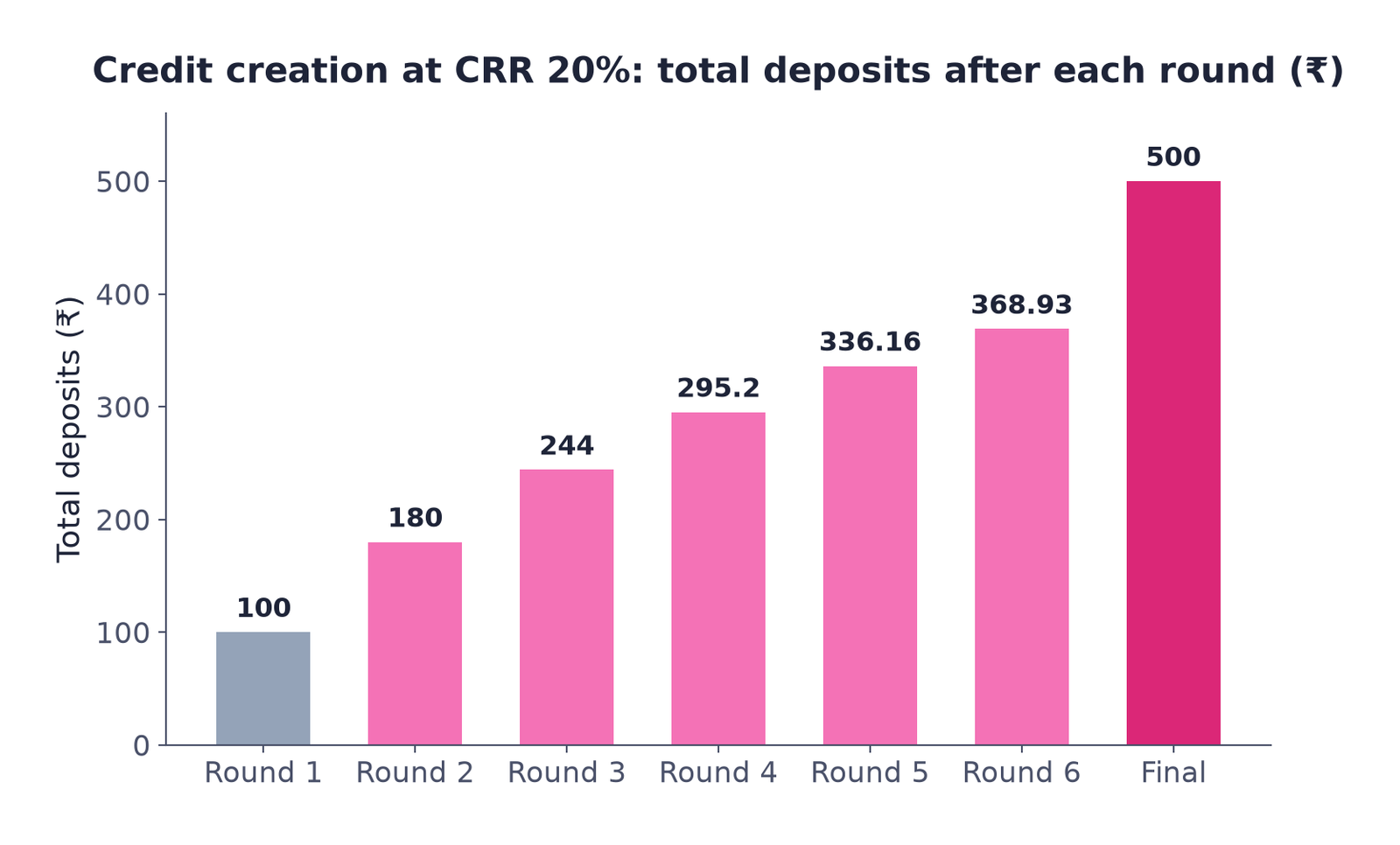
Table 3.3: Balance sheet of the bank at the end
| Assets | Liabilities | ||
|---|---|---|---|
| Reserves | ₹100 | Deposits (100 + 400) | ₹500 |
| Loans | ₹400 | ||
| Total | ₹500 | Total | ₹500 |
- M1 = Currency + Deposits = 0 + 500 = ₹500; money supply rises from ₹100 to ₹500
- With a CRR of 20% the bank cannot lend beyond ₹400; the reserve requirement is the limit to money creation
6.4 The money multiplier
The money multiplier tells us how many times the initial deposit (reserves) the banking system can create as total deposits (money). In the book, money multiplier = 1 ÷ Cash Reserve Ratio.
Legal Reserve Ratio (LRR): the minimum fraction of deposits banks must by law keep as reserves; one part is kept with the central bank (CRR) and the other with the banks themselves (SLR). The CBSE supplementary material writes the multiplier as 1 ÷ LRR; if a question gives “LRR” or “required reserve ratio”, use it in place of the CRR.
The book’s Key Concepts also list two more terms: currency deposit ratio = currency held by the public ÷ its bank deposits; reserve deposit ratio = total reserves of banks ÷ their deposits.
…(3.A)
Total deposits (total money created) = initial deposit ×
Total loans (credit) = total deposits − initial deposit
Required reserves = total deposits × CRR (at the end this equals the initial deposit)
So reserves of ₹100 create deposits of 5 × 100 = ₹500.
The CRR and the money multiplier are inversely related: a lower CRR raises the multiplier and credit creation; a higher CRR lowers them. With an LRR of 0.1 the multiplier is 10; with 0.4 it is 2.5 (CBSE supplementary material). Always write all three: the multiplier, total deposits and total loans.
Given
Initial deposit ₹1,000; CRR 10%
To find
Money multiplier, total deposits, total credit (loans)
Formula: money multiplier = 1 ÷ CRR (½)
Substituting: 1 ÷ 0.10 = 10 (½)
Total deposits: 1,000 × 10 = ₹10,000 (1)
Total credit (loans): 10,000 − 1,000 = ₹9,000 (1)
Meaning: an initial deposit of ₹1,000 lets the banking system give ₹9,000 of new loans and create ₹10,000 of deposits in all.
Question: an initial deposit of ₹2,000 created total deposits of ₹10,000. Find the CRR.
Formula: multiplier = total deposits ÷ initial deposit = 10,000 ÷ 2,000 = 5
CRR = 1 ÷ multiplier = 1 ÷ 5 = 0.2 = 20%
Question: at a CRR of 20%, banks gave total loans of ₹8,000. What was the initial deposit?
Solution: total loans = initial deposit × (multiplier − 1), so initial deposit = 8,000 ÷ (5 − 1) = ₹2,000 (total deposits ₹10,000).
Working: if the CRR is raised from 20% to 25%, the multiplier = 1 ÷ 0.25 = 4; reserves of ₹100 now support only ₹400 of deposits and ₹300 of loans (book: “the banking system would now be able to loan Rs 300 only”). Loans were ₹400, so banks must call back some loans and the money supply falls.
The other way: on a new deposit of ₹1,000, a CRR cut from 5% to 4% raises the multiplier from 20 to 25; total deposits rise from ₹20,000 to ₹25,000, i.e. ₹5,000 more money created.
- Leaving the CRR as a percentage: not 1 ÷ 20 but 1 ÷ 0.20 = 5
- Treating “total deposits” and “total loans” as the same: at ₹100 and 20% CRR, deposits ₹500, loans ₹400
- Writing that a higher CRR raises the multiplier: the relation is inverse
- Taking the second-round loan as (180 − 36) instead of (100 − 36): the bank’s cash is only the original ₹100
Infinite geometric series: , with . Multiplying by r and subtracting gives , so
In credit creation each round’s new deposit is 80% of the last: 100 + 80 + 64 + 51.2 + … , with a = 100 and r = 1 − CRR = 0.8, so S = 100 ÷ (1 − 0.8) = ₹500. (The appendix’s own example takes a = 1, r = 0.4 and gets 1 ÷ 0.6 = 5/3.)
7 Policy tools to control money supply (monetary policy)
The RBI regulates money supply by controlling the stock of high powered money, the bank rate and the reserve requirements of commercial banks, and it also sterilises (sterilisation) the money supply in the economy against external shocks (the book’s summary). The Reserve Bank is the only institution that can issue currency. When commercial banks need more funds to create more credit, they may go to the market or to the central bank.
The RBI’s role of being ready to lend to banks at all times makes it the lender of last resort. Even when a bank can get funds nowhere else, the central bank provides them.
7.1 Changing the Cash Reserve Ratio (CRR)
- A higher CRR makes banks keep more reserves; the lendable amount and the multiplier fall; money supply falls
- A lower CRR does the opposite: the multiplier and credit creation rise
- Book example: from 20% to 25%, loans fall from ₹400 to ₹300 (Worked example 4)
7.2 Statutory Liquidity Ratio (SLR)
- A higher SLR makes banks hold a larger share of deposits in liquid assets, leaving less to lend; credit falls
- A lower SLR frees more funds for lending
7.3 Bank rate
The rate at which the RBI gives loans to commercial banks is called the bank rate in India.
7.4 Open market operations (OMO)
Open market operations are the buying and selling of bonds issued by the government in the open market. The central bank carries them out on behalf of the government.
RBI buys bonds
- Pays by cheque
- The cheque raises the total reserves in the economy
- Banks can lend more
- Money supply rises
RBI sells bonds
- Buyers (individuals or institutions) pay the RBI
- Reserves fall
- Banks can lend less
- Money supply falls
Outright and repo operations
| Basis | Outright open market operation | Repo (repurchase agreement) |
|---|---|---|
| Later reversal | No promise to sell later what is bought (or buy back what is sold) | The purchase agreement itself fixes the date and price of resale |
| Effect | Injection or absorption of money is permanent | Money for a fixed period (overnight, 7-day, 14-day, etc.) |
| Importance | Not the main tool | Repo and reverse repo are now the main tool of RBI monetary policy |
When the central bank buys a security with an agreement specifying the date and price at which it will resell it, the agreement is a repurchase agreement or repo. The interest rate at which money is lent this way is the repo rate. Simply put, it is the rate at which the RBI lends to banks for the short term.
When the central bank sells a security with an agreement specifying the date and price at which it will buy it back, the agreement is a reverse repurchase agreement or reverse repo. The rate at which money is withdrawn this way is the reverse repo rate; simply put, the rate the RBI pays banks for parking their surplus funds with it.
| Tool | To reduce money supply (contract credit) | To raise money supply (expand credit) |
|---|---|---|
| CRR | Raise | Lower |
| SLR | Raise | Lower |
| Bank rate | Raise | Lower |
| Repo rate | Raise (bank borrowing costlier) | Lower |
| Reverse repo rate | Raise (banks prefer to park funds with the RBI) | Lower |
| Open market operations | Sell bonds | Buy bonds |
| Margin requirement | Raise | Lower |
| Moral suasion | Ask banks to lend less | Encourage banks to lend more |
7.5 Qualitative tools: margin requirement and moral suasion
Margin requirement: the margin is the difference between the amount of the loan and the market value of the security the borrower offers against it (gold, shares, goods). The central bank fixes it. If the margin is 40%, a bank can lend only up to 60% of the value of the security (CBSE supplementary material).
Maximum loan = market value of the security × (1 − margin)
Given: security worth ₹10,00,000; margin 40%
Maximum loan: 10,00,000 × (1 − 0.40) = ₹6,00,000
At a 50% margin: 10,00,000 × 0.50 = ₹5,00,000
Meaning: raising the margin cut the loan on the same security by ₹1,00,000, so credit contracts; lowering it expands credit. The book places it with moral suasion among the qualitative tools.
Moral suasion is persuasion by the central bank to make commercial banks encourage or discourage lending.
- Treating the repo rate and the bank rate as the same: a repo carries an agreement to sell back a security; the bank rate is the rate on ordinary loans
- Writing reverse repo as “RBI lends to banks”: in a reverse repo banks give funds to the RBI (it absorbs money)
- Saying the RBI’s sale of bonds raises the money supply: the money goes to the RBI, so supply falls
- Calling the margin requirement a quantitative tool: it is qualitative
8 Demand for money: a detailed discussion (Box 3.1) (Not in CBSE 2026-27 syllabus)
This box is for the state boards. Money is the most liquid asset: universally acceptable and easily exchanged for other goods. But it has an opportunity cost: a fixed deposit would have earned interest.
How much money to hold is decided by weighing the advantage of liquidity against the disadvantage of the interest forgone. So the demand for money balance is called liquidity preference. People hold money broadly from two motives: the transaction motive and the speculative motive.
8.1 The transaction motive
- The principal motive is to carry out transactions, since income arrives at discrete dates but spending goes on continuously
- Book example: ₹100 earned on the first day of each month and run down evenly; balance ₹100 at the start, ₹0 at the end; average cash = (100 + 0) ÷ 2 = ₹50, half the monthly transactions
- Two-person economy (a firm and a worker): the firm pays a salary of ₹100 at the start of the month, the worker spends it on the firm’s output over the month; each holds ₹50 on average, total transaction demand ₹100, while monthly transactions are ₹200 (₹100 of output and ₹100 of services)
…(3.1)
…(3.2)
…(3.3)
The number of times a unit of money changes hands during the unit period is the velocity of circulation of money. In the two-person example each rupee changes hands twice a month, so v = 2 (the inverse of k = 1/2).
- Annual transactions include intermediate goods, so they far exceed nominal GDP, but the two are related in a stable, positive way
- Hence (3.3): transaction demand is positively related to real income (Y) and the price level (P)
Given: k = 0.25, P = 1.2, real GDP Y = ₹5,000 crore
Formula:
Substituting: 0.25 × 1.2 × 5,000 = ₹1,500 crore
Meaning: ₹1,500 crore of money is demanded for transactions; it rises in proportion if Y or P rises.
8.2 The speculative motive
- Wealth can be held as land, bullion, bonds, money and so on; for simplicity all assets other than money are called bonds
- Bonds: papers issued by governments or firms to borrow from the public, promising a stream of money returns over a period; they are tradable in the market
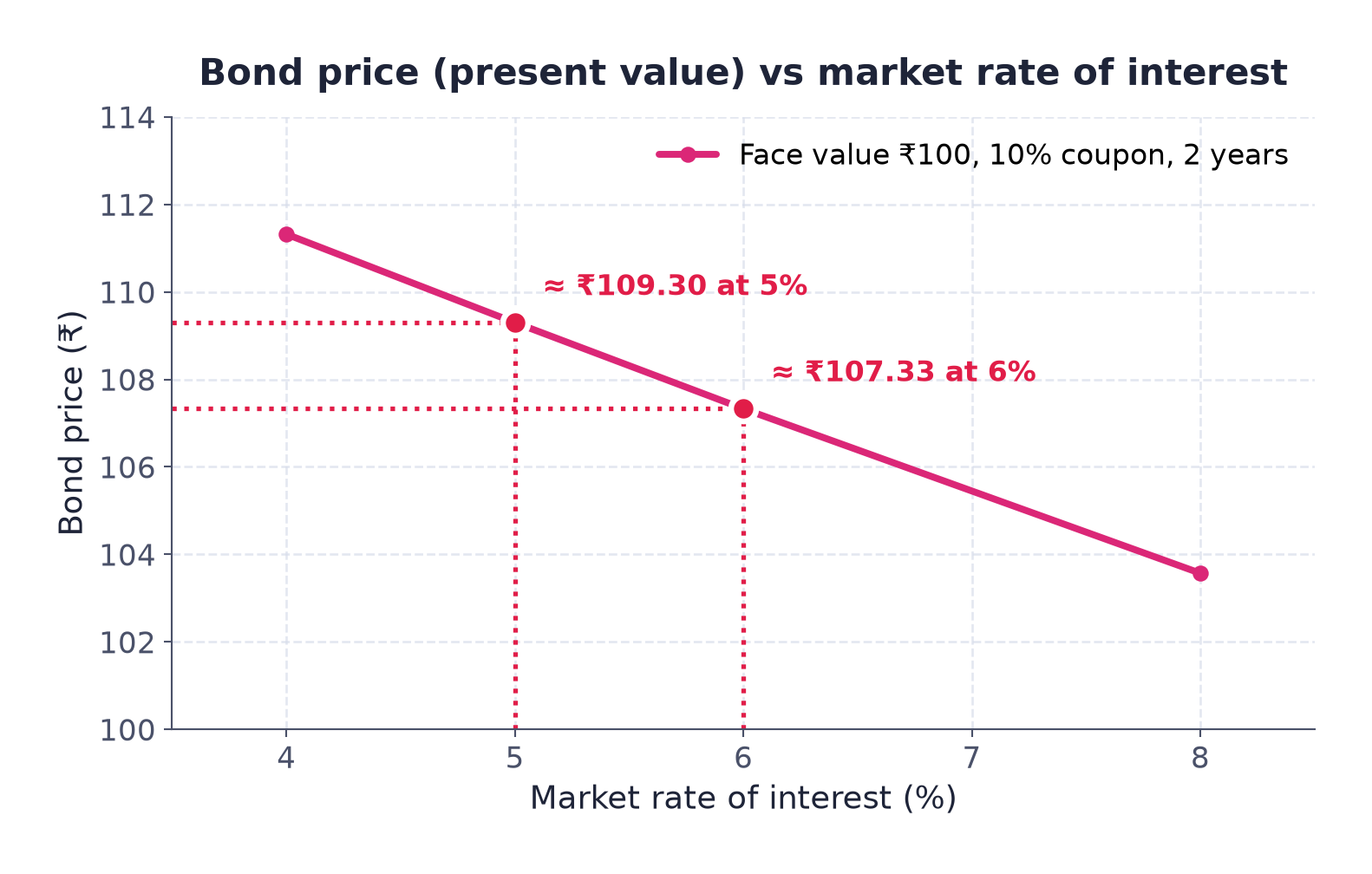
- The book’s bond: a firm borrows ₹100, pays ₹10 at the end of year 1 and ₹10 + the principal ₹100 at the end of year 2. Face value ₹100, maturity period 2 years, coupon rate 10%
(at 5% interest)
- With 5% interest on a savings account, the bond’s present value is about ₹109.30 (the book prints “Rs 109.29 (approx.)”): ₹109.30 in the savings account would earn the same return as the bond
- But the bond sells at its face value of ₹100, so people rush to buy it; competitive bidding raises its price to the present value. If the price goes above PV, excess supply pushes it back. In equilibrium bond price = present value
- If the interest rate rises from 5% to 6%, the same bond is worth about ₹107.33; so the price of a bond is inversely related to the market rate of interest
- A loss from a falling bond price is a capital loss to the bond holder; a gain from a rising price is a capital gain
- Someone who expects interest rates to rise (bond prices to fall) sells bonds and holds money; this is the speculative demand for money
- Interest rate very high: everyone expects it to fall and anticipates capital gains, converts money into bonds; speculative demand low
- Interest rate low: more people expect it to rise and fear capital losses, convert bonds into money; speculative demand high. So speculative demand is inversely related to the rate of interest
…(3.4)
r is the market rate of interest; and are its upper and lower limits (positive constants). As r falls from to , rises from 0 to infinity.
When the interest rate is already so low () that everyone expects it to rise (and bond prices to fall), nobody wishes to hold bonds; any extra money is simply held as money balance and the interest rate falls no further. This is a liquidity trap. Here the speculative money demand function is infinitely elastic.

…(3.5)
Total demand for money = transaction demand (directly proportional to real GDP and the price level) + speculative demand (inversely related to the rate of interest).
9 The supply of money: various measures
- In India currency notes are issued by the Reserve Bank of India (the monetary authority), but coins are issued by the Government of India
- Balances in savings and current accounts are also money, because cheques drawn on them settle transactions
Demand deposits
- Savings and current accounts
- Payable by the bank on demand
- Usable by cheque; part of M1
Time deposits
- Fixed deposits and the like
- Fixed period to maturity
- Part of M3, not M1
9.1 Fiat money and legal tender
The paper of a ₹100 note is worth far less than ₹100, and the metal in a ₹5 coin is probably not worth ₹5. People still accept them because their value comes from the guarantee of the issuing authority: every currency note bears a promise from the Governor of RBI that RBI will be responsible for giving the holder purchasing power equal to the value printed on it.
Currency notes and coins are fiat money: they have no intrinsic value like a gold or silver coin; their value comes from the guarantee of the issuing authority.
Currency notes and coins are legal tender: no citizen of the country can refuse them in settlement of any transaction. A cheque on a savings or current account can be refused by anyone, so demand deposits are not legal tender.
9.2 Narrow and broad money: M1, M2, M3, M4
Like the demand for money, the supply of money is a stock variable: the total stock of money in circulation among the public at a point of time. The RBI publishes four alternative measures.
M1 = CU + DD, where CU = currency (notes and coins) held by the public and DD = net demand deposits held by commercial banks. “Net” means only the public’s deposits are counted; interbank deposits one bank holds in another are not part of money supply.
- M1 and M2 are narrow money; M3 and M4 are broad money
- The measures are in decreasing order of liquidity: M1 most liquid and easiest for transactions, M4 least liquid
- M3 is the most commonly used measure; it is also called aggregate monetary resources
Given (₹ crore)
Currency with the public 400; net demand deposits of banks 600; savings deposits with post office savings banks 50; net time deposits of banks 1,500; total deposits with post office savings organisations (excluding NSC) 120
To find
M1, M2, M3, M4
M1 = CU + DD = 400 + 600 = ₹1,000 crore
M2 = M1 + post office savings deposits = 1,000 + 50 = ₹1,050 crore
M3 = M1 + net time deposits = 1,000 + 1,500 = ₹2,500 crore
M4 = M3 + total post office deposits = 2,500 + 120 = ₹2,620 crore
Note: M3 adds to M1, not to M2.
9.3 M1 and M3 in India (Appendix 3.2, not in CBSE syllabus)
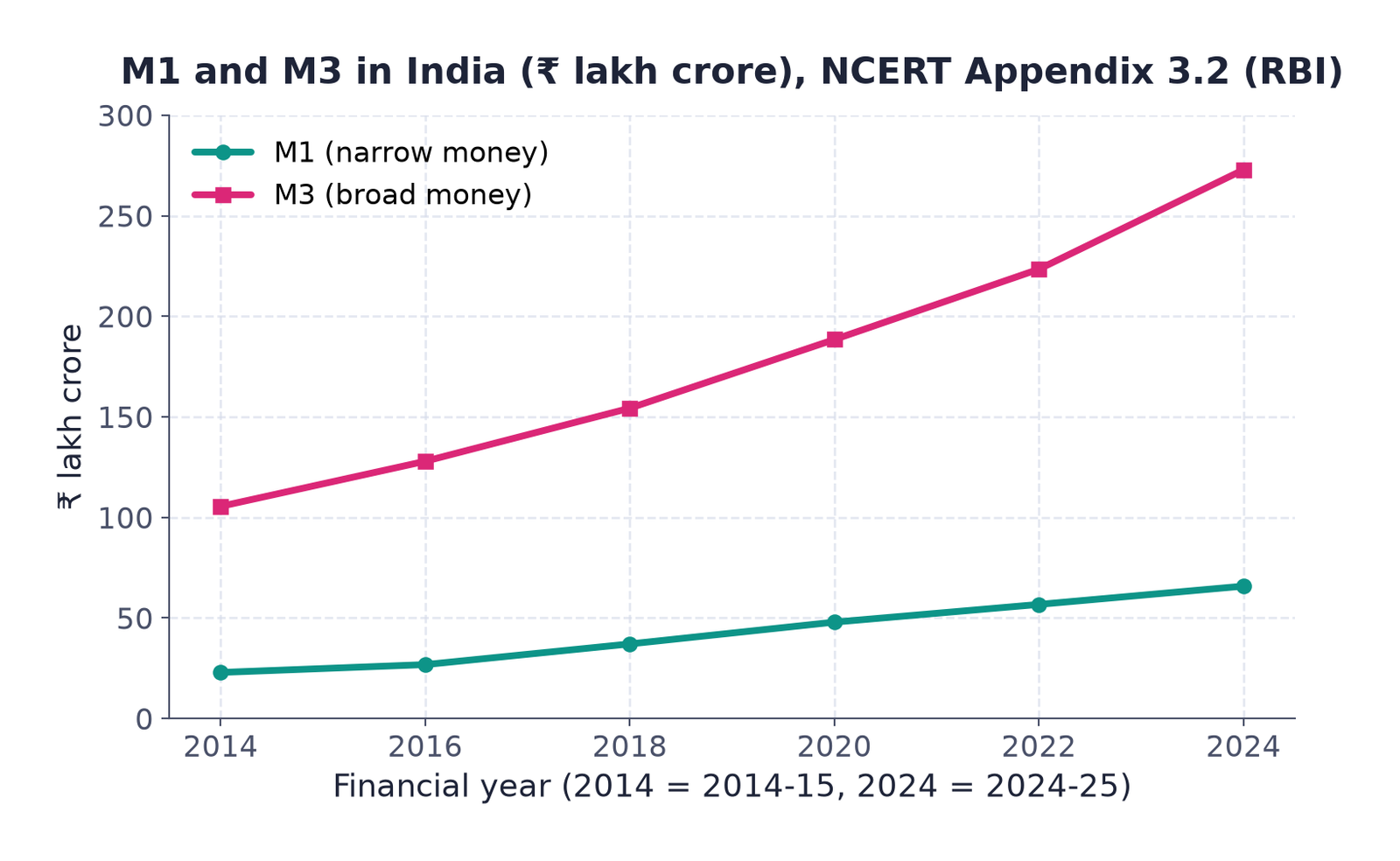
- The gap between the two columns is due to the time deposits of commercial banks: in 2024-25, 2,72,86,589 − 65,84,081 = ₹2,07,02,508 crore
- In 2024-25 M3 was about 4.14 times M1, so most of the public’s money is in time deposits
10 Demonetisation (Box 3.2)
Demonetisation is the withdrawal of the legal tender status of a series of currency notes in circulation. The Government of India took this new initiative in November 2016.
Corruption
To tackle the problem of corruption
Black money
To tackle the problem of black money
Terrorism
To tackle the problem of terrorism
Fake currency
To tackle the circulation of fake currency
To avoid a complete breakdown and cash crunch, the government allowed exchange of old notes for new currency up to ₹4000 per person per day.
Criticism (negative effects)
- Long queues outside banks and ATM booths
- Shortage of currency in circulation hurt economic activity
- Things improved with time and normalcy returned
Positive effects
- Better tax compliance; a large number of people brought into the tax net
- Savings channelised into the formal financial system; banks have more resources to lend at lower interest rates
- A signal that tax evasion will no longer be tolerated; it will bring financial penalty and social condemnation; corruption will decrease
- Transactions shifted out of cash into the formal payment system; households and firms moving to electronic payments
The book’s Table 3.5 shows currency in circulation of ₹16,63,463 crore in 2015-16, falling to ₹13,35,266 crore in 2016-17 (the demonetisation year), a drop of ₹3,28,197 crore (about 19.7%). In 2017-18 it rose again to ₹18,29,348 crore. Demonetisation is also examined under “Indian Economic Development” in the syllabus.
11 Key formulas
| Quantity | Formula |
|---|---|
| Relative price | price of good A ÷ price of good B (pen = 10 ÷ 2 = 5 pencils) |
| Balance sheet | Assets = Reserves + Loans; Liabilities = Deposits; Net worth = Assets − Liabilities |
| Money multiplier | 1 ÷ CRR (supplement: 1 ÷ LRR) |
| Total deposits | initial deposit × 1/CRR |
| Total loans (credit) | total deposits − initial deposit = initial deposit × (multiplier − 1) |
| Maximum loan (margin) | value of security × (1 − margin) |
| M1 / M2 / M3 / M4 | CU + DD / M1 + PO savings deposits / M1 + net time deposits / M3 + total PO deposits |
| Transaction demand (not CBSE) | ; v = 1/k |
| Present value (not CBSE) | return ÷ (1 + r) + return ÷ (1 + r)2 + … |
| Speculative demand (not CBSE) |
12 Differences the exam asks for
| Basis | Central bank (RBI) | Commercial bank |
|---|---|---|
| Main aim | Control money supply and credit in the interest of the economy | Profit from the spread between loan and deposit rates |
| Currency | Sole right to issue notes | Cannot issue notes; creates credit (deposits) |
| Customers | Government and banks | Public and firms |
| Role | Lender of last resort, controller of credit | Accepting deposits, giving loans |
| Basis | CRR | SLR |
|---|---|---|
| Kept where | With the central bank (RBI) | With the bank itself |
| In what form | Cash reserves | Specified liquid assets |
| Effect of a rise | Both cut lendable funds and credit | |
| Basis | Repo rate | Reverse repo rate |
|---|---|---|
| Flow of funds | RBI to banks (RBI lends) | Banks to RBI (RBI absorbs) |
| Agreement | RBI buys securities, will resell | RBI sells securities, will buy back |
| Effect of a rise | Bank borrowing costlier, credit falls | Banks park funds with RBI, credit falls |
| Basis | Quantitative tools | Qualitative tools |
|---|---|---|
| Purpose | Control the extent of money supply and total credit | Make banks encourage or discourage lending |
| Examples | CRR, SLR, bank rate, repo, reverse repo, open market operations | Margin requirement, moral suasion |
| Basis | Narrow money | Broad money |
|---|---|---|
| Measures | M1, M2 | M3, M4 |
| Liquidity | Higher | Lower |
| Time deposits | Not included | Included |
| Basis | Bank rate | Repo rate |
|---|---|---|
| Type of lending | Rate on RBI’s ordinary loans to banks | Rate on short-term lending under a repurchase agreement |
| Security | No repurchase agreement | Repurchase agreement on government securities |
- Barter: exchange without money; main drawback is no double coincidence of wants
- Functions of money: medium of exchange, unit of account, store of value, standard of deferred payments
- When the price level rises, the purchasing power of money falls
- RBI 1935: bank of issue, government’s bank, bankers’ bank, controller of credit, custodian of foreign exchange reserves
- High powered money = currency issued by the RBI (held by public + banks)
- Spread = loan interest rate − deposit interest rate = bank’s profit
- Assets = reserves + loans; liabilities = deposits
- Money multiplier = 1/CRR; at 20% CRR, ₹100 creates ₹500 of deposits and ₹400 of loans
- Raising CRR, SLR, bank rate, repo, reverse repo or margin, or selling bonds, reduces money supply
- Qualitative: moral suasion, margin requirement; a 40% margin allows loans up to 60%
- Fiat money: no intrinsic value; legal tender: cannot be refused; cheques are not legal tender
- M1 = CU + DD; M3 = M1 + net time deposits; M1, M2 narrow; M3, M4 broad
- Demonetisation, November 2016: old ₹500, ₹1000 withdrawn; new ₹500, ₹2000
- Can I write each drawback of barter against the function of money that removes it?
- Given a CRR and an initial deposit, can I find the multiplier, total deposits and total loans, and work backwards to the CRR?
- Can I draw the credit creation table with the first two rounds and the last row?
- For each tool, can I say whether the RBI raises or lowers it to cut money supply?
- Can I write the demonetisation dates, aims and both kinds of effects?