
Covers T.R. Jain & V.K. Ohri (2026-27) ch 11-12. Based on NCERT Introductory Macroeconomics, Chapter 6 (Reprint 2026-27) and the CBSE curriculum 2026-27, Unit 5 “Balance of Payments” (6 marks).
- say what an open economy is and how foreign trade changes aggregate demand
- name every component of the current account and capital account, and tell credit items from debit items
- work out the balance of trade, current account balance and overall BoP step by step
- explain autonomous and accommodating transactions, surplus and deficit, errors and omissions
- show how demand and supply fix the exchange rate, and what depreciation and appreciation mean, with diagrams
- compare flexible, fixed and managed floating exchange rates, and explain devaluation and revaluation
1 The open economy
Earlier chapters studied a closed economy, which has no links with the rest of the world. That was only to keep the analysis simple. In reality most modern economies are open.
An open economy is one that trades with other nations in goods and services and, most often, also in financial assets.
1.1 Three ways an economy is linked
Output market
The economy trades goods and services with other countries. Consumers and producers can choose between domestic and foreign goods.
Financial market
The economy can buy financial assets from other countries. Investors can choose between domestic and foreign assets.
Labour market
Firms choose where to produce and workers choose where to work. Immigration laws restrict the movement of labour between countries.
- Movement of goods has traditionally been seen as a substitute for the movement of labour
- The chapter focuses on the first two linkages (output and financial markets)
- Example: Indians consume products made around the world, and some Indian products are exported
1.2 Foreign trade and aggregate demand
Imports = leakage
- Indians buy foreign goods
- The spending escapes from the circular flow of income
- Aggregate demand for domestic goods falls
- Our spending becomes the foreign country’s income
Exports = injection
- Foreigners buy our goods
- The spending enters the circular flow
- Aggregate demand for domestically produced goods rises
- Exports bring income to our country
1.3 Currency in international transactions
- At the international level there is no single currency issued by a single bank
- Foreigners accept a national currency only if they trust that its purchasing power will stay stable
- No international authority can force the use of a particular currency
- In the past, governments announced that their currency was freely convertible at a fixed price into another asset, most often gold or other national currencies
- The credibility of this promise rested on two things: free conversion in unlimited amounts, and the price at which conversion takes place
- The international monetary system was set up to handle these issues and keep transactions stable
- As the volume of transactions grew, gold ceased to be the asset into which currencies could be converted
- What matters in trade between two countries is the currency in which trade happens: an Indian buying a ten-dollar American good needs dollars and needs to know what that costs in rupees
The foreign exchange rate (or simply the exchange rate) is the price of one currency in terms of another currency.
2 The balance of payments
The balance of payments (BoP) records the transactions in goods, services and assets between residents of a country and the rest of the world for a specified time period, typically a year.
- The BoP has two main accounts: the current account and the capital account
- A transaction that brings foreign exchange in is a credit (receipt); one that takes foreign exchange out is a debit (payment)
Under the IMF’s BPM6 (Balance of Payments and International Investment Position Manual, sixth edition), transactions are divided into three accounts: current account, financial account and capital account. The biggest change is that almost all transactions in financial assets such as bonds and equity shares now go in the financial account. India has made the change, but the RBI still publishes BoP accounts under the old system as well, so the book teaches the old two-account system. Details are in the RBI’s Balance of Payments Manual for India (September 2010).
3 Current account
The current account is the record of trade in goods and services and transfer payments.
- Trade in goods: exports and imports of goods
- Trade in services: factor income and non-factor income transactions
- Factor income: net international earnings of factors of production (labour, land, capital), such as pay for work abroad, interest and dividends
- Non-factor income: net sale of service products such as shipping, banking, tourism and software services
Transfer payments are receipts which the residents of a country get for free, without having to provide any goods or services in return. They consist of gifts, remittances and grants, and may be given by the government or by private citizens living abroad.
3.1 Balance on current account
| Current account surplus | Balanced current account | Current account deficit |
|---|---|---|
| Receipts > Payments | Receipts = Payments | Receipts < Payments |
| The nation is a lender to other countries | Neither lender nor borrower | The nation is a borrower from other countries |
The balance on current account has two components: the balance of trade and the balance on invisibles.
3.2 Balance of trade (BOT)
The balance of trade (BOT) is the difference between the value of exports and the value of imports of goods of a country in a given period of time. It is also called the trade balance.
- Export of goods is a credit item and import of goods a debit item in BOT
- Balanced BOT: exports of goods = imports of goods
- Surplus BOT (trade surplus): the country exports more goods than it imports
- Deficit BOT (trade deficit): the country imports more goods than it exports
3.3 Net invisibles
Net invisibles is the difference between the value of exports and the value of imports of invisibles of a country in a given period of time. Invisibles include services, transfers and flows of income between countries.
Goods can be seen at the port, so they are “visible”; services, income and transfers cannot, so they are “invisible”. Current account balance = balance of trade + net invisibles.
4 Capital account
The capital account records all international transactions of assets. An asset is any one of the forms in which wealth can be held, for example money, stocks, bonds and government debt.
Debit item: purchase of an asset
- An Indian buys a UK car company
- Foreign exchange flows out of India
- Capital outflow
Credit item: sale of an asset
- A share of an Indian company is sold to a Chinese customer
- Foreign exchange flows into India
- Capital inflow
- Foreign direct investment (FDI): investment to acquire control of, or a lasting stake in, a business abroad
- Foreign institutional investment (FII): portfolio investment by foreign institutions in financial assets such as shares and bonds
4.1 Balance on capital account
| Position | Condition |
|---|---|
| Capital account in balance | Capital inflows (loans received from abroad, sale of assets or shares in foreign companies) = capital outflows (repayment of loans, purchase of assets or shares in foreign countries) |
| Capital account surplus | Capital inflows > capital outflows |
| Capital account deficit | Capital inflows < capital outflows |
4.2 Current account vs capital account
| Basis | Current account | Capital account |
|---|---|---|
| What is recorded | Trade in goods and services, and transfer payments | Transactions in assets |
| Nature | Flows that affect the country’s income | Changes in the country’s assets and liabilities |
| Examples | Tea exports, software services, remittances from abroad | FDI, FII, external commercial borrowings, external assistance |
4.3 Credit or debit, current or capital: at a glance
| Transaction | Account | Side |
|---|---|---|
| India exports garments | Current (goods) | Credit |
| India imports crude oil | Current (goods) | Debit |
| A foreign tourist pays a hotel bill in India | Current (services) | Credit |
| An Indian working in a Gulf country sends money home | Current (transfers) | Credit |
| India gives earthquake relief grant to a neighbour | Current (transfers) | Debit |
| A foreign company sets up a factory in India (FDI) | Capital | Credit |
| An Indian company buys a foreign company | Capital | Debit |
| India repays the principal of a foreign loan | Capital | Debit |
Interest paid on a foreign loan is income (factor income), so it is a debit in the current account; repaying the principal is a debit in the capital account. Do not put both in the same account.
5 BoP surplus and deficit
5.1 Financing a current account deficit
- A person who spends more than her income must finance the difference by selling assets or by borrowing
- In the same way, a country with a current account deficit (spending more than it receives from sales to the rest of the world) must sell assets or borrow abroad
- So any current account deficit must be financed by a capital account surplus, that is, a net capital inflow
…(1)
- When the current account deficit is financed entirely by international lending without any reserve movements, the country is in balance of payments equilibrium
5.2 Official reserve transactions
- A country can also use its reserves of foreign exchange to balance a deficit
- The reserve bank sells foreign exchange when there is a deficit; this is called official reserve sale
- A decrease in official reserves is the overall BoP deficit; an increase is the overall BoP surplus
- The monetary authorities are the ultimate financiers of any BoP deficit (or recipients of any surplus)
- Official reserve transactions are more relevant under fixed exchange rates than under floating rates
5.3 Autonomous and accommodating transactions
Autonomous transactions are international economic transactions made for some reason other than to bridge the gap in the BoP (for example, to earn profit), that is, independent of the state of the BoP. They are called “above the line” items.
Accommodating transactions are determined by the gap in the BoP (deficit or surplus), that is, by the net consequences of the autonomous transactions. They are called “below the line” items.
- The BoP is in surplus if autonomous receipts are greater than autonomous payments, and in deficit if they are less
- Official reserve transactions are made to bridge the BoP gap, so they are the accommodating item; all others are autonomous
| Basis | Autonomous | Accommodating |
|---|---|---|
| Motive | Profit or another economic reason | To bridge the BoP gap |
| Link to state of BoP | Independent of it | Depends on it |
| Position | Above the line | Below the line |
| Examples | Exports, imports, FDI, remittances | Official reserve transactions |
5.4 Errors and omissions
- It is difficult to record all international transactions accurately
- So, apart from the current and capital accounts, the BoP has a third element, errors and omissions, which reflects this
5.5 Overall balance and reserve change
| BoP deficit | Balanced BoP | BoP surplus |
|---|---|---|
| Overall balance < 0 | Overall balance = 0 | Overall balance > 0 |
| Reserve change > 0 | Reserve change = 0 | Reserve change < 0 |
The sign of “reserve change” in this table is an accounting sign: in a deficit, foreign exchange drawn from reserves fills the gap, so it enters the accounts as a positive entry that brings the total to zero. Remember the meaning: deficit = reserves fall, surplus = reserves rise.
5.6 Table 6.1: Balance of Payments for India (sample, million USD)
| No. | Item | Million USD |
|---|---|---|
| 1 | Exports (of goods only) | 150 |
| 2 | Imports (of goods only) | 240 |
| 3 | Trade balance (exports − imports) | −90 |
| 4 | (Net) invisibles [4a + 4b + 4c] | 52 |
| a. Non-factor services | 30 | |
| b. Income | −10 | |
| c. Transfers | 32 | |
| 5 | Current account balance [3 + 4] | −38 |
| 6 | Capital account balance [6a to 6f] | 41.15 |
| a. External assistance (net) | 0.15 | |
| b. External commercial borrowings (net) | 2 | |
| c. Short-term debt | 10 | |
| d. Banking capital (net), of which non-resident deposits (net) 9 | 15 | |
| e. Foreign investments (net) = FDI 13 + portfolio 6 | 19 | |
| f. Other flows (net) | −5 | |
| 7 | Errors and omissions | −3.15 |
| 8 | Overall balance [5 + 6 + 7] | 0 |
| 9 | Reserves change | 0 |
- The table shows a trade deficit and a current account deficit, but a capital account surplus
- The capital account surplus (41.15) together with errors and omissions (−3.15) covers the current account deficit (−38), so the BoP is in balance and reserves do not change
Given (₹ crore, a hypothetical country)
Exports of goods 500; imports of goods 650; net invisibles +80; no change in reserves
To find
Balance of trade, current account balance and the capital account balance needed
Formula: balance of trade = exports of goods − imports of goods (½)
Substitution: 500 − 650 = (−) ₹150 crore, a trade deficit (½)
Formula: current account balance = balance of trade + net invisibles (½)
Substitution: −150 + 80 = (−) ₹70 crore, a current account deficit (½)
Capital account: with no reserve change, current account + capital account = 0, so the capital account balance = (+) ₹70 crore (surplus) (1)
Interpretation: the country spent more on goods; services and remittances covered part of the gap, and the remaining ₹70 crore came from borrowing abroad or selling assets (capital inflow).
The balance of trade covers goods only. Adding service exports (such as software) to the BOT is wrong; they belong in invisibles, that is, in the current account. A country can run a trade deficit and still have a current account surplus if net invisibles are large enough.
6 The foreign exchange market
- Example: an Indian resident wants to holiday in London (an import of tourist services); she must pay in pounds for her stay
- She needs to know where to get pounds and at what price; that price is the exchange rate
The foreign exchange market is the market in which national currencies are traded for one another.
- Major participants: commercial banks, foreign exchange brokers, other authorised dealers and monetary authorities
- Participants may have their own trading centres, but the market itself is world-wide
- There is close and continuous contact between trading centres, and participants deal in more than one market
6.1 Foreign exchange rate
- The foreign exchange rate (forex rate) is the price of one currency in terms of another
- It links the currencies of different countries and makes international costs and prices comparable
- Example: if we pay ₹50 for one dollar, the exchange rate is ₹50 per dollar
- To keep it simple, the book assumes India and the USA are the only two countries, so only one exchange rate has to be determined
6.2 Demand for foreign exchange
Imports
To buy goods and services from other countries
Gifts
To send gifts and transfers abroad
Assets
To buy financial assets of another country
6.3 Supply of foreign exchange
Exports
Foreigners buy our domestic goods and services
Gifts
Foreigners send gifts or make transfers
Assets
Foreigners buy assets of our country
- A rise in the price of foreign exchange lowers the foreigner’s cost (in USD) of buying Indian products, other things constant
- India’s exports rise, so the supply of foreign exchange may rise
- Whether it actually rises depends on several factors, especially the elasticity of demand for exports and imports; the supply curve is normally drawn upward sloping
7 Determination of the exchange rate: flexible exchange rate
A country’s exchange rate can be determined by a flexible (floating) exchange rate, a fixed exchange rate or a managed floating exchange rate.
A flexible exchange rate (floating exchange rate) is determined by the market forces of demand and supply in the foreign exchange market. In a completely flexible system the central bank does not intervene.
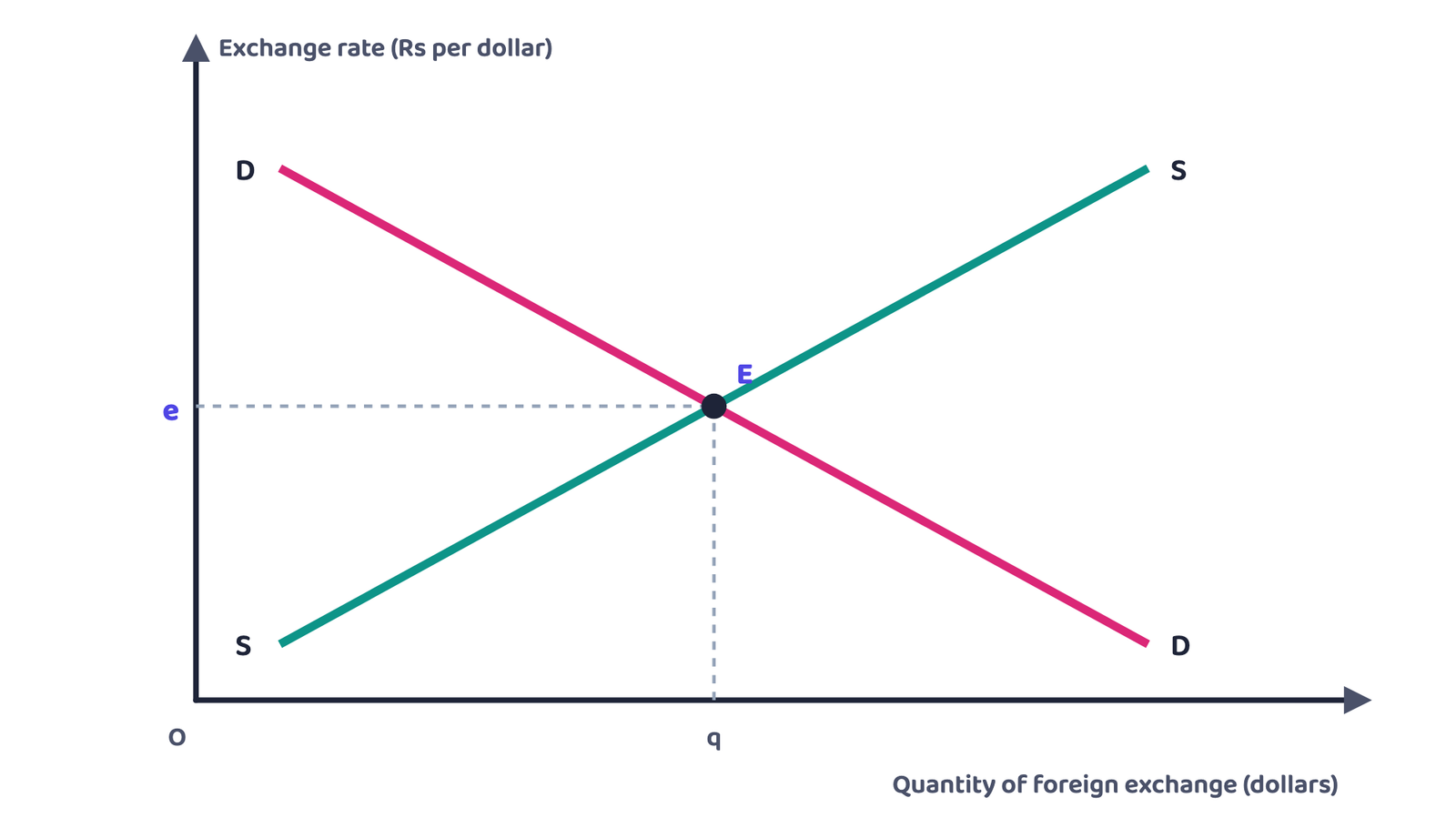
- The exchange rate is fixed where the demand curve meets the supply curve, at point e on the Y-axis
- Point q on the X-axis is the quantity of dollars demanded and supplied at that rate
- Above e, supply of dollars exceeds demand and the rate falls; below e, demand exceeds supply and the rate rises, so e is the equilibrium
7.1 Rise in demand: depreciation of the domestic currency
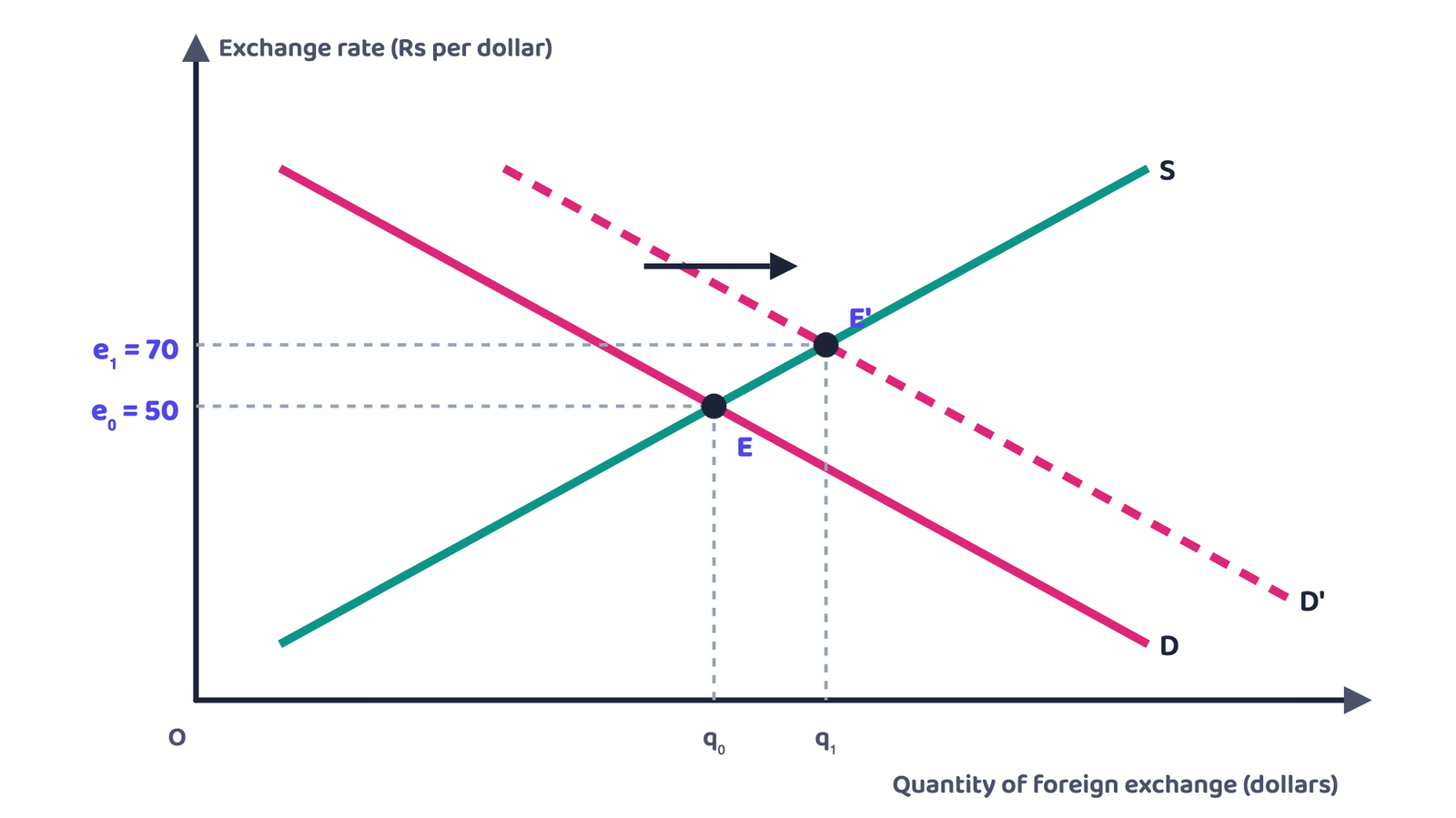
- More international travel by Indians raises demand for foreign goods and services
- The demand curve for foreign exchange shifts up and to the right, from D to D′
- The initial rate e₀ = ₹50 per dollar becomes the new equilibrium rate e₁ = ₹70 per dollar
- We now pay more rupees for a dollar: the value of the rupee in terms of dollars has fallen and the value of the dollar in terms of rupees has risen
Depreciation: in a flexible exchange rate system, when the price of foreign currency in terms of domestic currency rises (the exchange rate rises), the domestic currency is said to depreciate in terms of the foreign currency.
Appreciation: in a flexible exchange rate system, when the price of domestic currency in terms of foreign currency rises, the domestic currency is said to appreciate. We then pay fewer rupees for one dollar.
7.2 Rise in supply: appreciation of the domestic currency
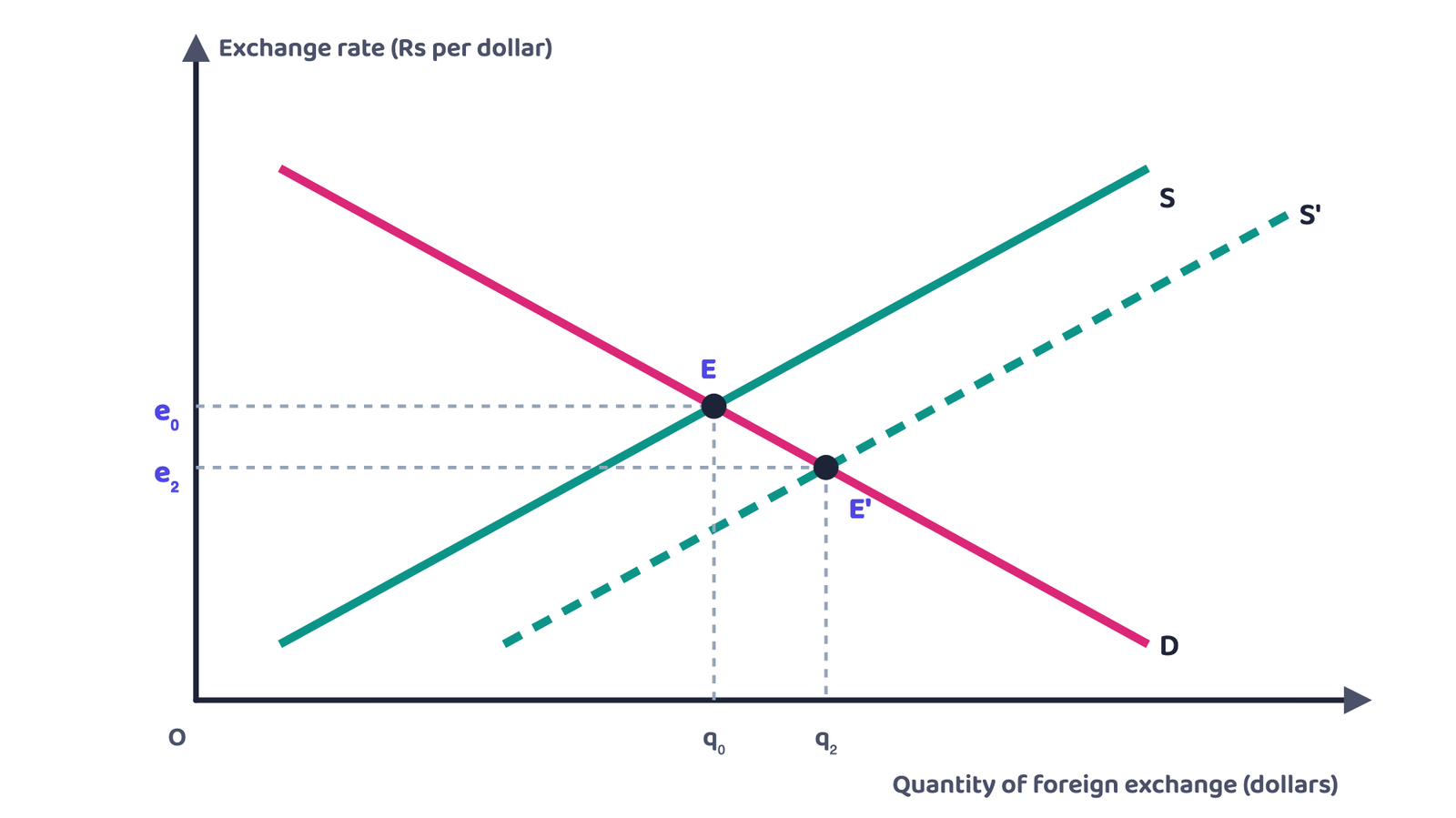
- If foreign investors bring in more FDI, or India’s exports rise, the supply of dollars rises
- The supply curve shifts right from S to S′; the new equilibrium is E′ and the rate falls from e₀ to e₂
- We pay fewer rupees for a dollar: the rupee appreciates
- A large capital account inflow can finance a current account deficit; with no intervention under flexible rates, reserves do not change and the adjustment shows up as a fall in the exchange rate
7.3 Speculation
- Money in any country is an asset
- Exchange rates are also affected when people hold foreign exchange expecting to gain from its appreciation
- If Indians believe the British pound will rise in value relative to the rupee, they will want to hold pounds
Given: current rate ₹80 per pound; investors expect the pound to be worth ₹85 by the end of the month.
Step 1: pounds bought with ₹80,000 = 80,000 ÷ 80 = 1,000 pounds
Step 2: sale at month-end = 1,000 × 85 = ₹85,000
Result: profit = 85,000 − 80,000 = ₹5,000
Interpretation: this expectation raises the demand for pounds now, so the rupee-pound exchange rate rises in the present. The belief fulfils itself (self-fulfilling).
7.4 Interest rates and the exchange rate
- In the short run, the interest rate differential (the difference between interest rates of countries) is an important factor
- Huge funds owned by banks, multinational corporations and wealthy individuals move around the world in search of the highest interest rates
- If country A’s government bonds pay 8% and equally safe bonds in country B pay 10%, the interest rate differential is 10 − 8 = 2%
- Investors from A buy B’s currency, selling their own; investors in B also prefer investing at home and demand less of A’s currency
- The demand curve for A’s currency shifts left and the supply curve shifts right: A’s currency depreciates, B’s appreciates
- So a rise in interest rates at home often leads to an appreciation of the domestic currency (assuming no restrictions on buying foreign government bonds)
7.5 Income and the exchange rate
- If income abroad also rises, our exports rise and the supply curve of foreign exchange shifts outward
- The domestic currency may or may not depreciate; it depends on whether exports are growing faster than imports
- In general, a country whose aggregate demand grows faster than the rest of the world’s finds its currency depreciating, because its imports grow faster than its exports and its demand curve for foreign currency shifts faster than its supply curve
7.6 Exchange rates in the long run: purchasing power parity
According to the purchasing power parity (PPP) theory, as long as there are no barriers to trade such as tariffs (taxes on trade) and quotas (quantitative limits on imports), exchange rates eventually adjust so that the same product costs the same whether measured in rupees in India or dollars in the US, except for differences in transportation.
- PPP is used to make long-run predictions about exchange rates under a flexible exchange rate system
- In the long run, the exchange rate between two currencies adjusts to reflect differences in the price levels of the two countries
Given (Example 6.1)
A shirt costs 8 dollars in the US and ₹400 in India; later prices rise 20% in India and 50% in the US
To find
The PPP exchange rate before and after
Formula: PPP rate = Indian price ÷ US price (½)
Before: 400 ÷ 8 = ₹50 per dollar (½)
Why this rate: at ₹60, a US shirt costs 8 × 60 = ₹480 against ₹400 in India, so all buyers buy from India; below ₹50 all the shirt business goes to the US.
After: India 400 × 1.2 = ₹480; US 8 × 1.5 = 12 dollars (½)
New rate: 480 ÷ 12 = ₹40 per dollar (½)
Interpretation: US prices rose faster, so the dollar has depreciated (a dollar now buys fewer rupees).
8 Fixed exchange rate
Under a fixed exchange rate system, the government fixes the exchange rate at a particular level and maintains it through intervention.
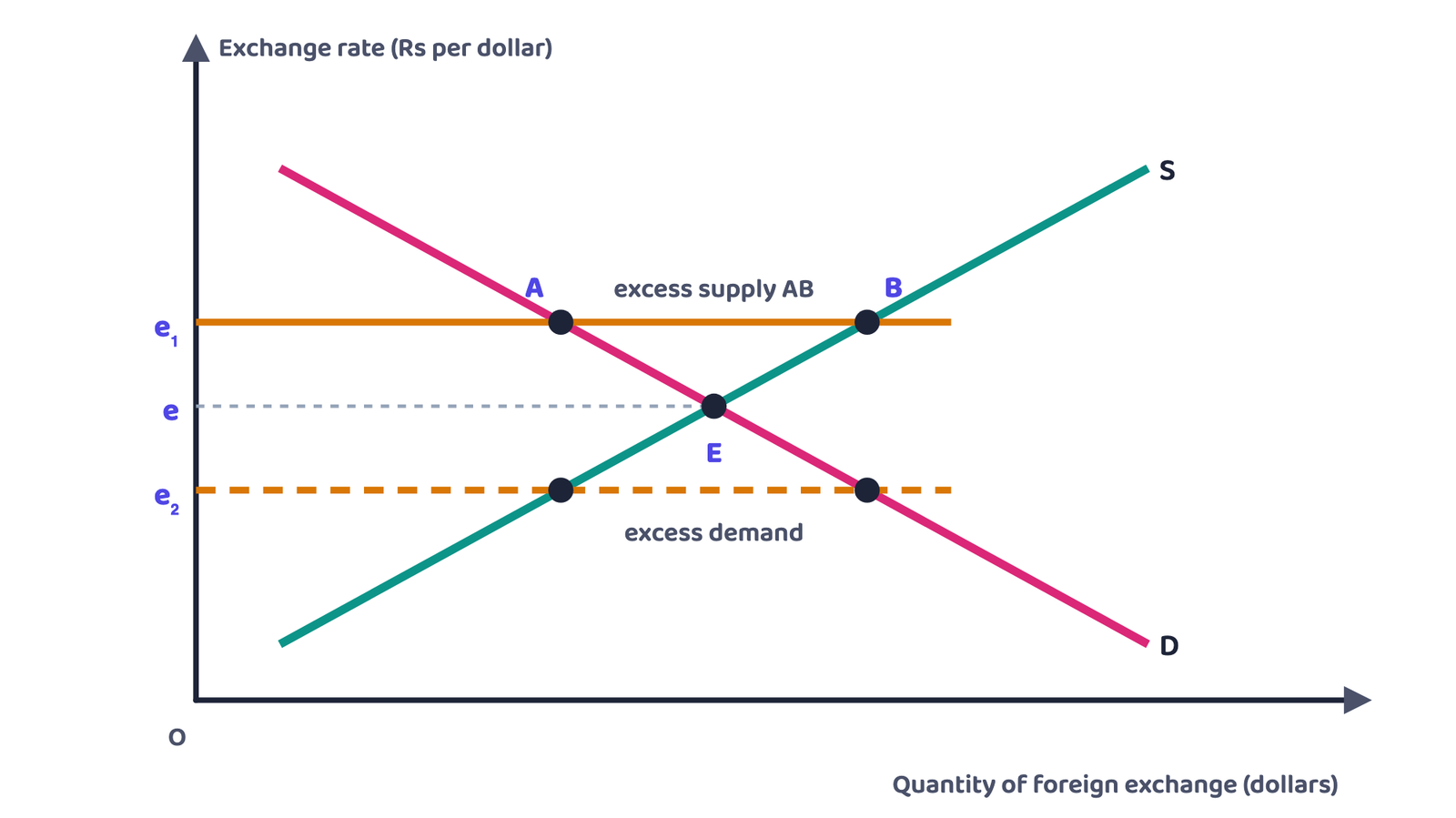
- The market-determined rate is e (₹50 per dollar)
- Suppose the government wants to encourage exports, so it must make the rupee cheaper for foreigners; it fixes a higher rate e₁ (say ₹70 per dollar), e₁ > e
- At e₁ the supply of dollars exceeds demand; this excess supply is AB
- To absorb it, the RBI purchases dollars for rupees in the foreign exchange market
- Through intervention the government can maintain any rate, but it keeps accumulating foreign exchange as long as the intervention continues
- If the government sets a lower rate such as e₂, there is excess demand for dollars; it must withdraw dollars from its past holdings to meet it
- If it fails to do so, a black market for dollars may come up
Devaluation: in a fixed exchange rate system, when government action increases the exchange rate (making the domestic currency cheaper), it is called devaluation.
Revaluation: in a fixed exchange rate system, when the government decreases the exchange rate (making the domestic currency costlier), it is called revaluation.
| Basis | Depreciation | Devaluation |
|---|---|---|
| System | Flexible exchange rate | Fixed exchange rate |
| Who causes it | Market demand and supply | The government (official action) |
| Result | The domestic currency loses value | The domestic currency’s value is lowered |
| Opposite | Appreciation | Revaluation |
“The exchange rate rose” means more rupees per dollar, so the rupee became weaker. A move from ₹70 per dollar to ₹75 per dollar is a depreciation of the rupee, not an appreciation. And the market depreciates a currency; the government devalues it.
9 Merits and demerits of flexible and fixed exchange rates
9.1 Fixed exchange rate
- Main feature: there must be credibility that the government can keep the rate at the stated level
- If the BoP is in deficit, the government must intervene with its official reserves to cover the gap
- If people learn that reserves are inadequate, they doubt the government’s ability to hold the rate, which can give rise to speculation of devaluation
- When this belief turns into aggressive buying of one currency and forces the government to devalue, it is a speculative attack on the currency
- Fixed rates are prone to such attacks, as seen in the period before the collapse of the Bretton Woods System
9.2 Flexible exchange rate
- Gives the government more flexibility; no need to keep large stocks of foreign exchange reserves
- Major advantage: movements in the exchange rate automatically take care of BoP surpluses and deficits
- Countries gain independence in monetary policy, since they do not have to intervene to maintain the rate
| Basis | Fixed exchange rate | Flexible exchange rate |
|---|---|---|
| Determined by | Government / central bank | Market demand and supply |
| Reserves needed | Large reserves | No large reserves |
| BoP imbalance | Covered by intervention from reserves | Corrected automatically by rate changes |
| Monetary policy | Tied to defending the rate | Independent |
| Risk | Speculative attack, black market | Fluctuating rate |
| Fall / rise of currency | Devaluation / revaluation | Depreciation / appreciation |
10 Managed floating exchange rate
A managed floating exchange rate is a mixture of a flexible system (the float part) and a fixed system (the managed part), in which central banks intervene to buy and sell foreign currencies to moderate exchange rate movements whenever they feel it is appropriate. It is also called dirty floating.
- The world moved to this system without any formal international agreement
- Official reserve transactions are therefore not equal to zero, because the central bank buys and sells from time to time
10.1 Nominal and real exchange rate (key concept)
The nominal exchange rate is the price of one unit of foreign currency in terms of domestic currency (for example ₹84 per dollar).
The real exchange rate is the relative price of foreign goods in terms of domestic goods: it is commonly measured as nominal exchange rate × foreign price level ÷ domestic price level, a measure of international competitiveness; when it equals one, the two countries are at purchasing power parity. (The formula is not printed in the English text; it is needed for Exercises 3 and 4.)
- The book lists “nominal and real exchange rate” among the chapter’s key concepts, and Exercises 3 and 4 test it
11 Determination of equilibrium income in an open economy (Appendix 6.1): Not in CBSE 2026-27 syllabus
This part is not in the CBSE 2026-27 syllabus, but it is in the book and Exercises 9 to 14 and 18 are based on it. Read it briefly for state boards.
11.1 Demand for domestic goods vs domestic demand for goods
Domestic demand for goods
- Total demand of the country’s households, firms and government
- C + I + G
- Includes demand for foreign goods (imports)
Demand for domestic goods
- Total demand for goods made at home, from home and abroad
- C + I + G + X − M
- Exports added, imports subtracted
…(2)
- Net exports NX = exports − imports; positive NX means a trade surplus, negative NX a trade deficit
- Imports depend positively on domestic income (Y) and negatively on the real exchange rate (R)
- Exports depend positively on foreign income (Yf) and on R; for our country they are taken as autonomous (exogenous)
- The real exchange rate is the relative price of foreign goods in terms of domestic goods; a higher R makes foreign goods dearer, so imports fall and exports rise
11.2 Import function and the open economy multiplier
Given: c = 0.8, m = 0.3; domestic autonomous demand rises by 100
Closed economy multiplier: , output rises by 100 × 5 = 500
Open economy multiplier: , output rises by 100 × 2 = 200
Interpretation: the multiplier is smaller in an open economy.
- Why smaller: a rise in autonomous spending (say government spending) raises income and has an induced effect on consumption; part of this induced consumption goes to foreign goods (imports)
- So the induced effect on demand for domestic goods, and on domestic income, is smaller; imports per unit of income are an additional leakage from the circular flow at each round of the multiplier process
- A rise in exports: , income rises (just like a rise in government spending or investment)
- A rise in autonomous imports: , demand for domestic output and equilibrium income fall
In the open economy multiplier, m is added in the denominator: 1/(1 − c + m). Writing 1/(1 − c − m) makes the multiplier bigger, which is the opposite conclusion.
12 In one place: formulas, differences and mistakes
✓ Do this
- Take only goods in the balance of trade
- Put loan interest in the current account and loan principal in the capital account
- Write “deficit” along with the (−) sign
- Label the axes “Exchange rate (₹ per dollar)” and “Quantity of foreign exchange”
✗ Never do this
- Treat depreciation and devaluation as the same thing
- Read a rise in the exchange rate as a stronger rupee
- Call official reserve transactions autonomous items
- Put remittances in the capital account; they are transfers
- Open economy: trade in goods, services and financial assets; imports a leakage, exports an injection
- BoP = a year’s transactions between residents and the rest of the world; two accounts, current and capital (three under BPM6)
- Current account = trade in goods + trade in services + transfers; balance = BOT + net invisibles
- Capital account = investments (FDI, FII), external borrowings, external assistance; purchase debit, sale credit
- CA + KA ≡ 0; fall in reserves = BoP deficit, rise = surplus
- Autonomous = above the line (profit motive); accommodating = below the line (bridging the gap, official reserves); errors and omissions the third element
- Demand for forex: imports, gifts, buying foreign assets (downward slope); supply: exports, gifts, foreign investment (upward slope)
- Flexible rate: where D = S; D rises, ₹50 to ₹70, rupee depreciates; S rises, rupee appreciates
- Speculation is self-fulfilling; higher home interest rate, appreciation; higher income, depreciation; PPP: 8 dollars = ₹400 ⇒ ₹50
- Fixed rate: at e₁ > e excess supply AB, RBI buys dollars; at e₂ excess demand, reserves fall, black market; devaluation/revaluation
- Managed floating = dirty floating; central bank intervenes when needed, official transactions not zero
- Can I write the components of the current and capital accounts without looking?
- Can I work out the current account balance and the overall balance from exports, imports, invisibles and capital account figures?
- Can I draw the three diagrams (determination, rise in demand, fixed rate) with labelled axes?
- Can I give three differences between depreciation and devaluation, and between autonomous and accommodating transactions?
- Can I state three merits of flexible rates and the demerits of fixed rates?