- What a secondary activity is, and why it makes raw material worth more
- The features that separate old craft production from modern large-scale manufacturing
- The seven factors that decide where a large industry sets up
- Four different ways to classify manufacturing industries: by size, raw material, output and ownership
- What makes an industry “high-tech”, and what a technopoly is
1What Are Secondary Activities?
All economic activities revolve around obtaining and using resources that people need to survive. Secondary activities are the ones that add value to natural resources by transforming raw material into a more valuable, finished product. Cotton in the boll has limited use, but once spun into yarn it becomes valuable and can be made into cloth. Iron ore cannot be used directly, but once converted into steel it becomes valuable and is used to make machines and tools. The same is true of materials from farms, forests, mines and the sea.
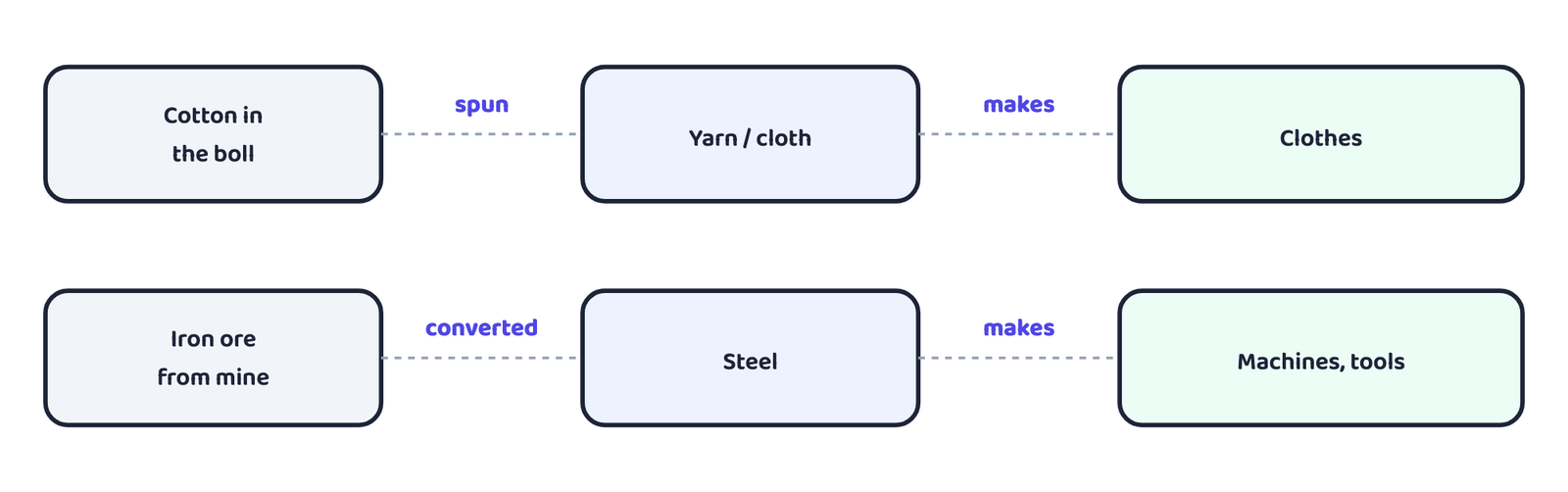
Secondary activities add value to natural resources by transforming raw materials into more valuable products. They cover manufacturing, processing, and construction (infrastructure) industries.
Manufacturing means the production of any good, from a handicraft made by hand to a computer or a space vehicle built with advanced technology.
Manufacturing literally means “to make by hand”, but today it also includes goods made by machines. An industry is a geographically located manufacturing unit that keeps its own accounts and records under a management system. But many secondary activities, like the tourism industry and the entertainment industry, are not carried out in factories at all. So the longer term “manufacturing industry” is used specifically for factory-based production, to avoid confusion.
2Characteristics of Modern Large-Scale Manufacturing
2.1 Specialisation of skills / methods of production
Craft method
- Factories produce only a few pieces
- Made to order
- Cost is high
Mass production
- Large quantities of standardised parts
- Each worker repeats one task
- Cost per unit is low
2.2 Organisational structure and stratification
Modern manufacturing uses complex machine technology with extreme specialisation and division of labour, so more goods are made with less effort and lower cost. This needs vast capital, large organisations and a whole layer of executive management to run.
2.3 Uneven geographic distribution
Major concentrations of modern manufacturing cover less than 10% of the world’s land area, yet these nations have become centres of economic and political power. Because manufacturing processes are so intensive, industrial sites take up far less land than agriculture for the same output.
A 2.5 sq km patch of the American corn belt usually holds about 4 large farms employing 10-20 workers, supporting 50-100 people. The same 2.5 sq km could instead hold several large integrated factories employing thousands of workers. Manufacturing packs far more activity into far less land than farming.
3Mechanisation, Automation and Technological Innovation
Mechanisation
Using gadgets and machines to accomplish tasks that were once done by hand.
Automation
The advanced stage of mechanisation: tasks are done without any human thinking during the process. Automatic factories now use feedback and closed-loop computer control systems where machines are built to “think”.
Technological innovation
Research and development (R&D) that improves quality control, eliminates waste and inefficiency, and helps fight pollution, an important part of modern manufacturing.
4Why Do Large-Scale Industries Choose Different Locations?
Industries maximise profit by cutting cost, so they are located where production costs are lowest. Several factors together decide where a large industry sets up.
4.1 Access to market
Market means people who both want a good and have the purchasing power to buy it. Remote, thinly populated areas are small markets. Europe, North America, Japan and Australia are large markets because purchasing power there is high; the densely populated regions of South and South-East Asia are large markets simply because of population size. A few industries, like aircraft manufacturing and the arms industry, have a global market.
4.2 Access to raw material
Raw material must be cheap and easy to transport. Industries based on cheap, bulky, weight-losing material (ores) locate close to the raw material source: steel, sugar and cement industries are examples. Perishable raw material is another reason to stay close to the source: agro-processing and dairy industries are processed near the farm or the milk supply.
4.3 Access to labour supply
Labour is an important locational factor. Some kinds of manufacturing still need skilled labour, but rising mechanisation, automation and flexible processes have reduced how much industry depends on labour.
4.4 Access to sources of energy
Power-hungry industries, such as the aluminium industry, locate near the source of energy. Coal was historically the main energy source; today hydroelectricity and petroleum are also important.
4.5 Access to transportation and communication facilities
Speedy, efficient transport is essential to carry raw material in and finished goods out. Transport cost strongly affects where an industrial unit locates. Western Europe and eastern North America have highly developed transport systems, which has always concentrated industry there. Communication is equally needed for exchanging and managing information.
4.6 Government policy
Governments adopt regional policies to promote balanced economic development, and set up industries in particular areas as part of that policy.
4.7 Access to agglomeration economies / links between industries
Many industries benefit from being located near a leading industry and other related industries: these benefits are called agglomeration economies. The savings come from the linkages that exist between different industries.
All seven factors above act together to decide industrial location. No single factor decides it alone. If asked “what determines the location of an industry”, name several factors, not just one.
Footloose industries can be located in a wide variety of places. They do not depend on any specific raw material and instead rely on component parts that can be obtained from anywhere. They produce in small quantity, employ a small labour force, are generally non-polluting, and their most important locational factor is accessibility by road.
5Classifying Manufacturing Industries
Manufacturing industries are classified on four different bases: their size, their inputs/raw materials, their output/products, and their ownership.
6Industries Based on Size
6.1 Household or cottage industries
The smallest manufacturing unit. Artisans use local raw material and simple tools to make everyday goods in their own homes, with the help of family members or part-time labour. The finished goods may be used in the same household, sold in local (village) markets, or bartered. Capital and transport barely influence this type of manufacturing because its commercial significance is low and most tools are made locally. Common products: foodstuffs, fabrics, mats, containers, tools, furniture, shoes, wooden figurines, leather goods, pottery and bricks, and gold/silver/bronze jewellery.
6.2 Small-scale manufacturing
Different from household industry in its production technique and place of manufacture: a workshop outside the producer’s home. It uses local raw material, simple power-driven machines and semi-skilled labour. It provides employment and raises local purchasing power, which is why countries like India, China, Indonesia and Brazil have developed labour-intensive small-scale manufacturing to employ their large populations.
6.3 Large-scale manufacturing
Needs a large market, a variety of raw materials, enormous energy, specialised workers, advanced technology, assembly-line mass production, and large capital. It developed over the last 200 years in the United Kingdom, north-eastern USA and Europe, and has since spread almost everywhere. Its industrial regions fall into two broad types:
Commercial farming on an industrial scale, often financed by businesses whose main interest lies outside agriculture, for example, large corporations in the tea plantation business. Agri-business farms are mechanised, large, highly structured and reliant on chemicals, and are sometimes called “agro-factories”.
7Industries Based on Inputs/Raw Materials
Classified into five categories on the basis of the raw material they use.
| Category | Raw material used | Examples |
|---|---|---|
| (a) Agro-based | Farm/field produce | Food processing, sugar, pickles, fruit juices, beverages (tea, coffee, cocoa), spices, oils/fats, textiles (cotton, jute, silk), rubber |
| (b) Mineral-based | Metallic and non-metallic minerals | Ferrous: iron & steel; Non-ferrous: aluminium, copper, jewellery; Non-metallic: cement, pottery |
| (c) Chemical-based | Natural chemical minerals, wood, coal | Petrochemicals (mineral oil), salts, sulphur, potash, synthetic fibre, plastic |
| (d) Forest-based | Timber, wood, bamboo, grass, lac | Furniture (timber), paper (wood/bamboo/grass), lac industry |
| (e) Animal-based | Leather, wool, ivory | Leather industry, woollen textiles, ivory goods (elephant tusks) |
Includes canning, cream production, fruit processing and confectionery. Older preservation techniques, drying, fermenting and pickling, have been known since ancient times, but had only limited use before the Industrial Revolution.
8Industries Based on Output/Product
Basic industries
- Products are used as raw material by other industries
- Example: iron and steel
Consumer goods (non-basic) industries
- Products are consumed directly by consumers
- Example: bread, biscuits, tea, soaps, toiletries, writing paper, televisions
9Industries Based on Ownership
Public sector
Owned and managed by government. India had many Public Sector Undertakings (PSUs); socialist countries have many state-owned industries; mixed economies have both public and private enterprises.
Private sector
Owned by individual investors and managed by private organisations. In capitalist countries, industries are generally privately owned.
Joint sector
Managed by a joint stock company, or by the private and public sectors together establishing and managing an industry.
10The Concept of High-Technology Industry
High technology (high-tech) is the latest generation of manufacturing activity: the application of intensive research and development (R&D) leading to products of an advanced scientific and engineering character.
Professional (white-collar) workers make up a large share of the total workforce in high-tech industry, and greatly outnumber the actual production (blue-collar) workers. Notable examples of high-tech activity include robotics on the assembly line, computer-aided design (CAD) and manufacturing, electronic control of smelting and refining, and the constant development of new chemical and pharmaceutical products.
The high-tech landscape looks different too: neatly spaced, low, modern, dispersed office-plant-lab buildings replace massive assembly structures, factories and storage areas. Regional and local development schemes now plan business parks specifically for high-tech start-ups.
Technopoly = Technology + Polis (city)
A technopoly is a high-tech industry cluster that is regionally concentrated, self-sustained and highly specialised. Silicon Valley (near San Francisco) and Silicon Forest (near Seattle) are classic examples.
Manufacturing contributes significantly to the world economy: iron and steel, textiles, automobiles, petrochemicals and electronics remain among the world’s most important manufacturing industries.
The one line to remember from this chapter
- Secondary activities add value to natural resources by converting raw material into a more valuable product
- Modern large-scale manufacturing means mass production, specialised labour, and heavy concentration on under 10% of the world’s land
- Seven factors decide industrial location: market, raw material, labour, energy, transport/communication, government policy, agglomeration economies, and they all act together
- Footloose industries need no specific raw material and locate anywhere with good road access
- Industries are classified four ways: by size (household/small/large), raw material (agro/mineral/chemical/forest/animal), output (basic/consumer), and ownership (public/private/joint)
- High-tech industry is R&D-driven, white-collar heavy, and clusters into technopolies like Silicon Valley
- Can I name all seven factors that decide where a large industry locates?
- Can I explain the difference between a basic industry and a consumer goods industry, with an example chain?
- Can I list the five categories of raw-material-based industries with one example each?
- Can I define footloose industry and technopoly without looking?
- 1 markWhich one of the following statements is wrong?
(a) Cheap water transport has facilitated the jute mill industry along the Hugli(b) Sugar, cotton textiles and vegetable oils are footloose industries(c) The development of hydro-electricity and petroleum reduced the importance of coal as a locational factor for industry(d) Port towns in India have attracted industries - 1 markIn which type of economy are the factors of production owned individually?
(a) Capitalist(b) Mixed(c) Socialist(d) None of these - 1 markWhich type of industry produces raw materials for other industries?
(a) Cottage industries(b) Small-scale industries(c) Basic industries(d) Footloose industries - 1 markWhich industry is generally located close to the source of its raw material because that raw material is highly perishable?
(a) Steel industry(b) Cement industry(c) Dairy/agro-processing industry(d) Aluminium industry - 1 markA regionally concentrated, self-sustained, highly specialised cluster of high-tech industry is called a:
(a) Technopoly(b) Agglomeration(c) Agro-factory(d) Free trade zone - 1 markCotton textiles, sugar and vegetable oil industries are commonly given as examples of:
(a) Basic industries(b) Footloose industries(c) Agro-based industries(d) High-tech industries - 1 markThe advanced stage of mechanisation, carried out without the aid of human thinking during the process, is called:
(a) Agglomeration(b) Automation(c) Diffusion(d) Stratification
- 1 mark
Assertion (A): Aluminium industry is generally located close to its source of energy.
Reason (R): Industries that use a large amount of power tend to locate near their energy supply.(a) Both A and R are true, and R is the correct explanation of A(b) Both A and R are true, but R is not the correct explanation of A(c) A is true, but R is false(d) A is false, but R is true
- 1 mark
Assertion (A): Footloose industries always locate close to their raw material source.
Reason (R): Footloose industries depend on component parts that can be obtained from anywhere, and their key locational factor is road accessibility.(a) Both A and R are true, and R is the correct explanation of A(b) Both A and R are true, but R is not the correct explanation of A(c) A is true, but R is false(d) A is false, but R is true
- 1 mark
Assertion (A): Modern manufacturing sites cover a much smaller area than agricultural land does, for a comparable amount of activity.
Reason (R): Manufacturing processes are far more intensive than agricultural processes, so more production can be packed into less land.(a) Both A and R are true, and R is the correct explanation of A(b) Both A and R are true, but R is not the correct explanation of A(c) A is true, but R is false(d) A is false, but R is true
- 1 markDefine secondary activities.
- 1 markWhat is meant by “manufacturing”?
- 1 markGive one example each of a ferrous and a non-ferrous mineral-based industry.
- 1 markWhat is an agri-business?
- 1 markName any two technopolies.
- 3 marksWrite a short note on High-Tech industry.
- 3 marksWrite a short note on Manufacturing.
- 3 marksWrite a short note on Footloose industries.
- 3 marksDistinguish between household (cottage) industry and small-scale manufacturing.
- 3 marksWhat is meant by agglomeration economies? Give one example of how they help an industry.
- 3 marksDifferentiate between basic and consumer goods (non-basic) industries with one example each.
- 5 marksDifferentiate between primary and secondary activities.
- 5 marksDiscuss the major trends of modern industrial activity, especially in the developed countries of the world.
- 5 marksExplain why high-tech industries in many countries are being attracted to the peripheral areas of major metropolitan centres.
- 5 marks“Africa has immense natural resources and yet it is industrially the most backward continent.” Comment.
- 5 marksExplain, with examples, the factors that influence the location of a large-scale manufacturing industry.
- 5 marksClassify manufacturing industries on the basis of size and describe each type briefly.
- 1 markWhich locational factor mainly explains the cement factory’s location?
- 1 markWhich category of industry (based on raw material) does the cement factory belong to?
- 2 marksName the type of industry the software company belongs to, and explain in one sentence why such industries are drawn to the edges of metropolitan cities.