
- Why equality is treated as an ideal, and why almost every society still falls short of it
- The difference between equal respect and identical treatment, and between natural and social inequality
- The three dimensions of equality, political, social and economic, and the four ideologies that argue about them
- Three ways to promote equality, formal equality, differential treatment and affirmative action (reservation)
•Overview
Equality is a value that is written into our own Constitution. This chapter works through four questions: what equality actually is, whether it means treating everyone the same way in every situation, how we can reduce inequality in practice, and how to tell apart its political, economic and social dimensions. Along the way you will meet socialism, marxism, liberalism and feminism, four ideologies that each answer these questions differently.
This chapter carries several data tables (like the fact sheet on global inequalities further down). The book says these facts and figures are only for you to appreciate the nature of inequality, and they need not be memorised. What you should take from them is what they show: the gap between rich and poor countries and people, the gap between rural and urban families in India, and the gap between castes and communities.
3.1Why Does Equality Matter?
Equality has guided human society for centuries as a moral and political ideal. It is implicit in nearly every faith, since each one declares all human beings to be the creation of God, and it is this idea of a shared humanity that lies behind notions like universal human rights. In the modern period, the equality of all human beings has repeatedly been used as a rallying slogan against inequalities of rank, wealth, status and privilege.
Equality is a moral and political ideal holding that, regardless of colour, gender, race or nationality, all human beings deserve equal worth and equal respect because of their common humanity.
Today equality is a widely accepted ideal, embodied in the constitutions and laws of many countries. Yet it is inequality, not equality, that is most visible around us, both in the world and within our own society: slums beside luxury housing, air-conditioned schools beside schools that lack even drinking water, food wasted alongside starvation.
| Fact sheet on global inequalities | Figure |
|---|---|
| Combined income of the richest 50 individuals in the world | Greater than the combined income of the poorest 40 crore people |
| Share of global income going to the poorest 40% of the world’s population | Only 5%, while the richest 10% control 54% |
| First world industrial countries (about 25% of world population) | Own 86% of the world’s industry, consume 80% of the world’s energy |
| Per capita consumption (advanced industrial vs. developing countries) | 3 times as much water, 10 times as much energy, 13 times as much iron and steel, 14 times as much paper |
| Risk of dying from pregnancy-related causes | 1 in 18 in Nigeria, 1 in 8,700 in Canada |
| Share of global CO2 / acid-rain emissions from first-world industrial countries | About two-thirds of CO2, three-quarters of sulphur and nitrogen oxide |
Source: Human Development Report, 2005, UNDP. The book itself says you do not need to memorise these figures, only to understand the nature of inequality they illustrate.
| Economic inequalities in India (Census of India, 2011) | Rural families | Urban families |
|---|---|---|
| Electricity connection | 55% | 93% |
| Tap water in the house | 35% | 71% |
| Bathroom in the house | 45% | 87% |
| Television | 33% | 77% |
| Scooter/moped/motorcycle | 14% | 35% |
| Car/jeep/van | 2% | 10% |
Almost everyone accepts the ideal of equality, and yet almost everywhere we encounter inequality: this is the paradox that makes equality one of the central themes of political theory.
The real question is whether inequality reflects genuine differences of talent and contribution, or whether it is a consequence of social position and rules.
3.2What is Equality?
The book opens this section with images of segregation signs: “Coloured served in rear”, a drinking fountain split into “White” and “Coloured”, and rest rooms marked “White only”. All of them draw a line between human beings on the grounds of race and colour, and this appears unacceptable to most of us, because it violates our intuitive sense that all human beings deserve the same respect and consideration on account of their shared humanity.
Treating people with equal respect does not have to mean treating them identically. No society treats all its members in exactly the same way under all conditions, for instance, giving a Prime Minister or an army general a special official rank is not usually seen as going against equality, so long as the privilege is not misused. But treating people differently simply because of the religion, race, caste or gender they were born into is unacceptable inequality.
Equality of Opportunity
Equality does not mean wiping out every difference between people. Since people differ in ambition, talent and effort, some will naturally become more successful in their chosen field than others, and this alone does not make a society unequal. What actually matters is whether everyone has equal access to basic goods, education, health care and safe housing, that let them develop that talent in the first place.
Equality of Opportunity means that all human beings are entitled to the same rights and opportunities to develop their skills and pursue their goals, even though the results, how successful each person actually becomes, may differ.
Natural and Social Inequalities
Political theory sometimes distinguishes between the two, though the line between them is not always clean.
Natural inequality
- Arises from people’s differing inborn capabilities and talents
- Generally assumed to be unalterable
- Example: one person becomes a fine musician, another does not
Social inequality
- Created by society itself
- Arises from unequal opportunity or the exploitation of one group by another
- Example: valuing intellectual work over manual work
Inequalities that have persisted a long time start to look “natural”, when they were really made by society. Women were long described as “the weaker sex”, assumed to be timid and less intelligent and in need of special protection, which was then used to justify denying them equal rights. Black people in Africa were considered by their colonial masters less intelligent and better suited to manual work, sport and music, a belief used to justify slavery. Both are now seen for what they were, distinctions created by differences of power between people and nations, not by anything inborn.
The famous physicist Stephen Hawking could hardly move or speak, yet made major contributions to science. The book uses this example to show how technology, computers helping blind people, wheelchairs and artificial limbs helping physical disability, can make a supposedly “natural” limitation stop being a fixed barrier at all, so denying disabled people help or fair reward on the ground that they are “naturally” less capable would seem unjust today.
Because of these complications, many theorists today prefer a different line altogether, not natural versus social, but inequality that comes from a person’s own choices versus inequality that comes from the family or circumstance they were simply born into. It is the second kind that advocates of equality want to minimise and eliminate.
3.3Three Dimensions of Equality
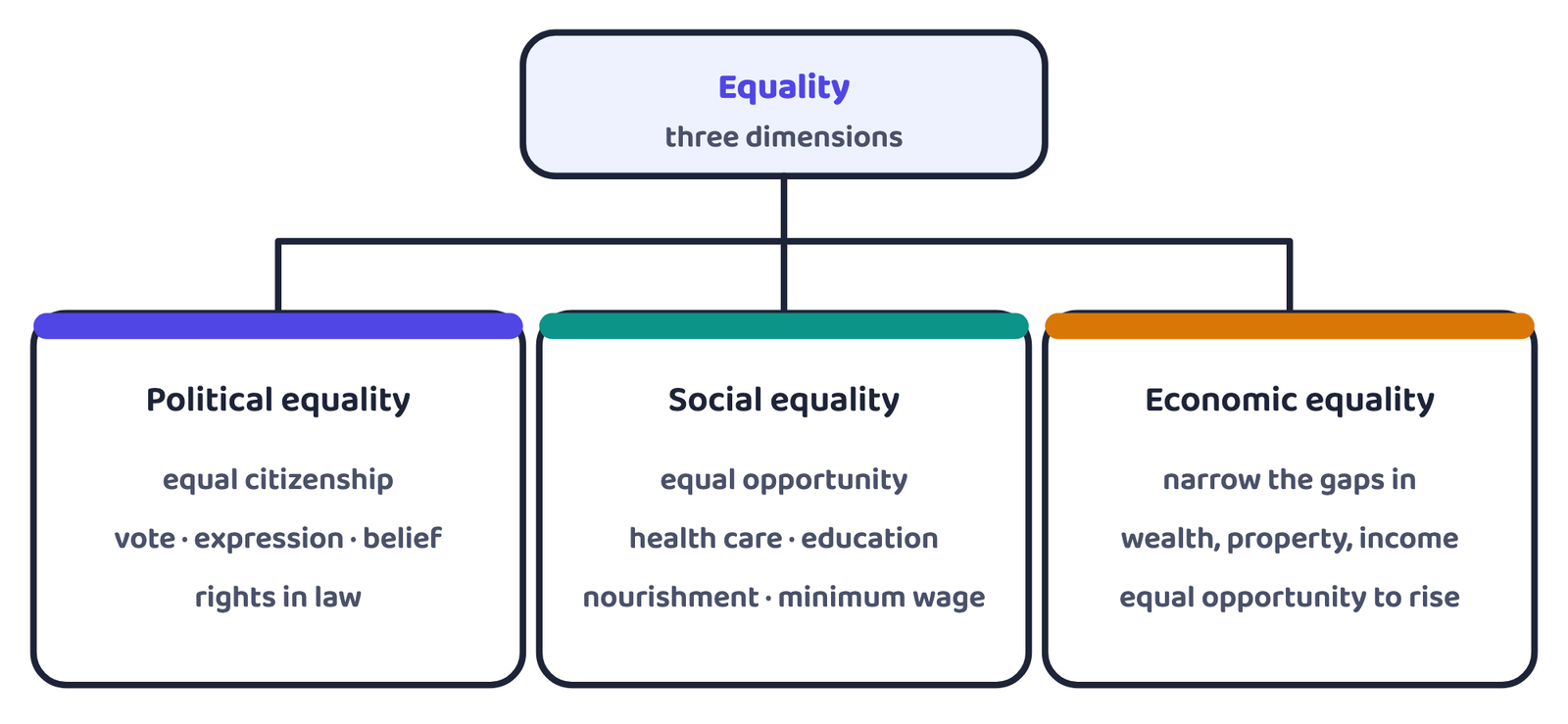
Different thinkers and ideologies have picked out three main dimensions of equality, political, social and economic, and a genuinely just society has to work on all three together.
Political Equality
In democratic societies, political equality normally means granting equal citizenship to all members of the state, the right to vote, freedom of expression, movement and association, and freedom of belief. These are legal rights, guaranteed by the constitution and the law. But considerable inequality can still exist even in countries that grant everyone equal rights, because people’s access to social and economic resources is not equal, which is exactly why demands for equal opportunity, or “a level playing field”, keep coming up. Political equality is an important component of a just society, but it is not enough on its own.
Social Equality
Political equality is a necessary first step, but it needs to be supplemented by equality of opportunity, adequate health care, the opportunity for a good education, adequate nourishment and a minimum wage. Without these minimum conditions, it is very difficult for everyone to compete on equal terms, and a whole pool of potential talent simply goes to waste. In India, a special problem comes not only from a shortage of facilities but from customs, women in some communities do not enjoy equal rights of inheritance, or face social prohibitions on certain activities or on higher education. The state has a significant role in such matters: it should make policies to prevent discrimination or harassment of women in public places or employment, and provide incentives to open up education or certain professions to women. But social groups and individuals also have a role to play in raising awareness and supporting those who want to exercise their rights.
| Caste/community inequalities in higher education, urban India | Graduates per thousand persons |
|---|---|
| Scheduled Caste | 47 |
| Muslim | 61 |
| Hindu, Other Backward Classes | 86 |
| Scheduled Tribes | 109 |
| Christian | 237 |
| Sikh | 250 |
| Hindu, Upper Caste | 253 |
| Other Religions | 315 |
| ALL INDIA AVERAGE | 155 |
Source: National Sample Survey Organisation (NSSO), 55th round survey, 1999-2000. You do not need to memorise these figures: the book asks whether such large differences between communities could have happened by chance, or whether they point to the working of the caste system and other factors.
Economic Equality
Economic inequality exists in a society when there are significant differences in wealth, property or income between individuals or classes. It can be measured in two ways, the relative gap between the richest and poorest groups, or the number of people living below the poverty line. Absolute equality of wealth or income has probably never existed in any society; most democracies instead try to provide equal opportunity, so that people with talent and determination at least get the chance to improve their condition.
Inequality that stays entrenched across generations is more dangerous than any other kind. When one class keeps enjoying wealth and power generation after generation while another stays poor, the society splits into rigid classes, which can build up resentment and even violence over time. And the power the wealthy classes hold makes such a society harder to reform.
Four ideologies that read equality differently
Feminism
A political doctrine of equal rights for women and men. Feminists trace inequality between men and women to patriarchy, a social, economic and cultural system that values men above women. They separate “sex” (a biological, inborn difference) from “gender” (the social role assigned to each sex), the fact that only women can bear children is biological, but that does not mean only women must raise children afterwards. Patriarchy also produces a division of labour in which women are made responsible for “private” and “domestic” matters and men for work in the “public” domain. Feminists point out that most women are in fact active in the public domain too, working outside the home while still being solely responsible for housework, which they call the “double burden”; yet women are given little or no say in decisions taken in the public domain. Feminists hold that this public/private distinction and all forms of gender inequality can and should be eliminated.
Marxism
The 19th-century thinker Marx traced entrenched inequality to the private ownership of key economic resources, oil, land, forests and other property. Private ownership does not just make the owning class wealthy, it hands them political power too, which can threaten democratic government. Marxists and socialists feel that economic inequality supports other forms of social inequality, such as differences of rank or privilege. The Marxist answer: go beyond equal opportunity and bring essential resources under public control.
Liberalism
Liberals treat competition as the fairest and most efficient way to distribute resources and rewards. The state may need to step in to guarantee a minimum standard of living and equal opportunity, but that alone cannot deliver equality and justice. As long as competition is open and free, inequalities are unlikely to become entrenched. For example, entry to professional courses is highly competitive, and the government and the courts have stepped in from time to time to regulate institutions and entrance tests so that everybody gets a fair and equal chance; some may still not get admission, but it is considered a fair way of distributing limited seats. Unlike socialists, liberals do not think political, social and economic inequalities are necessarily linked, each sphere should be tackled on its own terms. The problem for liberals is not inequality as such, but unjust and entrenched inequalities which prevent individuals from developing their capabilities.
Socialism
A response to the inequalities produced by industrial capitalism. Not opposed to markets altogether, but favours government regulation in key areas like education and health care. The Indian socialist thinker Rammanohar Lohia identified 5 inequalities, man-woman, skin colour, caste, colonial rule of some countries over others, and economic, to be fought simultaneously. In his time socialists commonly argued that class inequality was the only form worth struggling against; Lohia argued instead that each inequality had independent roots and had to be fought separately and simultaneously, so the five struggles were five revolutions. He added 2 more revolutions, for civil liberties and for non-violence, together the “Sapta Kranti” (Seven Revolutions).
Patriarchy is a social, economic and cultural system that gives men greater importance and power than women, resting on the assumption that men and women are different by nature.
Lohia’s 7 revolutions = 5 (man-woman, colour, caste, colonial rule, economic) + 2 (civil liberties, non-violence)
The name “Sapta Kranti” is itself examinable, remember the five inequalities and the two extra revolutions as two separate lists.
3.4How Can We Promote Equality?
The book sets out three steps for turning the ideal of equality into practice.
Establishing Formal Equality
The first step is ending the formal system of inequality and privilege. Around the world, custom and law once denied the poor the vote, kept women out of many professions, and in India confined the “lower” castes to manual labour. Our Constitution prohibits discrimination on grounds of religion, race, caste, sex or place of birth, and abolishes untouchability, this is formal equality in practice.
Equality Through Differential Treatment
Formal equality is necessary but not sufficient. Sometimes people must be treated differently precisely so that they can actually enjoy equal rights, disabled people may reasonably ask for ramps in public buildings, and women working night shifts in call centres may need special protection during their commute. These are not violations of equality, they are ways of enhancing it.
Affirmative Action
Affirmative Action rests on the idea that establishing formal equality by law is not enough on its own, so some positive steps, such as scholarships or reserved seats, are needed to correct the cumulative effect of past inequality.
Arguments for
- Some groups have been victims of social prejudice and exclusion in the past
- They cannot immediately compete on equal terms
- Temporary, time-bound special help is needed
Arguments against
- It denies other sections their right to equal treatment
- Reservation is itself a form of discrimination (“reverse discrimination”)
- Distinctions by caste or colour can reinforce prejudice instead of removing it
India has adopted a policy of quotas and reserved seats in education and jobs, which has been a subject of considerable debate. The book resolves this debate with a distinction, an individual’s equal right to fair consideration for admission or a job, and equality as a guiding principle of state policy, the state’s responsibility to make disadvantaged groups genuinely able to compete. Both need to be kept in view together.
The book also shows why the debate matters in practice. A first-generation learner, whose parents and ancestors were illiterate, does not compete on the same terms as a student born into an educated family. In education and health care India has done far less for its deprived population than is their due: many poor children in rural areas or urban slums have little chance of attending school, their schools have little to offer compared with elite schools, and they cannot afford special coaching or the high fees of professional courses. So most theorists accept the goal of equal opportunity and contest the policies: should the state reserve seats, or provide special facilities that develop talents and skills from an early age? Should the deprived be identified by an economic criterion, or by the social inequalities arising from the caste system? Since differential treatment was part and parcel of the caste system and of apartheid, liberals are usually very wary of departing from the norm of identical treatment.
Questions on “identical treatment” versus “treating as equal” come up repeatedly. Identical treatment gives everyone the same thing; treating as equal keeps the goal of promoting equality even where that requires different treatment for different people, but every such difference in treatment still needs to be justified.
The 19th-century women’s movement demanded the vote, the right to a college degree and the right to work, the same rights men already had. But once women entered the job market, they realised that actually using these rights required extra facilities too, maternity leave and crèches at the workplace, without which they could not seriously compete for jobs or build a successful professional and personal life.
Differential treatment always needs checking, is it truly necessary to let a group enjoy the same rights as the rest of society? It must never create new structures of domination or become a tool for a dominant group to reassert its own privilege. Its only justification is promoting a just and egalitarian society.
- Equality means equal respect from shared humanity; it does not require identical treatment in every situation
- Natural inequality is assumed inborn, social inequality is created by society, but the line is often blurred
- Three dimensions: political (citizenship rights), social (opportunity, minimum conditions), economic (narrowing gaps in wealth and income)
- Feminism traces inequality to patriarchy, Marxism to private ownership, liberalism trusts competition, socialism (Lohia) gives us the Sapta Kranti
- Three ways to promote equality: formal equality (the Constitution), differential treatment (ramps, safety), affirmative action (reservation)
- The Indian Constitution bans discrimination on religion, race, caste, sex and place of birth, and abolishes untouchability
- Can I explain the difference between equality and identical treatment without looking?
- Can I name all three dimensions of equality, with one example each, from memory?
- Can I state the core argument of feminism, Marxism, liberalism and socialism in one sentence each?
- Can I give one argument for and one against affirmative action?
- Can I write out Lohia’s full Sapta Kranti list without looking?