
1 Introducing Nationalism
Ask people what nationalism means and you will usually hear about patriotism, national flags, and sacrificing for one’s country. The Republic Day parade in Delhi is a striking symbol of Indian nationalism: it shows off power and strength, but also India’s diversity, all at once. Yet the moment you try to pin down a single, widely accepted definition of nationalism, it slips away. That does not mean the effort should be abandoned. For the last two centuries, nationalism has been one of the most powerful forces shaping world history, so it has to be understood, even if it cannot be neatly defined.
Nationalism’s effects have never pointed in only one direction. It has inspired deep loyalty and deep hatred in equal measure; it has liberated people from oppressive rule, and it has caused wars and bitterness. In nineteenth-century Europe it unified small kingdoms into what are today Germany and Italy, and it founded many new states in Latin America. Along with the consolidation of state boundaries, local dialects and local loyalties were gradually consolidated into state loyalties and common languages, and the people of the new states acquired a new political identity based on membership of the nation-state. Barely a few decades later, the same force helped break up the Austro-Hungarian and Russian empires in early twentieth-century Europe, and the British, French, Dutch and Portuguese empires in Asia and Africa. The freedom struggles of India and other former colonies were, at their core, nationalist struggles for independent nation-states, free of foreign control.
The process of redrawing state boundaries continues to take place. Since 1960, even apparently stable nation-states have been confronted by nationalist demands, which may include demands for separate statehood, from groups such as the Quebecois in Canada, the Basques in northern Spain, the Kurds in Turkey and Iraq, and the Tamils in Sri Lanka, among others. What makes this interesting is that the same language of nationalism is used to pull in opposite directions: Arab nationalism hopes to unite Arab countries into a pan-Arab union, while movements like the Basques or the Kurds struggle to divide existing states. That contradiction is exactly what this chapter sets out to explore: what is a nation, why do people form nations, and why do claims to nationhood become claims to statehood?
2 What Makes a Nation?
A nation is not just any casual collection of people, but it is also different from a family, tribe or clan. In a family or tribe, members are linked by face-to-face relationships or by ties of descent that can be traced. Most members of a nation, on the other hand, will never meet each other in person and need not share any tie of descent. Yet nations exist, and people live in them and value them deeply.
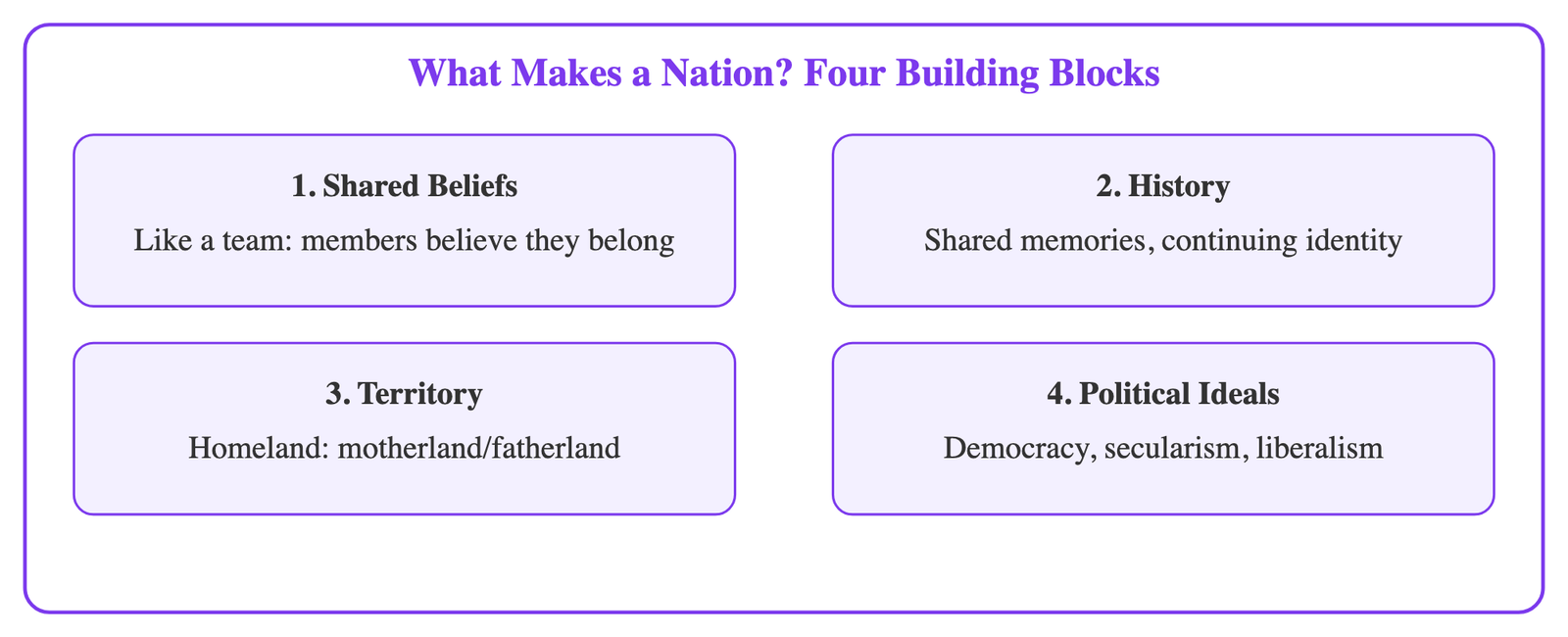
It is commonly assumed that nations are built on one shared feature, such as descent, language, religion or ethnicity. But no single feature of this kind is present in every nation. Canada has both English-speaking and French-speaking people; India has a huge number of languages spoken across its regions. So a common language is clearly not essential. Many nations do not share a common religion either. So what does make a nation? A nation is, to a large extent, an “imagined” community, held together by the collective beliefs, aspirations and imaginations of its members. The textbook identifies four building blocks for this idea, and then raises a fifth question: is a shared cultural identity enough on its own?
Pointing to India’s civilisational continuity as the historical basis of the Indian nation, Nehru wrote: “Though outwardly there was diversity and infinite variety among the people, everywhere there was that tremendous impress of oneness, which held all of us together in ages past, whatever political fate or misfortune had befallen us.”
Many people believe that a shared political vision is not enough, and that a nation also needs a shared cultural identity, such as a common language or common descent. The textbook treats this as dangerous for democracy, for two reasons. First, every major religion in the world is internally diverse, containing many sects with differing interpretations of the same texts; ignoring these differences and forcing one religious identity on everyone risks building an authoritarian, oppressive society. Second, most societies are already culturally diverse; making one language or religion a condition for belonging will exclude some groups, restricting their religious liberty or disadvantaging those who do not speak the “national” language, which damages the very thing democracy values most: equal treatment and liberty for all. For both reasons, it is better to imagine the nation in political terms rather than cultural terms: citizens owe their loyalty to a set of values written into the country’s Constitution, not to any one religion, race or language.
3 National Self-Determination
Unlike other social groups, nations seek the right to govern themselves and decide their own future. This is called the right to self-determination. In claiming it, a nation seeks recognition from the international community as a distinct political entity or state. Most often these claims come from people who have lived together on a given land for a long time and share a sense of common identity, and in some cases they are linked to the desire to form a state in which the group’s culture is “protected if not privileged”.
In nineteenth-century Europe, the idea of “one culture, one state” began to gain acceptance, and the same idea was used again after the First World War when the Treaty of Versailles redrew state boundaries. This created several small, newly independent states, but it proved impossible to satisfy every demand for self-determination that was raised at the time. The human cost was heavy: redrawing boundaries forced the mass migration of millions of people from homes their families had lived in for generations, and many became victims of communal violence. Even after all this reorganisation, most of the newly created states still contained more than one ethnic or cultural community. These smaller communities became minorities, and were often disadvantaged. The only positive aspect of these developments was that political recognition was granted to various groups who saw themselves as distinct nations and wanted to govern themselves and determine their own future.
The same right was claimed again in the twentieth century by national liberation movements fighting colonial rule in Asia and Africa, who expected political independence to bring dignity, justice and prosperity. But once again it proved impossible to give every distinct cultural group its own state, and migration, border wars and violence have continued in the region as a result. This produces a real paradox: nation-states that themselves won independence through struggle now resist minorities within their own borders who raise the very same claim to self-determination. Because of this, more and more people have come to believe that the solution is not to create new states, but to make existing states more democratic and equal, so that people of different cultural and ethnic identities can live together as equal citizens. A nation-state that fails to respect the rights and cultural identity of its minorities will always struggle to earn their loyalty.
4 Case Study: The Basque Movement
Basque is a hilly, prosperous region of Spain, recognised by the Spanish government as an “autonomous” region within the Spanish federation. But leaders of the Basque Nationalist Movement are not satisfied with this autonomy and want a fully separate country, and supporters have used both constitutional and, until recently, violent means to press the demand. Basque culture and language are very different from Spanish, and today only one-third of Basque people understand their own language. The region’s hilly terrain sets it apart geographically, and ever since Roman times the Basque region has never fully surrendered its own systems of justice, administration and finance to Spanish rulers. The modern Basque Nationalist Movement began around the end of the nineteenth century, when Spanish rulers tried to abolish this unique arrangement. In the twentieth century, the Spanish dictator Franco cut the autonomy back further and even banned the Basque language in public places and at home. These repressive measures have since been withdrawn, but Basque movement leaders remain suspicious of the Spanish government and wary of “outsiders” entering their region; their opponents say Basque separatists are exploiting an issue that has already been resolved.
Basque shows that the demand for self-determination is not just a textbook debate; it is a live political question. Should every culturally distinct group have the right to its own state? Is Basque really a nation? There is no single settled answer, which is exactly why the next section looks at how democratic societies try to deal with this dilemma.
5 Nationalism and Pluralism
Once the idea of “one culture, one state” is abandoned, it becomes necessary to find ways for different cultures and communities to survive and flourish together within one country. Many democracies have introduced measures to recognise and protect the identity of minority communities for exactly this reason. The Indian Constitution has an elaborate set of provisions protecting religious, linguistic and cultural minorities.
Across different countries, the group rights that have been granted mainly take two forms: constitutional protection for a minority group’s language, culture and religion, and, in some cases, the right to representation as a group in legislatures and other state institutions. These rights are justified on the ground that they secure equal legal treatment while also protecting a group’s cultural identity. National identity, in this view, must be defined inclusively, recognising the importance and unique contribution of every cultural community.
Even where such recognition is granted, some groups may still demand separate statehood. This can look paradoxical in an age of globalisation, but nationalist aspirations continue to motivate many groups regardless. Considerable generosity and skill is needed for countries to deal with such demands in a democratic manner. Because of this, the right to national self-determination has been reinterpreted: it is no longer understood as an automatic right to independent statehood for every group that sees itself as a distinct nation, since that would be both impossible and probably undesirable, likely creating states too small to be economically or politically viable and multiplying the problem of minorities all over again. Instead, it now means granting certain democratic rights to a nationality within an existing state. Every person carries many identities at once, such as gender, caste, religion, language and region, and can be proud of all of them together. In a democracy, a citizen’s political identity should have room for all of these; it would be dangerous to let intolerant, homogenising forms of nationalism take root.
The CBSE curriculum for 2026-27 adds a short reading on “Multiculturalism” to this chapter (Annexure, Additional Reference Material, Class XI). Multiculturalism, in the general sense, is the coexistence of people of different religions, cultural groups and communities in all countries of the globe. It originated in the 1970s with a counter-culturalism and human rights movement, in opposition to the homogenisation of other cultures in favour of the white culture of America and Europe. It broadly comprises the principles of both “acceptance” and “reverence”, and expects all countries to give equal acceptance and reverence to cultural groups. In the Indian context, multiculturalism is identified with the notion of the “Salad Bowl”, advocated by the social scientist Ashish Nandy: different cultural groups within a nation maintain their identity in their own distinct forms. CBSE states that this added material is for classroom transaction and will not be assessed in the Board examination.
6 Tagore’s Critique of Nationalism
Tagore opposed colonial rule and stood for India’s right to independence. He felt that the British administration of the colonies had no place for “upholding of dignity of human relationships”, an idea otherwise cherished in British civilisation. But he was also a sharp critic of the narrow nationalism he called “patriotism”. He wrote: “Patriotism cannot be our final spiritual shelter; my refuge is humanity. I will not buy glass for the price of diamonds, and I will never allow patriotism to triumph over humanity as long as I live.” Tagore drew a clear line between opposing Western imperialism and rejecting Western civilisation: Indians should stay rooted in their own culture and heritage, but should not resist learning freely from the outside world. He feared that rejecting “the West” in the name of Indian tradition could easily turn into hostility toward influences that have been present in India, including Christianity, Judaism, Zoroastrianism and Islam.
Tagore’s warning still matters today: wanting a national identity is entirely legitimate, but the moment it turns intolerant and demands one uniform culture from everyone, that same nationalism becomes a threat to both democracy and humanity.
- Nationalism has both built nation-states (Germany, Italy) and broken up empires (Austria-Hungary, Russia, British and French colonies)
- Four building blocks of a nation: shared beliefs, history, territory, shared political ideals; no single common language, religion or descent is required
- Making a shared cultural identity the only basis for nationhood is dangerous, both because religions are internally diverse and because most societies are culturally mixed
- After the Treaty of Versailles, “one culture, one state” was tried, but at a heavy human cost, and the minority problem still remained
- Basque movement: an autonomous region that still demands full independence, with a history of repression under Franco
- The modern solution is not more new states but making existing states more democratic and inclusive
- CBSE added reading, multiculturalism: acceptance and reverence for all cultural groups; in India the “Salad Bowl” notion (Ashish Nandy)
- Tagore: patriotism cannot rank above humanity; narrow nationalism is a real danger
- Can I list all four building blocks of a nation, each with its own example?
- Do I remember both reasons why a shared cultural identity alone is dangerous for democracy?
- Can I trace the link from the Treaty of Versailles to its consequences?
- Do I know the key Basque facts (one-third understand the language, Franco’s repression)?
- Can I state Tagore’s quote and his argument accurately?