
- The difference between absolute and relative humidity, and why it matters for weather
- What actually has to happen in the air for condensation to take place
- How to tell dew, frost, fog, mist and smog apart by the conditions that form each one
- The four basic cloud types, how to identify them, and what their combinations are called
- The difference between rainfall, snowfall, sleet and hail
- Why mountains create rain on one side and deserts on the other
1Humidity: Water Vapour in the Air
The air around you is never completely dry. It always carries some water vapour, varying from as little as 0% to as much as 4% of the atmosphere’s volume, and this small, invisible share of the air controls an enormous amount of the weather you actually experience: whether the day feels sticky or crisp, whether dew forms overnight, whether clouds build up by afternoon. Water enters the atmosphere from water bodies through evaporation and from plants through transpiration, and it keeps moving in a continuous exchange between the atmosphere, the oceans and the continents.
Humidity is the water vapour present in the air.
Absolute humidity is the actual amount of water vapour present in the atmosphere. It is the weight of water vapour per unit volume of air, expressed in grams per cubic metre. The air’s capacity to hold water vapour depends entirely on its temperature, so absolute humidity differs from place to place.
Relative humidity is the percentage of moisture present in the atmosphere compared to its full moisture-holding capacity at that same temperature. As air temperature changes, its capacity to retain moisture changes too, so relative humidity is always changing with it. It is greater over the oceans and least over the continents.
Absolute humidity
- The actual weight of water vapour present
- Measured in grams per cubic metre
- Depends only on how much vapour is actually there
Relative humidity
- A percentage of the air’s full capacity
- Has no fixed unit, expressed as %
- Changes even without adding or removing vapour, just by changing temperature
Saturated air is air that contains moisture to its full capacity at a given temperature. It cannot hold even a trace of additional moisture at that temperature.
Dew point is the temperature at which saturation occurs in a given sample of air.
“Differentiate between absolute and relative humidity” is a standard short-answer question from this chapter. Keep the answer to exactly the two points above: what each one measures, and what unit (or lack of one) it uses.
2Evaporation and Condensation
The amount of water vapour in the atmosphere is constantly being added to or withdrawn from, and these two processes are exactly opposite to each other.
Evaporation is the process by which water is transformed from the liquid to the gaseous state. Heat is the main cause of evaporation.
Latent heat of vaporisation is the amount of heat energy required to convert a unit mass of a liquid into vapour without any change in its temperature.
Rise in temperature
A warmer parcel of air can absorb and hold more moisture, so evaporation increases.
Low moisture content
If the air is already dry, it has a greater ability to absorb and retain more moisture.
Movement of air
Moving air replaces the saturated layer near the surface with unsaturated air, so evaporation keeps going.
Condensation is the transformation of water vapour into water. It is caused by the loss of heat, and it depends on the amount of cooling and the relative humidity of the air.
In free air, condensation results from cooling around very small particles called hygroscopic condensation nuclei. Particles of dust, smoke and salt from the ocean are particularly good nuclei because they readily absorb water.
Condensation can also happen when moist air comes in contact with a colder object, or when the air’s temperature is close to its dew point. Condensation is influenced by the volume of air, temperature, pressure and humidity. It takes place under three conditions:
Out of all three conditions above, the book singles out one as the most favourable condition for condensation overall: a decrease in air temperature. If a question only wants one answer, this is it.
3Forms of Condensation
Once condensation has taken place, the moisture in the atmosphere settles into one of a few recognisable forms: dew, frost, fog or clouds. Which one you get depends mainly on temperature and location, and condensation can take place whether the dew point is above or below the freezing point.
Dew
- Forms as water droplets on cold solid surfaces (stones, grass, leaves), not on nuclei in the air
- Needs clear sky, calm air, high relative humidity, cold and long nights
- Dew point must be above the freezing point
Frost
- Forms on cold surfaces when condensation happens below freezing point
- Excess moisture deposits as minute ice crystals, not water droplets
- Same ideal conditions as dew, but air temperature must be at or below the freezing point
Fog
- Forms when a large-moisture air mass cools suddenly, condensing on fine dust particles near the ground
- A cloud with its base at or very near the surface
- Cuts horizontal visibility to under 1 km
- Drier than mist; common where warm currents of air meet cold currents
Mist
- Same process, but each nucleus carries a thicker layer of moisture than in fog
- Common over mountains, where rising warm air meets a cold slope
- Limits visibility to 1-2 km, so it reduces visibility less than fog
Students mix up fog and mist as if they were the same thing with different names. They are not: mist actually carries more moisture per nucleus than fog, which is why fog is the drier and denser of the two, and why fog cuts visibility further than mist does.
Smog = Smoke + Fog
When smoke from urban and industrial centres mixes with fog, the result is called smog. The extra smoke particles act as more condensation nuclei, which is exactly why fog and smog are worse near cities and factories.
4Clouds
A cloud is a mass of minute water droplets or tiny ice crystals, formed by the condensation of water vapour in free air at considerable elevation. Because clouds form at different heights, they take on very different shapes.
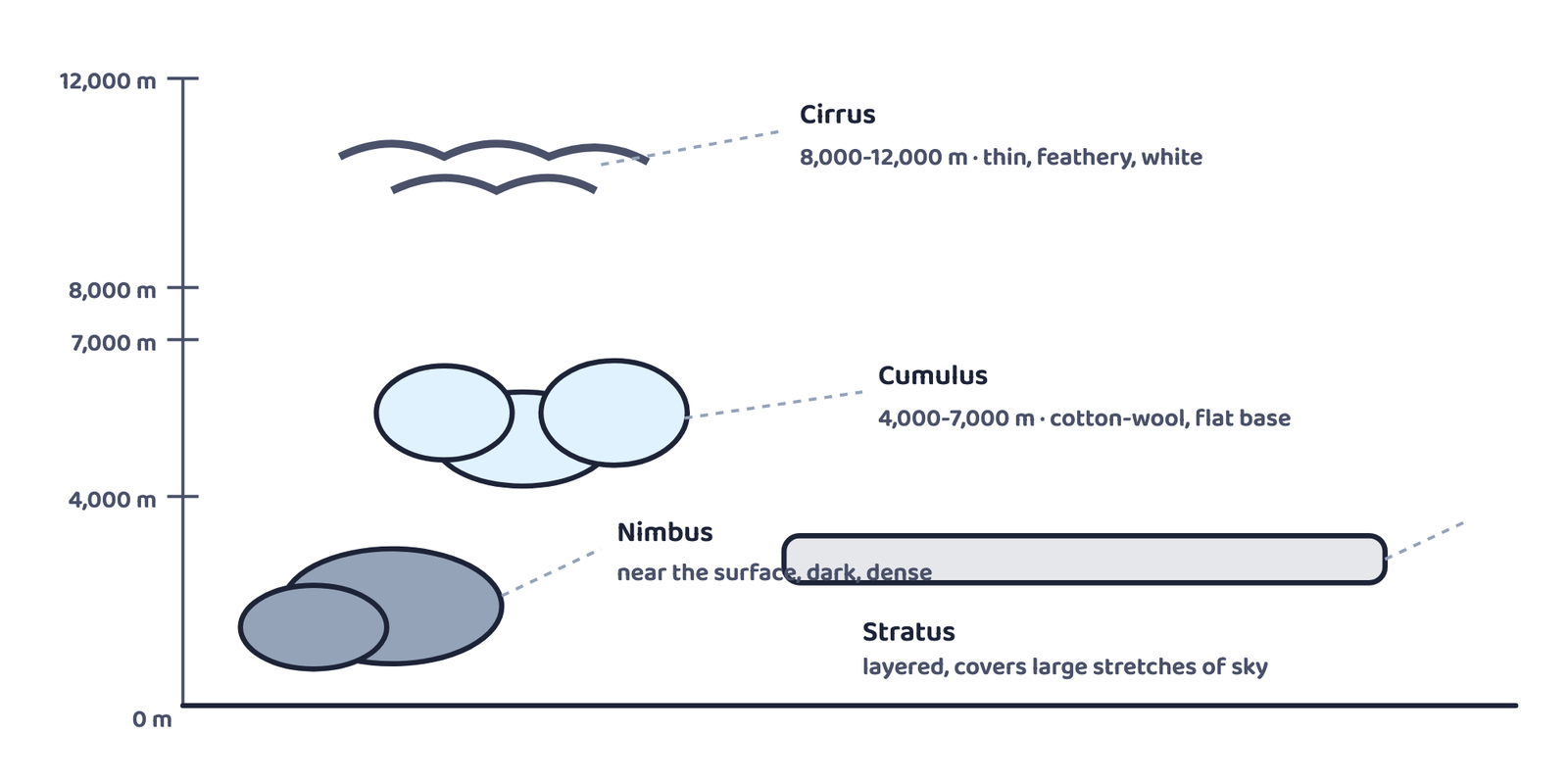
Clouds are grouped, by their height, expanse, density and transparency, into four basic types.
Cirrus
8,000-12,000 m. Thin and detached, with a feathery appearance. Always white.
Cumulus
4,000-7,000 m. Look like cotton wool, seen scattered in patches. Have a flat base.
Stratus
Layered clouds covering large portions of the sky. Formed by loss of heat, or by air masses of different temperatures mixing.
Nimbus
Black or dark grey, form at middle levels or very near the surface. Dense, shapeless, and opaque to the sun’s rays.
A combination of these four basic types gives rise to further named clouds:
| Group | Clouds |
|---|---|
| High clouds | Cirrus, cirrostratus, cirrocumulus |
| Middle clouds | Altostratus, altocumulus |
| Low clouds | Stratocumulus, nimbostratus |
| Clouds with extensive vertical development | Cumulus, cumulonimbus |
5Precipitation
Continuous condensation in free air lets condensed particles grow in size. Once the air’s resistance can no longer hold them against gravity, they fall to the earth’s surface. This release of moisture, after condensation, is called precipitation. It may be in liquid or solid form.
| Form | What it is |
|---|---|
| Rainfall | Precipitation in the form of water |
| Snowfall | Precipitation as fine flakes of snow when temperature is below 0°C; moisture is released as hexagonal crystals, which form the flakes |
| Sleet | Frozen raindrops and refrozen melted snow-water; raindrops leaving a warmer air layer meet a colder layer near the ground, solidify, and reach the ground as small ice pellets, no bigger than the raindrops they formed from |
| Hailstones | Small rounded solid pieces of ice, formed when raindrops pass through colder layers and solidify; built up in several concentric layers of ice |
Sleet and hail are both limited in occurrence and sporadic in both time and space; rain and snow are the main forms of precipitation.
Sleet and hail are the two forms of precipitation students confuse most. Sleet is simply frozen rain, no bigger than a raindrop. Hail is built up in layers as it is carried up and down inside a storm cloud, which is why hailstones show concentric rings of ice.
6Types of Rainfall and World Distribution
On the basis of how it forms, rainfall is classified into three main types.
Convectional rain
Heated air becomes light and rises in convection currents, expands, cools and condenses into cumulus clouds. Heavy rain with thunder and lightning, but it does not last long. Common in summer and in equatorial regions and continental interiors.
Orographic (relief) rain
Saturated air is forced to rise over a mountain, expands, cools and condenses. The windward slope receives the heaviest rain; the leeward slope stays dry. Orographic rain is also called relief rain.
Cyclonic (frontal) rain
Associated with extratropical cyclones, covered in the chapter on Atmospheric Circulation and Weather Systems. The same principle of rising, cooling, saturated air applies.
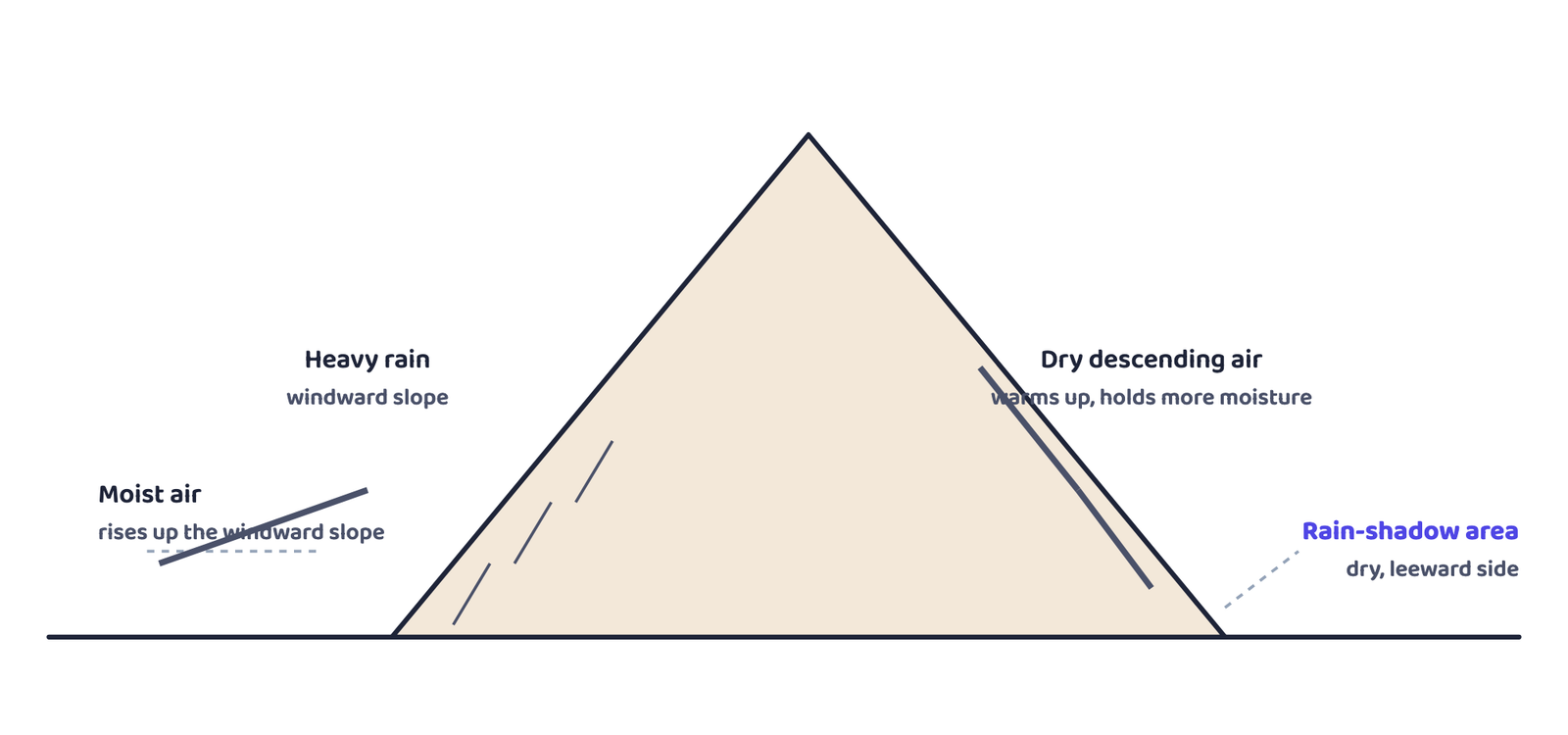
The area on the leeward side of a mountain, which receives little rainfall because the descending air has already lost its moisture and is now warming up, is called the rain-shadow area.
6.1 World distribution of rainfall
Different places on earth receive very different amounts of rainfall across a year, and across seasons.
- Rainfall decreases steadily as you move from the equator towards the poles
- Coastal areas receive more rainfall than continental interiors
- Oceans receive more rainfall than landmasses, because they are the bigger source of water for evaporation
- Between 35°-40°N and S of the equator, rain is heavier on the eastern coasts, decreasing towards the west
- Between 45°-65°N and S, the westerlies bring rain first to the western margins of continents, decreasing towards the east
- Wherever mountains run parallel to a coast, rain is greater on the windward coastal plain and decreases towards the leeward side
In the same list of rainfall regimes, the book adds that the coastal areas of the continents receive a moderate amount of rainfall.
The seasonal spread of rainfall matters just as much as the total amount. The equatorial belt and the western parts of cool temperate regions receive their rain fairly evenly through the year, while many other regions get almost all of theirs in just one season.
- Absolute humidity is the actual weight of water vapour (g/m³); relative humidity is a percentage of the air’s full capacity at that temperature
- Evaporation needs heat; condensation needs loss of heat, and works best around hygroscopic nuclei such as dust, smoke and salt
- The single most favourable condition for condensation is a fall in air temperature
- Dew needs a dew point above freezing; frost needs the same conditions but with the air at or below freezing
- Fog is a ground-level cloud (visibility under 1 km); mist has more moisture per nucleus and less visibility loss (1-2 km); smog is fog plus smoke
- The four basic cloud types are cirrus, cumulus, stratus and nimbus: cirrus is the highest (8,000-12,000 m), cumulus forms at 4,000-7,000 m, nimbus forms at middle levels or very near the surface, and stratus is a layered cloud covering large portions of the sky
- Precipitation takes the form of rainfall, snowfall, sleet or hail, depending mainly on temperature
- Rainfall is convectional (heated air rises), orographic or relief (forced up a mountain, leaving a dry rain-shadow on the leeward side) or cyclonic/frontal (from extratropical cyclones)
- Rainfall generally decreases from the equator to the poles, is greater over oceans than land, and is heavier on whichever coast faces the prevailing wind
- 1 markConsidering its effect on weather and human life, which of the following is the most important constituent of the atmosphere?
(a) Water vapour(b) Nitrogen(c) Dust particles(d) Oxygen - 1 markWhich process is responsible for transforming a liquid into vapour?
(a) Condensation(b) Transpiration(c) Evaporation(d) Precipitation - 1 markAir that contains moisture to its full capacity at a given temperature is called:
(a) Relative humidity(b) Specific humidity(c) Absolute humidity(d) Saturated air - 1 markWhich of these is the highest cloud in the sky?
(a) Cirrus(b) Stratus(c) Nimbus(d) Cumulus - 1 markAbsolute humidity is expressed in units of:
(a) Kilograms per litre(b) Grams per cubic metre(c) Grams per second(d) Millimetres per hour - 1 markWhich of the following is NOT one of the three forms in which water is present in the atmosphere?
(a) Gaseous(b) Liquid(c) Solid(d) Plasma - 1 markThe dry area on the leeward side of a mountain, left after orographic rainfall, is called:
(a) Convectional belt(b) Frontal zone(c) Rain-shadow area(d) Saturation zone - 1 markFog is best described as:
(a) A cloud with its base high up in the free air(b) A cloud with its base at or very near the ground(c) A layer of ice crystals in the stratosphere(d) A form of hail
Options for each item: (a) Both A and R are true, and R is the correct explanation of A; (b) Both A and R are true, but R is not the correct explanation of A; (c) A is true, but R is false; (d) A is false, but R is true.
Reason (R): As saturated air is forced to rise on the windward slope, it expands, cools, and its moisture condenses.
Reason (R): Absolute humidity is expressed in grams of water vapour per cubic metre of air.
Reason (R): Winds descending the leeward slope lose their moisture-holding capacity as they warm up.
Reason (R): Fog is a cloud with its base at or very near the ground, formed when the temperature of a moist air mass falls suddenly near the surface.
- 1 markDefine humidity.
- 1 markWhat is absolute humidity? State its unit.
- 1 markDefine dew point.
- 1 markWhat is the latent heat of vaporisation?
- 1 markName the four basic types of clouds.
- 1 markWhat is smog?
- 1 markDefine precipitation.
- 1 markWhat is a rain-shadow area?
- 2 marksName the main forms of precipitation.
- 3 marksExplain relative humidity.
- 2 marksWhy does the amount of water vapour decrease rapidly with an increase in altitude?
- 3 marksHow are clouds formed? Name their four basic types.
- 3 marksDifferentiate between sleet and hailstones.
- 2 marksWhat is the difference between fog and smog?
- 3 marksWhy do the leeward slopes of a mountain remain dry after orographic rainfall?
- 2 marksWhy is rainfall generally heavier over the oceans than over the continents?
- 5 marksDiscuss the salient features of the world distribution of precipitation.
- 5 marksWhat are the forms of condensation? Describe the process of dew and frost formation.
- 5 marksExplain the three main types of rainfall on the basis of their origin, giving the main characteristic of each.
- 5 marksWith the help of a labelled diagram, explain orographic rainfall and the formation of a rain-shadow area.