1 Position, Rest and Motion
Everything in nature is moving, from galaxies down to the dust dancing in a sunbeam. Such motion is far too complicated to study all at once, so scientists first study its simplest forms. You already know three of them: linear motion (in a straight line), circular motion and oscillatory motion. This chapter deals with the first and the last part of the second.
Before you can say anything about motion, you must be able to say where the object is. And “where” only means something if you first fix a point to measure from. That point is called the reference point.
Position of an object is its distance and direction from a fixed reference point, at a given instant of time.
Notice that distance alone is not enough. A shop 250 m away could be 250 m to your left or 250 m to your right. So the reference point is marked as the origin O on a straight line, and the two directions are shown with a plus sign and a minus sign. Positions to the right of O are usually taken as positive and those to the left as negative. You are free to pick any convenient point as the origin and either side as positive, but once you have picked, do not change it in the middle of a problem.
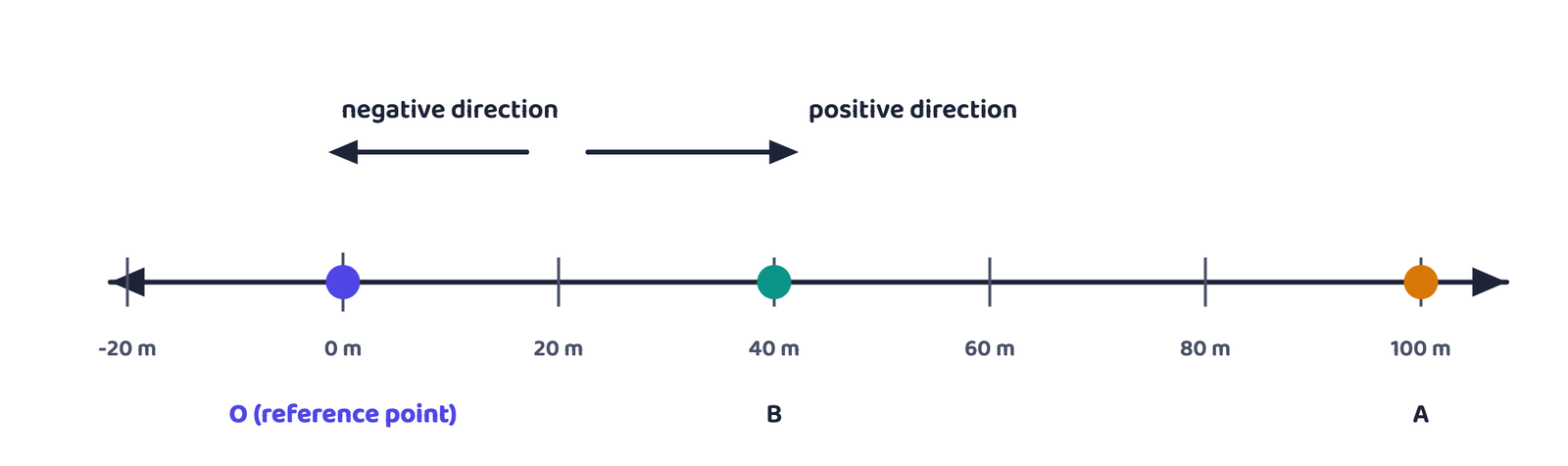
Once position is defined, rest and motion become easy to state. If the position of an object with respect to the reference point changes with time, the object is in motion. If it does not change, the object is at rest.
An instant of time is one single reading of a clock, like 4 s. A time interval is the gap between two readings, like the 6 s between 4 s and 10 s. Students mix these up and then divide by the wrong number.
2 Distance Travelled and Displacement
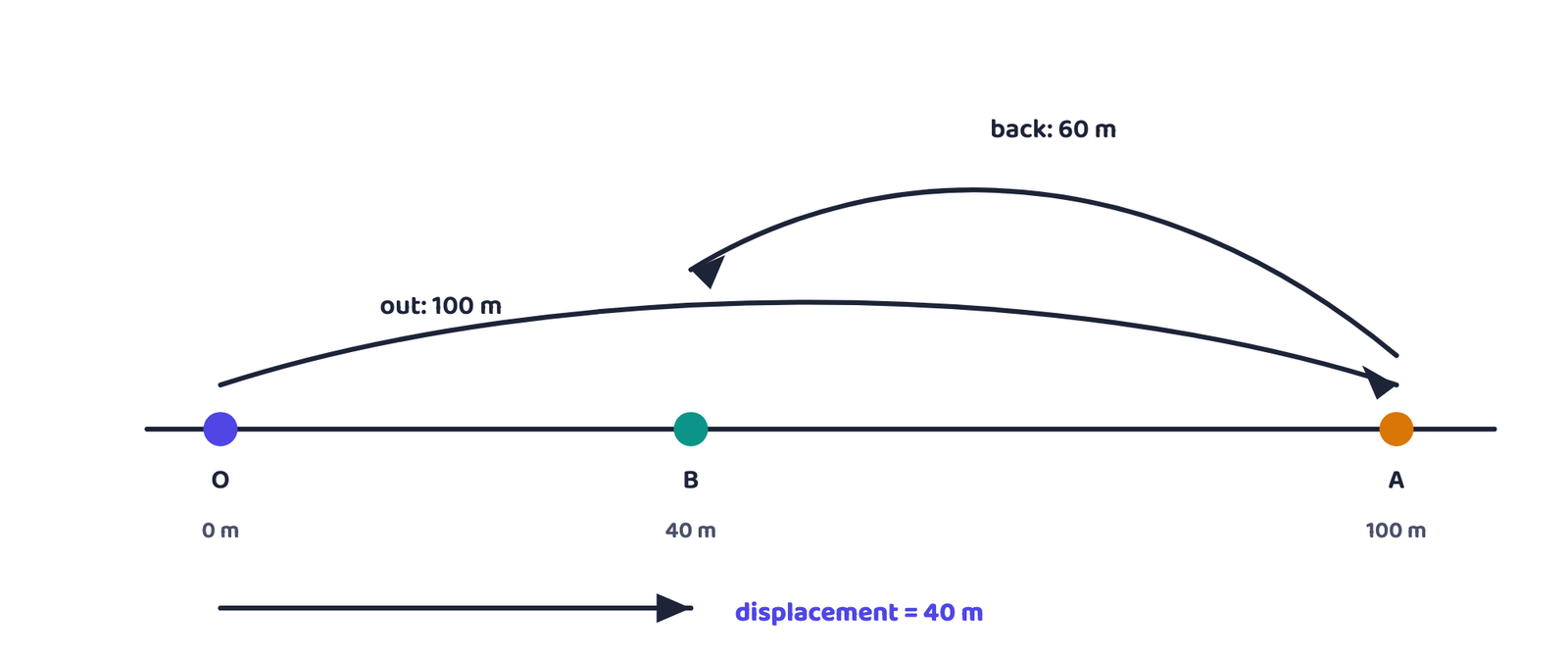
An athlete starts from O, runs 100 m to A, then turns around and runs back 60 m to B. Follow her feet and she has covered 100 m + 60 m = 160 m. But look at where she began and where she stopped: she has only shifted 40 m from O. Two different questions, two different quantities.
Total distance travelled is the whole length of the path actually covered by the object, whichever way it turned.
Displacement is the net change in the position of an object between two given instants of time. It is stated with both a magnitude and a direction.
| Point of difference | Total distance travelled | Displacement |
|---|---|---|
| What it measures | The whole path covered | Change of position, start to finish |
| Direction | Not needed | Must be stated |
| Can it be zero while the object moved? | No | Yes, if the object returns to its starting point |
| Which is larger | Distance is always greater than or equal to the magnitude of displacement | |
| SI unit | metre (m) | metre (m) |
The two become equal in one situation only: when the object moves in one direction and never turns back. The word magnitude that keeps appearing simply means the numerical value with its unit, kept apart from the direction.
Quantities that need only a numerical value, such as distance, time and speed, are called scalars. Quantities that need a direction as well, such as displacement, velocity and acceleration, are called vectors. You will study them properly in higher classes, but the split is exactly the one you have just seen.
The petrol your scooter burns depends on the distance travelled, never on the displacement. Ride 20 km out and 20 km back and the displacement is zero, but the tank is not full again. This exact reasoning is a favourite 2-mark question.
3 Average Speed and Average Velocity
Distance and displacement tell you how far. They say nothing about how quickly. For that you divide by the time taken.
Average speed is worked out from distance, so like distance it carries no direction. Average velocity is worked out from displacement, so it carries the direction of the displacement, written with a plus or a minus sign. Both are measured in metre per second, written or m/s, and in everyday life in .
km/h to m/s: multiply by 5/18. m/s to km/h: multiply by 18/5.
So 36 km/h is 10 m/s, 54 km/h is 15 m/s and 72 km/h is 20 m/s. Learn these three pairs, because the numericals in this chapter use them again and again.
An object is in uniform motion in a straight line if it covers equal distances in equal intervals of time, for every choice of time interval. If the distances covered in equal intervals are unequal, the motion is non-uniform.
There is a useful way to think about all of this. The ratio of a change in some quantity to the time taken for that change is called the rate of change. Average velocity, then, is just the average rate of change of position.
Given
Sarang swims one length of a 25 m pool and comes straight back, taking 50 s in all.
To find
Average speed and average velocity
Step 1. Total distance travelled = 25 m + 25 m = 50 m. Displacement = 0 m, because he finishes where he started.
Step 2. Average speed
Step 3. Average velocity
He was swimming hard the whole time, yet his average velocity is zero. That is the clearest possible demonstration of the difference between the two quantities.
The idea that speed is distance divided by time is not new in India. It appears in Aryabhata’s Aryabhatiya in the 5th century CE, and the 14th century text Ganitakaumudi sets this problem: two postmen 210 yojanas apart walk towards each other at 9 and 5 yojanas per day. Together they close 14 yojanas a day, so they meet after days, having walked 135 and 75 yojanas.
Everything above is an average over a time interval. Squeeze that interval smaller and smaller and you approach the velocity at one single instant, called the instantaneous velocity. That is roughly what your vehicle’s speedometer shows, while the direction the tyres point in gives the direction of that velocity.
4 Average Acceleration
When a bus pulls away from a stop you feel a jolt, and you feel another when it brakes. What you are feeling is the velocity changing. The quantity that measures how quickly velocity changes is acceleration.
Average acceleration of an object over a time interval is the change in its velocity divided by that time interval.
Speeding up
- Magnitude of velocity is increasing
- Acceleration points the same way as the velocity
- Comes out positive with the usual sign convention
Slowing down
- Magnitude of velocity is decreasing
- Acceleration points opposite to the velocity
- Comes out negative, which is what a minus sign in an answer means
Q. A bus moving at 36 km/h speeds up to 54 km/h in 10 s. Later the driver brakes and the bus stops in 5 s from 54 km/h. Find the acceleration in each case.
Speeding up: , ,
, in the direction of motion.
Braking: , ,
. The minus sign says the acceleration is opposite to the motion.
Acceleration is called constant when the velocity changes by equal amounts in equal intervals of time. A falling object is the standard example: its velocity reading goes 0, 9.8, 19.6, 29.4, 39.2 m/s at the end of each second, gaining exactly every second. That constant value is the acceleration produced by the Earth’s gravitational force and is written as g.
“Fast” and “accelerating” are not the same thing. A bus doing a steady 80 km/h on a straight highway has zero acceleration, because its velocity is not changing at all. Acceleration depends on how quickly velocity changes, not on how large it is.
5 Position-Time Graphs
Words and numbers are one way to describe motion. A graph is often better, because the shape of the line tells you the nature of the motion at a glance. To draw one you mark time along the X-axis, the other quantity along the Y-axis, choose a scale that uses the page well, plot the points and join them.
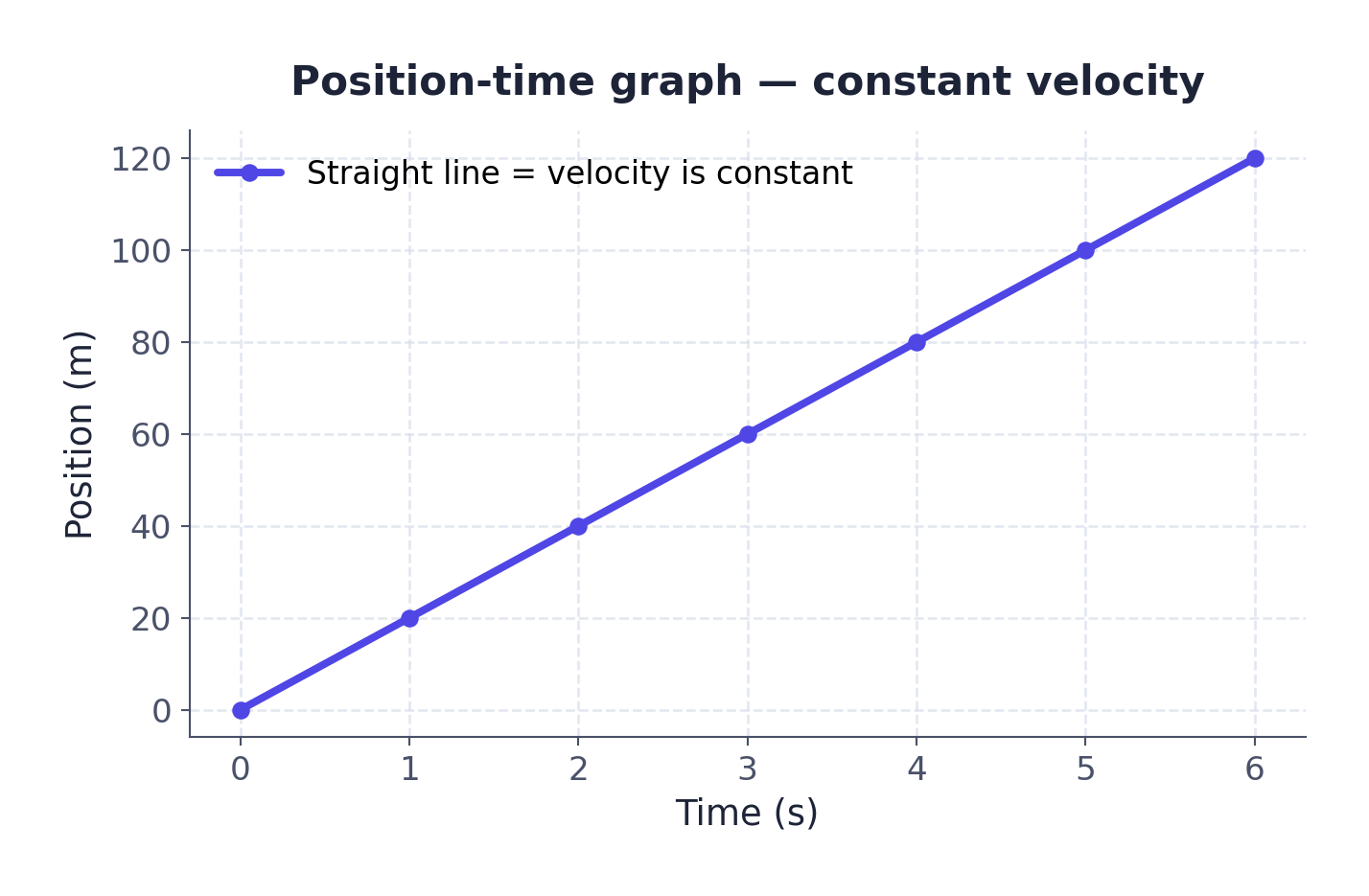
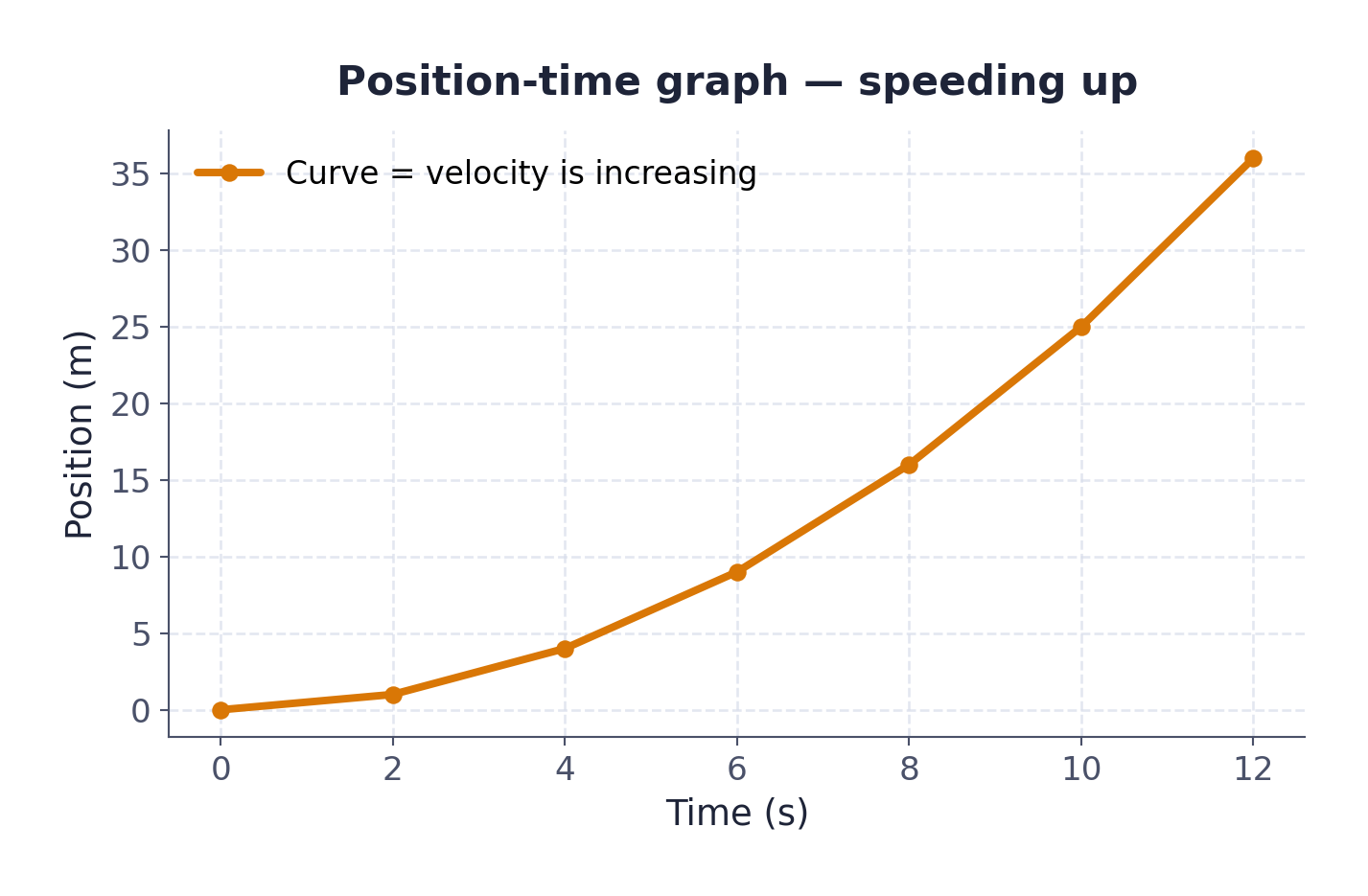
Compare the two. In Graph 1 the object covers 20 m in every second, so the displacements in equal time intervals are equal and the velocity is constant. In Graph 2 the displacement in each successive interval is larger than the last, so the velocity is increasing.
The slope of a line on a graph is its steepness. It gives the rate of change of the quantity on the Y-axis with respect to the quantity on the X-axis.
That single idea makes graphs powerful. On a position-time graph the Y-axis is position and the X-axis is time, so the slope is exactly change in position divided by time, which is the velocity. Reading Graph 1 between 2 s and 4 s:
✓ Read a position-time graph like this
- Straight sloping line: constant velocity
- Curve: velocity is changing, so there is acceleration
- Line parallel to the time axis: the object is at rest
- Steeper line: greater velocity
✗ Do not read it like this
- It is not a route map. It does not show the path taken
- A rising line does not mean the object is going uphill
- Do not compare steepness of two graphs drawn on different scales
6 Velocity-Time Graphs
Put velocity on the Y-axis instead and the same reading skills give you two new pieces of information.
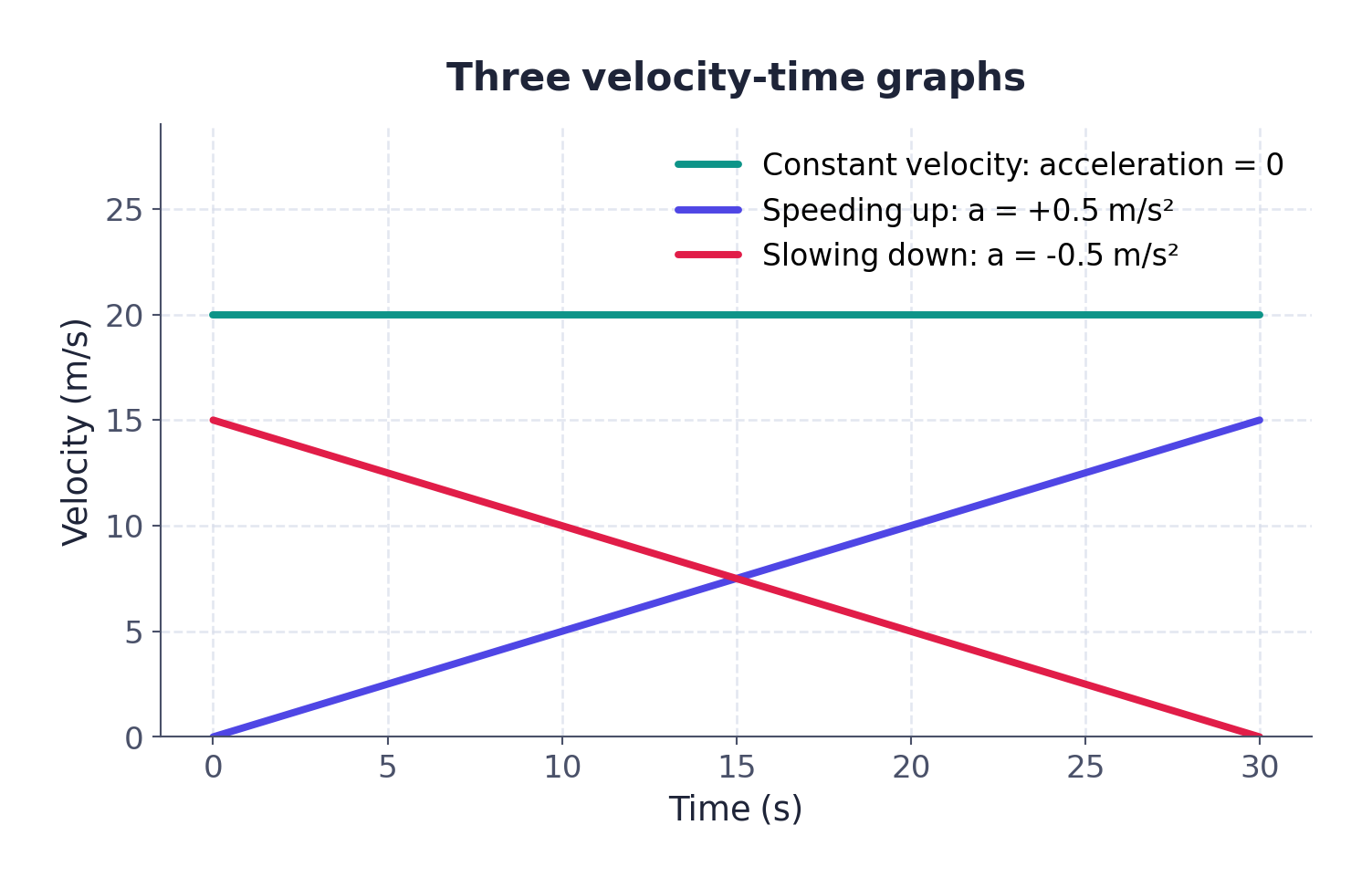
Since the Y-axis is now velocity, the slope of a velocity-time graph gives the acceleration. A flat line has zero slope, so acceleration is zero. The rising line climbs 5 m/s in 10 s, giving ; the falling line gives .
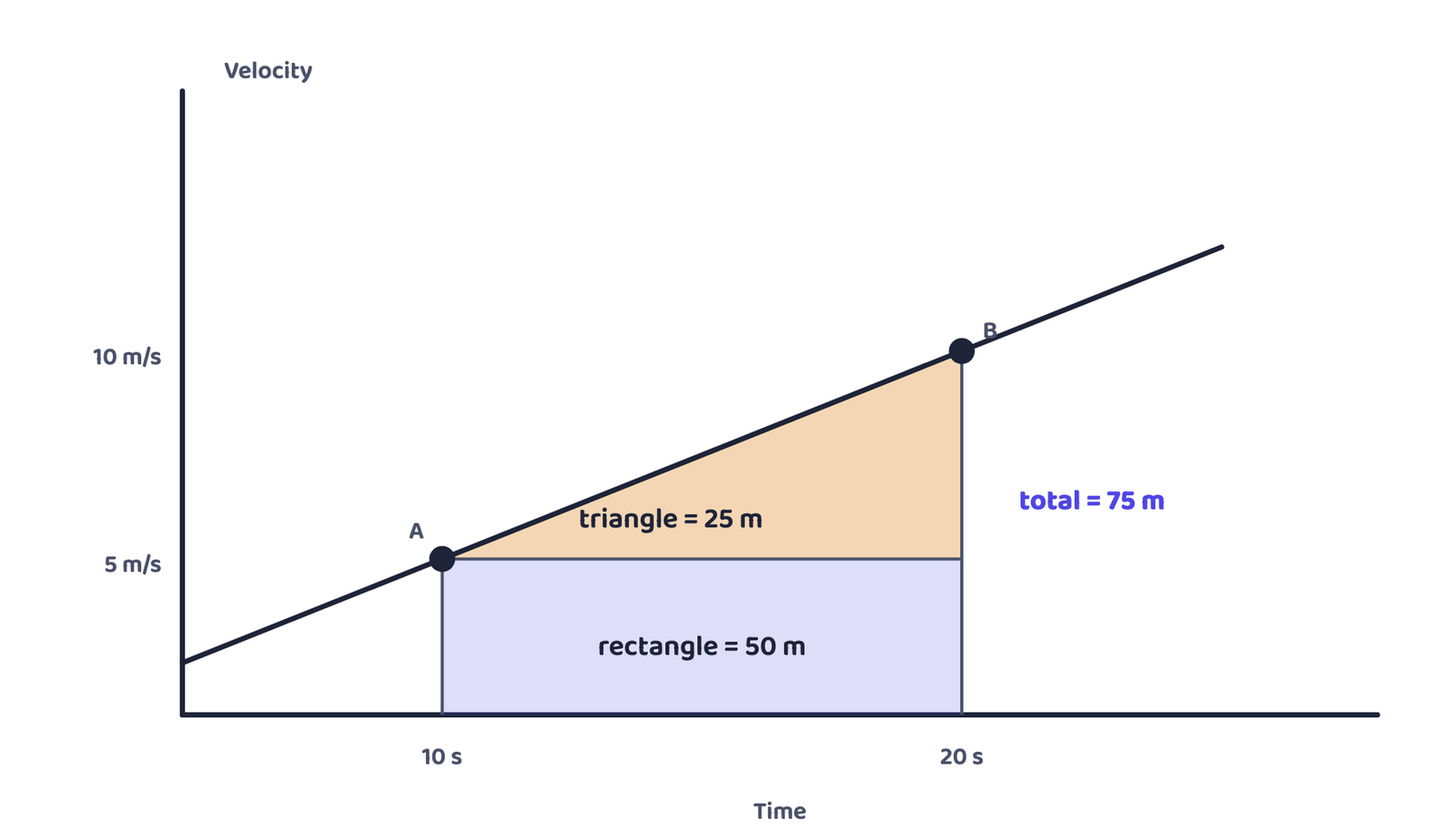
The second piece of information is new and is worth a full mark on its own: the area enclosed between the line and the time axis gives the displacement. For the flat line at 20 m/s over 6 s that area is a rectangle, so the displacement is m. When the line slopes, the area splits into a rectangle and a triangle.
7 The Three Equations of Motion
When the acceleration is constant, the graph work above can be turned into three formulas that solve almost every numerical in this chapter. They are called the kinematic equations.
Two more can be squeezed out of the same pair, and both save time in a numerical: , and , which is simply the area of a trapezium of parallel sides and and width .
Given
Brakes give , the car stops so , initial velocity 54 km/h = 15 m/s
To find
The distance covered before stopping
Time is not mentioned, so use .
28.1 m
Now double the speed to 108 km/h = 30 m/s: 112.5 m.
Doubling the speed did not double the stopping distance, it made it four times longer, because depends on . That one line of algebra is the whole argument for speed limits.
The real stopping distance is even longer, because the driver takes about half a second to react before touching the brake. It also grows on a wet road, with worn tyres and with a heavier vehicle. A “safe following distance” question is answered with these four factors plus the argument above.
8 Motion in a Plane: Uniform Circular Motion
A car overtaking another, a kicked football, a satellite going round the Earth: none of these stay on one straight line. Motion spread over a flat surface like this is called motion in two dimensions, or motion in a plane.
Take a child on a merry-go-round. Going once round a circle of radius , the distance travelled is the whole circumference , but the displacement is zero, because the child ends up exactly where they began. So over one full revolution taking time :
When an object moves along a circular path with constant speed, its motion is called uniform circular motion.
Now the surprising part. Watch an athlete run round a rectangular track: they change direction 4 times. On a hexagonal track, 6 times. Keep adding sides and the track becomes a circle, and the direction of the velocity is changing at every single instant. At any point that velocity points along the tangent to the circle, which is the straight line touching the circle at just that one point.
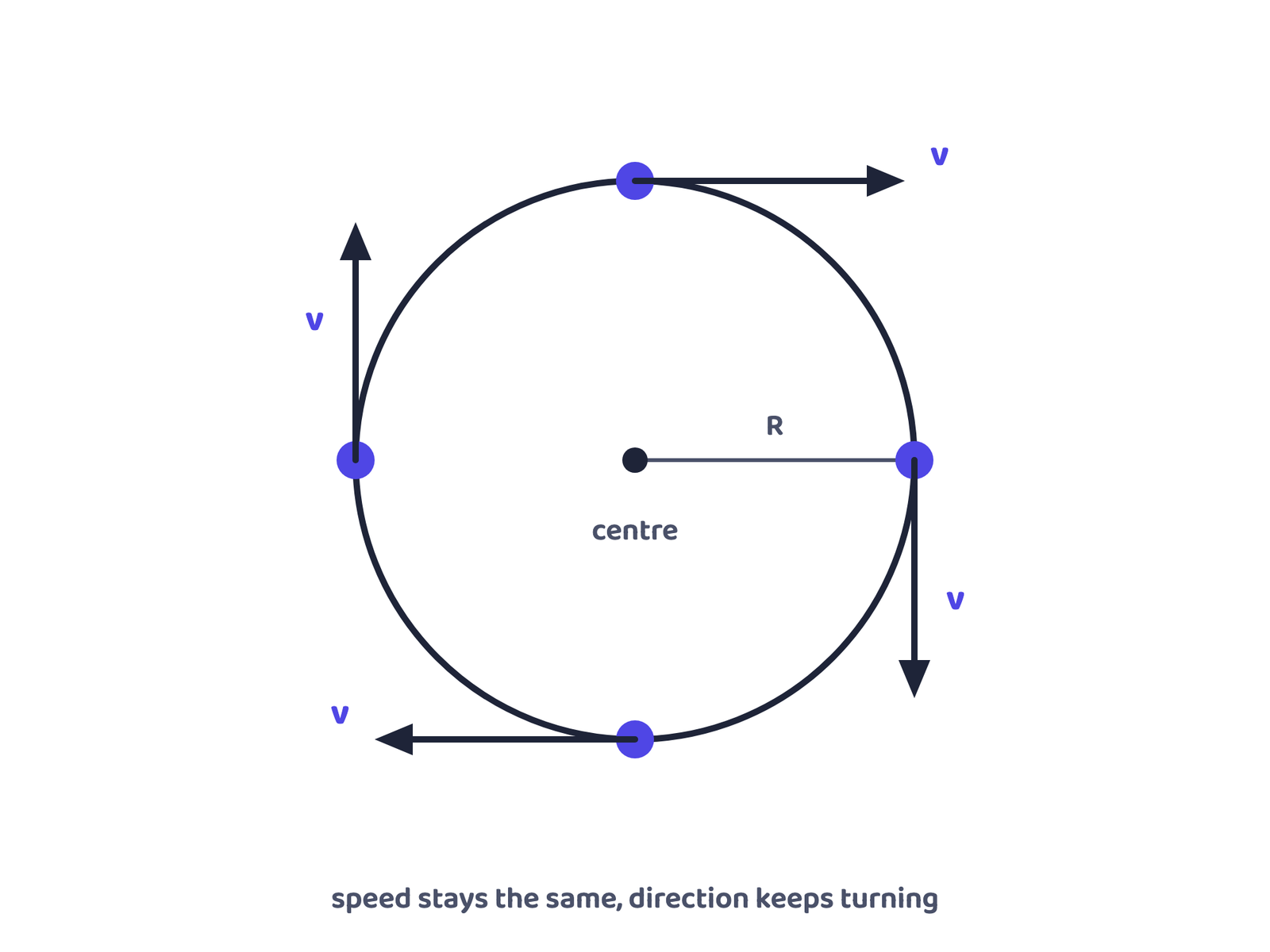
Velocity changes if its magnitude changes, or if its direction changes, or both. In uniform circular motion the magnitude never changes but the direction always does. So the motion is accelerated, even though the speedometer reading never moves. You can see the proof for yourself: spin a marble round the inside of a sticky-tape ring, then lift the ring away. The marble does not keep curving. It shoots off in a straight line, along the tangent it happened to be on.
An object can be accelerating without going any faster. Changing direction is enough.
the single idea to carry out of this chapter
In the real world a perfect circle at a perfectly steady speed almost never happens, so uniform circular motion is an idealised model. It is still worth learning, because it is the starting point for understanding planets going round the Sun and a bus taking a roundabout. Motion that also rises and falls, such as a car climbing a mountain road or a bird in flight, is called motion in three dimensions.
- Position needs a reference point, a distance and a direction. Motion means that position changes with time.
- Distance is the whole path covered; displacement is the straight shift from start to finish, and it can be zero.
- Average speed uses distance; average velocity uses displacement, so only velocity carries a direction.
- Acceleration measures how quickly velocity changes. Negative acceleration simply means it acts opposite to the motion.
- On a position-time graph, slope = velocity. Straight line means constant velocity, curve means acceleration, flat line means at rest.
- On a velocity-time graph, slope = acceleration and area under the line = displacement.
- For constant acceleration: , , .
- Stopping distance goes as , so doubling the speed makes it four times longer.
- In one revolution of a circle, distance = and displacement = 0.
- Uniform circular motion has constant speed but changing direction, so it is accelerated motion.
- 1 markDefine displacement.
- 1 markWrite the SI unit of acceleration.
- 1 markWhat does the slope of a velocity-time graph represent?
- 1 markConvert 72 km/h into m/s.
- 1 markWhat does a line parallel to the time axis on a position-time graph tell you?
- 1 markState the distance travelled by an object in one complete revolution of a circle of radius .
- 1 markName the quantity that is the average rate of change of position.
- 1 markGive one example of a body that has high speed but zero acceleration.
- 3 marksGive three points of difference between total distance travelled and displacement.
- 2 marksA girl riding a scooter finds her speedometer reading stays constant. Can her scooter still be accelerating? Explain.
- 2 marksThe fuel used by a vehicle depends on distance travelled or on displacement? Justify your answer.
- 3 marksMy father walks 250 m from home to a shop, comes back home for a bag, goes to the shop again and returns home. Find the total distance travelled and his displacement.
- 3 marksA student runs from the ground floor to the fourth floor of a school, then comes down to the second floor. Each floor is 3 m high. Find the total vertical distance travelled and the displacement.
- 3 marksA car starts from rest and its velocity reaches 24 m/s in 6 s. Find the average acceleration and the distance travelled in these 6 s.
- 3 marksA motorbike moving at 28 m/s stops after travelling 98 m under constant acceleration. Find the acceleration and the time taken.
- 3 marksYou drive 200 km north in 3 hours, then 200 km south in 2 hours. Find the average speed and the average velocity for the whole trip.
- 2 marksUnder what conditions is the magnitude of average velocity equal to the average speed?
- 3 marksA truck driver at 54 km/h slows to 36 km/h in 36 s. Find the distance he covers during this time, taking the acceleration as constant.
- 5 marksDerive the equation from the velocity-time graph of an object moving with constant acceleration.
- 5 marksA car starts from rest and accelerates uniformly to 20 m/s in 5 s, travels at 20 m/s for 10 s, then brakes uniformly and stops in 6 s. Find the total distance travelled.
- 5 marksA bus travelling at 36 km/h sees an obstacle 30 m ahead. The driver takes 0.5 s to react, then brakes with constant acceleration of magnitude 2.5 m/s². Will the bus stop in time? Show your working.
- 5 marksExplain why uniform circular motion is accelerated motion even though the speed is constant. Support your answer with the marble-and-ring activity.
- 5 marksRohan studies from 6:00 PM to 7:30 PM. For the tip of the minute hand of a wall clock of length 7 cm, find the distance travelled, the displacement, the speed and the velocity over this interval.
- 1 markWhat is the acceleration of the car during the first 2 minutes?
- 2 marksFind the displacement of the car in the first 2 minutes.
- 2 marksFind the total displacement over the whole 2 min 6 s, by treating the velocity-time graph as a rectangle plus a trapezium.
- 1 markThe magnitude of displacement of a moving object is:
(a) always equal to the distance(b) always greater than the distance
(c) less than or equal to the distance(d) never zero - 1 markThe area under a velocity-time graph gives:
(a) acceleration(b) displacement(c) speed(d) distance per unit time - 1 markA body moves 4 m east, then 3 m north. Its displacement is:
(a) 7 m(b) 1 m(c) 5 m(d) 12 m - 1 markWhich equation should be used when time is not given?
(a) (b) (c) (d) - 1 markIn uniform circular motion, the quantity that stays constant is the:
(a) velocity(b) speed(c) displacement(d) acceleration direction - 1 markA curved position-time graph indicates that the object is:
(a) at rest(b) moving with constant velocity(c) accelerating(d) moving backwards - 1 mark54 km/h expressed in m/s is:
(a) 10(b) 15(c) 18(d) 20
Choose: (a) both A and R true, R explains A; (b) both true, R does not explain A; (c) A true, R false; (d) A false, R true.
Reason (R): The direction of its velocity changes at every instant.
Reason (R): Displacement depends only on the starting and finishing positions.
Reason (R): Acceleration is the rate of change of velocity with time.