~35,000 years agoThe Lebombo Bone: 29 tally notches, among the earliest evidence of counting
Vedic eraSanskrit texts name powers of 10 up to 1012; the Ṛigveda uses powers of 10 for large quantities
628 CEBrahmagupta’s Brāhmasphuṭasiddhānta formally defines zero and gives rules for negative numbers (“debts”)
Learn by heartDefinition 1
Natural numbersN={1,2,3,4,…} are the counting numbers. They are closed under addition (the sum of two natural numbers is always natural) but not under subtraction (3−5 is not a natural number).
Rules for zero
a+0=a · a−0=a · a×0=0
Brahmagupta (628 CE) gave these three. He also wrote 0÷0=0, and that one is wrong: division by zero is not defined at all.
Learn by heartDefinition 2
IntegersZ={…,−2,−1,0,1,2,…} combine the natural numbers, zero, and the negative numbers.
Once negative numbers exist, every calculation needs a rule for what sign the answer carries. These five rules cover every case a paper can ask.
Operation
Rule for the sign
Example
Add, both signs the same
Add the two numbers and keep that common sign
5+4=9 (−5)+(−4)=−9
Add, signs different
Ignore the signs, subtract the smaller number from the bigger one, then give the answer the bigger number’s sign
8+(−3)=5 3+(−8)=−5
Subtract
Change the sign of the number being subtracted, then use the addition rules above
5−(−3)=5+3=8 (−5)−3=(−5)+(−3)=−8
Multiply or divide, both signs the same
The answer is positive
3×4=12 (−3)×(−4)=12 (−12)÷(−4)=3
Multiply or divide, signs different
The answer is negative
(−3)×4=−12 12÷(−4)=−3
Memory Trick
Same signs give +, different signs give −
That shortcut is for multiplying and dividing only. In addition the sign comes from the bigger number, which is why (−5)+4=−1 but (−5)×4=−20.
Common Mistake
Writing (−5)+(−4)=−1. Both numbers are negative, so they are added and the answer keeps the minus sign: −9. You only subtract when the two signs are different.
2Rational Numbers
Learn by heartDefinition 3
A rational number is any number expressible as qp, where p,q are integers and q=0. The set of rational numbers is denoted Q.
Real Numbers (R)
Rational (Q)p/q form; includes N, Z, fractions
IrrationalCannot be written as p/q, e.g. √2, π
Every rational number has infinitely many equivalent forms: −31=−62=−93. Its standard form is the one where p and q share no common factor other than 1 (they are co-prime).
Operation
Rule
Example
Equality
ba=dc exactly when ad=bc
32=96 since 2×9=3×6
Add or subtract, same denominator
ba±bc=ba±c
72+73=75
Add or subtract, different denominators
Take the LCM of the denominators first, or use ba±dc=bdad±bc
21+31=63+2=65
Multiply
ba×dc=bdac
32×75=2110
Divide
ba÷dc=ba×cd, with c=0
43÷52=43×25=815
Closure Property
Rational numbers are closed under addition, subtraction and multiplication, and under division too, as long as we never divide by zero. The result of any of these operations on two rationals is always another rational.
To place qp on the number line, divide the unit interval into q equal parts and count p parts from 0 (right if positive, left if negative).
0
1/2
1
3/2
2
Learn by heartDefinition 4
The absolute value∣x∣ of a rational number is its distance from 0, so ∣x∣≥0 always. The distance between two rationals a and b on the number line is ∣a−b∣.
Solved Example
Q. Find a rational number between 21 and 32.
Take the average: 221+32=263+4=127. Since 21<127<32, this works.
Did you know?
The averaging trick above never runs out: between any two rational numbers, however close, there is always another one. This property is called density, and it means there are infinitely many rational numbers between any two rationals.
3Irrational Numbers
Learn by heartDefinition 5
An irrational number cannot be written as qp for any integers p,q. Its decimal expansion never terminates and never repeats. Examples: 2, 3, π.
A unit square’s diagonal has length 12+12=2 by the Baudhāyana-Pythagoras theorem. Is 2 rational? We prove it is not, using proof by contradiction: assume the opposite of what we want to prove, and show it leads to a logical impossibility.
Assume 2=qp, in lowest terms (p,q co-prime)Step 1: the assumption to be contradicted
2=q2p2⇒2q2=p2Step 2-3: square both sides, clear the fraction
p2 is even ⇒p is even. Let p=2kStep 4: a perfect square is even only if its root is even
2q2=4k2⇒q2=2k2Step 5-6: substitute and simplify
q2 is even ⇒q is evenStep 7: same reasoning as for p
p and q are both even, contradicting “co-prime”Step 8: the contradiction
Conclusion
Since the assumption leads to a contradiction, it must be false. Therefore 2 cannot be written as qp; it is irrational.
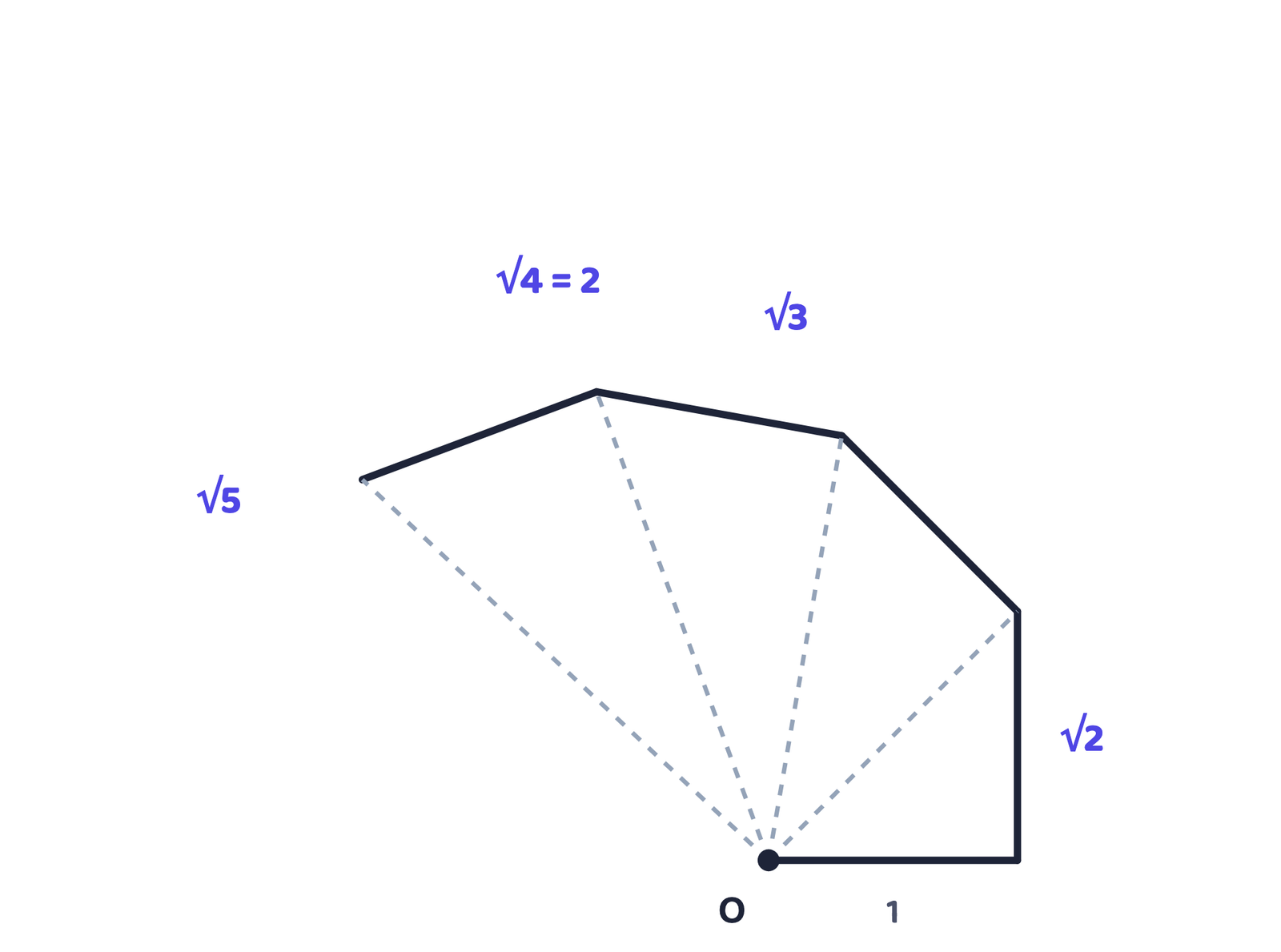
Irrational lengths can be constructed exactly with ruler and compass, using the same right-triangle idea repeatedly. Each new leg has length 1, perpendicular to the previous hypotenuse:
Figure 1: The square root spiral. Each new unit-length leg, drawn perpendicular to the last hypotenuse, produces the next integer’s square root.
Exam Tip
To mark 2 on a number line itself (not just build the triangle): after constructing OB=2 as above, open a compass to length OB, place the point at O, and draw an arc that cuts the number line. That crossing point is exactly 2.
4Real Numbers and Decimal Expansions
Learn by heartDefinition 6
Real numbersR are the union of all rational and irrational numbers, filling the number line completely with no gaps.
Number set
Symbol
Decimal expansion
Rational
Q
Always terminating or repeating
Irrational
R∖Q
Never terminates, never repeats
Predicting the type without dividing
Write qp in lowest terms. The decimal terminates exactly when the only prime factors of q are 2, 5, or both. Any other prime factor (3, 7, 11, …) in q means the decimal repeats.
Solved Example
Q. Will 207 terminate?
20=22×5, only 2s and 5s. So it terminates: 207=20×57×5=10035=0.35
Converting a repeating decimal back to qp uses the same trick every time: multiply to shift the repeating block, then subtract to cancel it.
Given
x=0.45=0.4555… (5 repeats, 4 does not)
Find
x as qp
Solution
Non-repeating digit: 1, so multiply by 10: 10x=4.55
Repeating block: 1 digit, so multiply again by 10: 100x=45.55
Subtract: 100x−10x=45.55−4.55⇒90x=41⇒x=9041
Did you know? Cyclic numbers
71=0.142857. Multiplying 142857 by 1,2,3,4,5,6 just cycles the same six digits in the same order: 142857,285714,428571,… This is called a cyclic number.
Common Mistake
0.9=0.999… is exactly equal to 1, not “just below” it. Proof: let x=0.9. Then 10x=9.9, so 10x−x=9.9−0.9=9, giving 9x=9, so x=1.
Every number is either rational (its decimal terminates or repeats) or irrational (its decimal never settles into a pattern). There is no third option.
the single idea to carry out of this chapter
Check yourself before the exam
Can I give the sign rule for adding, subtracting, multiplying and dividing signed numbers without hesitating?
Can I add, subtract, multiply and divide two rational numbers?
Can I reproduce the full proof that √2 is irrational, step by step?
Can I predict terminating vs repeating from the denominator alone, and convert a repeating decimal to p/q?
Quick Revision: read this the night before the exam
N ⊂ Z ⊂ Q ⊂ R; irrational numbers are in R but not in Q
Zero: a+0=a, a-0=a, a×0=0. Signs: same signs multiply to +, different signs to −
Assertion (A): There are infinitely many rational numbers between 0 and 1. Reason (R): Rational numbers are dense: the average of any two rationals is another rational strictly between them.
Case Study
A student draws a unit square and its diagonal, then uses the diagonal as one leg of the next right triangle, repeating the construction to build a square root spiral, exactly as in Figure 1.
1 markWhat is the length of the diagonal of the first unit square?
1 markIs this length rational or irrational? How do you know?
2 marksWhat length will the hypotenuse of the 4th triangle in the spiral be?
Answer Key
Q13/50=0.06 (terminates); 2/9=0.2 (repeats)
Q2Proof by contradiction, same structure as √2’s proof, using p2=5q2
Q30.0125=10000125=801
Q4x=2.41818…⇒55133 (using the two-stage multiply-subtract method)
Q5e.g. 0.26,0.28,0.30,0.32 (any 4 values strictly between 0.25 and 0.4)
Q6123x+122x=1225⇒5x=25⇒x=5
Q740=23×5, only 2s and 5s, so it terminates, in 3 decimal places
Q83 decimal places (denominator’s higher power is 103 after balancing 2s and 5s)
Q9a=−1/b⇒ab=−1, so ab is negative
Q10Since a<b, adding a to both sides gives 2a<a+b, so a<2a+b; similarly 2a+b<b
MCQ 1–3(b) · (a) · (b)
A/RBoth A and R are true, and R is the correct explanation of A
Case Study√2 · irrational, since 2 is not a perfect square (proved by contradiction) · √5