
Covers T.R. Jain & V.K. Ohri (2026-27) ch 7. Based on NCERT Indian Economic Development, Chapter 7 (Reprint 2026-27) and the CBSE 2026-27 curriculum.
Board note: CBSE teaches this book in Class 12; UP, Bihar, Rajasthan and MP Boards teach it in Class 11.
- Define environment, sort its biotic and abiotic elements, and explain its four functions
- Explain carrying capacity, absorptive capacity and environmental crisis, and why the opportunity costs of negative environmental impacts are high
- Write the causes, effects and international agreements for global warming and ozone depletion
- Use the reversal of the supply-demand relationship to explain why the environmental crisis is recent
- Describe the state of India’s environment: land degradation, air pollution and the work of the pollution control boards
- Write the definitions of sustainable development (UNCED, Barbier, Brundtland, Herman Daly) and its nine strategies
1 Introduction
- The economic development India has achieved so far has come at a very heavy price
- That price is the loss of environmental quality
- Globalisation promises higher growth, so India must consciously choose a path of sustainable development
- To do that, we first need to understand what the environment contributes to economic development
The environment, left to itself, can continue to support life for millions of years. The single most unstable and potentially disruptive element in the scheme is the human species.
Opening quotation of the chapter (Anonymous), shortened
2 Environment: Definition and Functions
2.1 Meaning of environment
Environment is defined as the total planetary inheritance and the totality of all resources. It includes all the biotic and abiotic factors that influence each other.
- A study of the environment is a study of the inter-relationship between these biotic and abiotic components
2.2 Four functions of the environment
Supplies resources
Both renewable and non-renewable resources.
Assimilates waste
Absorbs the waste produced by production and consumption.
Sustains life
By providing genetic and bio diversity.
Aesthetic services
Services like scenery.
Renewable resources are those which can be used without the possibility of the resource becoming depleted or exhausted, so a continuous supply remains available. Examples: trees in the forests, fishes in the ocean.
Non-renewable resources are those which get exhausted with extraction and use. Example: fossil fuel.
2.3 Carrying capacity and environmental crisis
- The environment performs its functions without interruption only as long as the demand on them is within its carrying capacity
Demand is within the carrying capacity when resource extraction is not above the rate of regeneration of the resource and the wastes generated are within the assimilating capacity of the environment.
Absorptive capacity means the ability of the environment to absorb degradation.
An environmental crisis is the situation in which the demand on the environment goes beyond its carrying capacity, so it fails to sustain life.
- This is the situation all over the world today
- Two causes: the rising population of developing countries and the affluent consumption and production standards of the developed world
- Together they have placed a huge stress on the first two functions (supplying resources and assimilating waste)
- Many resources have become extinct, and the wastes generated are beyond the absorptive capacity of the environment
- We are today at the threshold of environmental crisis
2.4 Why water has become an economic good
- Past development has polluted and dried up rivers and other aquifers
- So clean water is no longer free: it has to be paid for
- That is, water has become an economic good
Small, snow-fed Himalayan streams are the few fresh-water sources that remain unpolluted.
2.5 The opportunity costs of negative environmental impacts are high
Opportunity cost is the alternative given up. Money spent repairing environmental damage cannot be used for anything else. The cost comes in three forms:
Exploring new resources
Intensive and extensive extraction has exhausted some vital resources, so huge amounts are spent on technology and research to explore new ones.
Health costs
Air and water quality has declined (seventy per cent of water in India is polluted), raising respiratory and water-borne diseases and so health spending.
Global issues
Global warming and ozone depletion add to the financial commitments of the government.
Exercises 8 and 14 both come from this part. Write the three points separately and end with the book’s conclusion: “Thus, it is clear that the opportunity costs of negative environmental impacts are high.”
3 Global Warming and Ozone Depletion
3.1 Global warming (Box 7.1)
Global warming is a gradual increase in the average temperature of the earth’s lower atmosphere as a result of the increase in greenhouse gases since the Industrial Revolution.
- Much of the recent observed and projected global warming is human-induced
- Adding carbon dioxide, methane and other heat-absorbing gases to the atmosphere makes the planet’s surface warmer
Longer-term results of global warming
- Melting of polar ice, with a rise in sea level and coastal flooding
- Disruption of drinking water supplies that depend on snow melts
- Extinction of species as ecological niches disappear
- More frequent tropical storms
- Increased incidence of tropical diseases
A UN Conference on Climate Change held in Kyoto, Japan, in 1997 resulted in an international agreement to fight global warming. It called for reductions in emissions of greenhouse gases by industrialised nations.
3.2 Ozone depletion (Box 7.2)
Ozone depletion refers to the phenomenon of reductions in the amount of ozone in the stratosphere.
- Cause: high levels of chlorine and bromine compounds in the stratosphere
- Their origin: chlorofluorocarbons (CFCs), used as cooling substances in air-conditioners and refrigerators, or as aerosol propellants
- And bromofluorocarbons (halons), used in fire extinguishers
- Effect: more ultraviolet (UV) radiation reaches the Earth and damages living organisms
- UV radiation seems responsible for skin cancer in humans; it lowers the production of phytoplankton and so affects other aquatic organisms; it can also influence the growth of terrestrial plants
- A reduction of approximately 5 per cent in the ozone layer was detected from 1979 to 1990
Worldwide concern led to the adoption of the Montreal Protocol, banning chlorofluorocarbon (CFC) compounds and other ozone-depleting chemicals such as carbon tetrachloride, trichloroethane (methyl chloroform) and the bromine compounds known as halons.
| Basis | Global warming | Ozone depletion |
|---|---|---|
| Meaning | Rise in the average temperature of the lower atmosphere | Fall in the amount of ozone in the stratosphere |
| Main cause | Greenhouse gases (CO₂, methane): fossil fuels, deforestation | Chlorine and bromine compounds: CFCs, halons |
| Effects | Melting ice, rising sea level, storms, diseases, extinction of species | More UV radiation: skin cancer, less phytoplankton |
| International step | Kyoto, Japan (1997) | Montreal Protocol |
Global warming is not “the hole in the ozone layer”. They are two separate problems: one raises temperature (greenhouse gases), the other thins the ozone (CFCs and halons). The answer to Exercise 4 is: global warming and ozone depletion.
4 Why the Crisis Is New: Reversal of the Supply-Demand Relationship
- In the early days of civilisation, before the population boom and before industrialisation, the demand for environmental resources and services was much less than their supply
- So pollution was within the absorptive capacity, and extraction was slower than regeneration
- Hence environmental problems did not arise
- Then came the population explosion and the industrial revolution to meet the needs of the expanding population
- The demand for resources for production and consumption went beyond the rate of regeneration, and the pressure on absorptive capacity increased tremendously
- This is a reversal of the supply-demand relationship for environmental quality: demand is now high, but supply is limited because of overuse and misuse

Damodar Valley is one of India’s most industrialised regions. Pollutants from the heavy industries along the banks of the Damodar river are converting it into an ecological disaster.
5 State of India’s Environment
5.1 India has abundant natural resources
| Resource | What the book says |
|---|---|
| Soil | The black soil of the Deccan Plateau is particularly suitable for cotton, so textile industries are concentrated there |
| Plains | The Indo-Gangetic plains, from the Arabian Sea to the Bay of Bengal, are among the most fertile, intensively cultivated and densely populated regions in the world |
| Forests | Unevenly distributed, but provide green cover for a majority of the population and natural cover for wildlife |
| Minerals | Large deposits of iron-ore, coal and natural gas; India has nearly 8 per cent of the world’s total iron-ore reserves |
| Other minerals | Bauxite, copper, chromate, diamonds, gold, lead, lignite, manganese, zinc, uranium |
| Others | Hundreds of rivers and tributaries, a vast stretch of the Indian Ocean, ranges of mountains |
- But developmental activities have put pressure on India’s finite natural resources
- They have also affected human health and well-being
5.2 The dichotomy: a two-sided threat
Poverty-induced environmental degradation
- Book: poverty of agriculture-dependent people is a cause of land degradation
- To understand it: poor households depend directly on forests and land for fuel and fodder
- The book’s list of causes also has unsustainable fuel wood and fodder extraction and encroachment into forest lands
Pollution from affluence and industry
- Book: pollution from affluence and a rapidly growing industrial sector
- To understand it: affluent consumption means more vehicles and more waste
- It shows up as vehicular pollution in cities and industrial pollution
The most pressing environmental concerns of India are air pollution, water contamination, soil erosion, deforestation and wildlife extinction.
The five priority issues identified in the book:
Land degradation
Decline in the quality of land
Biodiversity loss
Loss of plant and animal species
Air pollution
With special reference to vehicular pollution in urban cities
Management of fresh water
Keeping clean water available
Solid waste management
Disposal of garbage and waste
5.3 Land degradation
- Land in India suffers from varying degrees and types of degradation
- It stems mainly from unstable use and inappropriate management practices
| No. | Factors responsible for land degradation (all twelve in the book) |
|---|---|
| (i) | Loss of vegetation due to deforestation |
| (ii) | Unsustainable fuel wood and fodder extraction |
| (iii) | Shifting cultivation |
| (iv) | Encroachment into forest lands |
| (v) | Forest fires and over grazing |
| (vi) | Non-adoption of adequate soil conservation measures |
| (vii) | Improper crop rotation |
| (viii) | Indiscriminate use of agro-chemicals such as fertilisers and pesticides |
| (ix) | Improper planning and management of irrigation systems |
| (x) | Extraction of ground water in excess of the recharge capacity |
| (xi) | Open access resource |
| (xii) | Poverty of the agriculture-dependent people |
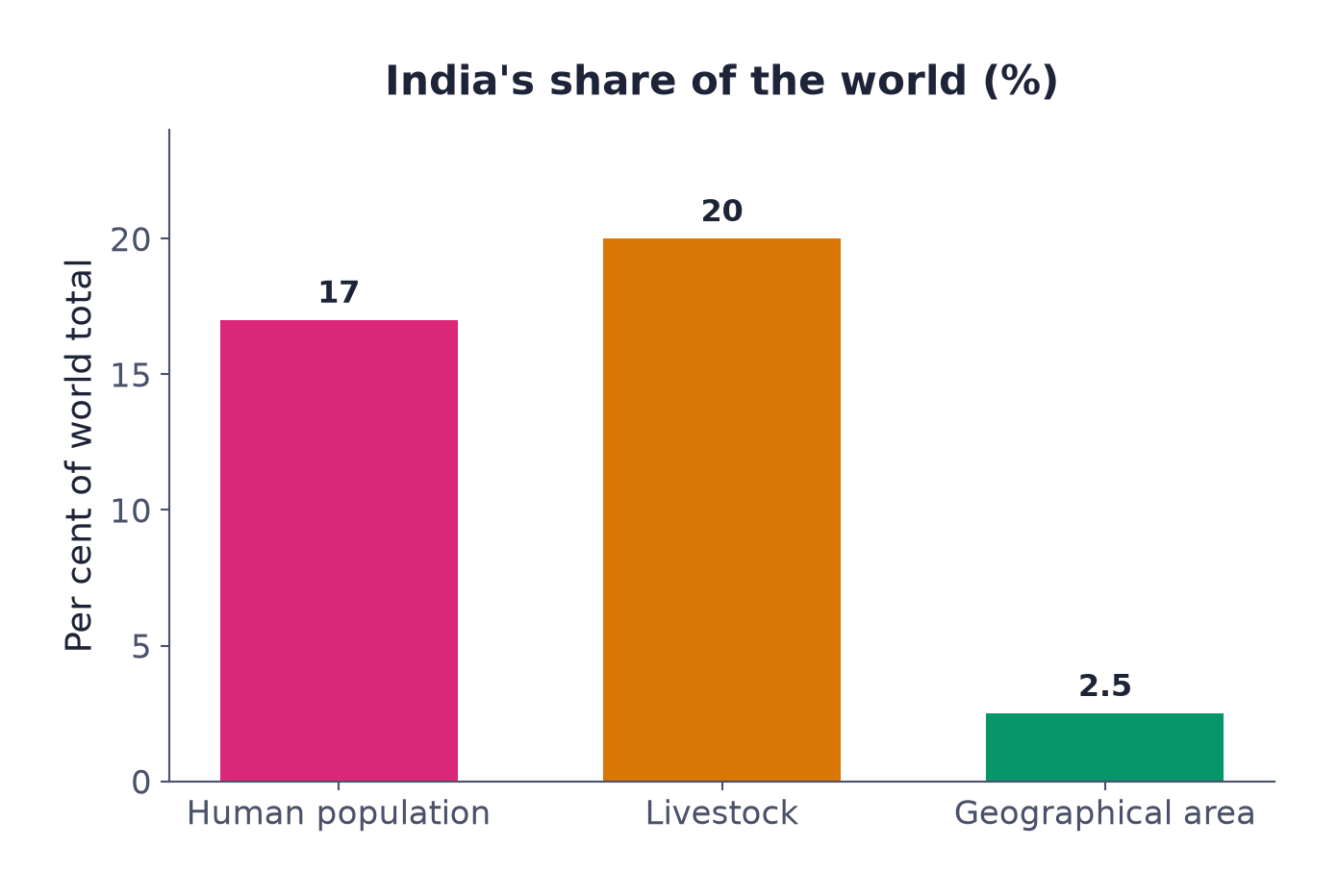
Why land is under such pressure: India supports approximately 17 per cent of the world’s human and 20 per cent of its livestock population on a mere 2.5 per cent of the world’s geographical area. The competing uses of land for forestry, agriculture, pastures, human settlements and industries add to the pressure on finite land.
- Because of soil erosion the country loses 0.8 million tonnes of nitrogen, 1.8 million tonnes of phosphorus and 26.3 million tonnes of potassium every year
- According to the Government of India, the quantity of nutrients lost to erosion each year ranges from 5.8 to 8.4 million tonnes
5.4 Air pollution and industrial pollution
- Air pollution is widespread in urban areas, where vehicles are the major contributors
- It is also high in a few areas with many industries and thermal power plants
- Vehicular emissions are of particular concern because they are ground-level sources, so they have the maximum impact on the general population
- India is one of the ten most industrialised nations of the world
- This status has brought unwanted consequences: unplanned urbanisation, pollution and the risk of accidents
- The Central Pollution Control Board (CPCB) has identified seventeen categories of industries (large and medium scale) as significantly polluting
5.5 Pollution Control Boards (Box 7.4)
- To address water and air pollution, the government set up the Central Pollution Control Board (CPCB) in 1974
- States then set up their own state-level boards
| Functions of the pollution control boards |
|---|
| Investigate, collect and disseminate information on water, air and land pollution |
| Lay down standards for sewage/trade effluent and emissions |
| Give technical assistance to governments to prevent water pollution and improve air quality |
| Carry out and sponsor investigation and research on water and air pollution |
| Run mass awareness programmes through the mass media |
| Prepare manuals, codes and guidelines for treatment and disposal of sewage and trade effluents |
| State boards inspect every industry through district-level officials |
| Provide background air-quality data for industrial siting and town planning |
| Monitor water quality in 125 rivers (including tributaries), wells, lakes, creeks, ponds, tanks, drains and canals |
5.6 Chipko or Appiko: what’s in a name? (Box 7.3)
- The Chipko Movement aimed at protecting forests in the Himalayas
- In Karnataka a similar movement was called Appiko, which means to hug
- Twelve years after a paper mill was set up in the Uttar Kanara area, bamboo was wiped out there
- Broad-leaved trees were removed, soil washed away, rivers dried up quicker, rainfall became erratic, and new diseases and insects attacked crops
- Appiko rules: consult local people before trees are marked for felling; do not fell trees within 100 metres of a water source or on a slope of 30 degrees or above
- The book asks: if a paper mill employs 10,000 workers and a plywood factory 800, but they deprive a million people of their daily needs, is it acceptable?
The measures of the Ministry of Environment and the pollution control boards may not yield results unless we consciously adopt sustainable development. Development without concern for posterity will deplete resources and degrade the environment fast enough to cause both an environmental and an economic crisis.
1. A truck driver paid a Rs 10,000 challan because his truck emitted black soot: the penalty is justified, since vehicular emissions are ground-level sources with the maximum impact on people.
2. Cut out a newspaper’s air-pollution reading a week before Diwali, on Diwali and two days after, and compare the values in class.
3. Game: trace every product back to nature, e.g. books ← paper ← trees ← forest ← earth; cloth ← cotton ← plant ← nature; machinery ← iron ← mineral ← earth.
4. Diseases from pollution: asthma (air pollution), cholera (water pollution), as the book’s table starts; students fill in noise pollution themselves.
6 Sustainable Development
6.1 Meaning and definition
- Environment and economy are interdependent and need each other
- Development that ignores its effect on the environment will destroy the environment that sustains life
- What is needed is development that allows all future generations a potential average quality of life at least as high as the current generation’s
Sustainable development (United Nations Conference on Environment and Development, UNCED): Development that meets the need of the present generation without compromising the ability of the future generation to meet their own needs.
- The two catch phrases of the definition are “need” and “future generations”
- The concept of “needs” is linked to the distribution of resources
- The report that gave the definition, Our Common Future, explained sustainable development as meeting the basic needs of all and extending to all the opportunity to satisfy their aspirations for a better life
- Meeting the needs of all requires redistributing resources, so it is a moral issue
6.2 Edward Barbier’s view
- Sustainable development is directly concerned with increasing the material standard of living of the poor at the grass root level
- This can be measured as increased income, real income, educational services, health care, sanitation, water supply and so on
- It aims at decreasing the absolute poverty of the poor by providing lasting and secure livelihoods
- Livelihoods that minimise resource depletion, environmental degradation, cultural disruption and social instability
- In this sense it meets the basic needs of all, particularly the poor majority, for employment, food, energy, water and housing, and ensures growth of agriculture, manufacturing, power and services to meet them
6.3 The Brundtland Commission and intergenerational equity
- The Brundtland Commission emphasises protecting the future generation
- This matches the environmentalists’ argument that we have a moral obligation to hand over the planet earth in good order to the future generation
- The present generation should bequeath a better environment to the future generation
- At least, it should leave a stock of “quality of life” assets no less than what it inherited
Intergenerational equity (equity between present and future generations) means the present generation should use resources so that the next generation gets environmental assets and a quality of life at least as good as the present generation enjoyed.
The present generation can promote development that is compatible with three things:
Conservation of natural assets
Protecting natural assets
Regenerative capacity
Preserving the regenerative capacity of the world’s natural ecological system
No added burden
Avoiding added costs or risks on future generations
6.4 Herman Daly’s five requirements
According to Herman Daly, a leading environmental economist, sustainable development needs:

- The carrying capacity of the environment is like the plimsoll line of a ship, its load limit mark
- Without a plimsoll line for the economy, the human scale grows beyond the carrying capacity of the earth and deviates from sustainable development
In 2015, the UN formulated 17 Sustainable Development Goals (SDGs), intended to be achieved by the year 2030.
7 Strategies for Sustainable Development
| Strategy | Key point |
|---|---|
| 1. Non-conventional sources of energy | Wind and solar instead of thermal and hydro power |
| 2. LPG, gobar gas in rural areas | Clean fuel in place of wood and dung cakes |
| 3. CNG in urban areas | Compressed natural gas in public transport |
| 4. Wind power | Electricity from windmills without adverse impact |
| 5. Solar power through photovoltaic cells | Electricity from sunlight, free from pollution |
| 6. Mini-hydel plants | Local power from mountain streams |
| 7. Traditional knowledge and practices | Ayurveda, Unani, herbal products |
| 8. Biocomposting | Compost instead of chemical fertilisers |
| 9. Biopest control | Neem and pest-eating animals instead of chemical pesticides |
7.1 Use of non-conventional sources of energy
- India depends heavily on thermal and hydro power plants for its power needs, and both have adverse environmental impacts
- Thermal power plants emit large quantities of carbon dioxide, a greenhouse gas
- They also produce fly ash, which, if not used properly, pollutes water bodies, land and other parts of the environment
- Hydroelectric projects inundate forests and interfere with the natural flow of water in catchment areas and river basins
- So efforts are being made to tap non-conventional sources such as wind power and solar rays
Conventional (thermal, large hydro)
- CO₂ emissions, fly ash pollution
- Forests inundated, river flow disturbed
- Adverse environmental impact
Non-conventional (wind, solar, mini-hydel)
- No or very little pollution
- No major change in land use
- Suited to sustainable development
7.2 LPG and gobar gas in rural areas
- Rural households generally burn wood, dung cake or other biomass as fuel
- This causes deforestation, reduced green cover, wastage of cattle dung and air pollution
- To rectify this, subsidised LPG is being provided; LPG is a clean fuel, cuts household pollution a great deal and minimises energy wastage
- Gobar gas plants are being provided through easy loans and subsidy
7.3 CNG in urban areas
- In Delhi, using Compressed Natural Gas (CNG) in public transport has significantly lowered air pollution and made the air cleaner
- In the last few years many other Indian cities have also begun to use CNG
- Delhi also adopted the odd/even scheme for specific periods, restricting vehicles with registration numbers ending in odd or even digits on alternate days
7.4 Wind power
- Where wind speed is usually high, windmills can provide electricity without any adverse impact on the environment
- Wind turbines move with the wind and electricity is generated
- The initial cost is high, but the benefits are such that the high cost gets easily absorbed
7.5 Solar power through photovoltaic cells
- India is naturally endowed with a large quantity of solar energy as sunlight
- We use it to dry clothes, grains and farm products and to keep warm in winter; plants use it for photosynthesis
- Photovoltaic cells use special materials to capture solar energy and convert it into electricity
- The technology is extremely useful for remote areas and for places where supplying power through the grid or power lines is not possible or very costly
- It is totally free from pollution
- India is leading an international body called the International Solar Alliance (ISA)
7.6 Mini-hydel plants
- In mountainous regions streams are found almost everywhere, and a large percentage are perennial
- Mini-hydel plants use the energy of such streams to move small turbines, and the electricity is used locally
- They are more or less environment-friendly because they do not change the land use pattern where they are located
- Meeting local demand means no large transmission towers and cables are needed, and transmission loss is avoided
7.7 Traditional knowledge and practices
- Traditionally, Indians have been close to their environment, more a component of it than its controller
- Our traditional agriculture, healthcare, housing and transport were environment-friendly
- Healthcare is an apt example: India has about 15,000 species of medicinal plants, and about 8,000 are in regular use, including the folk tradition
- With the onslaught of the western system, we ignored Ayurveda, Unani, Tibetan and folk systems; they are in great demand again for chronic health problems
- Cosmetic products (hair oil, toothpaste, body lotion, face cream) are now herbal; they are environment-friendly, relatively free from side effects and need no large-scale industrial and chemical processing
7.8 Biocomposting
- In the quest to raise farm output over the last five decades, we almost totally neglected compost and switched to chemical fertilisers
- Large tracts of productive land were harmed, water bodies including ground water suffered chemical contamination, and the demand for irrigation kept rising
- Farmers in large numbers have again started using compost made from organic wastes
- In some areas cattle are kept only for their dung, an important fertiliser and soil conditioner
- Earthworms convert organic matter into compost faster than the normal process; civic authorities also benefit as they have less waste to dispose of
7.9 Biopest control
- After the green revolution, the country used more and more chemical pesticides for higher yield
- Food, soil, water bodies and ground water were polluted with pesticides; even milk, meat and fishes were contaminated
- Pesticides based on plant products are now used; neem trees have yielded several pest-controlling chemicals
- Mixed cropping and growing different crops in consecutive years on the same land have also helped farmers
- Animals and birds that control pests: snakes (prey on rats, mice and other pests), owls and peacocks, and lizards; we need to know their value and save them
Wind and solar energy are non-conventional (renewable) sources. Thermal and large hydro plants are conventional sources. Do not swap them in an answer.
In the CBSE 2026-27 sample paper, “Elaborate any two strategies adopted by India to ensure sustainable development” carried 4 marks, and the marking scheme wrote wind energy and solar energy. Give each strategy a heading and explain it in two or three lines.
- Sustainable development has become a catch phrase; it is indeed a paradigm shift in development thinking
- Though it has been interpreted in a number of ways, following it ensures lasting development and non-declining welfare for all
8 Key Dates, Figures and Differences
| Basis | Renewable resources | Non-renewable resources |
|---|---|---|
| Meaning | Can be used without the risk of depletion; continuous supply | Get exhausted with extraction and use |
| Examples | Trees in forests, fishes in the ocean, water | Fossil fuels (coal, petroleum), iron-ore |
| Daly’s rule for sustainable use | Extraction should not exceed regeneration | Depletion should not exceed creation of renewable substitutes |
| Basis | Carrying capacity | Absorptive capacity |
|---|---|---|
| Meaning | Extraction not above regeneration and wastes within assimilating capacity | Ability of the environment to absorb degradation |
| Covers | All the functions: both resources and wastes | Only wastes and pollution |
1. Sustainable development does not mean “stopping development”; it is development that does not compromise future generations.
2. Do not call water “never exhausted”; the book says rivers and aquifers are being polluted and dried up.
3. The environment has four functions, not three; “aesthetic services” is the one usually left out.
4. India’s problem comes from poverty and from affluence; write both sides.
- Environment = total planetary inheritance and totality of all resources (biotic + abiotic)
- Four functions: supplies resources, assimilates waste, sustains life, aesthetic services
- Demand above carrying capacity means environmental crisis
- Opportunity costs are high: exploring new resources, health costs, global issues
- Two global problems: global warming (Kyoto 1997) and ozone depletion (Montreal Protocol)
- The supply-demand relationship has reversed, so the crisis is recent
- India’s dichotomy: poverty-induced degradation and pollution from affluence
- 17% of population, 20% of livestock, only 2.5% of area
- Sustainable development: present needs met without compromising future generations
- Nine strategies: non-conventional energy, LPG-gobar gas, CNG, wind, solar, mini-hydel, traditional knowledge, biocomposting, biopest control
- Can I write the definitions of environment, carrying capacity, absorptive capacity and sustainable development without looking?
- Can I list at least six factors of land degradation?
- Can I write Herman Daly’s five requirements in order?
- Can I explain any four strategies of sustainable development with examples?