
- How much of India’s water is actually usable, and where it comes from
- Why farming uses far more water than industry or homes, and what that does to groundwater
- What is polluting India’s rivers and groundwater, and which laws exist to stop it
- What watershed management and rainwater harvesting mean, with a real case study
- The two big government responses: National Water Policy 2012 and Jal Kranti Abhiyan
1India’s Water Budget
Water looks endless because it keeps cycling between the ocean, the air and the land, but almost none of it is water a person can drink or irrigate a field with. About 71% of the earth’s surface is covered in water, yet freshwater is only about 3% of that total, and only a small slice of even that freshwater is actually available for human use.
A water resource is any source of water that is useful, or potentially useful, to people. Water is called a cyclic resource because it keeps moving through evaporation, condensation and precipitation and returns to be used again, unlike a mineral, which is used up once and for all.
India accounts for about 2.45% of the world’s surface area and 4% of the world’s water resources, but it has to support more than 17% of the world’s population. That mismatch, a small share of water against a huge share of people, is the reason water scarcity keeps coming up as a national concern.
2Surface and Groundwater Resources
Surface Water Resources
India has four sources of surface water: rivers, lakes, ponds and tanks. There are about 10,360 rivers and their tributaries longer than 1.6 km each, and their combined mean annual flow is estimated at 1,869 cubic km (the book gives the same 1,869 cubic km figure for total water available from surface water and replenishable groundwater). But topography and hydrology limit what can actually be used: only about 690 cubic km (32%) of the available surface water can be utilised.
This water is not spread evenly. The Ganga, Brahmaputra and Barak river basins cover only about one-third of India’s total area, but because their catchments receive heavy rainfall, they hold 60% of the country’s total surface water. The south Indian rivers, the Godavari, Krishna and Kaveri, have already had most of their annual flow harnessed for use, while a large share of the Ganga and Brahmaputra basins’ potential is still unharnessed.
| Source of surface water | Key fact |
|---|---|
| Rivers & tributaries | ~10,360 rivers longer than 1.6 km; mean annual flow ≈ 1,869 cubic km |
| Ganga + Brahmaputra + Barak basins | ~1/3 of India’s area, but 60% of surface water (high catchment rainfall) |
| Godavari, Krishna, Kaveri (south India) | Most of their annual flow already harnessed |
| Brahmaputra & Ganga (potential unused) | Large share of their basin’s water not yet harnessed |
Groundwater Resources
India’s total replenishable groundwater resource is about 432 cubic km. It is used most heavily in the river basins of the north-western region and parts of south India.
Students assume “high groundwater use” is a good thing. It is not: groundwater utilisation is very high in Punjab, Haryana, Rajasthan and Tamil Nadu, and in Punjab, Haryana and western Uttar Pradesh this over-use has already lowered the groundwater table. If the present trend continues, demand will outrun supply, which the chapter itself warns can lead to social upheaval and disruption.
Lagoons and Backwaters
India’s coastline is long and very indented in some states, which has formed lagoons and lakes along the coast. Kerala, Odisha and West Bengal have large surface water resources locked up in these lagoons and lakes. The water in them is generally brackish (part salty), so it is used for fishing and for irrigating certain paddy varieties, coconut and similar crops rather than for drinking.
3Water Demand and Irrigation
Water Demand and Utilisation
India has traditionally been an agrarian economy, and about two-thirds of its population still depends on agriculture. Because of this, developing irrigation to raise farm output has been given very high priority in every Five Year Plan, and several large multipurpose river valley projects were built for exactly this reason.
Bhakra-Nangal
Sutlej river, Punjab/Himachal
Hirakud
Mahanadi river, Odisha
Damodar Valley
Damodar river, Jharkhand/West Bengal
Nagarjuna Sagar
Krishna river, Telangana/Andhra Pradesh
Indira Gandhi Canal Project
Carries Sutlej-Beas water into the Rajasthan desert
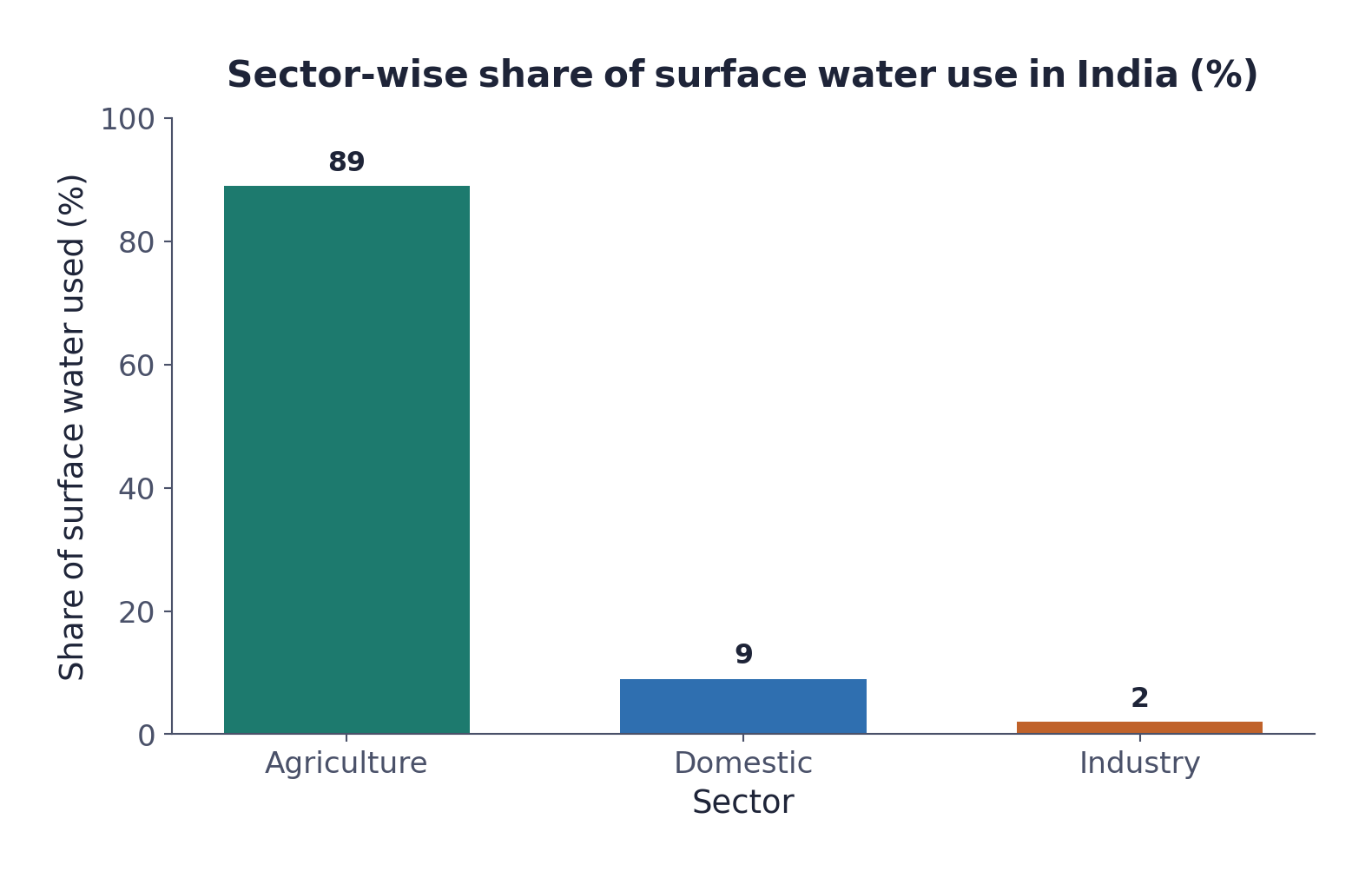
Agriculture dominates India’s water use: it accounts for 89% of surface water use and 92% of groundwater use. Industry’s share is much smaller: 2% of surface water and 5% of groundwater. The domestic sector’s share of surface water (9%) is actually higher than its share of groundwater. As India develops further, the industrial and domestic shares are expected to grow.
Demand of Water for Irrigation
Within agriculture, water is used mainly for irrigation, and irrigation is needed because rainfall in India varies so much across both space and time. North-western India and the Deccan plateau are drought-prone, and even relatively wet states like West Bengal and Bihar face dry spells when the monsoon breaks or fails. Crops like rice, sugarcane and jute need very high amounts of water that only irrigation can reliably supply.
Irrigation makes multiple cropping possible, and irrigated land is measurably more productive than unirrigated land, and it is also what lets high-yielding varieties get the steady moisture they need. This is exactly why the Green Revolution succeeded most in Punjab, Haryana and western Uttar Pradesh: in these states, more than 85% of the net sown area is under irrigation, and of the net irrigated area, 76.1% in Punjab and 51.3% in Haryana comes from wells and tubewells, that is, from groundwater.
Heavy well/tubewell irrigation in Punjab, Haryana and western Uttar Pradesh → over-use of groundwater → falling water table in these states. Over-withdrawals elsewhere have also harmed water quality: raised fluoride concentration in Rajasthan and Maharashtra, and raised arsenic concentration in parts of West Bengal and Bihar. Learn which problem goes with which states: it is a favourite long-answer question.
Launched by the Central Government in 2015-16 to give every farm assured irrigation. Its five broad objectives: expand assured irrigation to more cultivable area (Har Khet Ko Pani); integrate the water source, distribution and its efficient use through better technology; improve on-farm water use efficiency to cut wastage (Per Drop More Crop); introduce sustainable water conservation practices; and ensure the integrated development of rain-fed areas.
4Water Pollution
Emerging Water Problems
Per capita water availability keeps falling as population grows, and the water that is available is getting polluted by industrial, agricultural and domestic effluents, so the usable share keeps shrinking on two sides at once.
Deterioration of Water Quality
Water quality refers to the purity of water, or water free of unwanted foreign substances. Pollutants such as micro-organisms, chemicals and industrial waste dissolve or stay suspended in water, degrade aquatic systems, and can seep down to pollute groundwater as well.
Prevention of Water Pollution
The major rivers generally keep better water quality in their less densely populated upper stretches in hilly areas. In the plains, river water is used intensively for irrigation, drinking, domestic and industrial purposes, and drains carrying agricultural, domestic and industrial effluents join the rivers. The concentration of pollutants stays very high in the summer, when the flow of water is low.
The Central Pollution Control Board (CPCB), working with the State Pollution Control Boards, monitors water quality at 507 stations across the country. The data collected there shows that organic and bacterial contamination is the single biggest source of river pollution.
| River | Where it is most polluted |
|---|---|
| Yamuna | Most polluted river in India, between Delhi and Etawah |
| Sabarmati | At Ahmedabad |
| Gomti | At Lucknow |
| Kali, Adyar, Cooum | Entire stretches |
| Vaigai | At Madurai |
| Musi | At Hyderabad |
| Ganga | At Kanpur and Varanasi |
Groundwater pollution has occurred through high concentrations of heavy/toxic metals, fluoride and nitrates in different parts of the country. Two laws were meant to control all this: the Water (Prevention and Control of Pollution) Act, 1974 and the Environment Protection Act, 1986. Neither has been implemented effectively. In 1997, 251 polluting industries were still found located along rivers and lakes. The Water Cess Act, 1977, meant to discourage pollution through a levy, has also had only a marginal impact. The chapter stresses that public awareness and action can meaningfully cut pollution from agricultural, domestic and industrial sources.
5Watershed Management and Conservation
Recycle and Reuse of Water
Recycling and reuse of water means using water of lower quality, such as treated wastewater, for purposes that don’t need drinking-quality water, so that better-quality water is saved for where it is actually needed.
Reclaimed wastewater is an attractive option for industries to use for cooling and firefighting, which cuts their water costs. In cities, water used for bathing or washing utensils can be reused for gardening, and water used to wash vehicles can be reused the same way, freeing better-quality water for drinking. Recycling is currently practised only on a limited scale in India, but the chapter notes there is enormous scope to expand it.
Watershed Management
In the narrow sense, watershed management means the efficient management and conservation of surface and groundwater: preventing runoff and storing/recharging groundwater through percolation tanks and recharge wells. In the broader sense used by the chapter, it means the conservation, regeneration and judicious use of all resources, natural (land, water, plants, animals) and human, within a watershed, aiming to balance natural resources against the needs of society. Its success depends heavily on community participation.
Haryali
Central-Government watershed project executed by Gram Panchayats, helping rural people conserve water for drinking, irrigation, fisheries and afforestation
Atal Bhujal Yojana (Atal Jal)
Covers 8,220 water-stressed Gram Panchayats across 229 blocks/talukas in 80 districts of 7 states (Gujarat, Haryana, Karnataka, Madhya Pradesh, Maharashtra, Rajasthan, UP), about 37% of India’s water-stressed blocks. Aims to shift community behaviour from consumption to conservation
Neeru-Meeru & Arvary Pani Sansad
People’s-participation programmes in Andhra Pradesh and Alwar (Rajasthan) building percolation tanks, dug-out ponds (Johad) and check dams
Tamil Nadu’s rule
Rainwater harvesting structures are compulsory in every house: no building can be constructed without one
6Ralegan Siddhi
Work began with a percolation tank that had leaked and failed in 1975; villagers repaired it voluntarily, and for the first time in living memory the seven wells below it held water through summer. A youth group, the Tarun Mandal, banned dowry, caste discrimination and untouchability. Water-intensive sugarcane was banned; low-water crops like pulses, oilseeds and cash crops were encouraged instead. Local elections were held by consensus, and informal Nyay Panchayats were set up. No case has since gone to the police.
A school costing ₹22 lakh was built using only the village’s own resources, with no donations. Today, water is adequate and agriculture is flourishing, though fertiliser and pesticide use remains very high, and the village itself asks whether prosperity can be sustained once its founding leader is no longer there to guide it.
- 3 marksWhat three restrictions did Ralegan Siddhi impose on farming and grazing, and why?
7Rainwater Harvesting
Rainwater harvesting is a low-cost, eco-friendly method of capturing and storing rainwater for various uses, and for recharging groundwater aquifers, by guiding rainwater into borewells, pits and wells.
Benefits and Traditional Methods
✓ What it does
- Increases water availability and checks the declining groundwater table
- Dilutes contaminants like fluoride and nitrates, improving groundwater quality
- Prevents soil erosion and flooding
- Arrests saltwater intrusion in coastal areas when used to recharge aquifers
Traditional methods (still in use)
- Surface storage: lakes, ponds, irrigation tanks
- Rajasthan’s Kund or Tanka, a covered underground tank built near or in the house/village
- Modern rooftop & open-space harvesting, especially valuable in cities where demand already exceeds supply
Other Remedies, and the Real Bottleneck
Alongside conservation, the chapter names two more remedies for India’s water problem: desalinisation of water, particularly in coastal areas and of brackish water in arid and semi-arid areas (sea water is limited by its high cost) and inter-linking of rivers, transferring water from water-surplus regions to water-deficit ones. But it makes a sharper point too: from the point of view of individual users, households and communities, the single most important issue is the pricing of water, not any of the engineering solutions above.
8Policy Response
Objective: assess the existing situation and propose a framework for a unified national plan of action for water. Key recommendations:
- A national water framework law and comprehensive legislation for inter-State rivers and river valleys
- Water to be treated as an economic good, but only after pre-emptive needs are met first: safe drinking water, sanitation, food security, poor farmers’ livelihood, and minimum eco-system needs
- Climate-change adaptation strategies for designing and managing water structures
- Benchmarks for water use by purpose: water footprints and water auditing
- Removing the large disparity between urban and rural water supply
- Managing water projects and services with community participation
Launched by the Government of India to ensure water security through per capita water availability, involving local bodies, NGOs and citizens. Its proposed activities:
- Select one water-stressed village in each of 672 districts to create a “Jal Gram”
- Identify a model command area of about 1,000 hectares in different regions, e.g. UP, Haryana (North), Karnataka, Telangana, Tamil Nadu (South), Rajasthan, Gujarat (West), Odisha (East), Meghalaya (North-East)
- Abate pollution: water conservation and artificial recharge, reducing groundwater pollution, building arsenic-free wells in selected areas
- Create mass awareness through social media, radio, TV, print media, and poster/essay competitions in schools
- India has 2.45% of world land, 4% of world water, but 17%+ of world population
- Of 1,869 cubic km available water, only 1,122 cubic km is actually utilisable
- Only 32% of available surface water can be used; total replenishable groundwater ≈ 432 cubic km
- Punjab, Haryana, Rajasthan, Tamil Nadu = very high groundwater use; over-use → falling water table (Punjab, Haryana), fluoride (Rajasthan, Maharashtra), arsenic (West Bengal, Bihar)
- Agriculture uses 89% of surface water and 92% of groundwater, by far the largest user
- Yamuna (Delhi-Etawah) is India’s most polluted river; CPCB + State PCBs monitor 507 stations
- Water (Prevention and Control of Pollution) Act 1974 and Environment Protection Act 1986 exist but are weakly enforced
- Watershed management = balancing natural resources and society; Ralegan Siddhi is the model success story
- Rainwater harvesting recharges groundwater, dilutes fluoride/nitrates, and stops coastal saltwater intrusion
- National Water Policy (2012) treats water as an economic good after basic needs are met; Jal Kranti Abhiyan (2015-16) targets per-capita water security in 672 districts
- Can I state India’s three global-share figures (land, water, population) without looking?
- Can I name all four “very high groundwater use” states and explain why that is bad, not good?
- Can I explain watershed management in both its narrow and broad sense?
- Can I tell the Ralegan Siddhi story in five sentences?
- 1 markWhich one of the following best describes water as a resource?
(a) Abiotic resource(b) Non-renewable resource(c) Biotic resource(d) Non-cyclic resource - 1 markWhich south Indian state has the highest groundwater utilisation, as a percentage of its total groundwater potential?
(a) Tamil Nadu(b) Karnataka(c) Andhra Pradesh(d) Kerala - 1 markThe highest proportion of total water used in India is in which sector?
(a) Irrigation(b) Industries(c) Domestic use(d) None of the above - 1 markIndia’s total utilisable water resource is:
(a) 4,000 cubic km(b) 1,869 cubic km(c) 1,122 cubic km(d) 432 cubic km - 1 markWhich river is described as the most polluted river in India?
(a) Ganga(b) Yamuna(c) Sabarmati(d) Gomti - 1 markThe Kund or Tanka, a traditional rainwater harvesting structure, is associated with which state?
(a) Gujarat(b) Tamil Nadu(c) Rajasthan(d) Kerala - 1 markRalegan Siddhi, the well-known watershed development success story, is located in:
(a) Alwar, Rajasthan(b) Ahmadnagar, Maharashtra(c) Anantapur, Andhra Pradesh(d) Kutch, Gujarat - 1 markAtal Bhujal Yojana is being implemented in Gram Panchayats spread across how many states?
(a) 5(b) 6(c) 7(d) 9
- 1 mark
Assertion (A): The Green Revolution strategy has largely succeeded in Punjab, Haryana and western Uttar Pradesh.
Reason (R): Irrigated land has higher agricultural productivity than unirrigated land, and high-yielding crop varieties need the regular moisture that a developed irrigation system provides.(a) Both A and R are true, and R is the correct explanation of A(b) Both A and R are true, but R is not the correct explanation of A(c) A is true, but R is false(d) A is false, but R is true
- 1 mark
Assertion (A): Over-use of groundwater has led to a decline in the groundwater table in Punjab, Haryana and western Uttar Pradesh.
Reason (R): These states have among the lowest levels of groundwater utilisation in the country.(a) Both A and R are true, and R is the correct explanation of A(b) Both A and R are true, but R is not the correct explanation of A(c) A is true, but R is false(d) A is false, but R is true
- 1 mark
Assertion (A): Ralegan Siddhi’s watershed development needed only minimal dependence on government financial aid.
Reason (R): The success of watershed development depends largely on community participation.(a) Both A and R are true, and R is the correct explanation of A(b) Both A and R are true, but R is not the correct explanation of A(c) A is true, but R is false(d) A is false, but R is true
- 1 markName the four sources of surface water in India.
- 1 markWhat is India’s total replenishable groundwater resource, in cubic km?
- 1 markName any two multipurpose river valley projects mentioned in the chapter.
- 1 markWhat does PMKSY stand for?
- 3 marksDiscuss the factors responsible for the depletion of India’s water resources.
- 3 marksWhat factors are responsible for the very high groundwater development in Punjab, Haryana and Tamil Nadu?
- 3 marksWhy is agriculture’s share of total water used in the country expected to decline in future?
- 3 marksWhat are the possible impacts of consuming contaminated or unclean water?
- 3 marksWhy does the chapter call water a “cyclic resource”? Explain with one example.
- 3 marksName three rivers apart from the Yamuna that the chapter lists as severely polluted, and the city each is polluted near.
- 3 marksWhat is the difference between the narrow and the broad meaning of watershed management?
- 3 marksList the main objectives of the Jal Kranti Abhiyan.
- 5 marksDiscuss the availability of water resources in India and the factors that determine their spatial (uneven) distribution.
- 5 marks“Depleting water resources may lead to social conflicts and disputes.” Explain this statement with suitable examples from the chapter.
- 5 marksWhat is watershed management? Do you think it can play an important role in sustainable development? Support your answer with the Ralegan Siddhi case study.
- 5 marksDescribe the main sources of water pollution in India and the legislative steps taken to control it. Why have these laws had only limited effect?
- 5 marksExplain rainwater harvesting: what it is, how it is done, and what benefits it offers over and above simply increasing water supply.
- 5 marksDescribe the salient features of the National Water Policy, 2012.