
- How psychologists define and assess psychological attributes like intelligence, aptitude, personality and values
- The theories of intelligence the NCERT chapter presents: Binet, Spearman, Thurstone, Jensen, Guilford, Gardner, Sternberg and the PASS model
- How intelligence is measured (IQ, Mental Age), and how people at the two extremes of intelligence, intellectual disability and giftedness, are identified
- Why culture changes what “intelligent behaviour” even means, and what the Indian tradition adds to the idea
- What emotional intelligence, aptitude and creativity are, and how each relates to intelligence
In the CBSE 2026-27 Psychology curriculum, the theory paper carries 70 marks over 7 units, and this chapter is Unit I, Variations in Psychological Attributes: 13 marks. The Practical carries 30 marks: practical file and case profile 10, viva voce (a short oral exam) 5, and two tests 15. During the year you administer and interpret five psychological tests. These notes cover the NCERT theory text of Chapter 1.
1Individual Differences: Why People Are Not All Alike
If you watch your friends, classmates and relatives, you will notice that they perceive, learn, think and perform differently from one another. Variability is a fact of nature: people differ in physical traits (height, weight, strength, hair colour) exactly as they differ in psychological traits (intelligent or dull, dominant or submissive, creative or not, outgoing or withdrawn). One of the main concerns of modern psychology has been the study of individual differences from the time of Galton.
Individual differences refer to the distinctiveness and variations among people’s characteristics and behaviour patterns.
Why do people differ? Two views exist. Many psychologists believe our behaviours are influenced by our personal traits. Some others hold that our behaviours are influenced more by situational factors: a view called situationism. The situationist perspective views behaviour relatively more as a result of external factors; sometimes the situation is so powerful that people with differing personality traits respond to it in almost the same way.
Trait view
- Behaviour is influenced by personal traits
Situationism
- Behaviour is influenced more by the situations and circumstances a person is placed in
- Example: a generally aggressive person may act submissively before their boss
2Assessment of Psychological Attributes
Assessment refers to the measurement and evaluation of psychological attributes of individuals, often using multiple methods, against certain standards of comparison. An attribute is said to exist in a person only if it can be measured by scientific procedures.
Assessment can be formal (objective, standardised, organised: done by trained psychologists) or informal (varies from case to case and assessor to assessor, so it stays open to subjective interpretation). Which attribute we choose to assess depends on our purpose: a weak student’s intellectual strengths and weaknesses, a poorly-adjusted person’s personality, or a poorly-motivated person’s interests. Once assessment is done, we can use the information to predict how the person will probably behave in future, and to intervene if needed.
Psychological attributes are not linear or unidimensional: they are usually multi-dimensional. A complete assessment of a person checks how s/he functions in various domains, such as cognitive, emotional and social.
2.1 Five domains of psychological attributes
Intelligence
The global capacity to understand the world, think rationally, and use available resources effectively when facing challenges.
Aptitude
An individual’s underlying potential for acquiring skills: used to predict what a person can do given proper training.
Interest
A preference for engaging in one or more specific activities relative to others.
Personality
Relatively enduring characteristics of a person that make them distinct from others: dominant/submissive, outgoing/withdrawn, and so on.
Values
Enduring beliefs about an ideal mode of behaviour. Values set a standard for guiding one’s own actions and for judging others, and can be political, religious, social or economic.
2.2 Five assessment methods (from Class XI, recalled here)
| Method | What it is |
|---|---|
| Psychological test | An objective, standardised measure of mental/behavioural characteristics; widely used for clinical diagnosis, guidance, personnel selection, placement and training. |
| Interview | Seeking information from a person one-to-one: a counsellor with a client, a door-to-door survey, an employer selecting staff, a journalist interviewing a public figure. |
| Case study | An in-depth study of one individual’s psychological attributes and history, in the context of their psychosocial and physical environment; widely used by clinical psychologists; built from interviews, observation, questionnaires and tests. |
| Observation | Systematic, organised, objective recording of naturally-occurring behaviour (e.g. mother-child interaction); weakness: the observer has little control and reports may be subjective. |
| Self-report | A person provides factual information and opinions about themself, via an interview schedule, questionnaire, test or personal diary. |
3Intelligence: Changing Definitions
The everyday idea of “intelligence” is different from the psychological one. The Oxford Dictionary calls it the power of perceiving, learning, understanding and knowing. Early theorists built their definitions on the same attributes.
| Who | How they defined intelligence |
|---|---|
| Alfred Binet | The ability to judge well, understand well, and reason well. |
| Wechsler | The global and aggregate capacity of an individual to think rationally, act purposefully, and deal effectively with their environment. |
| Gardner and Sternberg | An intelligent individual not only adapts to the environment but also actively modifies or shapes it. |
4Theories of Intelligence
Theories fall into two broad approaches.
Psychometric / structural approach
- Intelligence = an aggregate of abilities
- Expressed as a single index of cognitive ability (e.g. IQ)
Information-processing approach
- Describes the processes used in reasoning and problem solving
- Focus is on how an intelligent person acts, not the structure of intelligence
4.1 Psychometric approach: four representative theories
Binet: one-factor theory
Intelligence is one set of abilities usable to solve any problem. This theory came to be disputed once psychologists analysed data collected with Binet’s test.
Spearman (1927): two-factor theory
Using factor analysis, a statistical method that groups test scores which rise and fall together into underlying factors: a g-factor (general, common to all mental performance) plus several s-factors (specific abilities). Excellent singers, architects, scientists and athletes can be high on g but also carry their own specific s-factor abilities.
Thurstone: Primary Mental Abilities
Seven relatively independent primary abilities (see table below).
Jensen: hierarchical model
Level I: associative learning, output ≈ input (rote learning, memory). Level II: cognitive competence: higher-order skills that transform input into an effective output.
| Thurstone’s 7 Primary Mental Abilities |
|---|
| (i) Verbal Comprehension: grasping the meaning of words, concepts, ideas |
| (ii) Numerical Abilities: speed and accuracy in numerical/computational tasks |
| (iii) Spatial Relations: visualising patterns and forms |
| (iv) Perceptual Speed: speed in perceiving details |
| (v) Word Fluency: using words fluently and flexibly |
| (vi) Memory: accuracy in recalling information |
| (vii) Inductive Reasoning: deriving general rules from given facts |
Guilford’s Structure-of-Intellect model classifies intellectual traits across three dimensions: Operations (cognition, memory recording, memory retention, divergent production i.e. coming up with many possible ideas, convergent production i.e. arriving at one correct idea, evaluation), Contents (visual, auditory, symbolic, semantic, behavioural) and Products (units, classes, relations, systems, transformations, implications). Since this is 6 × 5 × 6, the model has 180 cells, each expected to hold at least one factor.
4.2 Theory of Multiple Intelligences: Howard Gardner
Gardner (who studied extremely talented persons) proposed that intelligence is not one entity: distinct, independent intelligences exist, and being high on one does not predict being high or low on another. Different intelligences interact and work together to solve a problem. He described eight types:
| Type of intelligence | The ability | Likely to be high in |
|---|---|---|
| Linguistic | Produce and use language fluently and flexibly | Poets, writers |
| Logical-Mathematical | Think logically/critically, solve problems, manipulate symbols | Scientists, Nobel Prize winners |
| Spatial | Form, use and transform mental/visual images | Pilots, sailors, sculptors, painters, architects, interior decorators, surgeons |
| Musical | Produce, create and manipulate musical rhythms/patterns | The book names no occupation: such persons are very sensitive to sounds and vibrations and create new patterns of sounds |
| Bodily-Kinaesthetic | Use the whole body (or parts of it) flexibly and creatively | Athletes, dancers, actors, sportspersons, gymnasts, surgeons |
| Interpersonal | Understand others’ motives, feelings and behaviours; bond with people | Psychologists, counsellors, politicians, social workers, religious leaders |
| Intrapersonal | Understand one’s own feelings, motives and desires | Philosophers, spiritual leaders |
| Naturalistic | Identify features of the natural world | Hunters, farmers, tourists, botanists, zoologists, bird watchers |
4.3 Triarchic Theory of Intelligence: Robert Sternberg (1985)
Sternberg’s triarchic theory represents the information-processing approach to understand intelligence.
Sternberg defines intelligence as “the ability to adapt, to shape and select environment to accomplish one’s goals and those of one’s society and culture.”

Componential (analytical)
Analysis of information to solve problems; people high here think analytically, do well in school. Three sub-parts: knowledge-acquisition (learning how to do things), the meta/higher-order component (planning what and how to do), and the performance component (actually doing it).
Experiential (creative)
Using past experience creatively to solve new problems; reflected in creative performance and original discoveries.
Contextual (practical)
Dealing with everyday environmental demands: “street smartness”/”business sense.” A person adapts to, selects, or reshapes their environment to succeed.
4.4 PASS Model: Das, Naglieri and Kirby (1994)
This model (Planning, Attention-arousal, Simultaneous-successive) says intelligent behaviour comes from three neurological “functional units” of the brain working together: each unit is distinct, but depends on the other two. These processes are interactive and dynamic in nature, yet each has its own distinctive functions. The PASS model represents the information-processing approach to intelligence.
Das and Naglieri also developed a battery of tests, the Cognitive Assessment System (CAS): verbal and non-verbal tasks measuring basic cognitive functions independent of schooling, for people aged 5 to 18, used to remedy cognitive deficits in children with learning problems.
5Individual Differences in Intelligence
5.1 Heredity and environment
Evidence comes mainly from twin and adoption studies. The book gives these approximate correlations, a number between 0 and 1 showing how closely two people’s IQ scores move together: the closer to 1, the more alike they are.
Adopted children’s intelligence resembles their biological parents more than their adoptive parents: but as children grow older, their IQ moves closer to their adoptive parents. Twins separated early in childhood also show considerable similarity in their intellectual, personality and behavioural characteristics. Children from disadvantaged homes adopted into higher-status families show large IQ gains. Environmental deprivation lowers intelligence; rich nutrition, good family background and quality schooling raise it. The consensus: intelligence is a product of the complex interaction of heredity (nature), which sets a range, and environment (nurture), which shapes development within that range.
5.2 Assessing intelligence: Mental Age, Chronological Age, IQ
In 1905, Alfred Binet and Theodore Simon made the first successful formal attempt to measure intelligence. Their 1908 revision gave the concept of Mental Age (MA): a measure of a person’s intellectual development relative to others of the same age group. Chronological Age (CA) is the biological age from birth. Binet and Simon defined retardation as an MA two years below CA.
In 1912, German psychologist William Stern devised the Intelligence Quotient (IQ):
Q. A 10-year-old child has a Mental Age of 12. Find the IQ. What if the same child’s MA were 7?
Step 1 : 120 (bright child, MA above CA)
Step 2 : 70 (dull child, MA below CA)
Rule: if MA equals CA, IQ = 100; if MA is more than CA, IQ is more than 100; if MA is less than CA, IQ is less than 100.
(i) A 14-year-old child has a mental age of 16: IQ = (16 ÷ 14) × 100 ≈ 114. (ii) A 12-year-old child has an IQ of 90: MA = (90 × 12) ÷ 100 = 10.8 years.
IQ scores in a population form a symmetrical, bell-shaped normal curve around a mean of 100.
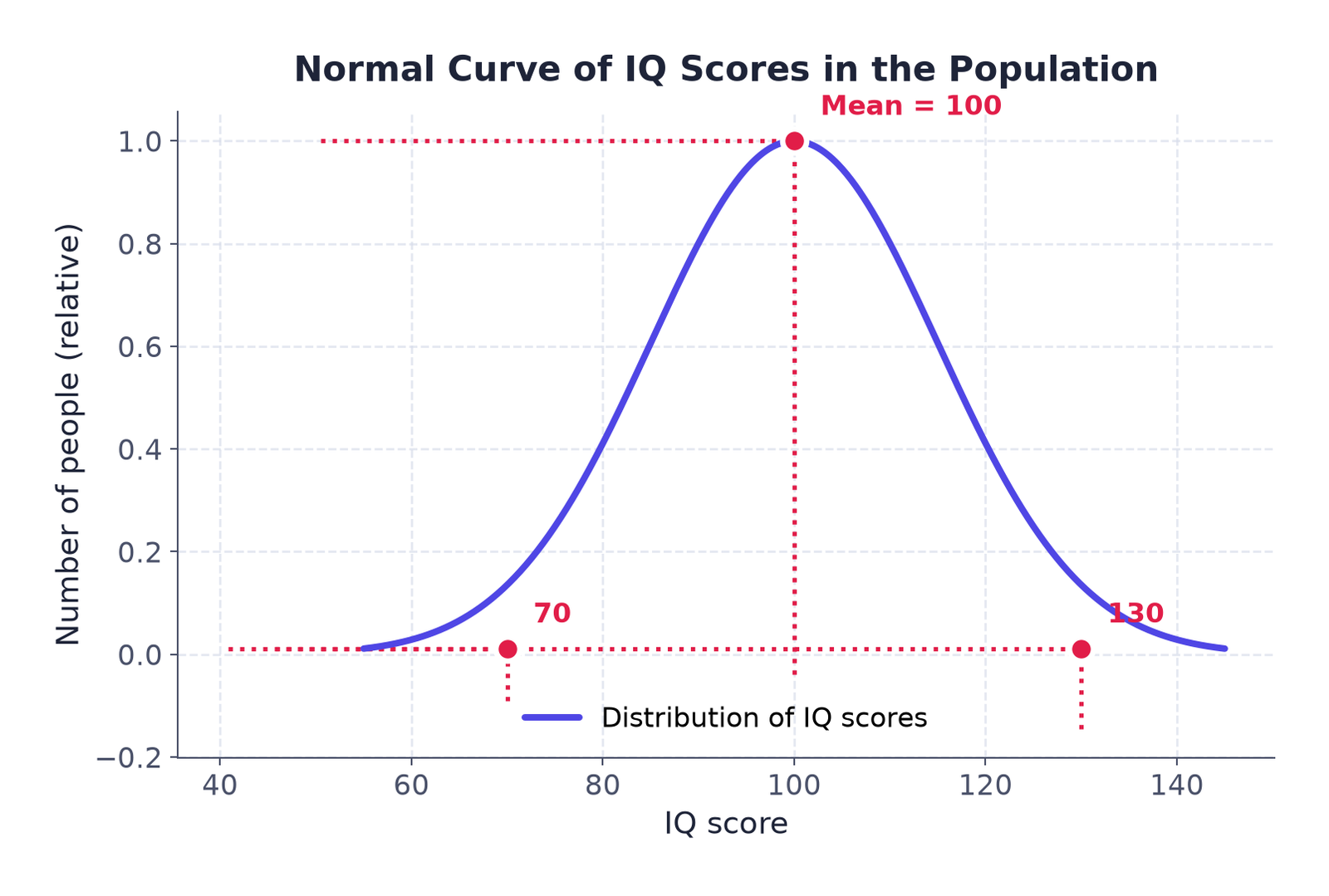
| IQ Range | Descriptive Label | % in Population |
|---|---|---|
| Above 130 | Very superior | 2.2 |
| 120-130 | Superior | 6.7 |
| 110-119 | High average | 16.1 |
| 90-109 | Average | 50.0 |
| 80-89 | Low average | 16.1 |
| 70-79 | Borderline | 6.7 |
| Below 70 | Intellectually disabled | 2.2 |
People with IQ 90-110 have normal intelligence. One practical use of intelligence tests is to identify persons at the extremes of intellectual functioning. About 2% of the population, with IQ above 130, are called intellectually gifted; a similar 2%, with IQ below 70, are called intellectually disabled. Both groups deviate considerably from normal in cognitive, emotional and motivational characteristics.
5.3 Intellectual deficiency
The American Association on Mental Deficiency (AAMD) defines intellectual disability as “significantly sub-average general intellectual functioning existing concurrently with deficits in adaptive behaviour and manifested during the developmental period.”
Three features follow from this: (1) sub-average intellectual functioning: IQ below 70; (2) deficits in adaptive behaviour: the capacity to be independent and deal effectively with one’s environment; (3) onset during the developmental period: between 0 and 18 years of age.
(More on the characteristics of intellectually disabled persons appears in Chapter 4.)
5.4 Intellectual giftedness
The study of gifted individuals began in 1925, when Lewis Terman began following the lives of about 1,500 children with IQ 130 and above to see how intelligence related to occupational success and life adjustment.
Giftedness
- Exceptional general ability
- Shows in superior performance across a wide variety of areas
Talent
- Remarkable ability in one specific field (spiritual, social, aesthetic, etc.)
- The highly talented are sometimes called “prodigies”
From a teacher’s point of view, giftedness depends on a combination of high ability, high creativity, and high commitment. Gifted children show early signs: larger attention span, good recognition memory, preference for novelty, sensitivity to environmental change, early language skills. Giftedness is not the same as brilliant academic performance alone; superior athletes with outstanding psychomotor ability (physical skill and coordination) are gifted too.
- Advanced logical thinking, questioning and problem-solving behaviour
- High speed in processing information
- Superior generalisation and discrimination ability
- Advanced level of original and creative thinking
- High level of intrinsic motivation and self-esteem
- Independent and non-conformist thinking; preference for solitary academic activities for long periods
Identification uses more than test scores: teachers’ judgment, school record, parent interviews, peer and self-ratings. Gifted children need special attention and life-enrichment programmes that sharpen productive thinking, planning, decision-making and communication.
6Types of Intelligence Tests
Individual tests need the tester to build rapport and stay sensitive to the subject’s feelings; responses can be oral, written, or by manipulating objects. Group tests give no such rapport and usually collect written, often multiple-choice, answers.
Verbal tests need oral or written responses (literate people only). Non-verbal tests use pictures: e.g. Raven’s Progressive Matrices (RPM), where the subject completes an incomplete pattern by choosing from given alternatives. Performance tests: written language is not necessary for answering the items: e.g. Kohs’ Block Design Test, where wooden blocks must be arranged to match a given design within a time limit; performance tests are easy to administer across cultures.
Used by an untrained tester, intelligence tests can: stigmatise a child after poor performance and hurt their self-respect; invite discrimination from parents, teachers and elders; underestimate the IQ of disadvantaged children if the test is biased toward the middle/higher class; and fail to capture creative and practical intelligence, which relate weakly to test scores anyway. The book’s own recommendation: use trained psychologists to analyse strengths and weaknesses.
Culture-fair vs culture-biased: tests developed in America/Europe reflect an urban, middle-class ethos and are normed on Western groups (their scoring scales were built from Western test-takers’ results), so it is nearly impossible to build one test equally meaningful across all cultures. Psychologists try to build culture-fair tests: assessing experiences common to all cultures, or asking questions in which language usage is not required; non-verbal and performance tests reduce this bias.
6.1 Intelligence testing in India
| Pioneer | Contribution |
|---|---|
| S.M. Mohsin | Pioneering Hindi-language intelligence test, 1930s |
| C.H. Rice | Standardised Binet’s test in Urdu and Punjabi |
| Mahalanobis | Standardised Binet’s test in Bengali |
| Long and Mehta | Mental Measurement Handbook: listed 103 intelligence tests across Indian languages |
| NLEPT (at NCERT) | National Library of Educational and Psychological Tests: documents and critically reviews Indian tests |
| J.M. Ojha | Indian adaptation of the Differential Aptitude Test (DAT) |
| Table 1.2: Verbal tests | Author |
|---|---|
| CIE Verbal Group Test of Intelligence | Uday Shankar |
| Group Test of General Mental Ability | S. Jalota |
| Group Test of Intelligence | Prayag Mehta |
| Bihar Test of Intelligence | S.M. Mohsin |
| Group Test of Intelligence | Bureau of Psychology, Allahabad |
| Indian adaptation of the Stanford-Binet Test, 3rd ed. | S.K. Kulshrestha |
| Test of General Mental Ability (Hindi) | M.C. Joshi |
| Table 1.2: Performance tests | Author |
|---|---|
| CIE Non-verbal Group Test of Intelligence | not named by author |
| Bhatia’s Battery of Performance Tests | “quite popular,” book’s own words |
| Draw-a-Man Test | Pramila Pathak |
| Indian adaptation of the Wechsler Adult Performance Intelligence Scale | R. Ramalingaswamy |
7Culture and Intelligence
Culture provides the context in which intelligence develops. Russian psychologist Vygotsky believed that cultures, like individuals, have a life of their own: they grow and change. Culture provides the social context in which people live, grow, and understand the world; elementary mental functions (crying, attending to a mother’s voice, walking) are universal, but higher mental functions like problem solving and thinking are largely culture-produced.
Technological intelligence (Western)
- Values generalisation, abstraction, speed, solving a problem in the fewest possible steps, mental manipulation
- Skills of attention, observation, analysis, performance, achievement orientation
- Personal achievement based on reasoning/judgment = intelligence
Non-Western societies
- Value social and emotional skills for relating to people, alongside cognitive competence
- Some value self-reflection and a collectivistic orientation over individual achievement
- Boundaries are blurring under Western influence
7.1 Intelligence in the Indian tradition
Intelligence in the Indian tradition can be termed “integral intelligence”: a holistic view giving equal weight to cognitive and non-cognitive processes and their integration, with strong emphasis on connectivity to the social and world environment. The Sanskrit word “buddhi” covers far more ground than the Western concept of intelligence; per J.P. Das, it includes mental effort, determined action, feelings and opinions along with cognitive competence (knowledge, discrimination, understanding), plus self-knowledge grounded in conscience, will and desire.
Cognitive competence
Sensitivity to context, understanding, discrimination, problem solving, effective communication.
Social competence
Respect for social order, commitment to elders/young/needy, concern for others, recognising others’ perspectives.
Emotional competence
Self-regulation and self-monitoring of emotions, honesty, politeness, good conduct, self-evaluation.
Entrepreneurial competence
Commitment, persistence, patience, hard work, vigilance, goal-directed behaviour.
8Emotional Intelligence
Salovey and Mayer, who first introduced the concept, defined emotional intelligence as “the ability to monitor one’s own and other’s emotions, to discriminate among them, and to use the information to guide one’s thinking and actions.”
Emotional intelligence broadens intelligence beyond the intellectual sphere to include emotions: it is “the feeling side of intelligence,” and it builds on the Indian tradition’s own concept of intelligence. A good IQ and scholastic record alone are not enough for success in life: many academically talented people struggle in family, workplace and interpersonal relationships. EQ (Emotional Quotient) expresses the amount of emotional intelligence the way IQ expresses intelligence.
- Perceive and be sensitive to your own feelings and emotions
- Perceive and be sensitive to others’ emotions through body language, voice/tone, facial expressions
- Relate your emotions to your thoughts so problem-solving and decisions take them into account
- Understand the powerful influence of the nature and intensity of your emotions
- Control and regulate your emotions and their expression to achieve harmony with others
Programmes that raise students’ emotional intelligence improve academic achievement, encourage cooperative behaviour and reduce antisocial activity.
9Special Abilities: Aptitude
Aptitude refers to special ability in a particular field of activity: a combination of characteristics that indicates a person’s capacity to acquire specific knowledge or skill after training. Aptitude tests predict future performance.
People of similar intelligence can still differ widely in specific skills. The book’s own example: you go to Aman for maths help, Avinash for literature, Shabnam to sing, John for a bike problem.
Interest
- A preference for doing an activity
Aptitude
- The potential/capacity to actually perform it
Both are needed for success: a student with high mechanical aptitude and interest in engineering is more likely to become a successful mechanical engineer than one with only one of the two.
Aptitude tests come in two forms: Independent (specialised): Clerical, Mechanical, Numerical, Typing Aptitude tests; and Multiple (generalised) test batteries: the Differential Aptitude Tests (DAT), the General Aptitude Tests Battery (GATB) and the Armed Services Vocational Aptitude Battery (ASVAB). DAT is the most common in educational settings, with 8 independent subtests: Verbal Reasoning, Numerical Reasoning, Abstract Reasoning, Clerical Speed and Accuracy, Mechanical Reasoning, Space Relations, Spelling, and Language Usage. J.M. Ojha developed an Indian adaptation of the DAT.
10Creativity
Creativity is the ability to produce ideas, objects, or problem solutions that are novel, appropriate and useful.
Creativity shows up in a novel solution, an invention, a poem, a painting, a new chemical process, a legal innovation or a disease-prevention breakthrough. The book names Tagore, Einstein, C.V. Raman and Ramanujan as examples of outstanding creative contribution: but creativity is not limited to the eminent; an ordinary person doing pottery, carpentry or cooking can be creative too, even if not at the same level as an eminent scientist or writer.
The book calls Einstein’s theory of relativity an example of the highest level of creativity: bringing out altogether new ideas, facts, theory or a product. Another level of creativity works on what has already been established, by modifying it, putting it in a new perspective, or finding it a new use.
Children begin to develop imagination in early childhood but express creativity mostly through physical activities and in non-verbal ways; once language and intellectual functions are fully developed, creativity is expressed through verbal modes too.
Heredity and environment: creativity is determined by both. Heredity sets the limits of creative potential; how much of it is realised, when and in what form is largely decided by environmental factors such as motivation, commitment, family support, peer influences and training opportunities. Every individual can raise her/his level of creative potential beyond its present level.
10.1 Creativity and intelligence
The book’s own example: Sunita completes work on time, tops her class, grasps quickly and reproduces material accurately, but rarely offers an idea of her own: she is called more intelligent. Rita is an average student who learns her own way, improvises new ways to help at home, and finds new ways to do her assignments: she is called more creative.
Terman (1920s) found that persons with high IQ were not necessarily creative: creative ideas could come from people without a very high IQ. Other researches have shown that not even one of those identified as gifted, followed up throughout their adult life, became well known for creativity in any field. Both high and low creativity can be found in highly intelligent children and in children of average intelligence.
Researchers have found that the relationship between creativity and intelligence is positive. The book’s own conclusion, worth learning word for word: “A certain level of intelligence is required for creativity but beyond that intelligence does not correlate well with creativity.” Learn this sentence exactly: it is the answer to “how is creativity related to intelligence?”
Creativity tests
- Open-ended: many possible answers
- Use divergent thinking
- Assess: variety of ideas, seeing new relationships, guessing causes/consequences, using objects in new ways
Intelligence tests
- One correct answer expected
- Use convergent thinking
- Assess: memory, logical reasoning, accuracy, perceptual ability, clear thinking
Named creativity-test developers: Guilford, Torrance, Khatena, Wallach and Kogan, Paramesh, Baqer Mehdi, and Passi. Each test has a standardised procedure, a manual, and an interpretation guide, usable only after training.
Activity 1.1 (Discovering the Attributes of Intelligent Persons): describe the most intelligent classmate and three other intelligent persons, then compare the attributes. Activity 1.2 (On the ‘Practical’ Track): newly admitted to a school/college and wanting high marks, rank seven courses of action and compare with classmates. Activity 1.3: computing IQ (worked above). Project Ideas: (1) observe and interview 5 persons in your neighbourhood across all five domains and compare their psychological profiles; (2) study 5 vocations and the psychological attributes each needs, and write a report.
- Individual differences = distinctiveness in people’s traits and behaviour; trait view vs situationism
- Five domains assessed: intelligence, aptitude, interest, personality, values: by test, interview, case study, observation, self-report
- Intelligence theories: Spearman (g + s factors, 1927), Thurstone (7 primary abilities), Jensen (Level I/II), Guilford (180 cells), Gardner (8 multiple intelligences), Sternberg (triarchic: componential/experiential/contextual, 1985), Das-Naglieri-Kirby (PASS: arousal, simultaneous-successive, planning, 1994)
- IQ = MA/CA × 100 (Stern, 1912); Binet & Simon (1905, 1908) gave MA; mean IQ = 100; Table 1.1 classification
- Intellectual disability: AAMD’s 3-feature definition; mild/moderate/severe/profound bands. Giftedness: Terman 1925, 1500 children, IQ 130+; teachers’ view: ability + creativity + commitment
- Tests: individual/group, verbal/non-verbal/performance, culture-fair/biased; India: Mohsin, Rice, Mahalanobis, NLEPT
- Culture shapes intelligence: technological intelligence (West) vs integral intelligence/buddhi (Indian tradition, 4 facets)
- Emotional intelligence (Salovey & Mayer): feeling side of intelligence; aptitude ≠ interest; creativity needs some intelligence but is not guaranteed by it
- Can I state the g-factor/s-factor distinction and name who proposed it?
- Can I list all 8 of Gardner’s intelligences without looking?
- Can I explain the triarchic theory’s three parts and the PASS model’s three units?
- Can I calculate IQ from MA and CA, and recall Table 1.1’s exact figures?
- Can I state AAMD’s definition of intellectual disability and its three features?
- Can I explain integral intelligence and the four facets of intelligence in the Indian tradition?
- Can I explain, in the book’s own words, how creativity relates to intelligence?