
1 The Indian Approach to Regional Diversity
India chose a democratic approach to diversity: regional aspirations can be politically expressed and are not treated as automatically anti-national, unlike many European nations that saw cultural diversity as a threat to the nation. Democratic politics both strengthens regional aspirations (parties can organise around regional identity) and is meant to accommodate them in policy-making: a balance that can itself create tension.
2 Jammu and Kashmir
Kashmiriyat: the regional identity sentiment among Kashmiris who saw themselves as Kashmiris first, opposed both the Maharaja’s rule and joining Pakistan. The popular movement was led by Sheikh Abdullah’s National Conference.
| Region | Character |
|---|---|
| Jammu | Foothills and plains; predominantly Hindu, with Muslims, Sikhs and others |
| Kashmir Valley | Mostly Kashmiri Muslim, with Hindus, Sikhs, Buddhists and others |
| Ladakh | Mountainous, sparsely populated, roughly split between Buddhists and Muslims |
Internal Kashmiri grievances: the promised post-accession plebiscite was never held; Article 370’s special status was eroded in practice (“Greater State Autonomy” demand); democratic institutions lagged the rest of India. Externally, Pakistan still claims the valley, and part of J&K remains under what India calls Pakistan-occupied J&K (POJK).
3 The Dravidian Movement (Tamil Nadu)
One of India’s earliest, most effective regional movements: it never took up arms, working instead through public debate and elections. E.V. Ramasami “Periyar” led the anti-Brahmin, anti-Hindi, pro-Dravidian-pride movement and founded the Dravidar Kazhagam (DK), whose political legacy passed to the DMK.
The DMK’s 1953–54 agitation had three prongs: restoring “Kallakudi” as a station name (against North Indian economic symbols), more Tamil history in school curricula, and opposing a craft-education scheme seen as Brahminical, plus opposition to Hindi as sole official language. The 1965 anti-Hindi agitation boosted the DMK’s popularity, and it won power in 1967.
After leader C. Annadurai’s death, DMK split into DMK and AIADMK; both have dominated Tamil politics for decades, and since 1996 a Dravidian party has often shared power at the Centre: regional politics here proved compatible with, not opposed to, Indian nationalism.
4 Punjab
Reorganised on linguistic lines only in 1966 (later than most of India), creating a Sikh-majority Punjab. The Akali Dal led the “Punjabi Suba” movement, but its position stayed precarious: it formed coalition governments in 1967 and 1977, its government was dismissed by the Centre mid-way through its term, it did not enjoy strong support among the Hindus, and the Congress got more support than the Akalis among the Dalits.
The Anandpur Sahib Resolution (1973) demanded regional autonomy and a redefined centre-state relationship: a plea to strengthen federalism, though it had limited mass appeal at first.
PM Manmohan Singh formally apologised to the nation in Parliament in 2005 for the 1984 anti-Sikh violence.
5 The North-East
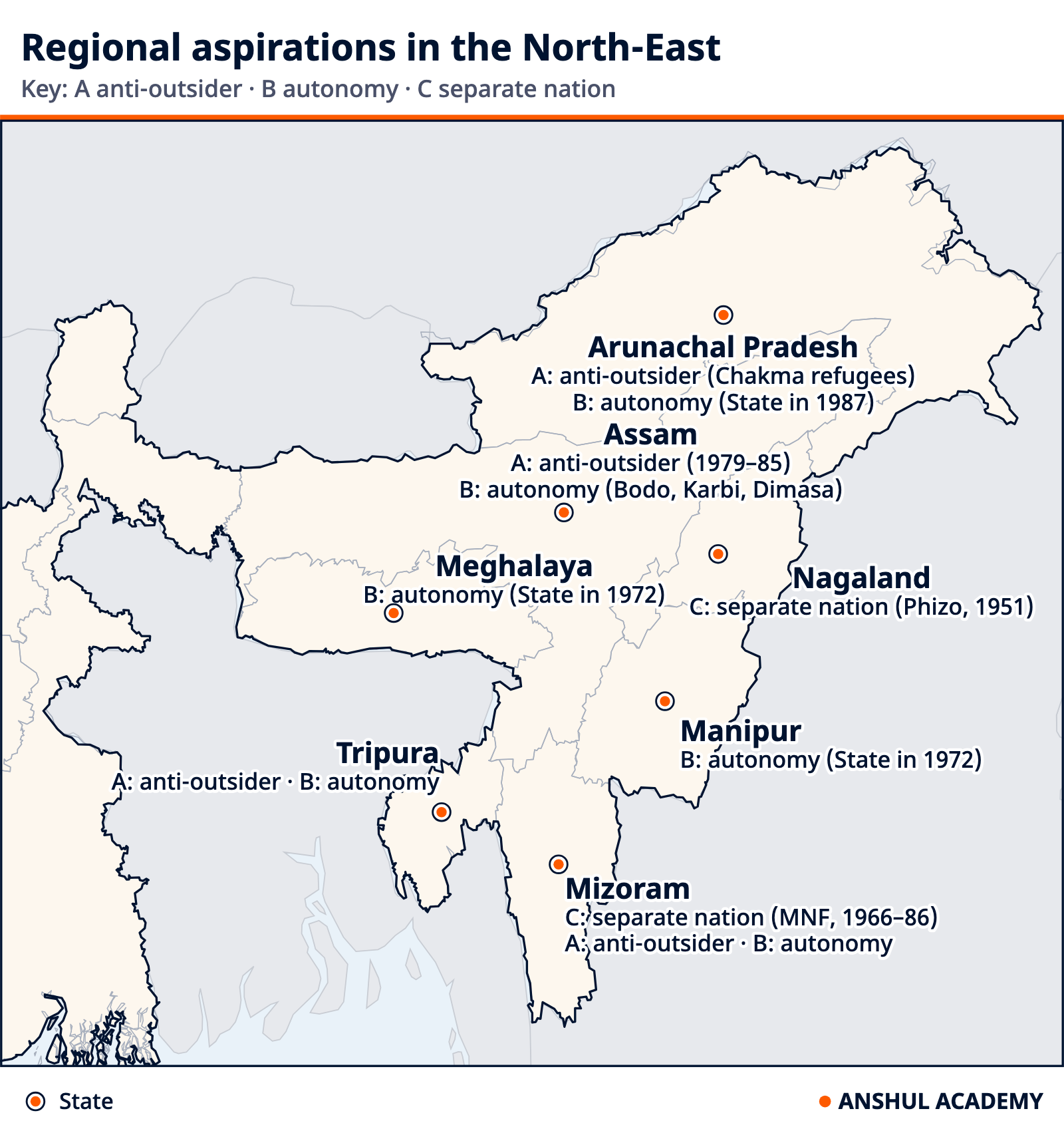
Eight states: the “Seven Sisters” (Arunachal Pradesh, Assam, Nagaland, Manipur, Tripura, Mizoram, Meghalaya) plus Sikkim (“the Brother”). About 4% of India’s population, roughly twice that share of land area; only a ~22-km corridor links it to the rest of India; borders China, Myanmar, Bangladesh.
| Issue | How it played out |
|---|---|
| Autonomy demands | Non-Assamese resisted Assamese-language imposition; tribal leaders formed the Eastern India Tribal Union → All Party Hill Leaders Conference (1960) → Meghalaya, Mizoram, Arunachal Pradesh carved out; Tripura, Manipur upgraded. Later, Bodos/Karbis/Dimasas got District/Autonomous Councils rather than full statehood |
| Secession: Mizoram | Mizo National Front (Laldenga) launched an armed campaign in 1966 after the 1959 famine’s poor handling; two-decade insurgency ended in the 1986 Rajiv Gandhi–Laldenga Accord: full statehood, MNF gave up secession, Laldenga became CM. Mizoram is now among the region’s most peaceful states |
| Secession: Nagaland | Angami Zapu Phizo’s Naga National Council declared independence in 1951: started earlier than Mizoram’s movement but has not reached a final settlement |
| Opposition to “outsiders”: Assam | The Assam Movement (1979–85), led by AASU, targeted suspected illegal Bengali migrants; ended in the 1985 Assam Accord (migrants after the Bangladesh war to be identified/deported); the AASU and the Asom Gana Sangram Parishad formed the Asom Gana Parishad, which won power in 1985, though the underlying issue was never fully resolved |
6 Sikkim’s Merger, 1975
Before 1975, Sikkim was a “protectorate”: India handled its defence and foreign affairs, while internal administration stayed with the monarch, the Chogyal. The Nepali-majority population resented rule by the minority Lepcha-Bhutia elite. The first democratic Sikkim Assembly election (1974) was swept by the pro-integration Sikkim Congress; in April 1975 the Assembly passed a resolution for full integration, confirmed by referendum: Parliament accepted immediately, and Sikkim became India’s 22nd state. The merger enjoyed strong popular support and never became a divisive issue.
7 Goa’s Liberation
Although British rule ended in 1947, Portugal refused to withdraw from Goa, Diu and Daman, which had been under its colonial rule since the sixteenth century; it had suppressed the people, denied them civil rights and carried out forced religious conversions. India tried patiently to persuade Portugal to withdraw, and a strong popular movement for freedom inside Goa was strengthened by socialist satyagrahis from Maharashtra. Finally, in December 1961, the Government of India sent the army, which liberated these territories after barely two days of action. Goa, Diu and Daman became a Union Territory.
8 Lessons: Accommodation and National Integration
Regional aspirations are normal
Not an aberration: compare Scotland/Wales/N. Ireland in the UK, Basque separatism in Spain, Tamil separatism in Sri Lanka.
Negotiate, don’t suppress
Instead of treating the movements in Punjab, Assam and Mizoram as simple law and order problems, the government reached negotiated settlements, which reduced tensions.
Power-sharing matters
Formal democratic structure isn’t enough: regions need an actual share of power, or a sense of injustice grows.
Regional economic imbalance
Uneven development feeds a real sense of regional discrimination.
Finally, the Constitution’s flexible federalism, special provisions for states like J&K and the North-East, and the Sixth Schedule (tribal autonomy to preserve customary practices/laws), proved crucial to resolving several of these conflicts, even as Article 370 itself was abrogated in 2019.
- India’s democratic approach lets regional aspirations be expressed without treating them as anti-national
- J&K: accession 1947, Article 370 (1948), insurgency from 1989; coalition governments from 2002 (Mahbooba Mufti first woman CM, April 2016; President’s rule June 2018); abrogated 5 August 2019 (J&K + Ladakh UTs)
- Dravidian movement stayed democratic throughout: DMK won power in 1967, split into DMK/AIADMK
- Punjab: Anandpur Sahib Resolution 1973, Operation Blue Star June 1984, Indira Gandhi assassinated 31 Oct 1984, Punjab Accord July 1985
- North-East: autonomy (District/Autonomous Councils), secession (Mizoram resolved 1986, Nagaland unresolved), “outsiders” (Assam Accord 1985)
- Sikkim became India’s 22nd state in 1975 via referendum, with strong popular support
- Goa: liberated from Portugal by army action in December 1961; January 1967 opinion poll kept it out of Maharashtra; became a State in 1987
- Five lessons: aspirations are normal, negotiate not suppress, share power, fix regional imbalance, flexible federalism works
- 1 MarkWhat is “Kashmiriyat”?
- 1 MarkOn what date was Article 370 abrogated, and by which Act?
- 1 MarkWho led the Dravidian movement and founded the Dravidar Kazhagam?
- 1 MarkWhat was the Anandpur Sahib Resolution?
- 1 MarkOn what date was Indira Gandhi assassinated?
- 1 MarkWho led the Mizo National Front, and when was the Mizo Accord signed?
- 1 MarkWhich students’ organisation led the Assam Movement?
- 1 MarkIn what year did Sikkim become India’s 22nd state?
- 1 MarkWho became the first woman Chief Minister of Jammu and Kashmir, and when?
- 1 MarkWhen did the Government of India send the army to liberate Goa, Diu and Daman?
- 2 MarksWhat were the three regions of Jammu and Kashmir, and how did they differ?
- 2 MarksWhat was the outcome of Operation Blue Star?
- 2 MarksWhy did the Sikkim merger not become a divisive issue?
- 2 MarksWhat was the January 1967 ‘opinion poll’ in Goa, and what was its result?
- 4 MarksExplain the internal divisions of Jammu and Kashmir and how they led to multiple regional aspirations.
- 4 MarksCompare the outcomes of the Mizoram and Nagaland secessionist movements.
- 4 MarksWhat were the main provisions of the Punjab Accord?
- 4 MarksThe Assam movement was a combination of cultural pride and economic backwardness. Explain.
- 6 MarksDiscuss the roots and evolution of the Jammu and Kashmir problem up to the 2019 reorganisation.
- 6 MarksAll regional movements need not lead to separatist demands. Explain with examples from this chapter.
- 6 MarksWhat lessons can be drawn from India’s experience of accommodating regional aspirations?
- 1 MarkArticle 370 was abrogated in:
(a) 2014(b) 2016(c) 2019(d) 2020 - 1 MarkThe DMK’s popularity was boosted by the anti-Hindi agitation of:
(a) 1953(b) 1965(c) 1967(d) 1973 - 1 MarkOperation Blue Star took place in:
(a) 1973(b) 1980(c) 1984(d) 1985 - 1 MarkThe Mizo Accord was signed in:
(a) 1966(b) 1979(c) 1985(d) 1986 - 1 MarkSikkim became India’s 22nd state in:
(a) 1966(b) 1972(c) 1975(d) 1987
Options: (a) Both true, R correctly explains A · (b) Both true, R does not explain A · (c) A true, R false · (d) A false, R true.
- 1 Mark
Assertion (A): Regional movements in India always lead to separatist, anti-national demands.
Reason (R): The Dravidian movement in Tamil Nadu remained democratic and became compatible with Indian nationalism. - 1 Mark
Assertion (A): The Naga movement was resolved as successfully and completely as the Mizo movement.
Reason (R): Both movements were led by armed groups demanding secession from India.